


Imagine you are birding in one of South Africa’s nature reserves and you hear an unfamiliar call of a bird, which species you know it may belong to. Then with today’s modern technology, you open your Sasol or Roberts’s bird app on your phone and find the species. To confirm your identification, you play the species’ call and—there you go—you guessed it right! But have you ever thought how the bird call appeared on your app, where it was obtained or even how recordings of bird calls have been made over the years?
In this article, I take the reader on a tour of how bird recordings started and of how the techniques and equipment used to make recordings have evolved over time – until today when this can be done with a smartphone! I use an example of a vocalization research project on African Rock Pipits at the National Museum Ornithology Department.
The history of recording bird sounds
The history and development of the sound recording technology can be summarized into four phases. The first period (pre-1930s) was characterised by the use of phonographs and wax cylinders, and later, by field systems of parabolic reflectors and film sound recorders used between the 1930s and 1940s. After WWII, the more convenient and portable magnetic tape was used for decades. Since the 2000s, digital recording kicked in, with handheld recorders and available software such as Raven Pro and AudaCity.

Since early days, scientists were interested to document bird behaviour and to record bird vocalizations for research and commercial use, as well as for outreach and educational purposes. Researchers of the Cornell University Lab of Ornithology in Ithaca, New York, USA, started to embrace technological advances to record their observations in as early as the 1910s. During the next decade, the very first recordings of wild birds were made using motion-picture film with synchronized sound. The first vocal recordings of birds were attempted in 1929 by Cornell’s professor of ornithology and biological acoustics Peter Kellogg and his student Albert Brand; they used expensive and heavy equipment, yet their results were disappointing.
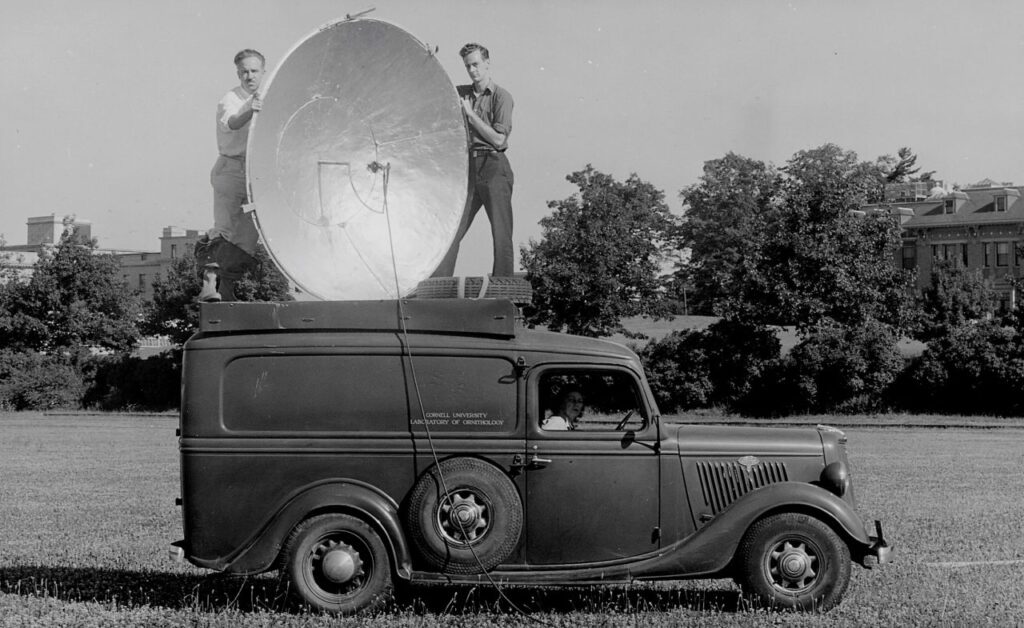
Later, Albert Brand (Fig. 1) invested in development of in sound recording equipment such as a large parabolic reflector and testing it in the field. Brand and his team succeeded with recording of about 40 bird species within a year. From the 1930s onwards, ornithologists started to use amplifiers with film sound recorders mounted on a truck, positioning large parabolic reflectors on the roof of a stationary vehicle (Fig. 2). Those were crafted based on the World War I parabola moulds from the Cornell Physics Department.
After World War II, the magnetic tape technology opened the doors for easily portable recording systems, also capable of playing back the bird sound. By the 1970s, the Cornell Lab Sound Library grew from about 15,000 to more than 140,000 bird recordings. This laid a solid foundation to massive recording archives, and the Library of Natural Sound at Cornell’s Lab of Ornithology established in 1929 developed into Macaulay Library of Cornell University, named after two enthusiastic birders, Linda and William Macaulay who themselves contributed some 6000 recordings of more than 2600 bird species. During that time other sound and photographic archives were created by museums and other institutions in the UK, Germany, Australia and South Africa, where the Fitzpatrick Bird Communication Library at the Ditsong Museum (formerly the Transvaal Museum, Pretoria) founded in 1979, grew to about 30,000 bird sound recordings, mostly from South Africa, by 2004.
During the early 1900s and gramophone era, pioneering work was also done in the UK by Ludwig Kock, who launched the bird sound recording in Europe. Koch made his first known birdsong recording of a White-rumped Shama Kittacincla malabarica as a child in 1889, when his father brought home an Edison Phonograph and a box of cylinders. That was also the first ever known recording of a bird’s song. By 1910, Koch continued to play a significant role in the development of the wildlife sound capturing. The first commercial wildlife recording was done by Carl Reich from Germany of a Nightingale kept in captivity, and released as single-sided gramophone discs by The Gramophone Co. Ltd in 1913. The scope of this activity widened and other bird calls were released several times. In the 1930s, Kock started to work with ornithologists, particularly British environmentalist Edward Max Nicholson, and commenced a project on the first sound identification guide to British birds, which was released as Songs of Wild Birds in 1936. More birdsong guides followed and the Songs of British Birds was issued as a four-disc set in 1953.
Today, Florida Museum of Natural History—like many other museums—have started digitising their reel-tape analog bird-sound recordings. They curate about 23,650 catalogue items representing about 3000 species. These records are from about 2200 reel-to-reel and cassette tapes with bird sounds from the New World. One of undisputed benefits of the digital archives is their virtual permanence, whereas the analog tapes irreversibly degrade after 40–50 years.
However, prior to the advent of digital platforms and birding apps, a major contribution to recording avian vocalisations in southern Africa was done by Len Gillard in the early 1980s by releasing four cassette tapes of southern African bird calls. This was soon followed in 1991 by Guy Gibbon who published six cassette tapes of about 880 of southern African bird species. These comprehensive audio collections—as cassette tapes and later on compact discs—covered hundreds of species and were accompanied by detailed species lists and notes. For many birders, these recordings provided the first practical means of learning and identifying bird calls outside the field. The ground-breaking work of both Gillard and Gibbon set an important foundation for the later integration of sound into modern field guides and birding applications. Gordon Lindsay Maclean (1937–2008) was the first in South Africa who used avian sonograms to supplement the species accounts in the fifth edition of the popular Robert’s Birds of Southern Africa book in 1985 with the bird vocalization descriptions. This method later evolved later to birding apps where the sonogram of a bird call or song is linked to each species account in the Firefinch application, the Birds of the World and other applications in the birding industry.
National Museum Ornithology Department avian digitised collection
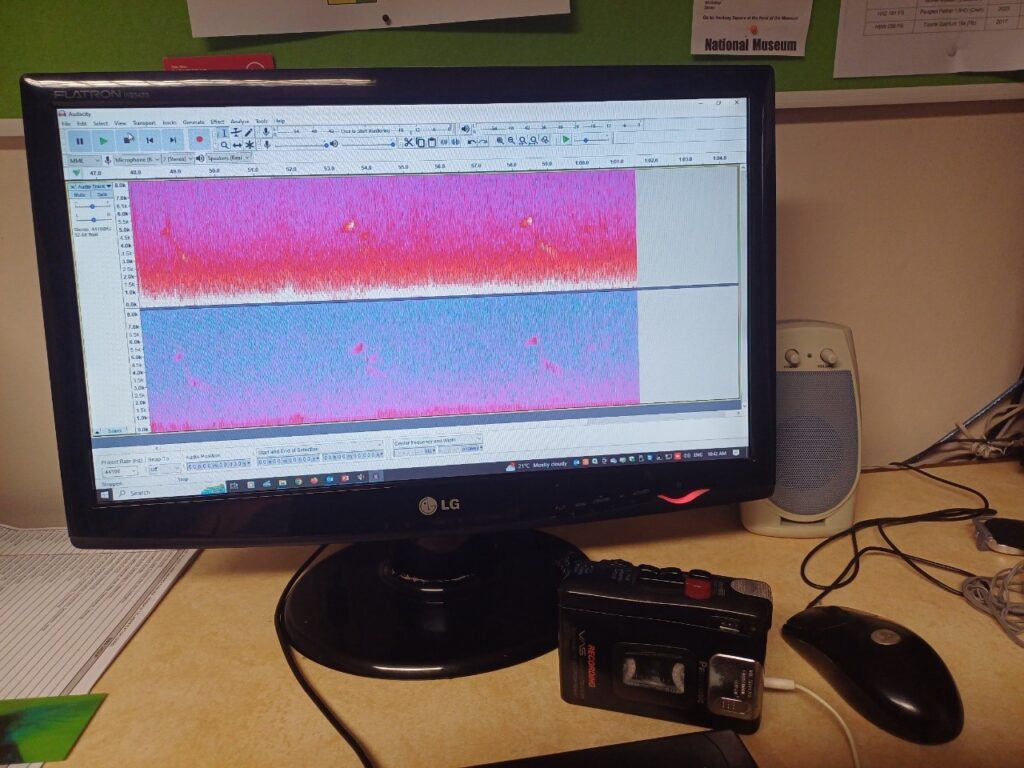
Most of the old sound recordings made during field research projects by the Ornithology Department before 2010 were mainly taped and stored on compact cassettes. Digitisation of the National Museum collection began in the mid-2000s. Devices such as an Olympus LS_P5 voice recorder, Sony PCM10 and Zoom H4n Pro recorders, and Brodan SS-2 parabolic and Sennheiser MKE 600 shotgun microphones were used in the field. The old cassette tape recordings were digitised using special software (AudaCity, https://www.audacityteam.org) and saved as audio files WAV or Mp3 (Fig. 3). The digitisation of the avian vocalization collection started in May 2021 with tape recordings dated as far back as 1988, with aim to capture all the African Rock Pipit other species calls over the coming years.
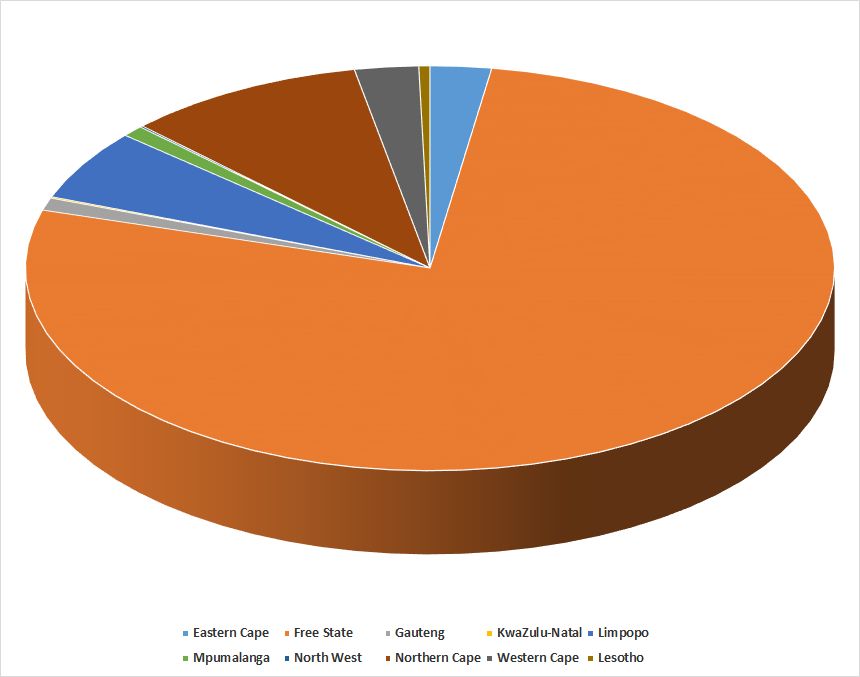
This avian vocalization collection is curated as sound files with an accompanying database that comprises over 1800 bird sounds representing around 230 species from the Free State, Northern Cape and other provinces in South Africa, and Lesotho (Fig. 4). Most of these sound files were created during research projects on Karoo Prinias Prinia maculosa and Drakensberg Prinias P. hypoxantha, African Rock Pipits Anthus crenatus, Gurney’s Sugarbirds Promerops gurneyi and Rufous-eared Warblers Malcorus pectoralis.
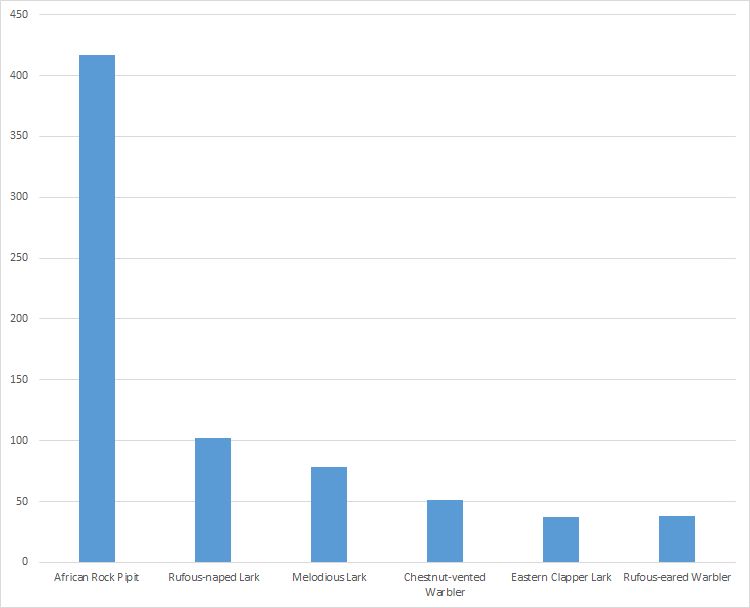
The collection consists of more than 400 African Rock Pipits sound files captured during the late 1990s and 2000s. Recordings of Rufous-naped Corypha africana, Melodious Larks Mirafra cheniana and Eastern Clapper Larks Corypha fasciolata, and Chestnut-vented Warblers Sylvia subaeruleum contribute to the high numbers in the Ornithology Department collection (Fig. 5).
A case of the African Rock Pipit vocalization study
In this article, a research project on African Rock Pipits is used as an example of how avian recordings have been used to study inter and intra-population variations in the song behaviour of this species through interpretation of sonograms. The recordings have been obtained since 1995 from several localities in the Free State, the Northern Cape, as well as other South African provinces and the Lesotho highlands.
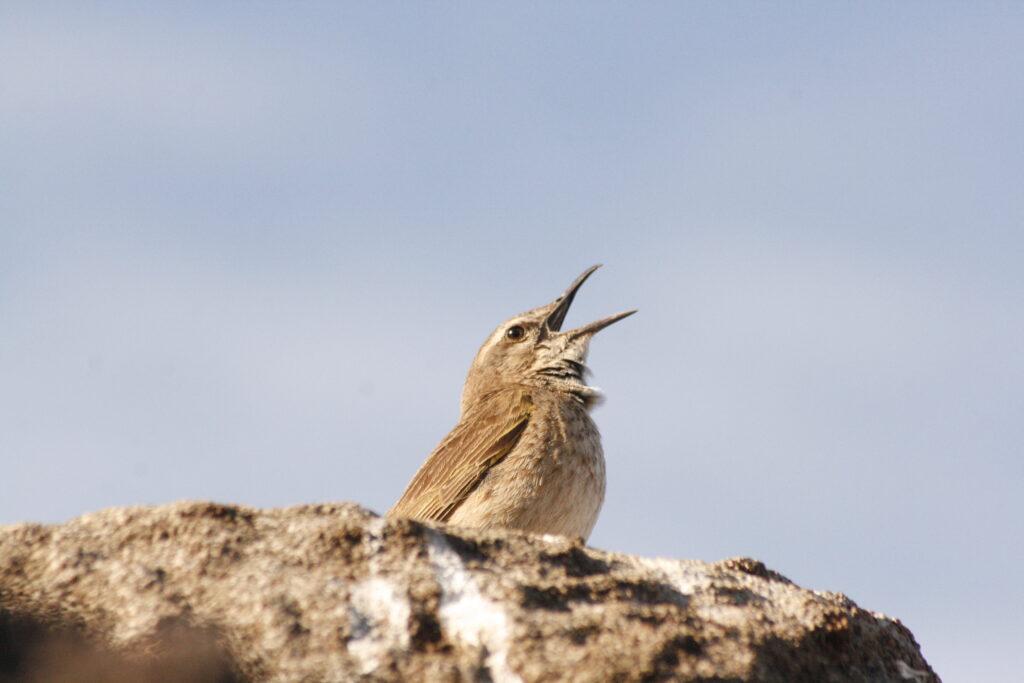
African Rock Pipits are endemic to South Africa and Lesotho and associated with mountain ranges, isolated hilly areas and escarpments where they prefer open rocky hills with an adequate grass cover and boulders, which are used as song posts. Their core range follows the central and eastern parts of the escarpment, eastwards to the high lying areas of the Eastern Cape, the Drakensberg Mountains of Lesotho towards the KwaZulu-Natal escarpment and northwards into Mpumalanga. Several isolated populations occur in the Northern Cape Province, include those at Springbok, the Keimoes area, hills around Groblershoop, hills east of Witsand Nature Reserve, hills at the Tswalu Kalahari Reserve, Mokala National Park, and also in the Kuruman area. The Northern Cape populations are separated by unsuitable habitat over a distance of 280 km from the core escarpment range. In these mountainous habitats with rocky boulders, a characteristic feature is the sighting of a perching bird on a large boulder or any other song post, and vocalizing its characteristic whee-tsreeee or wheeeu-prrreeu call (Fig. 6). They also nest in the grass between the rocks on the slopes during summer.
Their songs can be described as a loud, far-carrying series of disyllabic phrases that starts with a whistle note and follows by a trilling or rattling sound, repeated several times. Several song phrases have been recorded in one singing bout (when calling without interruption), and such a song bout can last up to several minutes or even up to 40 minutes! Also, two main variations have been observed in the trilling part of the song, with the first variation as a constant frequency thrill and the second variation being audible as descending from high to low frequency trilling call. These trilling parts of their songs (S2) have been measured with the sound analysis software (Raven Pro 1.6.5), and significant differences in the song elements revealed by the statistical analysis shows considerable intra- and inter-population variations. In other words, the study demonstrates that the number of song sub-types, durations and frequency ranges of the vocalizations differs significantly among the individuals and populations.
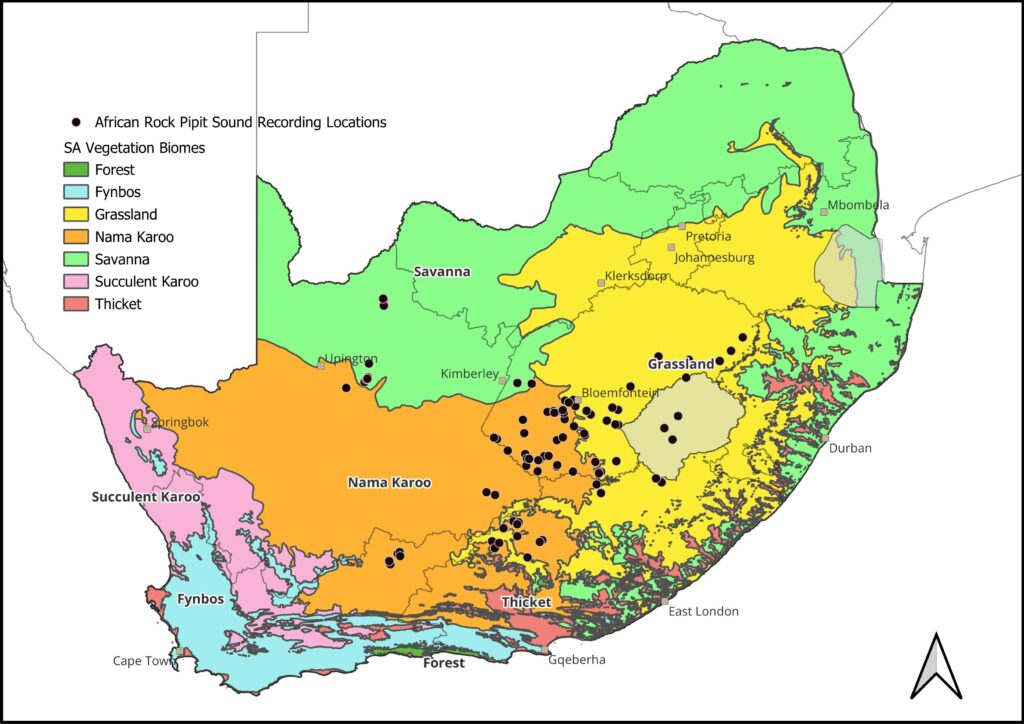
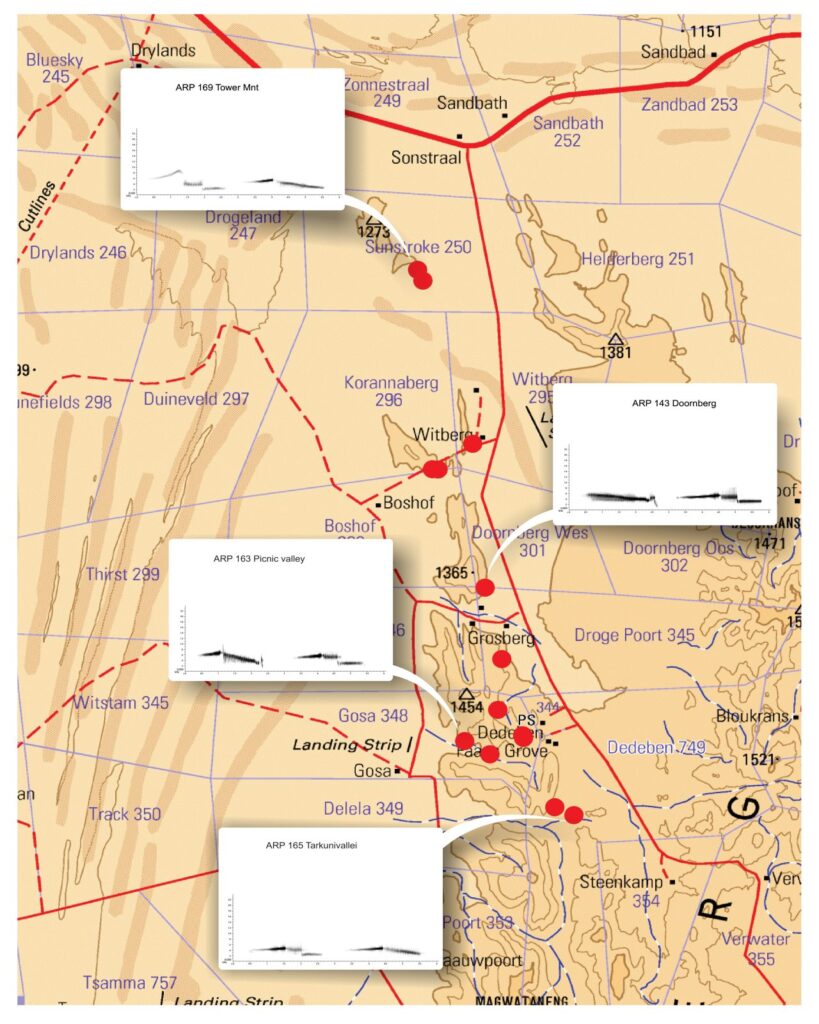
The analysis of song phrase variants (constant and descending frequencies) suggests that the African Rock Pipit populations can be grouped into three distinct geographic areas corresponding to three South African biomes, namely the Grassland, Nama Karoo and Savannah, and differentiated on the basis of specific song parameters, although further sampling is needed to confirm this (Fig. 7). Here, the African Rock Pipit song variations are illustrated by two examples of linked sound clips from isolated localities in the Northern Cape. The first example, giving three variations in a song, is produced by a male from Tswalu Kalahari, Kuruman (click on the link below to play)
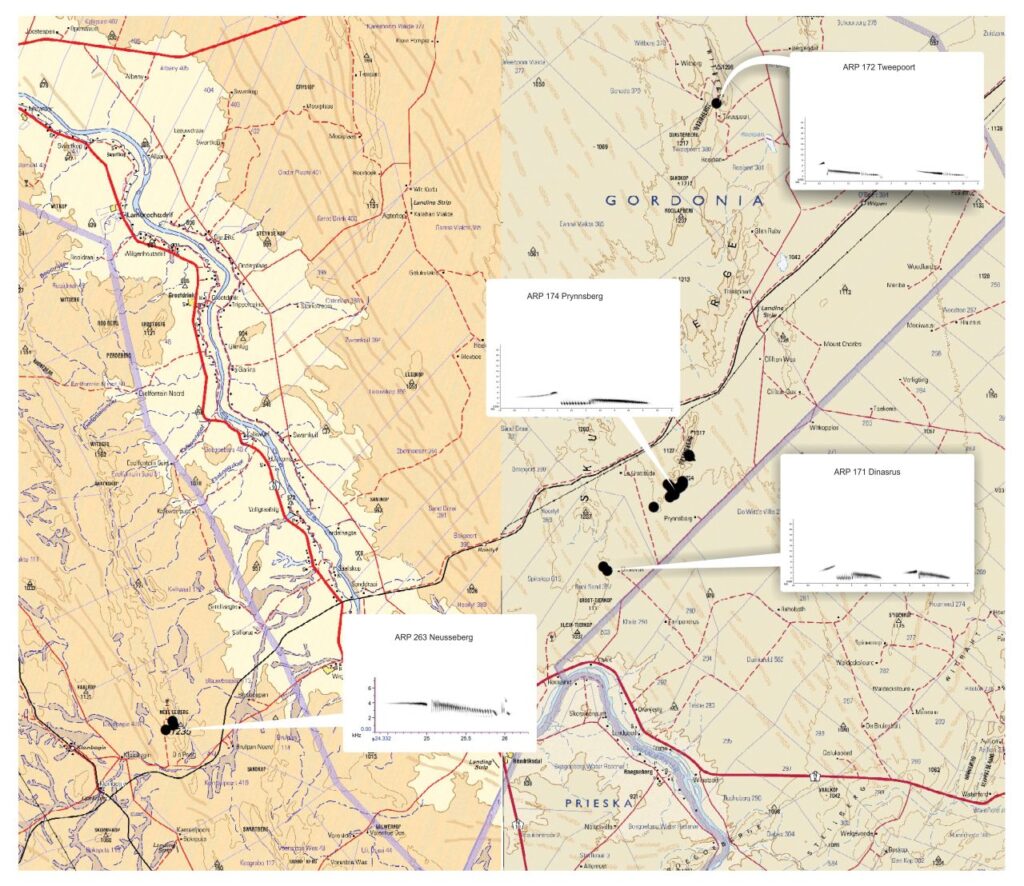
The other population is from the Groblershoop area, mostly from the hills at Prynnsberg, is represented by a vocalizing male, giving two variations in his song (click on the link below to play)
[Footnote for two URL’s for printed text: https://macaulaylibrary.org/asset/656695397 & https://macaulaylibrary.org/asset/656696008
Digitised avian sound recordings in social media and birding applications
Digitised avian sound recordings and sonograms are broadly used in birding applications such as Firefinch, BirdPro and the Roberts or Sasol field guides, which are a valuable resource assisting both amateur birders and scientists with bird identifications. Most of these recordings have been collected in the field by citizen scientists and ornithologists and made available for research projects or for commercial and social media use. But the popularity of birding as a hobby is only growing.
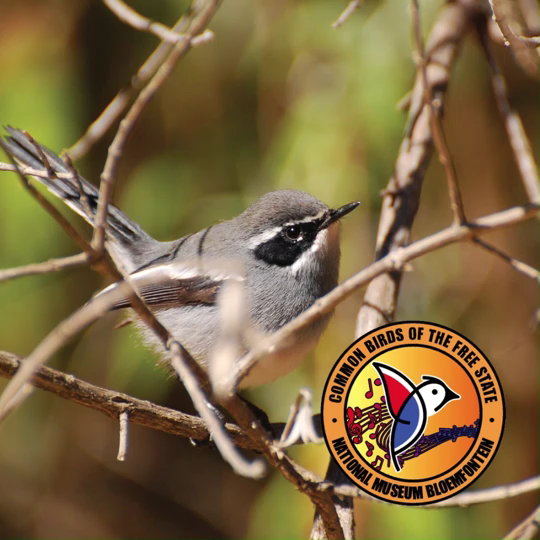
To promote ornithology in the Free State and beyond, the National Museum Facebook group posted weekly on Fridays during 2023 an avian sound file linked to an image of the specific bird and an explanatory text (e.g., Fig. 9). When the post was opened by clicking on the photo, the sound file of the bird call played, and the relevant text could be opened to learn about that particular species. This initiative started with ’Birds of Bloemfontein’ and was later expanded to ’Common Birds of the Free State’ to include other interesting species that occur in the province.
Today, advanced AI tools like the Merlin Bird ID (https://merlin.allaboutbirds.org) can directly listen to birds and identify them based on their calls. This is done via machine learning of sound recordings from, for example, archives of the Macaulay Library (https://www.macaulaylibrary.org), popular webinar Bird Life South Africa broadcasts Conservation Conversation (https://www.birdlife.org.za/blsa-conversations/) and web-based digital collections like Xeno-Canto (https://www.xeno-canto.org).
References
Bruyninckx, J. 2019. For science, broadcasting, and conservation: wildlife recording, the BBC, and the consolidation of a British Library of wildlife sounds. Technology and Culture 60: S188–S215. https://doi.org/10.1353/tech.2019.0068
Cillié, B., Cillie, N., Penlington, P., Hadaker, T. & Wiesler, K. 2022. Veld birds of southern Africa. Johannesburg: Sunbird Publishers Ltd.
Cornell Lab. [n.d.]. Macaulay Library. History. https://www.macaulaylibrary.org/about/history (accessed 10.06.2026)
Cornell Lab. 2026. RAVEN: Empowering bioacoustics research and conservation. https://www.ravensoundsoftware.com (accessed 10.06.2026)
Davies, I. 2026. Conservation Conversations: The Big Year of African Sounds. YouTube, 27 January 2026. https://www.youtube.com/watch?v=MQap1YJIUek
De Swardt, D.H. 2010. Individual and inter-population variation in African Rock Pipit Anthus crenatus songs. In: Harebottle, D.M., Craig, A.J.F.K., Anderson, M.D., Rakotomanana, H. & Muchai, M. (Eds), Proceedings of the 12th Pan-African Ornithological Congress, 2008. Cape Town: Animal Demography Unit, pp. 105–112.
De Swardt, D.H. 2015. African Rock Pipits Anthus crenatus in the Northern Cape: A study at two isolated populations in Tswalu Kalahari Reserve and in the Groblershoop area. Poster presentation at the 6th Annual Diamond Route Research Conference. Johannesburg.
De Swardt, D.H. 2017. Living in isolation – Observations on African Rock Pipits in the Northern Cape. Biological Observations 8: Art. 13. https://doi.org/10.15641/bo.411
De Swardt, D.H. 2019. Close encounters with African Rock Pipits. Culna 73: 10–11. https://nationalmuseumpublications.co.za/close-encounters-with-african-rock-pipits
De Swardt, D.H. & Engelbrecht, G.D. 2024. Yellow-tufted Pipit Anthus crenatus, version 2.0. In: Engelbrecht, G.D. & Smit, B. (Eds), Birds of the World. Ithaca, NY, USA: Cornell Lab of Ornithology,. https://doi.org/10.2173/bow.yetpip1.02
Gibbon, G. 1991. Southern African bird sounds. Durban: Southern African Birding.
Gillard, L. 1983. Southern African bird calls. Johannesburg: EMI S.A.
Hockey, P.A.R., Dean, W.R.J. & Ryan, P.G. (Eds) 2005. Roberts Birds of southern Africa. 7th ed. Cape Town: Trustees of the John Voelcker Bird Book Fund. https://www.robertsbirds.co.za/roberts-birds-7.html
Kanapaux, B. 2010. Bird sound recordings going digital. Gainesville: Florida Museum of Natural History. https://www.floridamuseum.ufl.edu/science/bird-sound-recordings-going-digital (accessed 10.06.2026)
Maclean, G.L. 1985. Roberts’ Birds of southern Africa. 5th ed. Cape Town: Trustees of the John Voelcker Bird Book Fund. https://archive.org/details/robertsbirdsofso0000robe_i8n2
Ranft, R. 2004. Natural sound archives: past, present and future. Annals of the Brazilian Academy of Sciences 76(2): 455–465. https://doi.org/10.1590/S0001-37652004000200041
Roden, H. [n.d.]. First, rare and only sound recordings from the British Library’s collections. https://www.britishlibrary.cn/en/articles/first-rare-and-only-sound-recordings-from-the-british-librarys-collections (accessed 10.06.2026)
Tipp, C. 2011. An overview of early commercial wildlife recordings at the British Library. IASA Journal 37: 47–54. https://www.iasa-web.org/sites/default/files/iasa-journal-37-part7.pdf



Comments are closed.