

Batho, Bloemfontein’s oldest existing historically-black township, boasts a long gardening tradition. From the early 1920s, when the Town Council started moving Bloemfontein’s black residents from the old Waaihoek location to Batho, gardens were laid out on most properties. Batho’s gardens came in all shapes and sizes, depending on the position of the house. In cases where the house was built at the back of the site, there was adequate space to lay out a sizeable front garden. Where the house was built more-or-less in the middle of the erf, the front garden and back yard were the same size.
Then there were those properties where the house was built almost on the verge of the pavement, so that only a narrow strip was left open between it and the fence. Because there was not much space to lay out a proper front garden, the owners of such properties typically planted privet hedges in front of their houses in order to create an attractive and welcoming feature. These narrow front gardens are known as ‘hedge gardens’, because in all such cases the clipped hedge is the main feature of the garden. A number of Batho’s hedge gardens have survived to this day, and one such garden belongs to Jacob and Florence Segoe of number 1203 Thepe Street. This is the story of their hedge garden.
The history of Jacob and Florence’s hedge garden dates back to the mid-1930s when Batho was still a relatively new township. This was a challenging time for most South Africans. Because of the economic depression and severe drought that had ravaged the country and in particular the Free State, both black and white South Africans had fallen on hard times. In Bloemfontein and Batho matters were made worse by the influx of scores of poor people from drought-stricken and impoverished Free State farms. It was during this period that Jacob’s parents, Peter and Nellie Segoe, were married. Because the newlyweds could not afford to live on their own, they moved in with Nellie’s parents at number 1203 Thepe Street. Nellie’s parents were known as Pa and Ma Sebegoe. “Everyone just called them Pa and Ma Sebegoe,” Florence remembers. Pa and Ma lived in a typical red brick Batho house in an area known as Sports. The name ‘Sports’ relates to Masenkeng sports ground (formerly ‘Ramblers’ in Batho) situated nearby. Because of the tough economic conditions, money was scarce in the Sebegoe household. As a result, Pa Sebegoe, who loved gardening, did not plant a proper garden.
Peter was a keen gardener himself. Not long after he and Nellie had moved in with the Sebegoes he convinced Pa Sebegoe that the house would look neat with a clipped hedge in front of it. Peter believed “a garden is not a garden without a hedge”. Pa Sebegoe agreed to the hedge, since he had always felt that his house looked rather dull compared to the neighbours’ handsome property. Florence remembers that the neighbours, the Mochochokos, had a beautiful garden. In those days it was fashionable to plant privet hedges, so Peter paid a visit to W. & C. Gowie nursery (also known as Gowie’s) in town and bought a few trays of small privet plants.
Peter planted the privet plants in a straight row next to the wire and brick fence and pampered them until they grew into dense bushes. Then the time came to clip them. According to Florence, her father-in-law loved to clip that hedge and assumed responsibility for its maintenance. While the hedge was taking shape, Peter also laid out long rectangular flowerbeds next to it. As was customary in those days, the beds were edged with overlapping square bricks. Florence remembers that the flowerbeds were cultivated with a variety of dahlias, also purchased at W. & C. Gowie (which was later taken over by Eric Lamb nursery).
During the late 1930s economic conditions in South Africa improved and so did Peter and Nellie’s financial position. The house that they shared had become too small, especially after Peter and Nellie’s children were born. Peter and his father decided to add more bedrooms to the back of the house to accommodate the growing family. After much deliberation it was also decided to build a handsome verandah in front of the house. This was a dream come true for Florence’s father-in-law, because his favourite pastime was to sit and watch pedestrians passing by. Furthermore, he could enjoy the beautiful dahlias and, of course, appreciate the dark green privet hedge which had grown into a dense and handsome showpiece. The hedge’s foliage was healthy and the leathery leaves shone as if they had been individually waxed by hand.
According to Florence, the privet hedge had always been the main feature of the garden and the history of the house and the Segoe family is intertwined with it. It grew and changed along with the family, almost as if it were a backdrop to the family members’ lives. In 1965 Florence married Peter and Nellie’s son Jacob. Just as Peter and Nellie had moved in with Pa and Ma Sebegoe after their marriage, the young couple moved in with Peter and Nellie. By then, Pa and Ma Sebegoe had both passed away. Florence’s husband and his father got along very well because they shared a common interest in gardening. Both of them also loved to clip the hedge – and both had strong opinions about what it should look like.
As far back as Florence can remember, the hedge had always been clipped in the way that her father-in-law clipped it. Its shape had almost become a family tradition. From the outset, father and son agreed that it should be clipped into a rectangular shape with a flat surface. According to Florence, while the shape of the hedge was unanimously agreed upon, this was not the case as far as the hedge’s height was concerned. Differing opinions about the height of the hedge caused family disputes. Her father-in-law preferred that the hedge was not to be too high because he wanted to see what was happening in the street. Jacob, on the other hand, preferred privacy and did not want passers-by to be able to look over the hedge. He also felt that this was a necessary safety measure because by the 1960s and 1970s tsotsis were becoming a problem in Batho. Jacob respected his father’s opinion and did not allow the hedge to grow too high. However, after Peter passed away, Jacob had his way and promptly allowed the hedge to grow higher. The Segoe family’s hedge had become like a solid, dark green wall.
Today, Florence and Jacob are in their mid-seventies and are still living in the same house. Jacob has become too weak and sickly to clip the hedge, so Florence and a gardener who lives nearby have taken over this responsibility. Florence is now able to let her own taste dictate the appearance of the hedge. Like her father-in-law, she prefers it to be low. This is because criminals hide behind hedges at night. Florence’s physical strength is declining but she is proud to still be able to maintain the Segoe hedge. And the shape? “The shape, I like it as it is” she says with a mischievous grin.
References
Du Bruyn, D. 2011. Eric Lamb (1909-1980): Bloemfontein’s gentleman nurseryman. Culna 66: 26-27.
Interview in Batho, Bloemfontein: F.K. Segoe, 4.11.2014.
Schoeman, K. 1980. Bloemfontein: die ontstaan van ’n stad, 1846-1946. Cape Town: Human & Rousseau.
The Friend, 29.7.1933, 16.8.1933, 12.9.1933, 14.9.1933 & 17.1.1934.
Photos: The Segoe Family Photographic Collection.

The Segoe family’s house at number 1203 Thepe Street, Batho, late 1930s or early 1940s. The young privet hedge is visible behind the brick and wire fence. Peter Segoe poses on the newly built verandah.
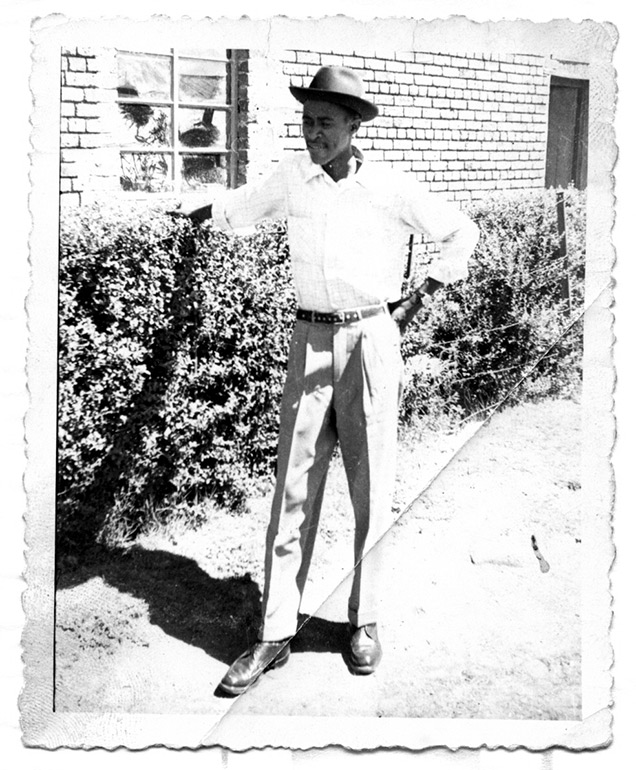
Jacob Segoe admiring a section of the clipped privet hedge, about 1959.
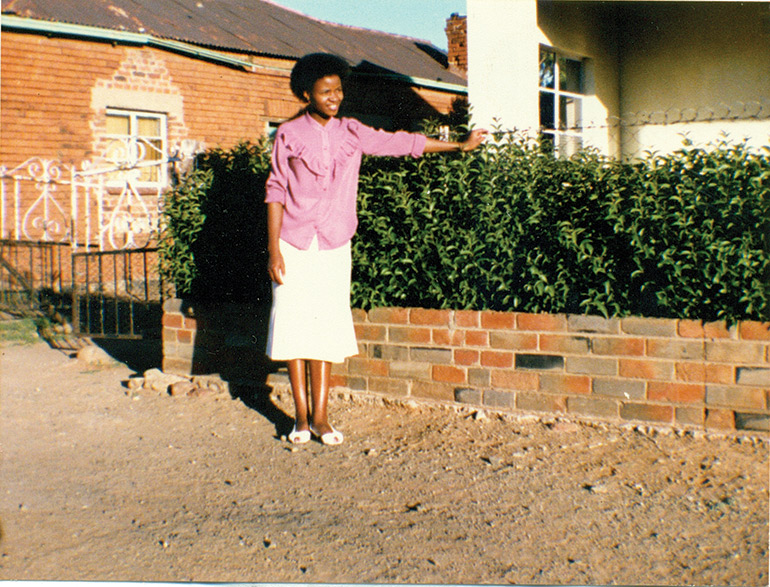
Virginia Segoe, Jacob and Florence’s daughter, beside the privet hedge, mid-1990s. The tall hedge completely obscures the wire fence in front of it.
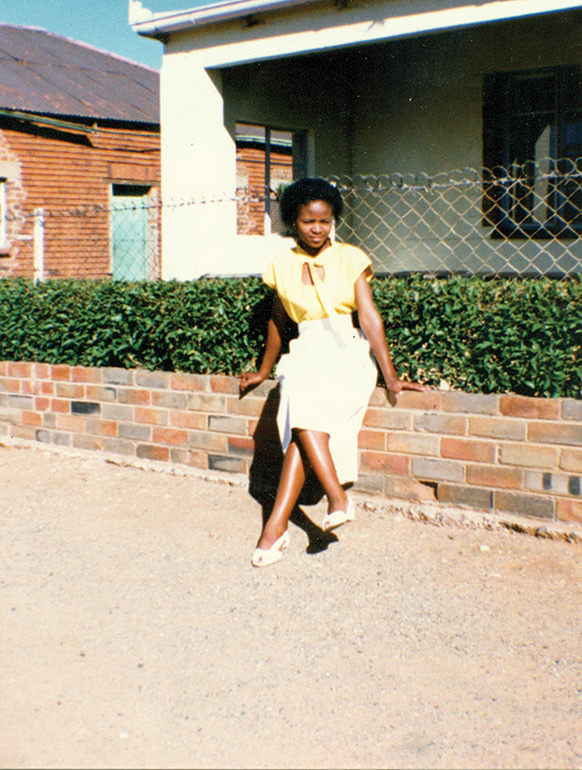
Virginia Segoe sitting on the low brick wall in front of the wire fence, mid-1990s. The hedge is neatly clipped and the wire fence is exposed.
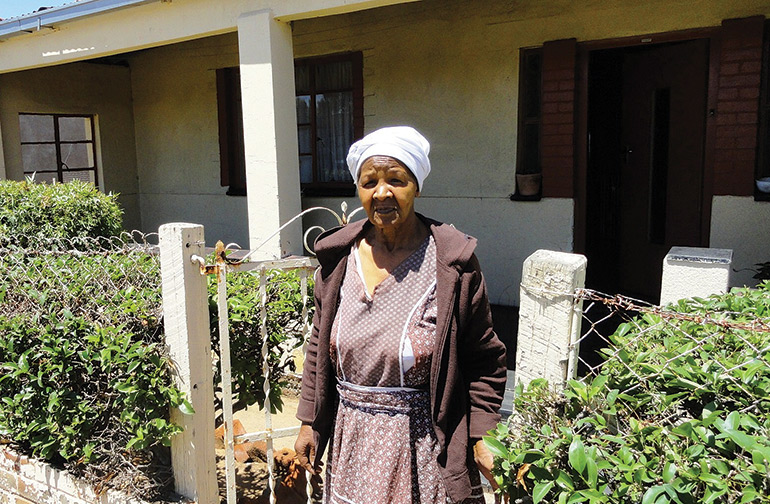
Florence Segoe standing at the gate of her house in 2014.



Comments are closed.