


Carlos Achadinha was 18 years old when he left the small town of Estreito da Calheta on the island of Madeira, Portugal. Not only did he leave his childhood home behind but also his homeland, when he decided to explore opportunities in South Africa. Carlos left Madeira in 1947 and, like many other Portuguese men who were searching for greener pastures, he travelled by ship to Lourenço Marques (Maputo), the capital of Mozambique. At the time, Mozambique was a Portuguese colony and a key point of entry – legal or illegal – into South Africa. While some Portuguese waited in Lourenço Marques for their carta de chamada (immigration documents) that allowed them to enter South Africa legally, others entered the country covertly. Carlos’s second eldest son and namesake, Carlos Achadinha Junior, explained that his father and a group of Madeiran men came to South Africa “on foot” via Swaziland (Eswatini). A shorter route through the Kruger National Park, teeming with predators, seemed to be too risky.

The Madeirans – a “bunch of them” – according to Carlos Junior, headed straight to Pretoria, where Carlos Senior had a brother, António Achadinha. Their immediate priority was to apply for South African work permits. They were assisted by Manuel Coutinho, a local Portuguese who acted as mediator between undocumented Madeiran immigrants and the local immigration office. The fact that Carlos had a brother in Pretoria made life easier for him compared to other undocumented immigrants who were often left at the mercy of documented Portuguese, who exploited them as cheap labour. While waiting for his ‘green card’, Carlos found a job on a vegetable farm near Boksburg and Benoni on the East Rand. His initial intention was to work in South Africa for some time to earn enough money to return to Madeira to marry and start a family.
Carlos became absorbed in his new life in South Africa, but Madeira was never far from his mind. In fact, he was torn in two because the love of his life, Maria de Agrela Pereira Luis, was still on the island. In 1955, Carlos returned to Madeira to marry Maria. The following year, he travelled back to South Africa with a ‘green card’ that allowed him to live and work in the country. For four years, Carlos and Maria maintained a long-distance marriage; he lived in South Africa, and his wife and daughter, Goretti, lived in Madeira. They only joined Carlos in South Africa in 1960.

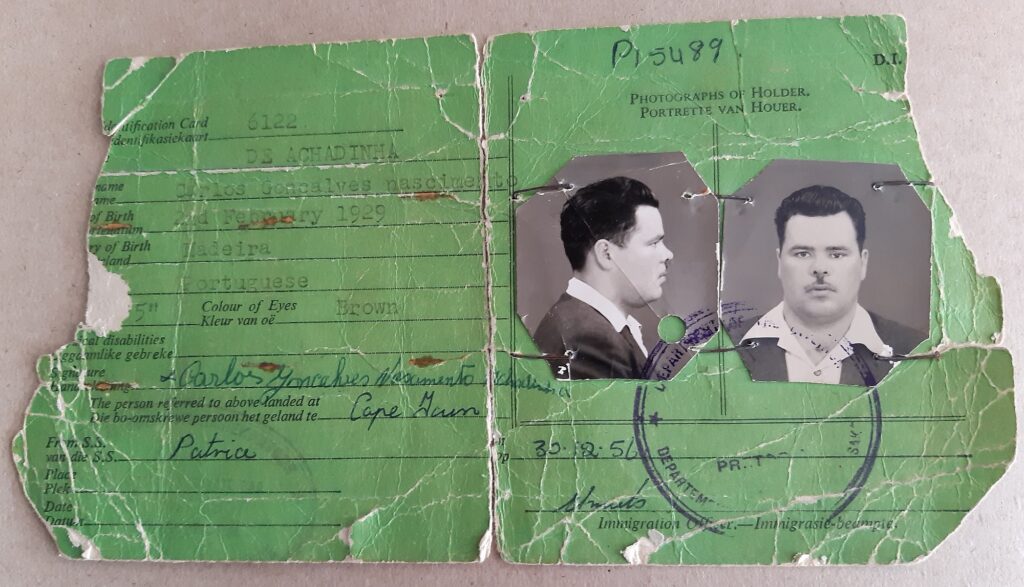
It became clear that the hard-working and ambitious Carlos not only had a talent for growing vegetables but also for selling them. According to Carlos Junior, his parents spent some time in Johannesburg before Manuel Coutinho convinced Carlos Senior to join him in a business venture in Bloemfontein. The two of them, who had previously visited Bloemfontein, formed a partnership and started Republic Wholesalers in the city in 1960. Owing to his contacts with the immigration office, Manuel could arrange ‘green cards’ for unemployed Madeiran men to come to Bloemfontein to work for him and Carlos.
Although Carlos was doing well for himself in his adopted country, he and Maria still longed for Madeira. He owned a property on the island that he leased. In 1967, Carlos and his family returned to Madeira “for good”, to quote Carlos Junior. However, things did not work out for them because the tenants refused to vacate the property. To make matters worse, Madeira’s strict property laws protected the tenants from being evicted. After only six months on the island, the Achadinha family returned to Bloemfontein, where opportunities beckoned. Back in Bloemfontein, the Achadinha family settled in a house in Universitas, where Carlos and Maria created a haven for their seven children: Goretti, Venceslau (Vench), Carlos, Fátima, Pedro, Francisco (Frankie) and Lúcia (Lucy).
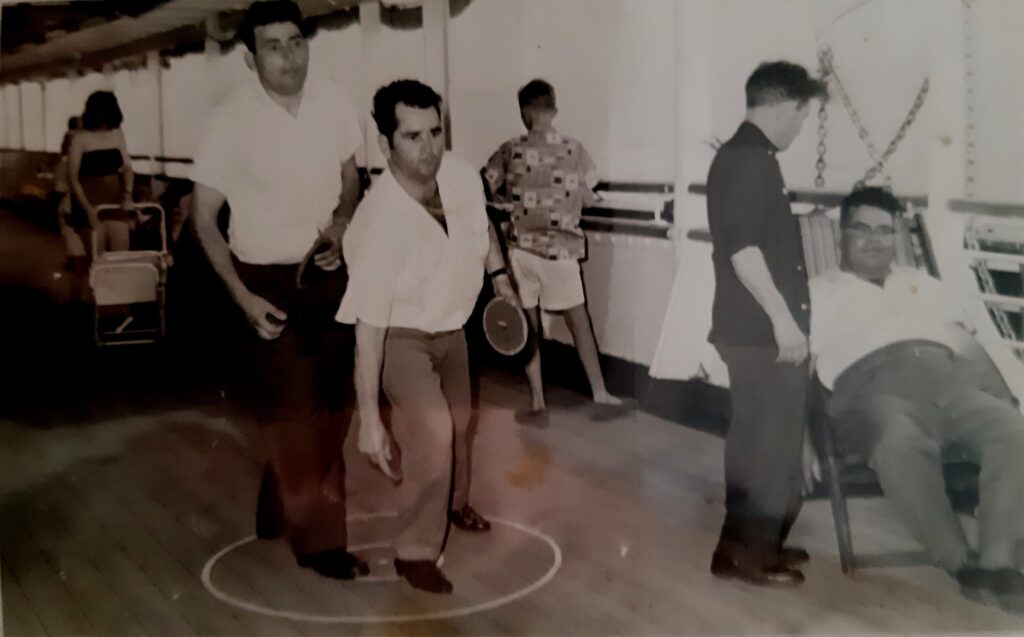

For Carlos, it was literally back to business when he and two other Portuguese men purchased a farm in Bloemspruit near the well-known Irene Cash Store. This farm, and other nearby rented farms, provided enough land to grow a steady supply of vegetables. Later, another farm on the Jagersfontein Road, known as Pampieta, was purchased. Most of the fresh produce were sold at Bloemfontein’s market. Thanks to Carlos’s business skills and ability to spot opportunities in the local food market, he decided to venture out on his own. He started small when he opened Shannon Cash Store in 1976. Instead of selling groceries, Carlos focussed on fruit and vegetables only. A year or so later, he sold the grocery store and opened Portuguese Gardens on Zastron Street. This small fruit and vegetable store was the first of several iconic fresh produce shops that served Bloemfontein residents. During the 1970s, Carlos emerged as a prominent Bloemfontein businessman.
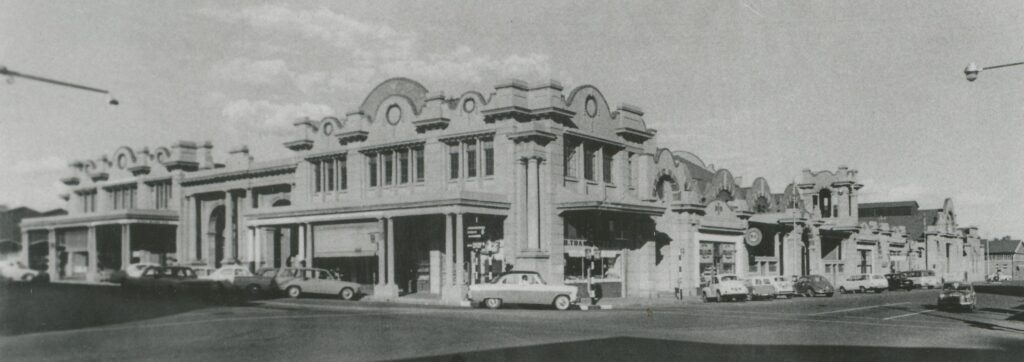
At the time when Carlos ventured into the fruit and vegetable business, most of the grocery stores in Bloemfontein did not sell fresh produce. Local consumers relied on small-scale greengrocers (mostly Portuguese- and Greek-owned) for their fresh fruit and vegetables. It was a lucrative market and Carlos did not wait for others to fill the void. Shortly after opening the Portuguese Gardens, Carlos and a partner opened Truckman, a fruit and vegetable store on one of the corners of the old market building in town. The success of these two stores prompted Carlos to venture bigger – in the mid-1970s, he opened the well-known Westdene Fruiterers, and in 1979, he started Brandwag Fruiteries. Over the course of time, Westdene Fruiterers expanded and became a landmark on Second Avenue.


Carlos Achadinha’s rise to prominence as a business leader coincided with his becoming a mentor among Bloemfontein’s growing Portuguese community. According to Carlos Junior, he was friends with everyone, including the alfacinhas (the nickname for Portuguese from Lisbon). He helped many Portuguese, especially Madeirans, to obtain the necessary immigration papers. Taking into account the challenges involved in starting a business from scratch in a foreign country, many Madeirans became successful greengrocers and café owners remarkably quickly. The fact that they could learn from an experienced businessman was to their advantage.
Despite being a loyal and proud Bloemfontein resident, Carlos Achadinha never forgot his Madeiran roots. As a lover of Madeiran vinho (wine) he brought the island’s centuries-old winemaking tradition to Bloemfontein. Carlos constructed big vine trellises on his property, where he cultivated several grape varieties. He even built his own winepress. His daughter, Fátima, remembered that all the Achadinha children helped their father with the laborious winemaking process. In addition to the Madeiran culture, Carlos also brought the Madeiran trait of diligence to Bloemfontein and, subsequently, he instilled it in his children. Carlos Junior and his sister Lucy remembered that every day after school, the Achadinha children had to work in their father’s shops. In addition to their schoolwork, helping in the stores “was our homework”, Lucy said.

Tragically, the lives of both Carlos and Maria Achadinha were abruptly cut short in September 1985, when they died in a horrific car accident on the N1 outside Winburg. The couple was returning from Johannesburg to Bloemfontein with their son Venceslau when an oncoming vehicle suddenly swerved into their lane and caused a head-on collision. While Venceslau miraculously survived the accident, his parents and another four people were killed. While the Achadinha couple’s untimely death (Carlos was 56 and Maria only 47) had a huge emotional impact on his family, Bloemfontein’s Portuguese community was also hard hit. Carlos Achadinha’s death left a huge void in a community he passionately loved and served for most of his life.
Sources
Achadinha Private Collection (documents and photographs).
Glaser, C. 2010. Portuguese immigrant history in twentieth century South Africa: A preliminary overview. African Historical Review 42(2): 61–83. https://doi.org/10.1080/17532523.2010.517398
Glaser, C. 2013. White but illegal: Undocumented Madeiran immigration to South Africa, 1920s–1970s. Immigrants & Minorities: Historical Studies in Ethnicity, Migration and Diaspora 31(1): 74–98. https://doi.org/10.1080/02619288.2012.686216
Haasbroek, H. 2015. Die 1922-debat rondom die strewe na en besluit oor ’n nuwe Bloemfonteinse markterrein. Navorsinge van die Nasionale Museum Bloemfontein 31(2): 29–48. https://nationalmuseumpublications.co.za/wp-content/uploads/2020/08/VOLUME-31-PART-2.pdf
National Museum Oral History Collection: F.D. Pereira Achadinha Janthan, 6 March 2024; C.C. Pereira Achadinha, 13 February 2025; L. Laranja Achadinha, 13 February 2025.
Telephone communication with T. Coutinho, 15 May 2025.

Comments are closed.