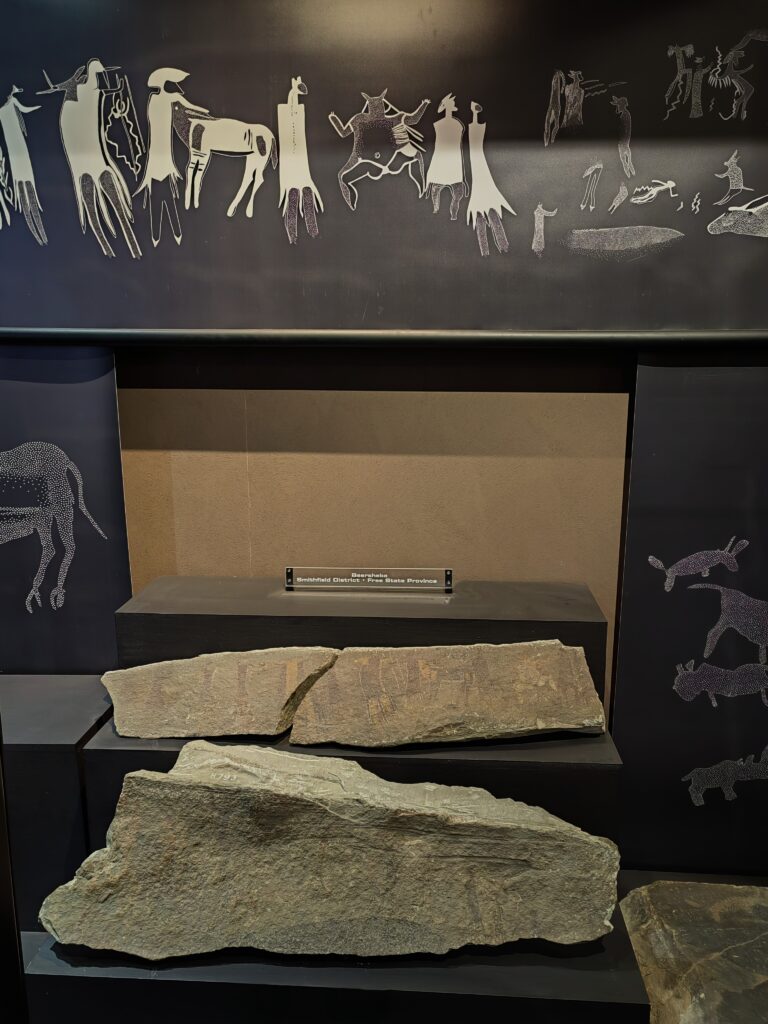
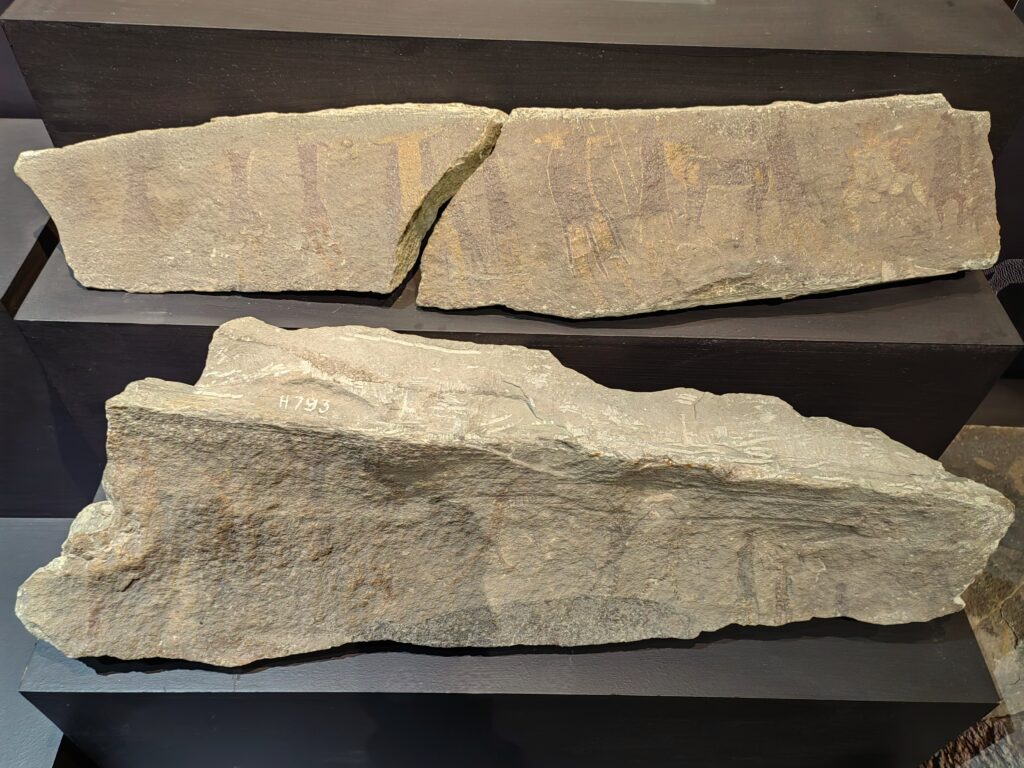
Museums across the world have collections of fragments of rock paintings and engravings that have been removed due to concern over their damage or deterioration. As early as 1870, geologist and ethnologist George William Stow warned that rock art was “becoming obliterated very fast” (Jones 1870: 107). Stow and his fellow rock art enthusiast, Charles Sirr Orpen visited several sites in the then Orange Free State, making watercolour and charcoal copies of the art. So profound was their interest in the preservation of the rock art that they proceeded to remove certain painted panels from rock shelters. Two of these panels[1] can be viewed on permanent display in the Archaeology Hall in the National Museum, Bloemfontein (Fig. 1).
The original location of these paintings was on a farm near the town of Smithfield in the Xhariep District of the Free State Province. Since the late 1820s the land was a trekboer camp for semi-nomadic pastoral farmers, hunters and traders from the Cape Colony. The land was abandoned in 1834 due to the Cape colonial decree that insisted that all colonists who had temporary settlements north of the Orange River must return to the colony (Coplan 2009). At that time, the land belonged to the Basotho King Moshoeshoe who was glad to see the Boers leave. The land in question was highly sought after due to its many permanent springs and plentiful grazing grounds. So idyllic was the land that in 1835 the Paris Evangelical Mission Society sent Reverend Samuel Rolland to establish a missionary station there. The Afrikaans name for the land was ‘Zevenfontein’ meaning Seven Fountains, which Rolland later renamed the Beersheba Mission, after the biblical name of a similar meaning (Schoeman 1987). The mission also failed to get permission from King Moshoeshoe but later that year he sent Rolland a letter welcoming the mission settlement on the royal land (Schoeman 1987). This was a strategic move on the King’s part because he considered the mission stations as protection against the marauding Korana and Griqua groups.
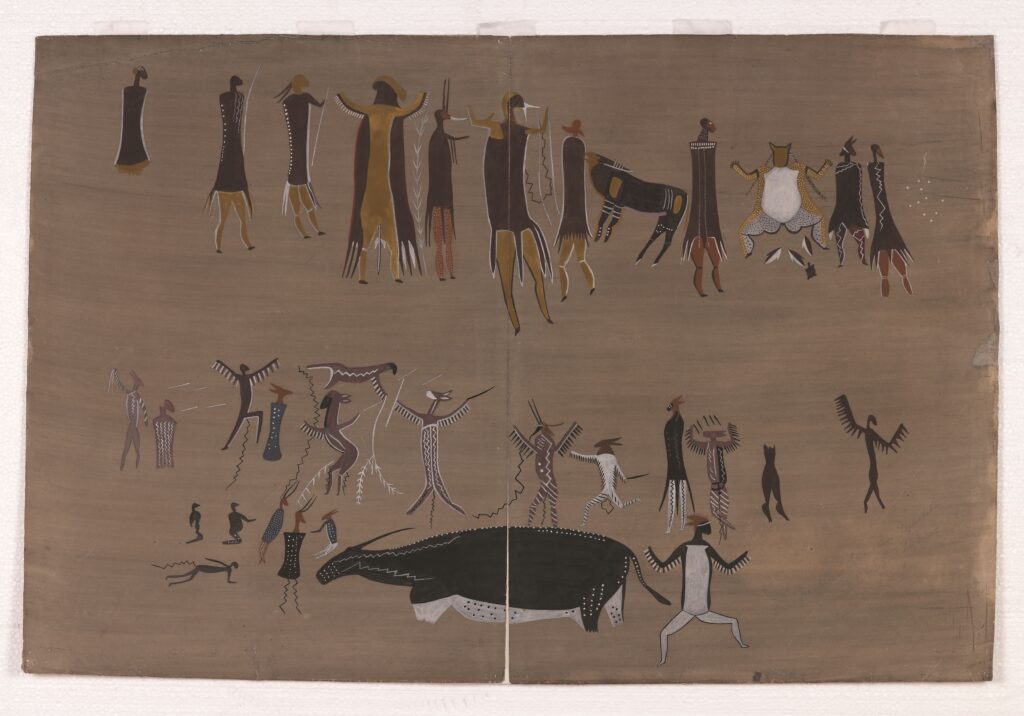
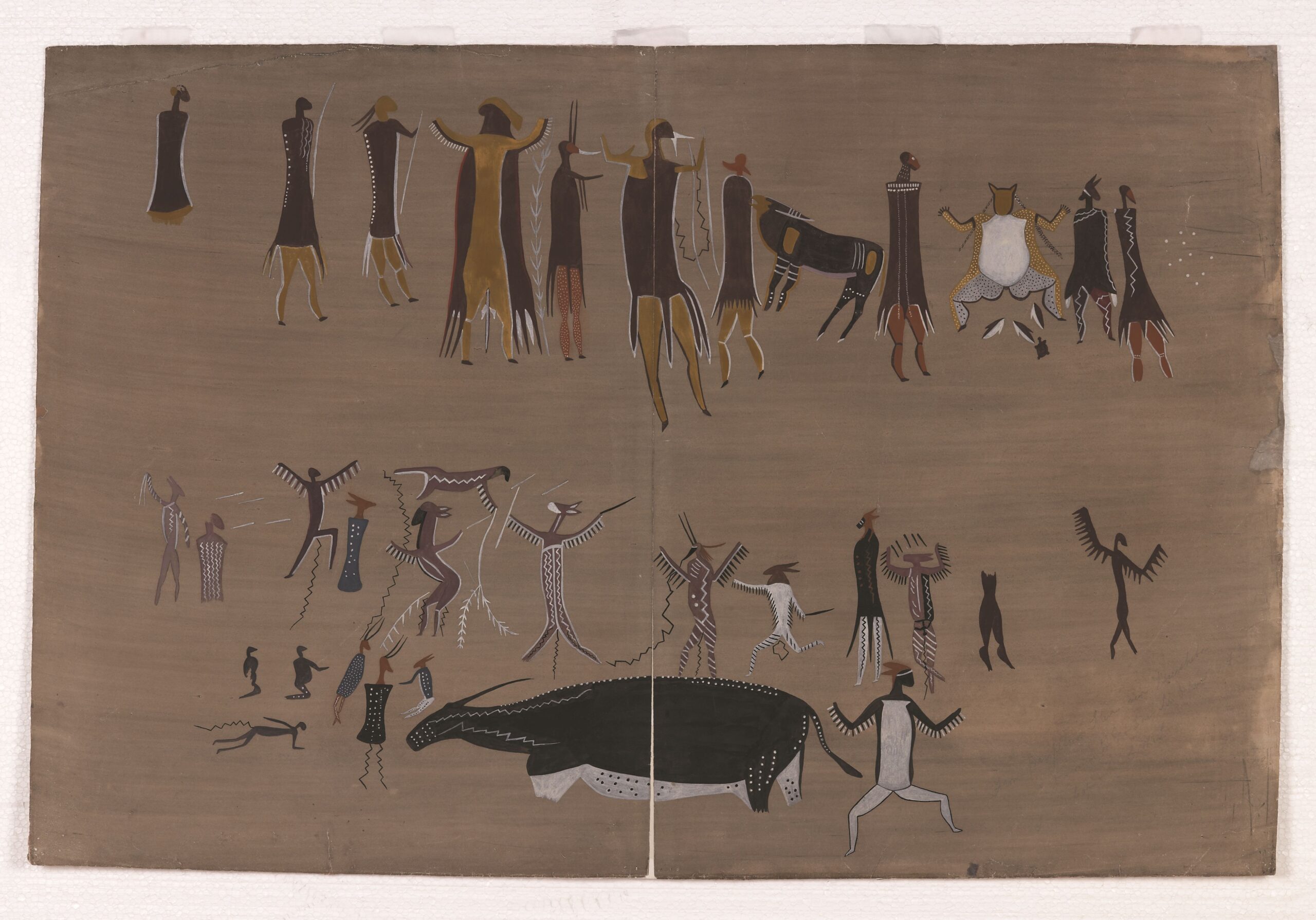
Over the next few decades this land was always a point of contention due to the threat of raids from displaced groups from the Cape Colony and the Boers, who still considered Zevenfontein their land. In March 1858 this strife culminated in the massacre of 30 Beersheba residents by a Boer commando led my Commandant Sauer (Schoeman 1987). Rolland and his followers abandoned the mission station, and the land was sold to Johannes Swanepoel in 1862 (Coplan 2009). The land remained under the ownership of the Swanepoels when paintings were visited by Orpen and Stow in the 1870s. Stow made a reproduction of the paintings in watercolours, which is currently housed in the Iziko Museum, Cape Town (Fig. 2). The exact date of the copy is uncertain because Stow’s annotations do not include such information. It is most likely that the copy was made during the two weeks in early November 1876 when Stow stayed at Orpen’s home in Smithfield (Young 1908). However, it is unclear when the two fragments were removed from the rock shelter (Fig. 3).
Stow’s watercolour copy was published by an esteemed anthropologist, Dorothea Bleek in 1930 (Stow & Bleek 1930: pl. 58). Bleek noted that Mrs Van der Merwe, the daughter of Johannes Swanepoel, remembers Orpen “…often visiting her home in childhood. He collected fossils and also cut out paintings.” It is possible that Orpen was responsible for removing the fragments sometime after Stow’s watercolour copy in 1876 and before his death in 1887. Orpen was a great proponent of the National Museum of the Orange Free State since its inception in 1877 (Moodley 2025). On 6 August 1879, Orpen’s Smithfield-versameling (collection) finally reached the museum after months of correspondence with the Scottish Freemason Lodge Caledonia (Staff writer 1879). This collection was so large that it had to be transported by an ox-driven buck-wagon, and the museum was closed until October that year with the purpose of accessioning the new acquisitions (van der Bank 1997). It is likely that the two painted fragments, which were removed from the Smithfield area, were part of this collection.
In her publication, Bleek (Stow & Bleek 1930: pl. 58) mentions that the original rock painting of the Stow copy is in the Bloemfontein Museum and that, “The two slabs in the Museum contain nearly all figures shown here very much faded; the bottom of the lower line has been cut away.” She made these observations when she visited Bloemfontein in September 1920 (Staff writer 1920), meaning that the fragments where already housed in the National Museum by then. Bleek was referring to the black rain animal on the lower fragment that was broken off, either during its removal or through mishandling (Fig. 4). Interestingly, a painted copy of the lower fragment was donated to the Rijks Ethnographisch Museum in Leiden, Netherlands (Buckland pers. comm. 2025). Pierre Corneille Baerveldt, the Netherlands Consul in Johannesburg donated four reproductions of San rock paintings, accompanied by a letter dated 20 August 1894. Baerveldt was a member of the South African Republic (ZAR)[2] delegation at the Antwerp International Exposition in 1884 (Exposition Universelle d’Anvers 1894). There is speculation that the copy was part of the ZAR exhibition at the Exposition (Wereld Museum 2025). However, the ZAR pavilion focused heavily on the mining industry in a bid to highlight the industrialisation of the Republic and their independence from the British Cape Colony. According to the official catalogue of the Exposition, the ZAR pavilion did not include an exhibition devoted to the indigenous art (Exposition Universelle d’Anvers 1894), but it is plausible that the copy was a supplement to other exhibits listed in the catalogue.

A tracing of Stow’s painted copy (Fig. 5) was created by Helen Tongue, a school teacher and colleague of Dorothea Bleek. In 1907 and 1908, the two rock art enthusiasts embarked on a journey to locate and copy rock art sites that had been documented by Stow (Weintroub & de Harde 2021). In 1908 Tongue exhibited her copies at the Royal Anthropological Institute in London and published them in Bushman Paintings in 1909. Her copy is part of the Helen Tongue Collection that was acquired by the Rock Art Research Institute at the University of Witwatersrand, Johannesburg in 1986.

These painted fragments are archaeological artefacts that, although removed from their original context, still hold great significance. They simultaneously remind us of what remains and what is lost. These fragments are tangible pieces of the past but to genuinely appreciate their significance, is to consider the network of relationships involved. From their conception, creation and use by the San, to the colonial-era copies, removal and continued viewing. The tale of the two painted fragments continues provided that we, the audience, remain interested.
References
Coplan, D.B. 2009. Erasing history: The destruction of the Beersheba and Platberg African Christian communities in the Eastern Orange Free State, 1858–1983. South African Historical Journal 61(3): 505–520. https://doi.org/10.1080/02582470903189733
Exposition Universelle d’Anvers. 1894. Section e la République Sud-Africaine. In: Catalogue official general. Brussels: A. Mertens. https://archive.org/details/catalogueofficie02expo/page/76
Jones, T.R. 1870. Cave paintings by Bushmen. Nature 3(58): 107. https://doi.org/10.1038/003107b0
Moodley, S. 2025. C.S. Orpen historic copies. Culna 79: 53–54. https://nationalmuseumpublications.co.za/uploads/CULNA_79.pdf
Schoeman, K. 1987. The recollections of Elizabeth Rolland. Cape Town: Human & Rousseau.
Staff writer. 1879. The Friend of the Free State and the Bloemfontein Gazette. 7 August 1879.
Staff writer. 1920. The Friend. 28 September1920.
Stow, G.W. & Bleek, D.F. 1930. Rock paintings in South Africa from parts of the Eastern Province and Orange Free State. London: Methuen. https://archive.org/details/rockpaintingsins00stow
Tongue, M.H. 1909. Bushman Paintings. London: Clarendon Press.
van der Bank, D.A. 1997. Nasionale Museum Deel I. Stigting en vroeë geskiedenis. Navorsinge van die Nasionale Museum, Bloemfontein 13(2): 45–99. https://hdl.handle.net/10520/AJA00679208_1487
Weintroub, J. & de Harde, L. 2021. “Admirable Facsimiles”: Coffee Tables, Copying Contexts and Helen Tongue’s Rock Art Book c1909. Critical Arts 35(4): 84–102. https://doi.org/10.1080/02560046.2021.1955940
Wereld Museum. 2025. Schildering van Khoisan-rotstekeningen. https://hdl.handle.net/20.500.11840/1248188 (accessed 24.02.2025)
Young, R.B. 1908. The life and works of George Stow. Cape Town: Darter Bros. and Co.
[1] One fragment fractured when it was removed from an older permanent display.
[2] The ZAR refers to Zuid-Afrikaansche Republiek also known as the Transvaal Republic. In 1894, South Africa was not unified, it consisted of the Boer independent states of ZAR and Orange Free State, and the British-ruled Cape Colony.