


Historical research often requires visits to repositories, record centres and libraries. These treasure chests of information offer a unique window into our past. They are gateways to documents and records that were created by people who passed away long ago. These old records from days gone by are commonly known as archives.Researchers are challenged by the fact that they must find a way through the archives without the assistance of those who created them. Archival materials typically date from times that were radically different from the present. Therefore, a scholar must be familiar with the historical period when the records in question were created. This helps to understand the past environment and circumstances, in which the records came into being. It is almost like doing time travel and imagining what life was like at a specific point in time.
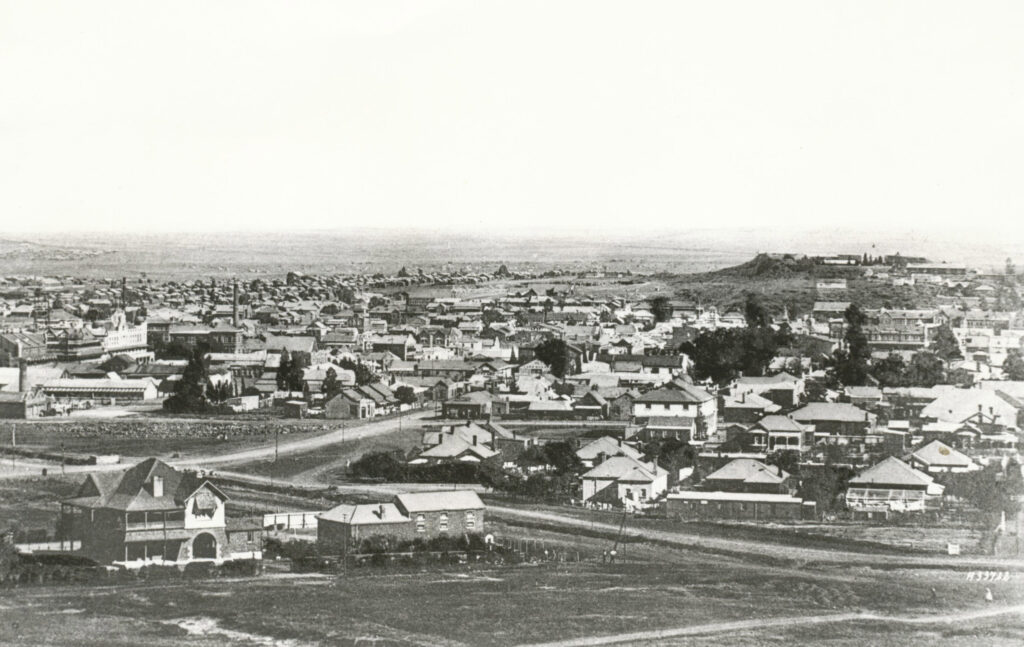
Over a century ago, the Free State was a British colony known as the Orange River Colony (ORC; 1902–1910). Bloemfontein was a predominantly English colonial capital that was integrated into the vast British Empire. The ORC government and the Bloemfontein municipality (known as The Corporation of Bloemfontein) were dominated by English-speaking men, most of whom were born in Britain. A typical example was Sir Henry Francis Wilson (1859–1937), Colonial Secretary of the ORC from 1902 to 1907. Inevitably, Sir Henry’s way of doing things – the English way of doing things – permeated every aspect of governance and recordkeeping in the Free State.
For a researcher, it is vital to understand that the upper-middle-class English bureaucrats and ‘penpushers’ like Sir Henry spoke, wrote and reasoned differently. In practical terms, it meant they spoke and wrote a version of formal upper-class English known as U-language. Some of the words and phrases that were commonly used then have become obsolete today. Even members of Bloemfontein’s black middle-class, such as Thomas Mtobi Mapikela (1869–1945) and Henry Selby Msimang (1886–1982), were familiar with the English style of communicating. In fact, these “black Englishmen”, to quote historian Peter Limb, spoke and wrote like their colonial masters despite the strict racial divide in Bloemfontein and elsewhere at the time. A researcher consulting records from the colonial era must ‘get under the skins of the English bureaucrats’, so to speak, because they influenced the way records were created. 
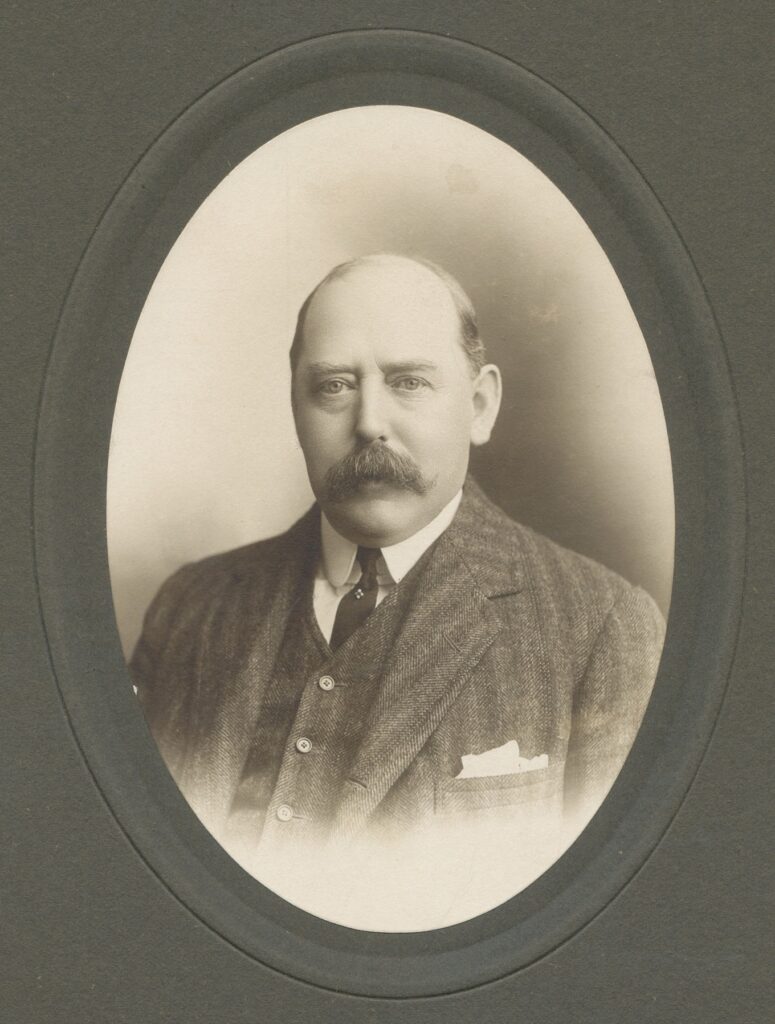
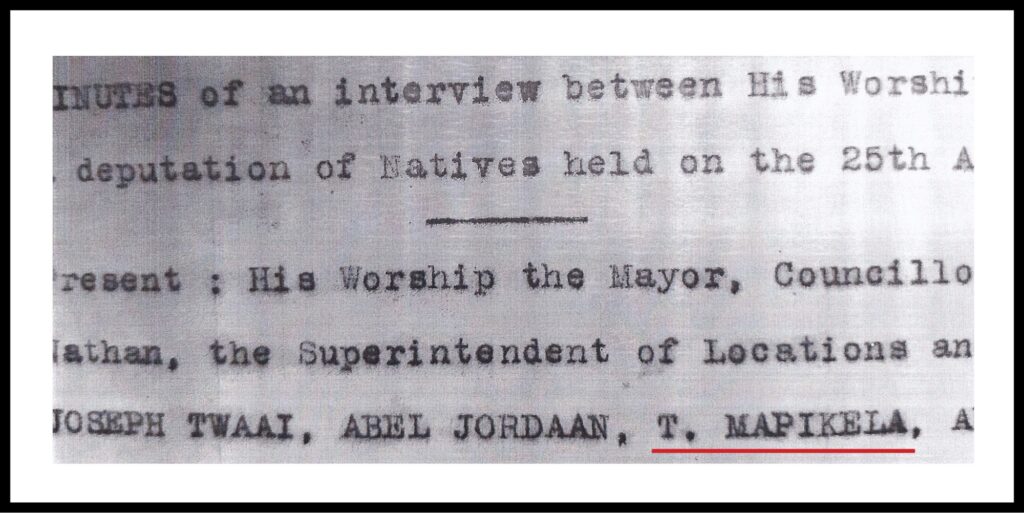
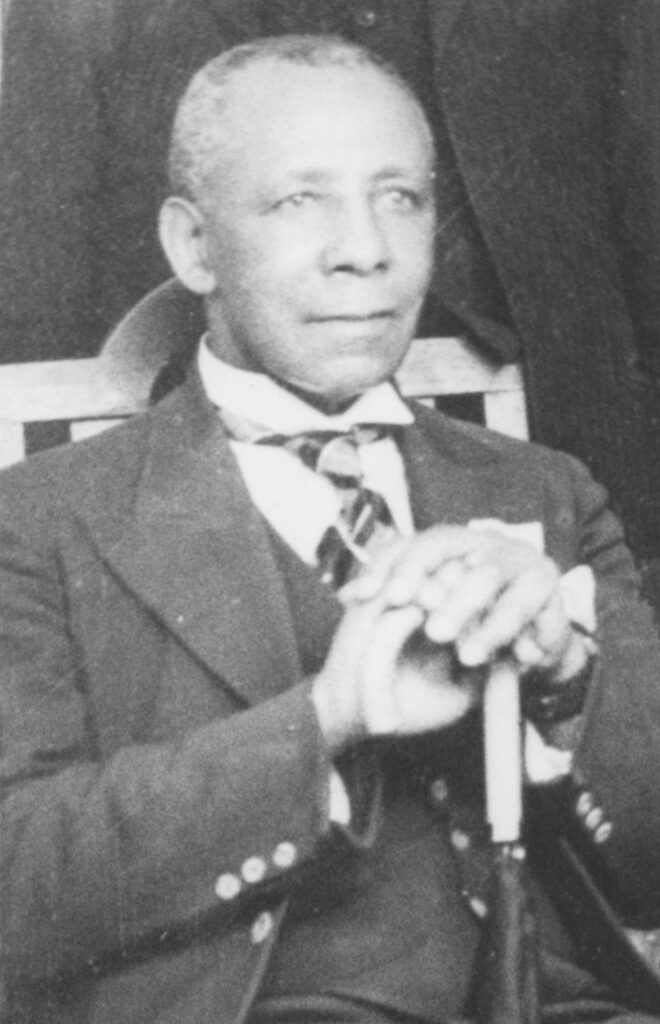
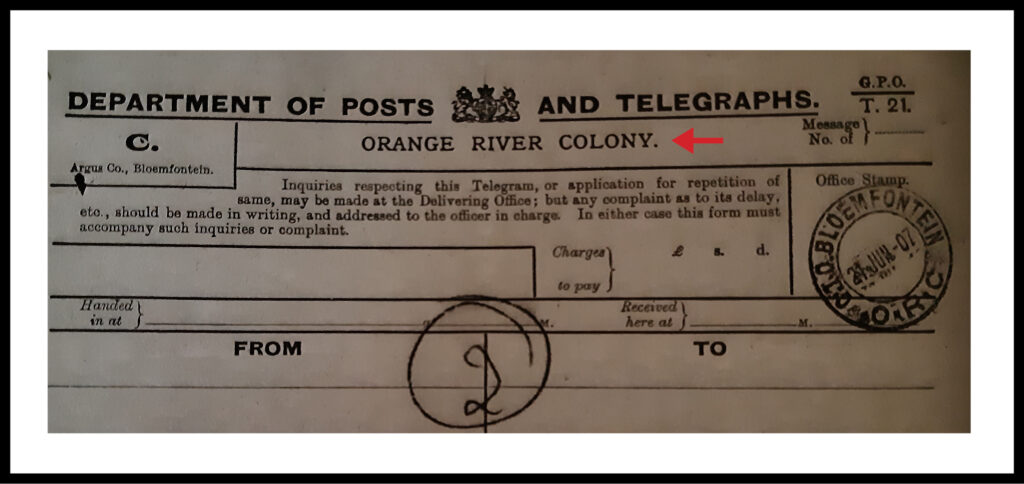
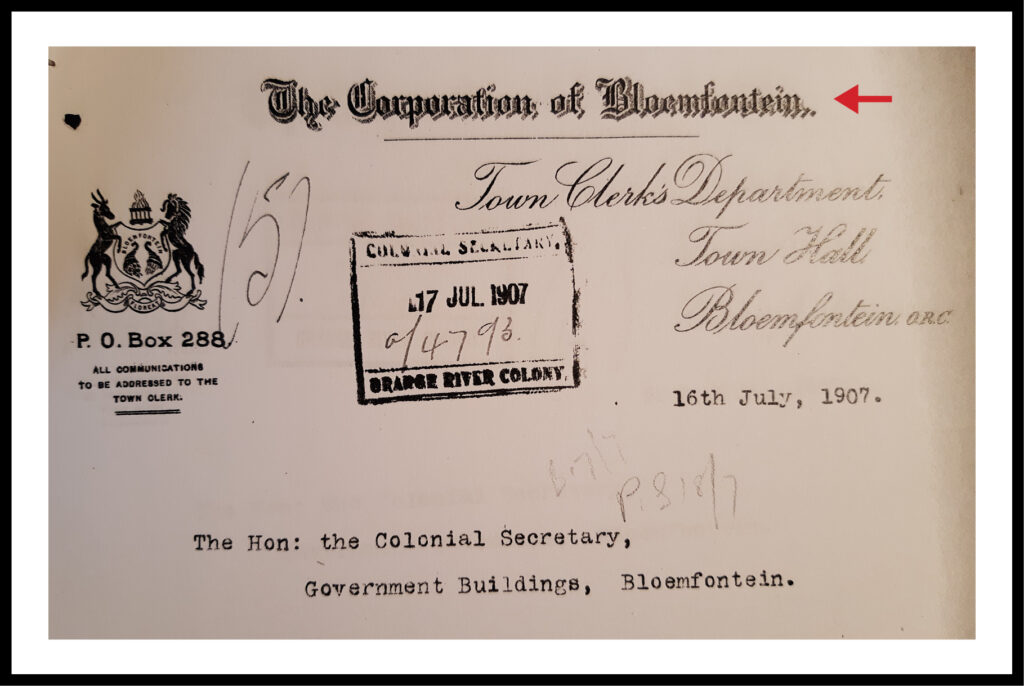
It is crucial for a historian or researcher to be mindful of the context in which a historical record was created. In fact, a well-known South African archivist, Verne Harris, argues that the archive itself is the law that determines context. Archives cannot be understood outside their context because of the risk of misinterpreting and misunderstanding the content. In simple terms, the issue of context relates to where a specific record originated, when and how it was created, by whom it was created, and for what purposes. For example, if we take records from Bloemfontein’s British colonial period (1902–1910) – the focus of this article – this would mean they were created in the context of the British colonial ideology, policies and protocols as well as the recordkeeping practices of the time. Therefore, a researcher must engage critically and questioningly with such records, but more about this later.
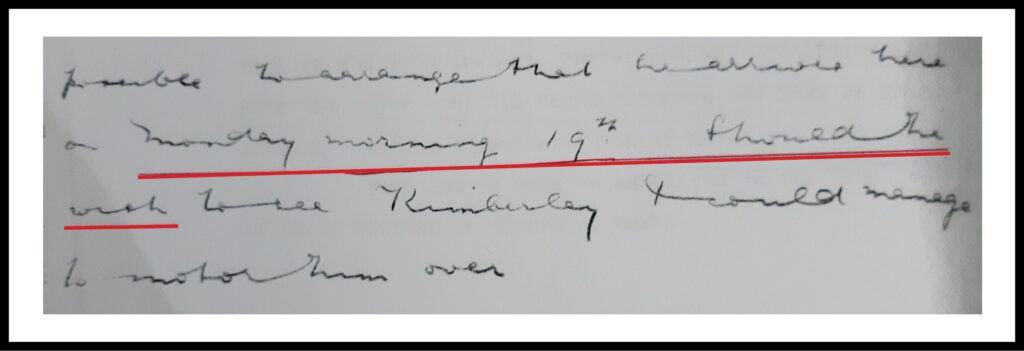
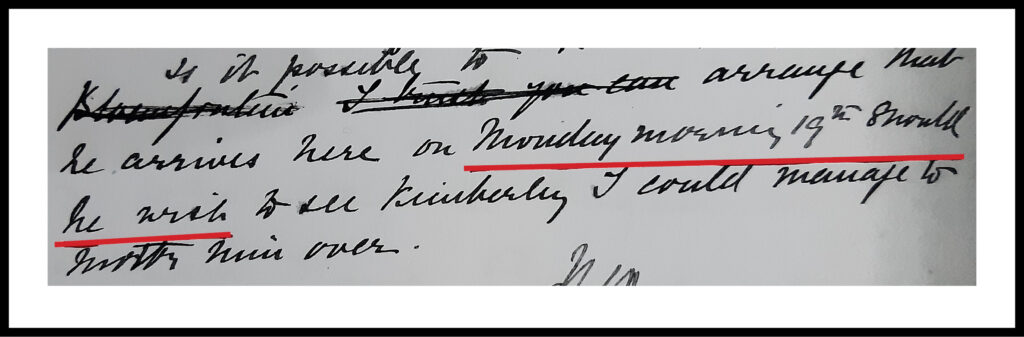
Understanding the context in which a record was created is a step in the right direction, but a scholar may also encounter other practical problems. During the early 1900s, a substantial amount of official correspondence produced by the colonial government in Bloemfontein was handwritten. Telegrams – almost exclusively handwritten – were a popular means of communication, especially when messages had to be conveyed speedily. The legibility of the handwriting in letters and telegrams was often compromised by an overtly cursive style of writing. This type of handwriting, developed in the 19th century, was charecterised by slender letters, graceful curves and inconsistent line thickness. Handwriting was meant to be aesthetically attractive! While this style of script may be pleasing to look at, it is notoriously difficult to read. Researchers often battle to figure out individual letters because of the illegible scribble. Is it an ‘m’ or a ‘w’? The handwriting of Bloemfontein’s colonial bureaucrats is no exception; deciphering it is an arduous challenge.
A more serious hurdle that can leave a researcher in the dark is the use of a code language in top secret and classified correspondence. The code language was typically resorted to when movements of very important persons, high profile politicians and military staff were discussed. For example, this was the case when the Portuguese Crown Prince, Dom Lúis Filipe, visited Bloemfontein in August 1907. Telegrams and letters written in the code language often contain meaningful words only in every second or third sentence, while the rest makes no sense at all! In the illustrated example, the Crown Prince’s travel arrangements between Bloemfontein and Kimberley are discussed. The only recognisable clues are the words ‘Heirship’ (meaning Crown Prince), ‘motor’, ‘motors’ and ‘Kimberley’. Often such coded communication must be seen in the context of other related correspondence to figure out where it fits in and what it is about.

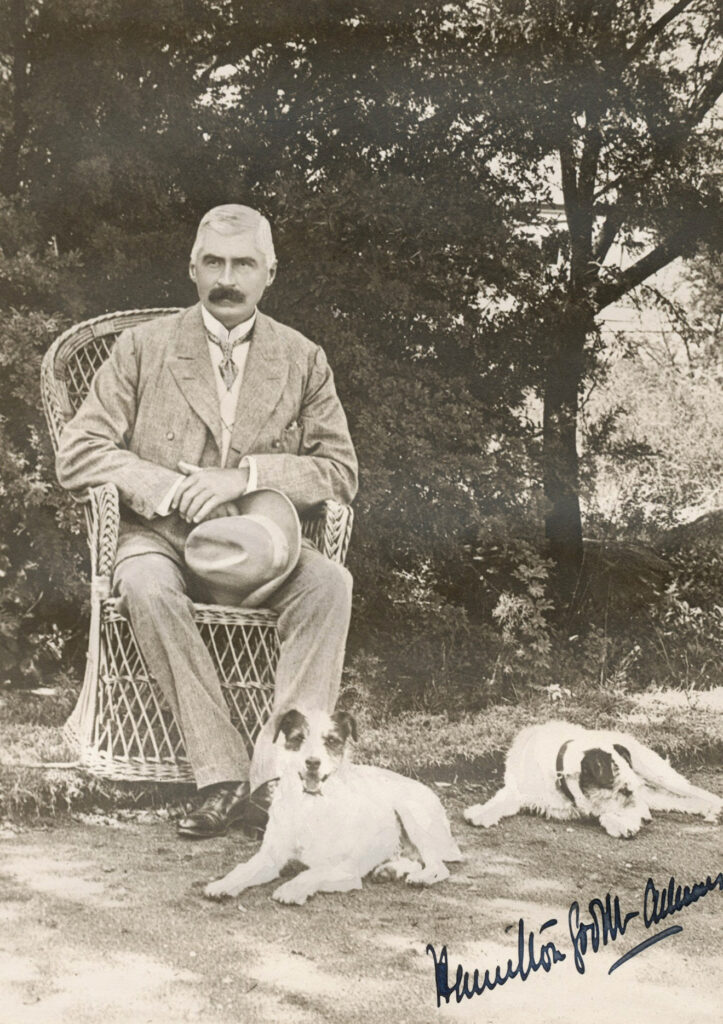
Since official correspondence was mostly handwritten and not typed, it was customary to use a wide range of abbreviations to save time. For a researcher not familiar with the colonial vocabulary, reading these letters and telegrams can feel like running a written obstacle course. For example, the abbreviation ‘Lieut.-Gov. O.R.C.’ – meaning Lieutenant-Governor of the Orange River Colony – referred to Sir Hamilton Goold-Adams (1858–1920), Governor of the ORC from 1901 to 1910. His signature appears on many letters and documents from the colonial period but without his title or military rank. It is up to the researcher to make a connection between signatures and titles or ranks.
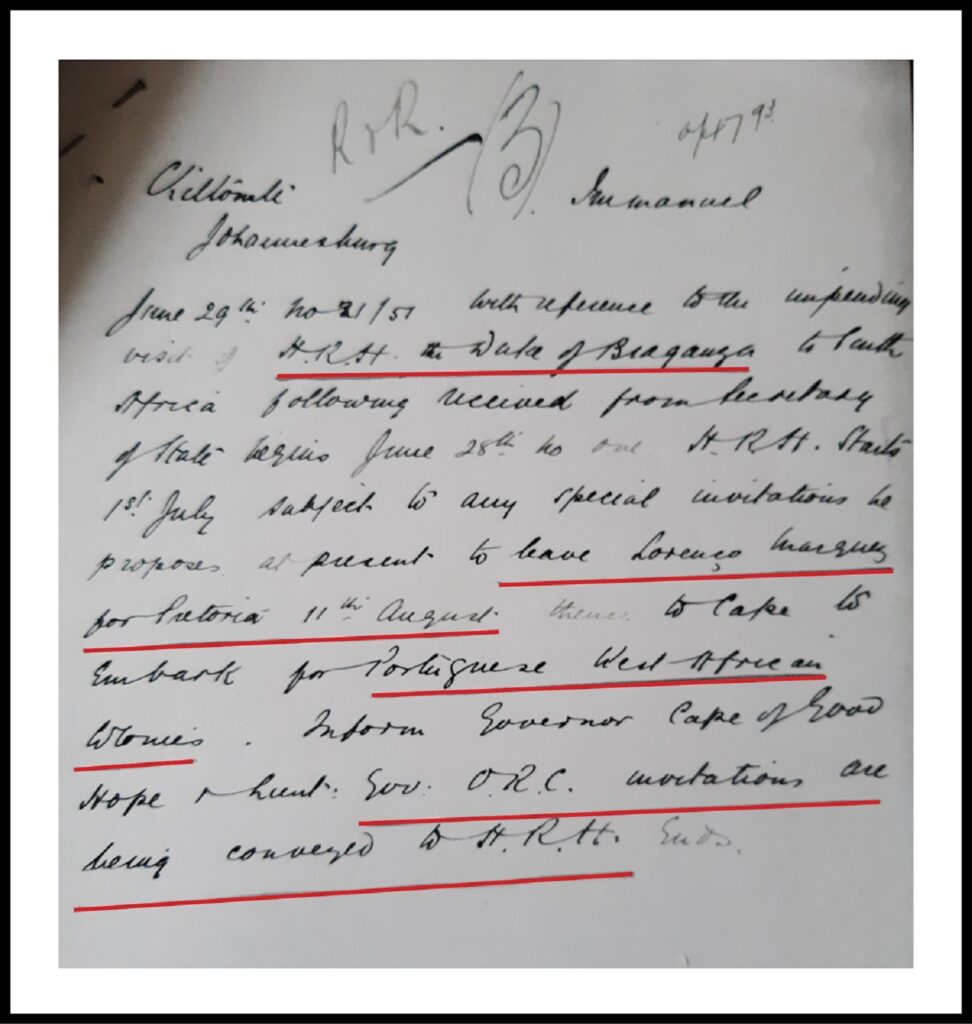
Another challenge is outdated geographical names that have fallen into disuse. The letter below is a time capsule from the colonial era. What is the post-colonial name of the Mozambican capital Lourenço Marques or, in short, L.M.? Answer: Maputo. Where is Portuguese West Africa? Answer: Angola. The colonial geography of the early 1900s is vastly dissimilar from the present southern African reality. Maps from the period are a useful resource but a researcher must be mindful of the huge differences between southern Africa’s pre-colonial, colonial and post-colonial geographical dispensations. For this reason, historian David Lowenthal famously said, “the past is a foreign country”.
Each period in Free State history poses its own hindrances for a scholar trying to make sense of the archival records. Not everything written in old paperwork should be trusted blindly or believed at face value. Governmental archives from the colonial period are mostly incomplete and one-sided; they represent the viewpoint of those who created them, namely British officials. In fact, all archives have some inherent bias; therefore, one must be constantly aware of potential prejudice embedded in the text. Consequently, it is advisable that all governmental records be used with caution. They must be subjected to internal critique and verified with other sources from the same period such as newspapers, books, diaries and even oral histories.
All-in-all, the challenges and potential pitfalls notwithstanding, archival research is a fascinating and rewarding endeavour. Historians ploughing through old documents may be compared to archaeologists excavating layers of dirt, with the only difference that they ‘dig’ through layers of paper deposited in files over time. Like archaeologists, historians never know what treasure (or shocker!) is buried between the pages.
Historical research may be conducted at the Free State Provincial Archives, Badenhorst Street, Universitas, Bloemfontein and at Adelaide Tambo Public Library (reference section), Wes-Burger Street, Bloemfontein.
Sources
Calitz, G.J. 1998. Introducing archives and the National Archives of South Africa. Pretoria: The National Archives of South Africa.
Harris, V. 2021. Ghosts of archive: deconstructive intersectionality and praxis. London: Routledge.
Kros, C., Wright, J., Buthelezi, M. & Ludlow, H. (Eds) 2022. Archives of times past: conversations about South Africa’s deep history. Johannesburg: Wits University Press.
Limb, P. 2002. Early ANC leaders and the British world: ambiguities and identities. Historia 47(1): 56–82. https://doi.org/10.17159/hasa.v47i1.1592
Lowenthal, D. 2015. The past is a foreign country revisited. Cambridge: Cambridge University Press.
Verwey, E.J. (Ed.) 1995. New dictionary of South African biography. (Vol. 1). Pretoria: HSRC Publishers.
Witz, L. 1988. Write your own history. Johannesburg: Ravan Press.



Comments are closed.