

Due to a rapidly changing natural environment, governments, conservation managers and scientists are increasingly challenged to understand and mitigate its impact on biodiversity. A pressing need is to understand how species distributions and abundance are changing, and what conservation interventions are needed to alleviate these changes.
Red Lists of biological species are widely-used resources to determine, or indicate, the status of biodiversity. They were first developed and published by the International Union for Conservation of Nature (IUCN) in 1964. Red Lists indicate the risk of extinction (conservation status) of species based on fixed sets of criteria. The main purpose of these lists is to highlight plants and animals facing a higher risk of extinction. Although Red Lists were developed to determine the extinction risks of species on a global level, a revised system has since appeared which can be used to assess the extinction risk of species on a smaller scale (i.e. in specific countries). These regional assessments, make it possible for organisations in specific regions to compile Red Listings for species occurring within their boundaries. A regional assessment provides a better picture of a species’ conservation status in a sub-area of its global range.
The accuracy of Red Lists is constantly changing for various reasons. New information on species ranges becomes available regularly, which may influence the initial listing. The conservation status of a species may change over time, usually where active conservation efforts are put in place to mitigate biodiversity loss. Ongoing research often sheds new light on the biology or ecology of a species, which in turn may impact its initial listing. New threats emerge constantly, which may impact the status of various species. For Red Lists to remain useful, it is therefore important that they are regularly updated.
Red Lists of various South African taxa have been published in recent years (e.g. Conservation Assessment of Butterflies of South Africa, Lesotho and Swaziland – Red List and Atlas, 2013; The Red List of South African Plants, 2014; Atlas and Red List of the Reptiles of South Africa, Lesotho and Swaziland, 2014). The last Red Data Book of the Mammals of South Africa was published in 2004 as the result of a partnership by the Conservation Breeding Specialist Group (CBSG) Southern Africa, the CBSG at the IUCN, and the Endangered Wildlife Trust (EWT). The publication assessed a total of 295 mammal species, including both terrestrial and marine species, of which 10 (3.4%) were classified as Critically Endangered, 18 (6.1%) as Endangered and 29 (9.8%) as Vulnerable.
The EWT, the South African Biodiversity Institute (SANBI) and MammalMAP are currently in the final stages of publishing updated versions of the Red Lists of South African mammals. The Department of Mammalogy at the National Museum contributed to this initiative on different levels, e.g. by providing distribution records for various species, and compiling and reviewing species accounts. Since this department houses the largest collection of preserved mammals from Free State Province, north-eastern parts of Eastern Cape Province and Lesotho (more than 80% of the ± 12 500 records in the collection originate from these areas), potentially large gaps in the distribution database of various species could be filled.
Apart from scientific institutions like museums, the general public has in recent times also emerged as a potentially important source of information for Red Listings. More people are now interested in recording species in their free time. Generally known as ‘citizen scientists’, these people make an invaluable contribution to Red Listings by posting their animal or plant sightings on an acknowledged online portal (e.g. The Virtual Museum developed by the Animal Demographic Unit, University of Cape Town and iSpot hosted by SANBI). By posting a good photograph, together with a locality description or GPS co-ordinates, citizen scientists provide data that can be used to supplement the distribution records from scientific institutions. As it becomes more costly and difficult for scientists to spent time in the field, large initiatives such as the Red Listings may have to rely increasingly on these contributions to obtain important baseline information.
References:
Endangered Wildlife Trust. 2015. Mammal Red Data List. www.ewt.org.za/Reddata/reddata.html. (31.8.2015).
Friedmann, Y. & Daly, B. 2004. Red data book of the mammals of South Africa: a conservation assessment. Johannesburg: CBSG Southern Africa, CBSG (SSC/IUCN) and Endangered Wildlife Trust.
International Union for Conservation of Nature and Natural Resources. 2015. The IUCN Red List of Threatened Species – Version 15.2. www.iucnredlist.org/ (31.8.2015)
Based on a range of criteria, species can be classified according to the IUCN Red List into one of nine groups:
Extinct (Ex) – No known individuals remaining
Extinct in the wild (EW) – Known only to survive in captivity, or as a naturalised population outside its historic range
Critically endangered (CR) – Extremely high risk of extinction in the wild (Threatened)
Endangered (EN) – High risk of extinction in the wild (Threatened)
Vulnerable (VU) – High risk of endangerment in the wild (Threatened)
Near threatened (NT) – Likely to become endangered in the near future
Least concern (LC) – Lowest risk (mostly widespread and abundant taxa)
Data deficient (DD) – Not enough data to make an assessment of its risk of extinction
Not evaluated (NE) – Has not yet been evaluated against the criteria
Adapted from https://en.wikipedia.org/wiki/IUCN_Red_List
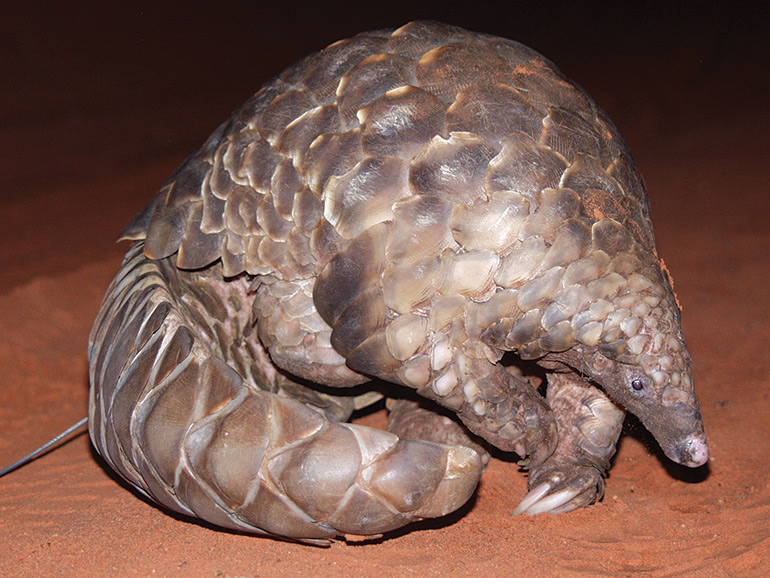
The Ground Pangolin (Smutsia temminckii) was classified as Vulnerable in the 2004 Red Data Book of Mammals of South Africa. Its range is currently restricted to a narrow band in the north and north-eastern parts of South Africa. Earlier data indicated that its range extended into the northern parts of the Free State Province, although it may now have been exterpated there. Their population numbers are mostly impacted by ongoing poaching and accidental killings from agricultural activities. (Photo: Darren Pietersen)

The White-tailed Rat (Mystromys albicaudatus) was classified as Endangered in the 2004 Red Data Book of Mammals of South Africa. It is endemic to South Africa and Lesotho and still occurs through this range. The species’ overall numbers are low due to its patchy distribution. It is the only threatened rodent that currently occurs within the Free State, and its numbers are impacted mainly by ongoing habitat degradation. (Photo: Cliff & Suretha Dorse)

The White Rhinoceros (Ceratotherium simum) was classified as Least Concern in the 2004 Red Data Book of Mammals of South Africa. Due to an increased rate of poaching it is, however, expected that this species will become Threatened in South Africa in the not too distant future (Photo: Johan du Plessis)




Comments are closed.