


The Department of Archaeology and Anthropology at the National Museum, Bloemfontein, participates in several projects focused on reconstructing the behaviour and biology of early humans, from the inception of the archaeological record in the Early Pleistocene up to the ethnographic present of southern Africa. Much of our research focuses on fieldwork, and aims to explore past environments and cultures through the study of collections of material remains – often the debris of human activity – recovered through excavations of archaeological sites.
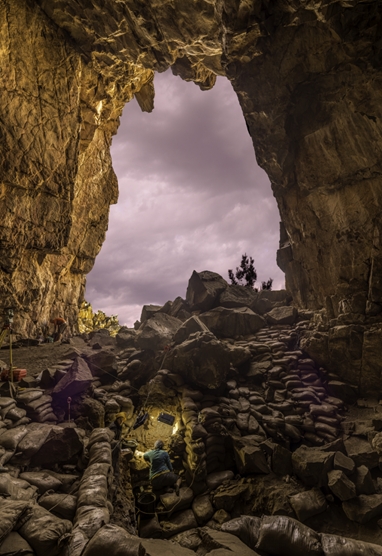
The accuracy and reliability with which we are able to reconstruct the past, however, are influenced more than you may think by methodological approaches to archaeological excavation: in other words, the ways in which scientists recover the collections of artefacts and fossils that you may see on displays in museums today. Although many key South African sites and fossils of ancient hominins were discovered in the first part of the 20th century, approaches to archaeology and archaeological excavation have changed substantially since then. Today excavations require permits that are issued by a relevant government authority, only after careful review of an application outlining the research questions of an expedition, explanation of what will be excavated, and how. Archaeological excavations, however, were not always under such regulation, or subjected to the degree of collegial scrutiny that they are today.
Montagu Cave (hereafter ‘the site’) is a well-known archaeological site located on the edge of the Klein Karoo, in the foothills of the Langeberg Mountain range, about 130km north east of Cape Town, and has a history of research that well reflects evolving approaches to archaeological excavation in South Africa over the last century (Figure 1).
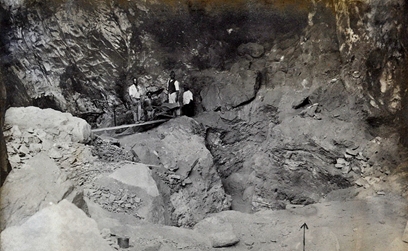
The site was first excavated in 1919 by Houghten and Barnard who were associated with what was then known as the Cape Town Museum (Goodwin and Van Riet Lowe 1929), and again in 1963-64 by Cedric Poggenpoel and Charles M. Keller from the University of Cape Town and Berkley, USA, respectively (Keller 1973). Houghten and Barnard’s excavation in 1919 took place over a period of a few weeks only, wherein >75% of the archaeological deposits – several tens of cubic meters of sediment – were removed from the shelter with pick-axes and shovels (Goodwin 1929) (Figure 2). Houghten and Barnard excavated within standards accepted at the time. Yet it is challenging today to imagine how so much deposit could be excavated (by modern standards) even in the course of several lifetimes. Hundreds of thousands of artefacts were collected in the 1919 excavations of Montagu Cave, however, the destructive methods of recovery and the limited documentation resulted in these older collections being difficult to correlate with later excavation efforts at the site.
In 1963, Keller – under the guidance of his PhD supervisor, the well-known Africanist Archaeologist Prof. J. Desmond Clark – was interested in digging an Early Stone Age site in primary context, in other words, an old site where the spatial and temporal layouts of the artefacts left behind by ancient humans are well preserved and somewhat resemble their everyday activities.
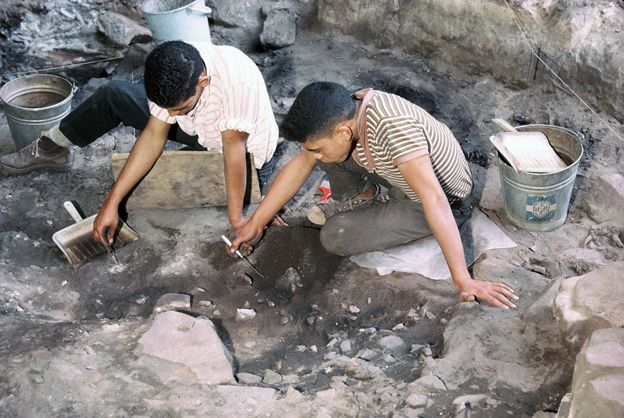
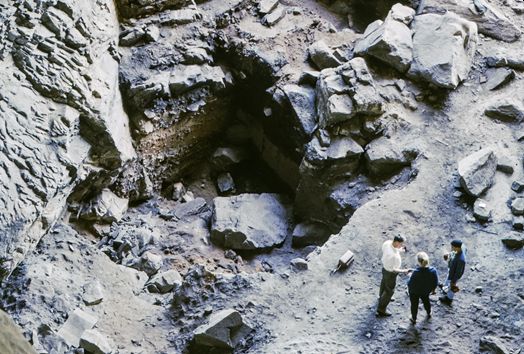
Inspired by his directly preceding field experiences at the site of Kalambo Falls (in Zambia), Keller’s focus at Montagu Cave was on documenting hominin ‘living surfaces’ represented, in theory, by lateral spatial distributions of stone artefacts left behind by hominins while they were going about their daily activities. In partnership with Poggenpoel, Keller initiated re-excavation of Montagu Cave with this purpose in mind. In contrast to Houghten and Barnard, Keller and Poggenpoel dug slowly and meticulously, and recorded the precise positions of many artefacts lying on what were believed then to be intact, discrete living surfaces of the site (Figures 3 and 4).
More recent research on archaeological deposits has shown that few sites of substantial antiquity actually preserve the layouts of hominin living waste that Keller was after. Rather, the majority of archaeological sites represent averages of many individual events – the making of a stone tool, the butchering of an animal carcass, the burning of a hearth – that may be separated from one another by substantial periods of time (perhaps hundreds or even thousands of years). Combined, these time- separated sets of events, or ‘palimpsests’, form the dense archaeological record we excavate in our field projects today.
Tools and statistical methods are available today that allow us to get much information from such aggregated evidence of past human activity. Digital excavation recording methods are now widely used, and are facilitated through the availability of a piece of equipment called a total station. You may sometimes see these box-shaped machines on tall tripods at construction sites. Such options were not available to Poggenpoel and Keller in the 1960s, yet they excavated Montagu Cave with meticulous attention to stratigraphic detail. Poggenpoel and Keller manually piece-plotted – mapped to the millimetre in X, Y and Z – several thousand artefacts that were carefully exposed with dental picks and brushes, over metres and metres of laterally exposed sediment.

The attention to detail evident in the excavations of Keller and Poggenpoel resulted in the possibility of tying in some of their work with modern digital recording databases. For instance, when my team visited Montagu Cave for the first time in 2014 we were able to digitize many of Keller’s manually plotted data, and were able to contextualize this information within georeferenced 3D models of the cave as it looks today, 50 years after these data were collected (Figure 6).
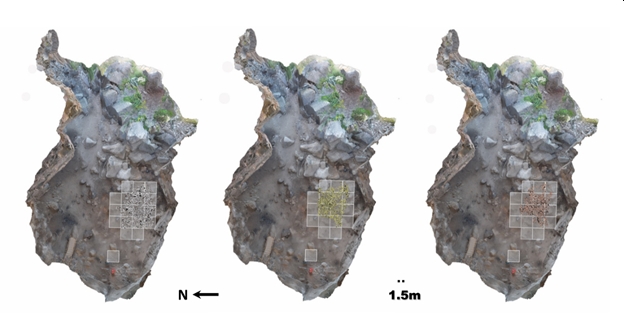
Today we approach archaeological excavations with equipment and digital recording methodologies that were not available to archaeologists in 1919 or in 1963. In Stone Age sites, we generally record all cultural remains larger than 2.5cm in three-dimensions (X, Y and Z) with sub-millimetre accuracy using a total station (Figures 7 and 8), and give all plotted archaeological finds unique identification numbers that are associated with their spatial and stratigraphic information, as well as other relational data. This level of detail allows us to reconstruct many aspects of the story of how these material remains of human activity ended up in the site.
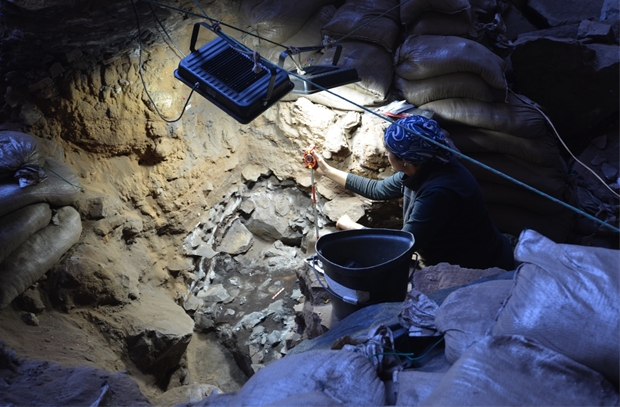
To explore the context of excavated assemblages and to assess the effects on them of altering processes – e.g. water flow, animal burrowing – we record all objects with recognizable elongation axes (long objects) with two points, in order to obtain so-called ‘dip and orientation’ spatial data for each excavated layer. This spatial information feeds back on geological observations of the sediment encompassing artefacts and fossils, which together tell the story of the depositional history of an excavated assemblage.
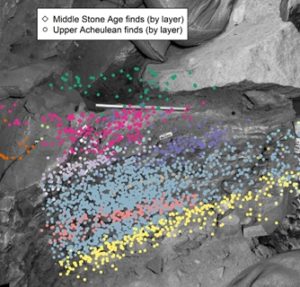
Much of the information we record during excavations today is useful for reconstructing occupational and depositional histories of sites (Figure 8). Some information, however, may be less obviously relevant to current analyses, yet may be useful to future generations of archaeologists who may come back to sites with new objectives, technologies and recording systems that are not available to field archaeologists today.
References
Goodwin, A. J. H. (1929). The Montagu Cave: A full report of the investigation of the Montagu rock shelter, South African Museum.
Goodwin, A. J. H. and C. V. R. Lowe (1929). The stone age cultures of South Africa, AMS Press.
Keller, C. M. (1973). Montagu Cave in prehistory: a descriptive analysis. University of California Publications. Anthropological Records 28: 1-98.




Comments are closed.