


During August 2020 I underwent bird ringing training at the Oliewenhuis gardens. I was trained in all aspects of bird ringing such as setting up nets and traps, removing trapped birds from nets without injuring the bird, taking measurements and recording data, and putting a ring on a bird. Museum ornithologist Dawie de Swardt conducted the training.
Administration of bird ringing in South Africa
SAFRING (South African Bird Ringing Unit) administers bird ringing in South Africa and ringing is done by registered bird ringers. A metallic ring (plastic tags and colourings can be used for individual recognition) is attached to the leg of a bird. Ringing provides information for species identification, distribution, breeding, and survival rates. The information is also used for life cycle and migration studies.
Capturing the birds for ringing
Before a bird can be ringed, it must be captured. This can be achieved by several methods dedicated to the purpose. Mist netting is one of the most common. The net traps the bird in flight and the bird drops into the pocket created by the shelf-strings of the net. Spring-traps are also used for trapping. A meal worm is used as bait on the trap and once the bird is in proximity, the lever snaps and the bird is trapped inside. After being captured, it is weighed on a digital scale and the weight recorded. A ring is loosely fitted around the tarsus (to avoid hurting the bird) and the bird is measured. Measurements recorded include that of the bill (culmen), tarsus, tail, total head and wing lengths.
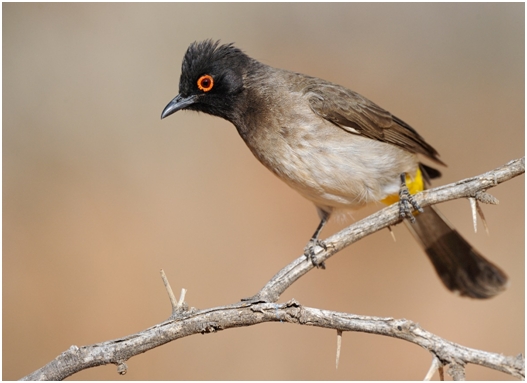
Image: African Red-eyed Bulbul. Photo: Albert Froneman
Once all this information is gathered, the bird ringing data are then submitted to SAFRING for collation. SAFRING also handles the registration of ringers, supply of rings, ringing equipment and other services to volunteer and professional ringers. A trainee ringer must receive training from a registered ringer and the trainee must handle at least 500 birds of different species. Thereafter, the trainee will be recommended for a SAFRING ringer’s number and will be required to apply for ringing permits from the Provincial Nature Conservation authorities. The new ringer can then ring birds independently and is allowed to order ringers and other equipment from SAFRING.
We captured a total of 17 birds over a two-day period at the Oliewenhuis; 15 birds were ringed and 2 recaptures were recorded:
- The most frequently occurring bird was the Orange River White-eye, Zosterops pallidus. Six of these birds were captured and ringed. They are characterised by peach-coloured plumage flanking the wings and a prominent yellow supra-loral stripe. This endemic bird is a common resident and local nomad in riparian woodland, thickets in the Karoo and semi-arid savanna.
- Four African Red-eyed Bulbul, Pycnonotus nigricans, were ringed. Distinguishing this bird is the red ring around the eyes and the black head. They are near-endemic and are residents in arid savanna, riverine bush and common in gardens.
- One Chestnut-Vented Warbler, also commonly known as the Tit Babbler (Sylvia subcaeruleum), was ringed. Interestingly this bird was ringed on two previous occasions. The adults of this species are characterised by a bold and extensive streaking of the throat and a chestnut vent. These features are absent in juveniles. They are common residents in thornveld and coastal thickets and are confined to dry watercourses in arid shrubland.
- Two Southern Fiscal, Lanius collaris, were captured in spring traps. These birds are common residents in most open habitats such as parks and gardens. They often hunt from roadside fences and telephone wires.
- One Acacia Pied Barbet, Tricholaema leucomelas, was ringed. This bird has a yellow-spotted black back, with a distinctive red-and-yellow forehead and black-and-white striped head. It is a common resident in woodland and savanna, especially acacia woodland.
- One Black-Chested Prinia, Prinia flavicans, was ringed. Characterised by a broad black band across its chest, this bird is a common resident in arid savanna, thornveld, scrub, orchards, plantations and gardens.
When a bird (dead or injured) has been found it is advised that the finder contacts SAFRING, which is based at the University of Cape Town. SAFRING administrators can be reached by telephone at 021 650 2421 (Kim Hunt) / 021 650 3305 (Janine Dunlop). A ringed bird can also be reported at the SAFRING website (safring.adu.org.za). The public can also contact the National Museum in Bloemfontein at 051 4479 609.
Further reading
De Swardt, D. H. 2020. Birds of the Oliewenhuis koppies. Available at: https://nationalmuseumpublications.co.za/birds-of-the-oliewenhuis-koppies/. (Accessed: 12 October 2020)
de Beer S. , Lockwood G. M., Raijmakers J. H. F., Raijmakers J. M. H., Scott W.A., Oschadleus H. D. & Underhill L. G. (eds). 2000. SAFRING Bird Ringing Manual. ADU Guide 5: 1-102.
Sinclair, I., Hockey, P., Tarboton, W., Perrins, D., & Ryan , P. (2020). Sasol Birds of Southern Africa. Cape Town: Struik Nature.



Comments are closed.