


Over the past five years, artworks from the ArtBankSA collection were featured on the cover of the National Museum’s Annual Reports. Each selection was deliberate and conceptually aligned with the Museum’s priorities for the year. The chosen works were not included solely for their aesthetic appeal, but for their ability to communicate key institutional messages in a compelling and accessible way.
As a public document tabled in Parliament and widely circulated among stakeholders, the Annual Report reaches a broad and diverse audience. In this context, visual art serves as a powerful medium of communication. It possesses a universal language capable of conveying complex ideas with immediacy and emotional resonance, often transcending the limitations of text and cutting through the rigidity of formal reporting. By using these carefully curated ArtBankSA pieces, the Museum has harnessed visual expression as a strategic tool to engage, inform and inspire its audiences, reinforcing its role as both a cultural custodian and a responsible public institution.
Museum spaces that work
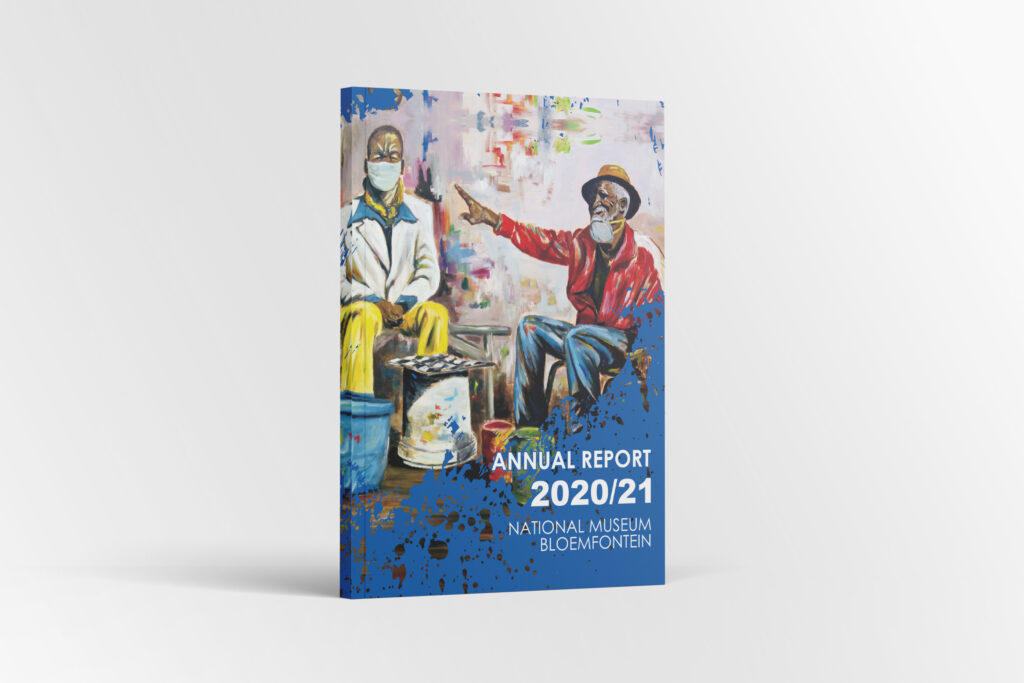
It was no coincidence that the first artwork from the ArtBankSA collection to feature on the cover of the Annual Report for the 2020/21 financial year was Vuyisile Adoon’s Social distancing. The chosen theme for the report, “Museum Spaces That Work,” resonated deeply with the realities of that year.
The year 2020 began with the stark realisation that the world was facing the COVID-19 pandemic and an unprecedented global lockdown. Like many institutions, the museum was forced to close its doors and transition to virtual operations. Researchers worked remotely, while the museum’s collections were presented as online exhibitions and shared widely on social media platforms.
In response to the severe financial strain experienced by artists during lockdown, ArtBankSA opened an additional funding window to acquire more works from local artists. At the same time, the South African government introduced the Presidential Employment Stimulus Programme in October 2020 to mitigate the devastating impact of the pandemic on employment. The programme aimed to create jobs and support livelihoods across various sectors. ArtBankSA participated in the implementation of this initiative in the visual arts sector, providing much-needed financial relief to artists during that challenging period. Many of the artworks acquired during that time addressed the social and emotional impact of COVID-19.
In Social distancing, Adoon offers a nuanced commentary on the pandemic within a rural or informal housing context. The painting depicts two men socialising and playing checkers in a typical township or rural setting. While the scene reflects the familiarity and warmth of everyday life, it is marked by the visible practices of social distancing and mask-wearing—subtle reminders of the global health crisis. In contrast to the overwhelming imagery of illness and death that dominated media coverage, Adoon’s work captures resilience, companionship and the quiet persistence of normality amid uncertainty.
Revisit and reimagine your museum
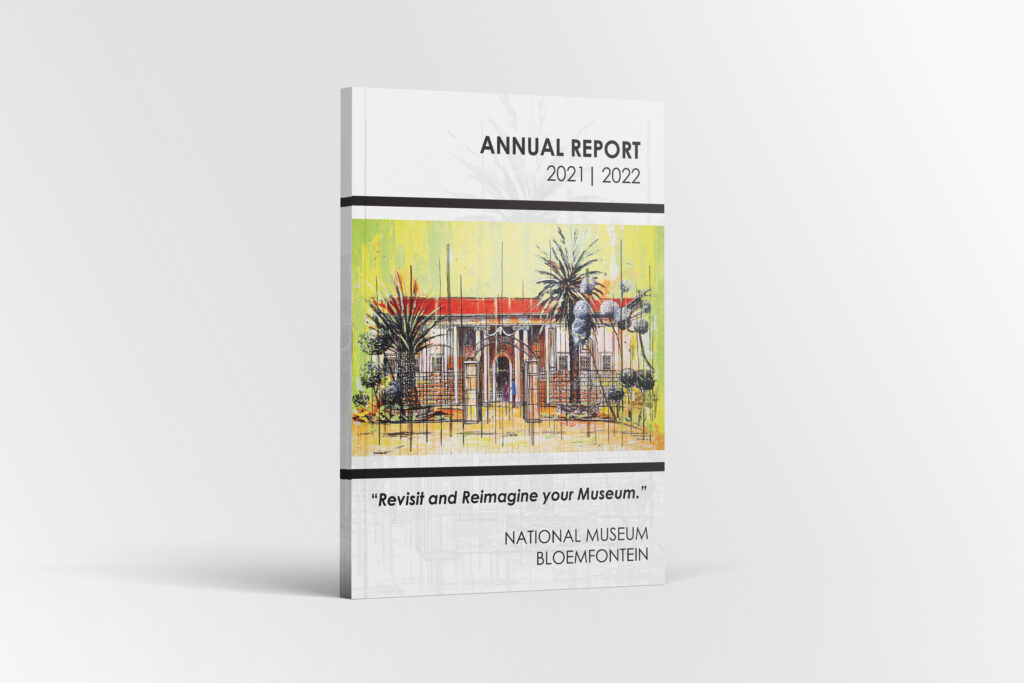
The cover of the 2021/22 Annual Report features an image of the National Museum created by Taiwo Ohu. The report’s theme, “Revisit and Reimagine Your Museum,” reflects ongoing global conversations about the evolving role of museums in society.
In recent years, museums have faced significant challenges. The COVID-19 pandemic and a persistent funding crisis placed considerable pressure on the sector, urging institutions to adapt rapidly to remain sustainable and relevant. Those circumstances prompted renewed reflection on what museum spaces should represent and how they could become more accessible, inclusive and responsive to their communities.
While the physical building remains central to the museum’s identity, the National Museum expanded its reach beyond its walls through initiatives designed to bring the museum experience directly into communities. During the reporting period, the resurgence of the Black Lives Matter movement further challenged the heritage sector to examine whether aspects of their historical collections and institutional practices contributed to systemic racism and exclusion.
Ohu’s depiction of the museum’s main building powerfully aligns with the Annual Report’s theme. It not only invites audiences to reimagine the museum space but also reinforces our strategic commitment to encouraging visitors to reconnect with museums as pandemic restrictions eased.
The power of museums
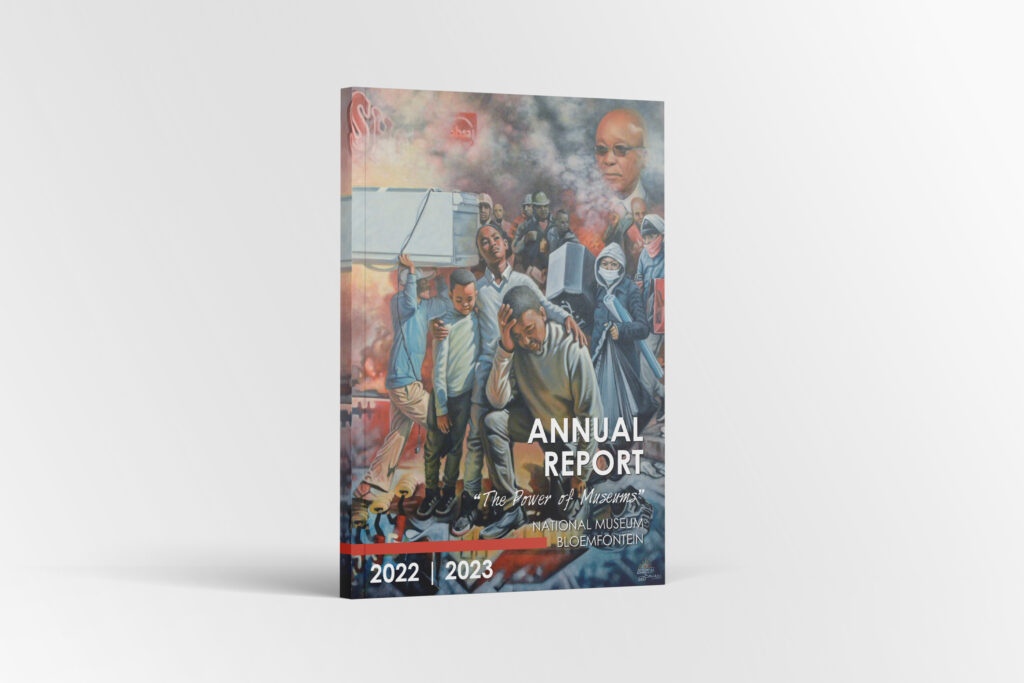
The cover of the 2022/23 Annual Report features Shattered dreams after unrest, a powerful work by Richard Bollers. The piece offers poignant political commentary on the devastating riots of 2021 in the provinces of KwaZulu-Natal and Gauteng. Commonly referred to as the Zuma riots, this period of civil unrest was triggered by the incarceration of the former South African president Jacob Zuma. Widespread job losses, deepening unemployment, persistent economic inequality and growing dissatisfaction with government pandemic policies further fuelled the upheaval.
Bollers captures the complexity of that turbulent period through a richly layered composition. In the foreground, two youths and an older man—who are not participating in the riots—cling to one another for support. The older man kneels, reflecting sorrowfully on the devastation surrounding him. Behind them, hooded and masked figures carry off looted goods, their concealed faces suggesting both anonymity and the lingering presence of the COVID-19 pandemic as a contributing force in this unfolding crisis.
Deeper within the image stand figures who are not looting but adopt a militaristic toyi- toying posture, evoking the political movement that rallied in support of Zuma. Dominating the final layer of the composition is Zuma’s face, looming large amid swirling grey smoke and flames. To his left appear the logos of Shoprite and Absa Group, underscoring the profound economic toll the unrest inflicted on corporate South Africa.
By then, the National Museum had been operating for more than two years under varying levels of lockdown restrictions. In June 2022, all restrictions were finally lifted in South Africa. The lockdown period, while challenging, provided the heritage sector with an opportunity for reflection on the transformative power of museums, their role in advancing sustainability and climate justice, and on the need to innovate in digitisation, accessibility and community-building through education.
Shaping and creating sustainable futures
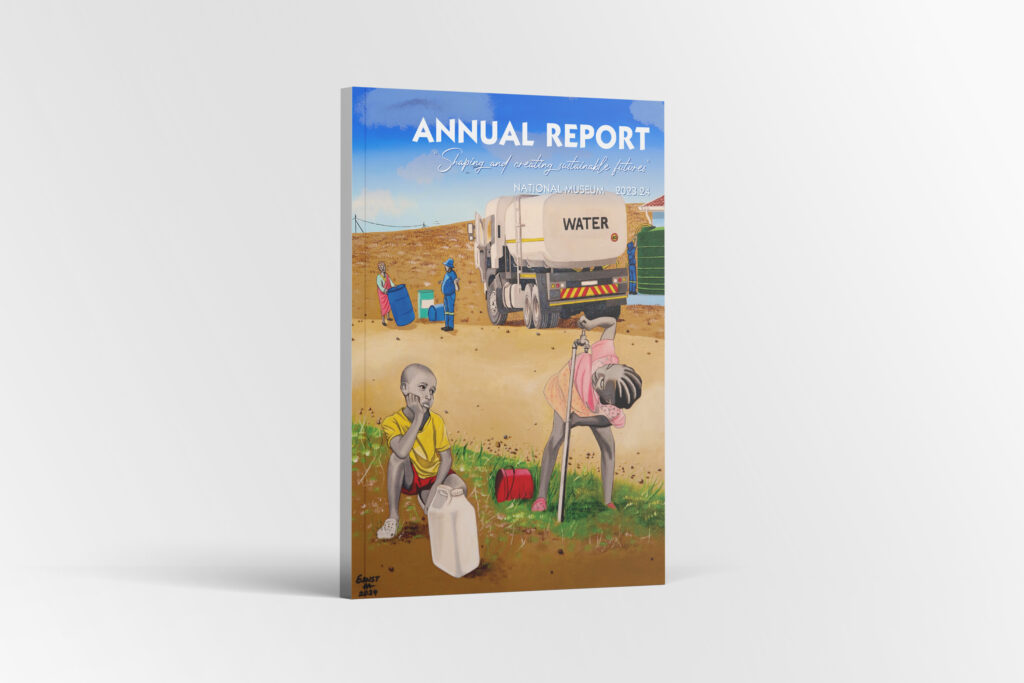
The Museum chose “Shaping and Creating Sustainable Futures” as the theme for its 2023/24 Annual Report. This theme reflects the institution’s commitment to building resilient and sustainable communities through research, educational programmes, exhibitions and community outreach initiatives. The International Council of Museums has identified museums as key contributors to sustainable development, uniquely positioned to advance the United Nations Sustainable Development Goals, including those related to climate action and environmental stewardship.[1]
Ernest Khomo’s artwork Water crisis echoed this theme and was picked as the cover image for the Annual Report. The piece powerfully pictures the harsh realities faced by rural communities dealing with water shortage. In the foreground, two children stand at the centre: a young girl bends over a dry communal tap, straining to get out even a single drop of water, while a little boy beside her looks on in quiet despair. Two empty water containers lie in the overgrown grass, just reinforcing the sense of neglect and scarcity.
Further into the composition, a large water truck dominates the scene. Its driver gestures to a woman standing nearby that the truck has no water left to refill her buckets. Behind the truck, however, a man has connected a hose and is filling a large water tank next to his house. His relative wealth is somewhat suggested, and his access to a large volume of water contrasts with the unmet needs of the others. The portrayal of this man enjoying seemingly unrestricted access to large amounts of water may also serve as a pointed social commentary on corruption, suggesting how power, privilege and influence can secure essential resources for a few, leaving the broader community to endure deprivation. Through this striking juxtaposition, Khomo reflects on deep inequalities that emerge during times of crisis, where those with a greater access to resources can secure and store essential supplies, while the most vulnerable are left waiting, their needs overlooked and inadequately planned for.
Museums for education and research
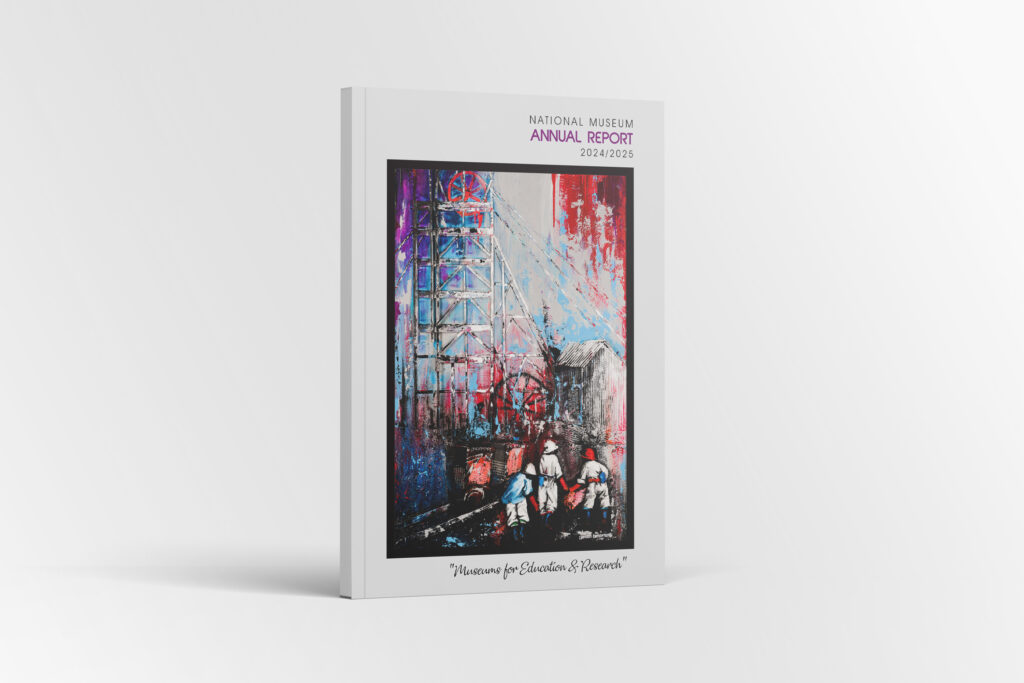
The artwork selected for the 2024/25 Annual Report cover is a piece titled Underground and completed by Lazarus Ramontseng in 2017. It powerfully resonates with issues dominating headlines and public space in 2024 and early 2025. Underground speaks directly to the social and political tensions surrounding Vala Umgodi (meaning “close the hole” in isiZulu), a South African government operation[2] aimed at curbing illegal mining by so-called zama zamas, a term for informal or illegal miners.
The operation resulted in thousands of miners—many of them undocumented foreign nationals—being stuck underground, triggering a humanitarian crisis. These illegal miners are widely believed to be exploited by criminal syndicates who compel them to work in dangerous, unregulated conditions at great depths that may exceed 2000 metres. Yet exploitation in the mining sector is not limited to criminal networks; the history of mining in South Africa has long been marked by the systemic abuse of vulnerable workers by corporate interests as well. The plight of mine workers remains a recurring theme in the country’s social and political discourse.
Public commentary around Vala Umgodi closely focused on the humanitarian crisis that unfolded as trapped miners were left in life-threatening conditions with no adequate access to food and water. Following several court challenges, the South African government was ordered to provide them with basic necessities. When many of the miners eventually resurfaced, over 1800 were arrested[3], further complicating the debate around legality, human rights and state responsibility.
Ramontseng’s Underground visually captures these layered tensions. The artwork portrays miners clad in protective gear, transporting raw materials from below the earth. Dominating the composition are towering steel structures and power lines that appear to channel electricity toward businesses and homes beyond the frame. In stark contrast, a makeshift shack—presumably belonging to the miners—stands just before the power lines disappear from view. Notably, the shack is not connected to the grid. This visual disjunction serves as a powerful metaphor: the workers labour hard to produce energy and wealth, yet remain excluded from its benefits. The fruits of their labour—symbolised by the transmitted electricity—flow outward to serve more well-off communities, while the miners themselves remain entrenched in poverty, disconnected from the very resources they help to generate.
[1] Legget, J. & Labrador, A.M.T.P. 2023. Museum sustainabilities. Museum International 75(1–4), vi–xi. https://doi.org/10.1080/13500775.2023.2348874
[2] SAnews.gov.za. 2025. Operation Vala Umgodi nets 18 000 in major crime crackdown. South African Government News Agency, 2 February 2025. https://www.sanews.gov.za/south-africa/operation-vala-umgodi-nets-18-000-major-crime-crackdown
[3] Parliamentary Monitoring Group. 2025. Illegal mining (SAPS briefing), Derelict and ownerless mines (DMRE briefing); with ministries. 18 March 2025. https://pmg.org.za/page/Illegal%20mining%20(SAPS%20briefing),%20Derelict%20and%20ownerless%20mines%20(DMRE%20briefing);%20with%20ministries



Comments are closed.