In April 2022, I led the first biological expedition focusing on dung beetles at Mount Mabu in the Zambézia Province of Mozambique. The expedition team was composed of Dr Werner Strümpher (Ditsong Museum of Natural History), Mr Isildo Nganhane (Universidade Lúrio, Mozambique) and I (PI of the project – Fig. 1). Werner and I flew from South Africa to Nampula (northern Mozambique), and Isildo took a bus from Maputo to Nampula. We hired a company that drove us from Nampula to the village of Tacuane (Zambézia Province, Mozambique). There is no road from Tacuane to Mount Mabu, thus, we hired local porters to carry our camping/kitchen gear and fieldwork equipment (Fig. 2). We took eight hours of hiking from Tacuane to the camping site inside of Mabu Forest.
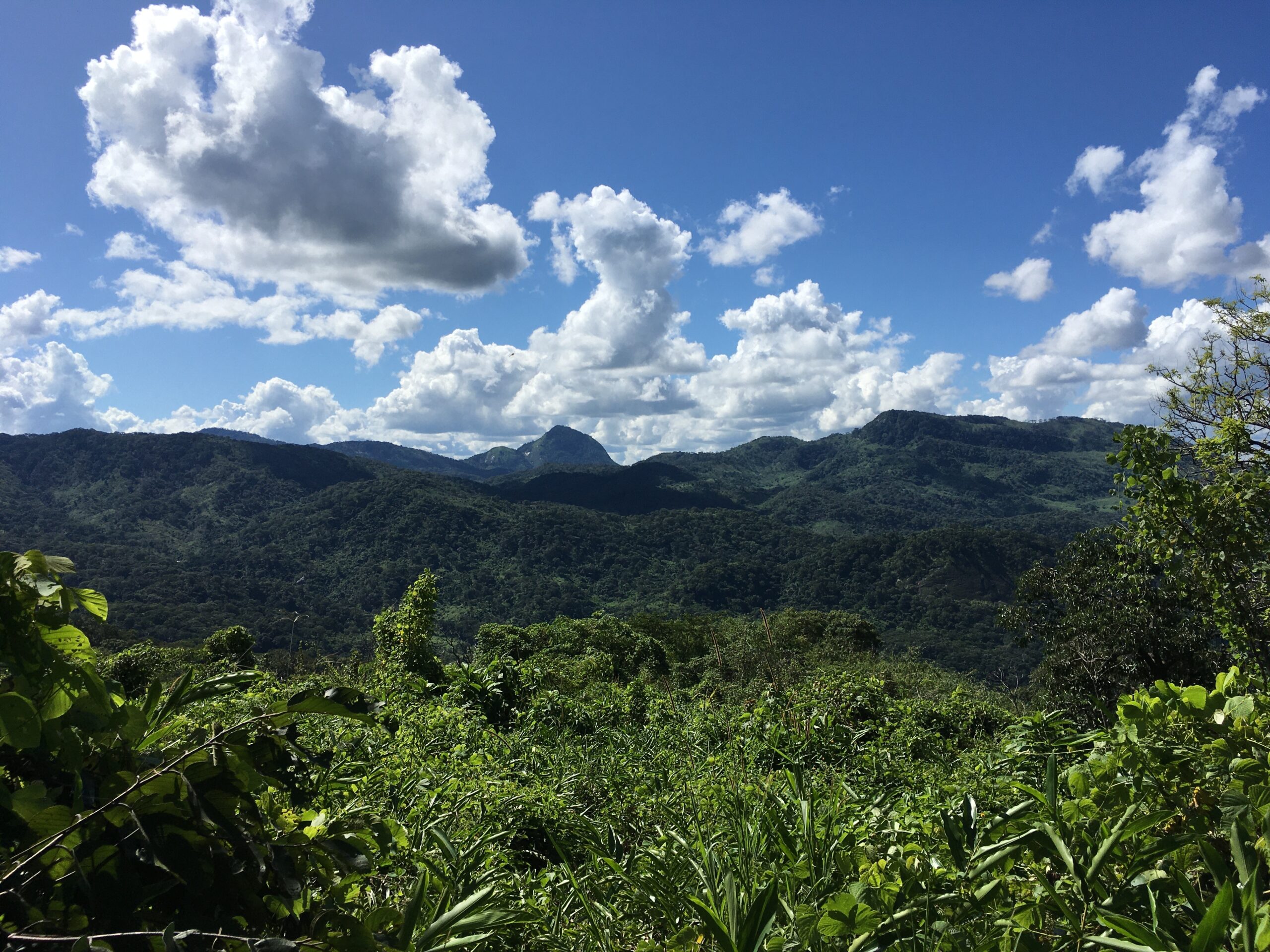
Mabu Forest is located in Zambézia Province, central Mozambique, comprising a chain of two mountains: Mount Namurothone in the foothills and Mount Mabu in the uphills. Mabu Forest includes c. 7,880 ha block of undisturbed rainforest, mostly at medium altitude (900–1,400 m), a forest type that is not well represented elsewhere (Figs. 3–4). It is the largest continuous block of medium-altitude forest in southern Africa; with patches at higher altitudes reaching approximately 1700 m a.s.l. The foothills are clothed in dense transitional woodland, bamboo and riparian forest to at least 300 m a.s.l (Daniel et al., 2023; Bayliss et al., 2014).
Mabu Forest was originally inhabitanted by hunters of the Manhawa Bantu ethnic group. Mabu means “beekeeping” in the native eManhawa language, which alludes to a community of beekeepers. However, nowadays, Mabu Forest is sometimes referred to as the Google Forest as it was “discovered” by western explorers through Google Earth or the Butterfly Forest because of the butterfly hill-topping on the summit at a certain period of the year.
Why dung beetles? Firstly, dung beetles are the prettiest creature in nature. Also, these beetles are mainly coprophagous, conducting a series of ecological processes and environmental services, such as secondary seed dispersal, control of other insects or parasite suppression, dung and nutrient recycling in ecosystems and subsequent increasing of soil fertility (Scholtz et al. 2009; Nichols et al., 2008) – which is important to other creatures, including humans, making them an important topic for investigation. However, these ecosystem processes can only be studied and understood when the constituent species are known. Secondly, surveys of dung beetles are frequently used to determine faunal patterns and are bioindicators of environmental quality in an area, owing to the relative cheap and easy way of obtaining quantitative data using baited pitfall traps and their sensitivity to differences in macroclimate, soil type, vegetation cover and microhabitat parameters (Davis et al., 2004; Nichols et al. 2007).
Why Mozambique and Mabu Forest? Only 326 species of dung beetles have been recorded in Mozambique (Daniel et al., 2023; Daniel & Génier 2019). However, the number of species reflects at the most half of the country’s diversity because many dung beetle surveys focus on southern Mozambique and Gorongosa National Park. In contrast, other areas of the country are poorly known. On the other hand, the increasing development, including land-use drivers, fragmentation, global climate change, direct overexploitation, and co-extinction of species dependent on other species are threats to biodiversity, as well as insect declining globally (Hallmann et al., 2017; Cardoso et al. 2020). Thus, it is critical that biodiversity surveys are expanded to remote and unsampled areas, especially “sky-island forests”, like Mount Mabu.
My curiosity about dung beetle exploration at Mount Mabu began in 2012, as an MSc student at the Federal University of Grande Dourados, Brazil, when I read about previous expeditions on plants, mammals, reptiles and butterflies, where at least 20 new species on these taxa were discovered. Based on the information of the previous expeditions and biogeographical isolation of the region, I was expecting many new dung beetle species to be discovered. As rightly predicted, within 15 days of a biological exploration, we collected over 4000 specimens of dung beetles from 30 species, of which half are new to science, and several are new country records (Figs. 5–6). Other novelties will likely increase in number with more detailed examination of material by fellow specialists. Most importantly, many dung beetle species collected on the expedition seem to be restricted (endemic) to this sky-island forest. For those species widely distributed are at the southern limit of their range – with these exciting findings, I can assure you that I am filling a blank page in the history of Mozambican biodiversity. Also, it is a call to national and international authorities to protect Mount Mabu and its rare and distinctive biodiversity.
Identifying these species is just the first step. My ultimate goal is to understand how these species are collectively inserted into a historical context of the evolution of African dung beetles, including its relationships in time and space with insect fauna from other sky-island forests in northern Mozambique, such as Mount Namuli, Mount Chiperone, Mount Rico and Mount Ribaué.
References
Bayliss, J., Timberlake, J., Branch, W., Bruessow, C., Collins, S., Congdon, C., … & Smith, P. (2014). The discovery, biodiversity and conservation of Mabu forest—the largest medium-altitude rainforest in southern Africa. Oryx, 48(2), 177-185.
Cardoso, P., Barton, P. S., Birkhofer, K., Chichorro, F., Deacon, C., Fartmann, T., … & Samways, M. J. (2020). Scientists’ warning to humanity on insect extinctions. Biological conservation, 242, 108426.
Daniel, G.M., Strumpher, WP., & Josso, J-F. in press. Dung beetle fauna from Mount Mabu, Mozambique. Part 1: A new species of Onthophagus Latreille, 1802, and a checklist of species belonging to group 3 (d’Orbigny 1913) (Coleoptera: Scarabaeidae: Scarabaeinae). Zootaxa. https://doi.org/10.11646/zootaxa.0000.0.0
Davis, A. L., Scholtz, C. H., Dooley, P. W., Bham, N., & Kryger, U. (2004). Scarabaeine dung beetles as indicators of biodiversity, habitat transformation and pest control chemicals in agro-ecosystems. South African Journal of Science, 100(9), 415-424.
Hallmann, C. A., Sorg, M., Jongejans, E., Siepel, H., Hofland, N., Schwan, H., … & De Kroon, H. (2017). More than 75 percent decline over 27 years in total flying insect biomass in protected areas. PloS one, 12(10), e0185809.
Nichols, E., Larsen, T., Spector, S., Davis, A. L., Escobar, F., Favila, M., … & Network, T. S. R. (2007). Global dung beetle response to tropical forest modification and fragmentation: a quantitative literature review and meta-analysis. Biological conservation, 137(1), 1-19.
Nichols, E., Spector, S., Louzada, J., Larsen, T., Amezquita, S., Favila, M. E., & Network, T. S. R. (2008). Ecological functions and ecosystem services provided by Scarabaeinae dung beetles. Biological conservation, 141(6), 1461-1474.
Scholtz, C. H., Davis, A. L. V., & Kryger, U. (2009). Evolutionary biology and conservation of dung beetles. Sofia-Moscow: Pensoft, 569 pp.
Caption of Figures
 Fig. 1. Dr Gimo Daniel – Museum Scientist and National Geographical Society Explorer conducting dung beetle survey at Mount Mabu.
 Fig. 2: Local community supporting our dung beetle expedition.

 Figs 3–4: A Landscape view of Mabu Forest, Zambézia, Mozambique.

Fig. 5. A new flightless Jansenssantus dung beetle species collected at Mount Mabu.
 Fig. 6. A new Onthophagus dung beetle species collected at Mount Mabu.