


Almost all terrestrial animals have some type of claw. Vertebrates like mammals, reptiles and birds have claws made from a protein called keratin, while invertebrates for example insects, spiders and mites have claw-like structures made from a combination of chitin, calcium carbonate and sclerotin. A typical claw is a curved, strong, often hard appendage at the end of a limb. Nails in humans are also made of keratin, but don’t end in a sharp or curved point. Claws have various functions such as walking, climbing, digging, catching and self-defense. Anyone who owned a cat can confirm their claws are very efficient for defense!
Claws can be very specific to the habitat an animal lives in. As the claw is the first contact the animal has with the substrate it walks on or through, one would assume that claws have evolved to adapt to the best environment for the animal. Different claw shapes and sizes may allow animals to inhabit different niches or habitats and therefore reduce competition for resources from other similar animals. Also, animals will move easier when the grip on the surface is better. It is easier to walk on a rough surface than a smooth one, for example it will be easier for a cat to climb a tree with rough bark, than a smooth streetlamp. In technical terms, if the diameter of the claw tip is smaller than the holes in the surface, the grip on the substrate is better. There are a few studies about claw size, surface roughness and correlation to ecology for dinosaurs, birds, lizards, insects and oribatid mites.
Oribatids are small eight legged organisms, with one, two or three claws, acting as decomposers in a variety of habitats such as forests, grasslands, freshwater and the marine intertidal zones. The claw related studies on oribatid mites was done in the marine intertidal zone and mangrove forests. The intertidal zone is the area of the shore that is flooded at high tide and exposed at low tide and is often hit by strong waves. Intertidal oribatids live on rocks, in barnacles or algae mats and might move to higher areas on the rocks during high tide to avoid getting wet, or hide in air pockets in rock crevices. Mangroves are trees or shrubs growing in salt water of estuaries and coastal lagoons in the tropics and subtropics. These plants, and the associated animals, are affected by the tides, but not so much by strong waves. Very few mangrove forests exist in South Africa and can only be found in certain coastal lagoons and estuaries on the east coast.
In a study done on Japanese Islands, the claws of oribatid mites from various habitats were compared namely, canopy of mangrove forests (leaves and branches), bark of flooded trunks, intertidal algae and forest floor of an adjacent forest. Interestingly, body size did not differ significantly between species from the different habitats, but claw length and the number of claws did. Mites in the intertidal environment, as well as from the flooded trunks of mangroves mostly had one long, sharp claw, while species from the canopy mostly had three short claws. The single claw of intertidal mites was also nearly twice as long in species with a single claw from the forest. Mites with three short claws in the trees can move faster, but cannot grip as tight while the mites in the intertidal zone with one claw have a tighter grip. This is probably due to the need for speed in unpredictable weather like wind and rain in the canopy, and a need for a tighter grip against the strong waves in the intertidal zone.
In a further study about only the single claw of intertidal oribatids, species from various islands in the tropics and subtropics were compared from algae on rocky shores and algae on mangrove roots. The shape of the claw differed between rocky shores and mangrove roots, with higher and more curved claws in species living on rocky shores and a more slender, less curved claw in mites in mangroves. Higher claws are supposedly more resistant to breakage and also assist with vertical climbing, and a more curved claw enhances clinging ability – all which helps to withstand strong waves and escaping the high tide. Mangrove roots on the other hand have more places to grip since mangrove stems may be hairy or covered by waxes or other secretions, providing good surface for an easier grip resulting in a less curved claw. Also, mangroves do not experience the strong waves of the rocky shores.
These studies show that claw shape and size correlates well with the habitat where oribatid mites live in the intertidal environment. The same may be true for mites living in other habitats. In short, home is where the claw fits.
References
Birn-Jeffery, A.V., Miller, C.E., Naish, D., Rayfield, E.J. & Hone, D.W.E. 2012. Pedal claw curvature in birds, lizards and Mesozoic dinosaurs – complicated categories and compensating for mass-specific and phylogenetic control. Plos One, 7(12), e50555.
Dai, Z., Gorb, S.N. & Schwarz, U. 2002. Roughness-dependent friction force of the tarsal claw in the beetle Pachnoda marginata (Coleoptera, Scarabaeidae). The Journal of Experimental Biology, 205, 2479-2488.
D’Amore, D., Clulow, S., Doody, J.S., Rhind, D. & McHenry, C. 2018. Claw morphometrics in monitor lizards: variable substrate and habitat use correlate to shape diversity within a predator guild. Ecology and Evolution, 8(13), 6766-6778.
Karasawa, S. & Hijii, N. 2004. Morphological modifications among oribatid mites (Acari: Oribatida) in relation to habitat differentiation in mangrove forests. Pedobiologia, 48, 383-394
Mucina, L. & Geldenhuys, C.J. 2006. Afrotemperate, subtropical and azonal forests. In: Mucina, L. & Rutherford, M.C. (eds) The vegetation of South Africa, Lesotho and Swaziland. Strelitzia 19, Pretoria, South African National Biodiversity Institute, pp 584-615.
Pfingstl, T., Kerschbaumer, M. & Shimano, S. 2020. Get a grip – evolution of claw shape in relation to microhabitat use in intertidal arthropods (Acari, Oribatida). PeerJ, 8:e8488.
Pugh, P.J.A., King, P.E. & Fordy, M.R. 1987. Ambulacral structure in the terrestrial moiety of the intertidal Acari, and its relationship with the lifestyle of the Acari. Acarologia, 28, 3-13.
Photo legends
 Photo 1: An intertidal mite, Fortuynia atlantica, clearly showing claws of all legs. (Photo by Tobias Pfingstl, from Pfingstl et al. 2020)
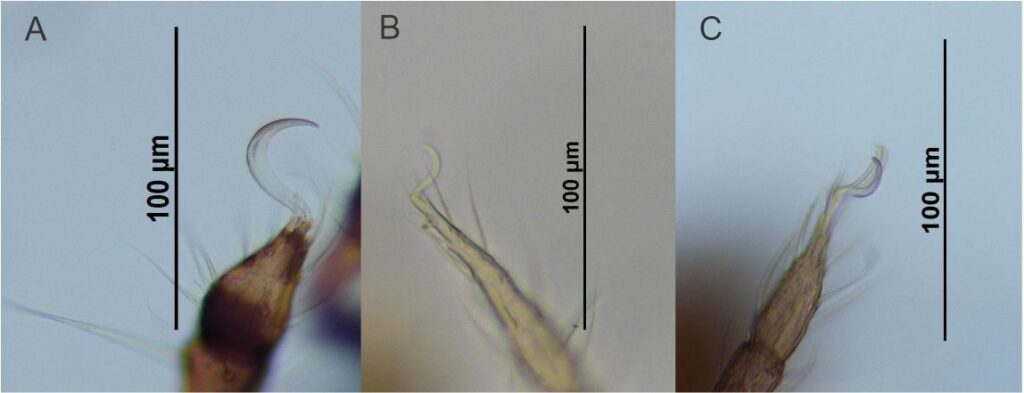 Photo 2: Claw of mites from different habitats: A: one claw from an intertidal mite, B: one claw from a terrestrial mite, C: three claws from a canopy mite
 Photo 3: Intertidal zone with a strong wave
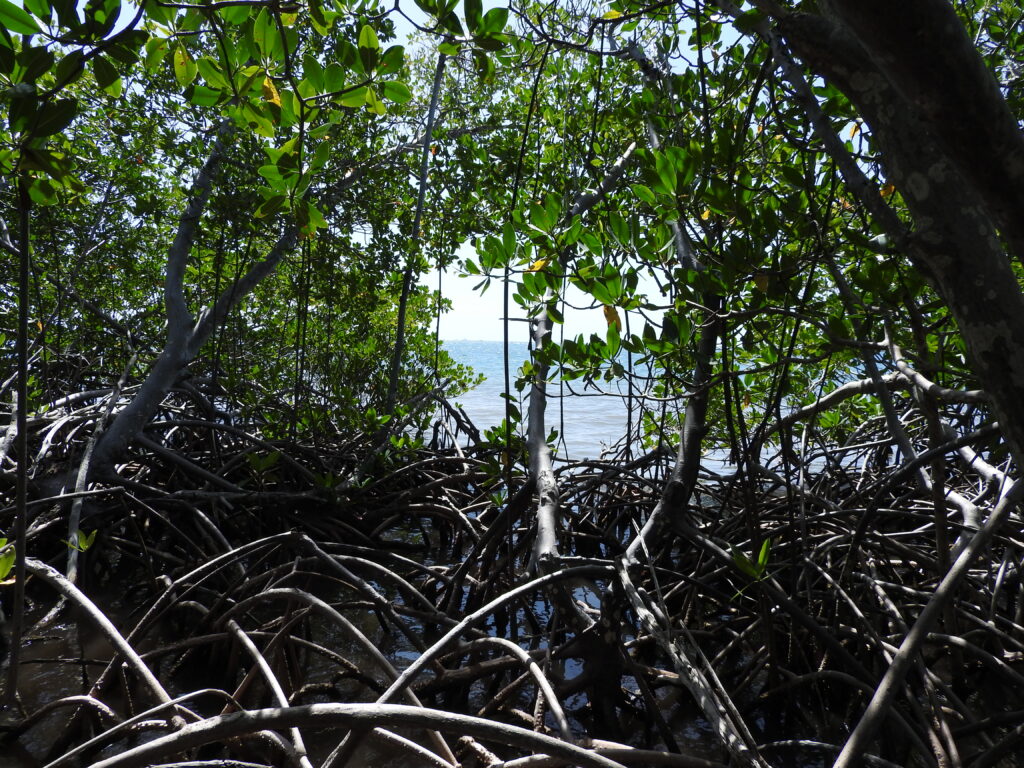 Photo 4: Mangrove forest (Photo by Tobias Pfingstl)



Comments are closed.