


This article explores the relationship between the Greater Honeyguides and humans, as well as cooperation between these birds and Honey Badgers. Honeyguides belong to the avian family Indicatoridae and most of them, to the genus Indicator, whose name stems from the Latin word ’indicare’ which means ‘to lead’. There are about 16 species of honeyguides in Africa and Asia, with six of them occurring in southern Africa. They are all brood parasites and lay their eggs in nests of a range of other bird species. Honeyguides are unique in eating wax of bee honeycombs and also waxy insects. The wax is thought to be digested by enzymes produced by specialised bacteria, although this is not yet fully understood. The nostrils on the honeyguides’ bill are also adapted for feeding on beeswax and have raised rims for protection from influxes of beeswax or honey. The Greater Honeyguide Indicator indicator is well known to guide humans, and possibly Honey Badgers (Mellivora capensis), to bees’ nests, using its chattering call for attention. Humans have been collecting honey for over 20 000 years (probably much longer), and our relationship with honeyguides is likely ancient and has evolved over time.
Honeyguides of the Free State
The Free State is home to the Brown-backed Honeybird Prodotiscus regulus, Lesser Honeyguide Indicator minor and the Greater Honeyguide Indicator indicator. Only the last species is known with certainty to guide humans to beehives.
The distribution of the Brown-backed Honeybird in the Free State is restricted mainly to the Vredefort Dome area, as well as to the region of Ficksburg following the eastern Free State escarpment towards Mpumalanga and adjacent parts of KwaZulu-Natal. There are also scattered records of this species in the central parts of the Free State. The birds mostly occur in savanna, open woodland, forest edges and plantations. They are smallish honeyguides with grey-brown plumage and have diagnostic white outer tail feathers. They don’t lead humans to bee nests and feed mostly on insects such as scales, woody aphids, and butterfly and beetle larvae. These birds may also eat bees, as evidenced by bee remains found in the stomach content of a museum specimen.
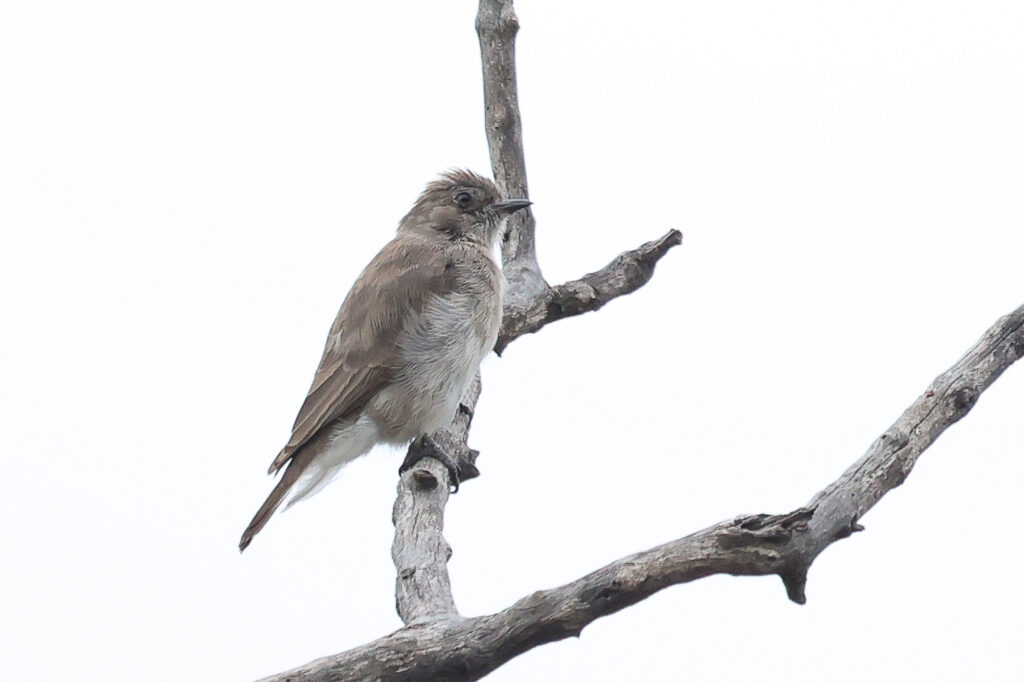
The Lesser Honeyguide is widely distributed in southern Africa including most parts of the Free State and can mostly be spotted by their “lew” or “klew” calls repeated several times. The birds have white outer tail feathers, which are an important identification feature when in flight, together with their olive-coloured wings. These honeybirds also don’t lead to bee nests, but their diet consists mainly of beeswax, larvae and pupae of honeybees, and other insects. The Lesser Honeyguides occur in a wide range of habitats including forest, woodland, savanna, gardens and plantations such as Eucapyptus clumps in grassland Karoo areas.
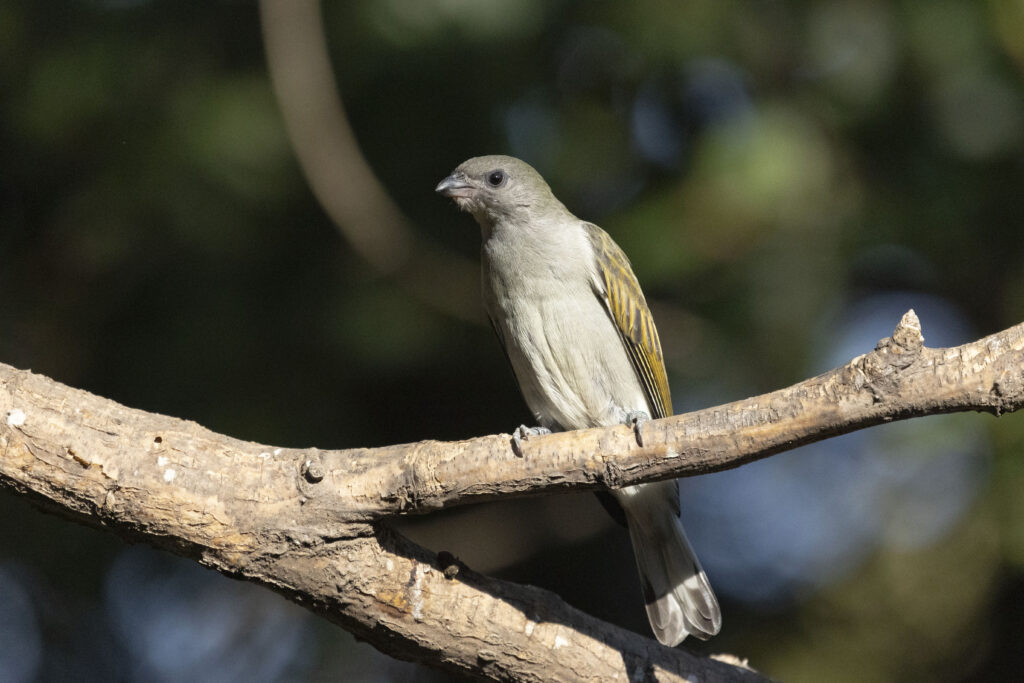
The Greater Honeyguide is a large grey-brown bird with pale edges on its wing coverts and a small yellowish shoulder patch on its wing. Males have a pink bill, a black throat and white ear coverts. Females are more greyish, and juveniles have olive green heads and yellowish undersides. The birds give a repetitive series of bi-syllabic “WHIT-purr, WHIT-purr” calls, also described as “VIC-tor”. When leading to a bee nest, the birds emit a guiding call, which is a harsh, rattling chatter. They occur in most parts of southern Africa and are absent from drier regions of the Northern Cape, Namibia, Botswana, and from the higher altitudes of the Lesotho highlands. In the Free State, the Greater Honeyguides occur scatteredly in the southern, central, eastern and northern parts of the province in variety of habitats including thornveld, savanna, grasslands with trees, but mostly associated with wooded areas and exotic tree plantations. They are the only South African honeyguide species who guide humans to bees’ nests.

The Greater Honeyguide and Honey Badger relationship
The Honey Badger is considered to be the mammalian associate of the Greater Honeyguide, although there are no documented records of a complete guiding sequence of a honeyguide leading an animal (Honey Badger) to a hive. In the few incidences which has been recorded where a Honey Badger leads honeyguides to beehives, the Honey Badger fumigates the beehive with a scent sprayed from its anal glands. This secretion is described as “suffocating” and causes the bees to flee or become moribund. This reduces the chance of the badger getting stung and helps it extract the honey safely.
Similarly to human gatherers, the badger leaves the beehive exposed and the honeyguide is rewarded with honey and wax. It is still believed that the symbiotic association between honeyguides and Honey Badgers are only mythical. Incidences of the mammal and honeyguide associations have been described by Kingdon in his book “East African Mammals”, which reports observations on honeyguides chattering to animal species (possibly Honey Badgers) for assistance in opening beehives. Also, both species dietary specialisation are the same as they feed on the same colonial insects. An observation in Malawi confirmed a positive response of a Honey Badger to a honeyguide. The observer described hearing a grunting, growling sound as well as the chatter call of the honeyguide. He later saw the adult honeyguide leading the Honey Badger, which responded with a guttural growl every time the honeyguide gave its chatter call. The guiding behaviour implies the learning and development of a relationship between animals of the two species, which also translates into extending their food supplies and the ecological success of both species.
Fincham studied the relationship between honeyguides and Honey Badgers in the Matobo National Park, Zimbabwe, and recorded positive responses from the honeyguides to the presence of a Honey Badger. These observations were detailed in written notes, photographs and videos. Fincham noted that the honeyguide intensified its efforts to attract the attention of the Honey Badger, albeit in the presence of a human honey-gatherer. Recent research on Honey Badger and honeyguide interactions suggested that it was unclear from Fincham’s reporting whether a honeyguide was calling to a badger or to the human present, without the badger reacting. Therefore, Fincham’s observation did not confirm the relationship between the bird and the animal at that time.
In 2022, Jessica van der Wal and her co-workers interviewed nearly 400 honey-hunters from 11 communities in nine African countries, where both honeyguides and Honey Badgers also occur. Their survey concluded that interactions between honeyguides and Honey Badgers were rare in the studied communities. Despite anecdotal observations over the years, there was still no consistent and credible evidence that the badger–honeyguide cooperation occurs widely across the distribution range of both species. Furthermore, none of researchers ever witnessed any such interactions in the course of several projects on both species over the years. It is possible that the observers misinterpreted what they saw. If the badger–honeyguide cooperation does occur, it is geographically restricted and relevant observations and beliefs are rare in the honey-hunter groups.
Most scientists rely on incomplete or second-hand accounts that do not convincingly indicate that these two species cooperate. Previous and current studies which suggest that honeyguides may follow Honey Badgers to bee nests seem reasonable. However, more observations are needed considering that these interactions might have been occurring between the bird and the mammal (and humans too) for millennia in the African bush, thus facilitating the evolution of the cooperative relationship to exploit honeybees. Researchers and amateur observers who witness the honey badger–honeyguide encounters are urged to publish their observations, oral history accounts and also photographs and/or videos.
Human and Greater Honeyguide interactions
From ancient times humans have been collecting honey from wild bees’ nests, and many communities still do so. For example, the Ndorobo of western Kenya and the Hadza of northern Tanzania keep up to 400 wild bees’ nests in hollowed tree trunks, where they collect honey each year. Over millennia, these people have developed intimate understanding of honeyguides. Their honey hunters use specific calls, which the birds learn and respond to by leading the honey hunters to the bees’ nests more readily. In Asia, honey hunters in the Himalayas use the Yellow-rumped Honeyguides Indicator xanthonotus, which is the closest relative of the Greater Honeyguide, as cues for locating bees’ nests. Indicator xanthonotus is restricted to the Himalayan Mountain Range, where the birds collect beeswax from nests mostly on rock faces.
The ancient practice of collecting honey from wild bees’ nests is recorded in 20,000-year-old rock art paintings in the rock shelters of Tassili, in the Ahaggar Mountains in the central Sahara. Rock art paintings depicting both bees and bees’ nests, and honey-gatherers at bees’ nests (with bees flying around) are also found in Southern Africa. These occur in the northern uKhahlamba-Drakensberg. In this area, there is also a rock art scene showing a bird ‘seated’ on a fly-whisk carried by an ‘elephant man’. This suggests that the association between honey gatherers and honeyguides goes back for thousands of years. The first modern account of interactions between honeyguides and honey hunters was provided by João dos Santos, a Portuguese missionary, who observed them in Sofala (present-day Mozambique) in as early as 1588.
Claire Spottiswoode led a study on honeyguide-human cooperation, together with a honey-hunting community from the Yao ethnic group, in the Niassa Special Reserve in northern Mozambique. The Yao community are excellent honey hunters, and they collaborate very closely with the honeyguides, known as sego in the Yao language. When a sego shows them a bee nest, Yao prepare a torch to smoke the bees out of the nest. The men gather wood and shape it with bundles of green leaves into a pack looking a bit like a duffle-bag, secured with strips of bark or palm leaves. Then they attach the bundle to a fork of a chopped branch and set it alight and hoist the flaming torch into the tree next to the beehive.
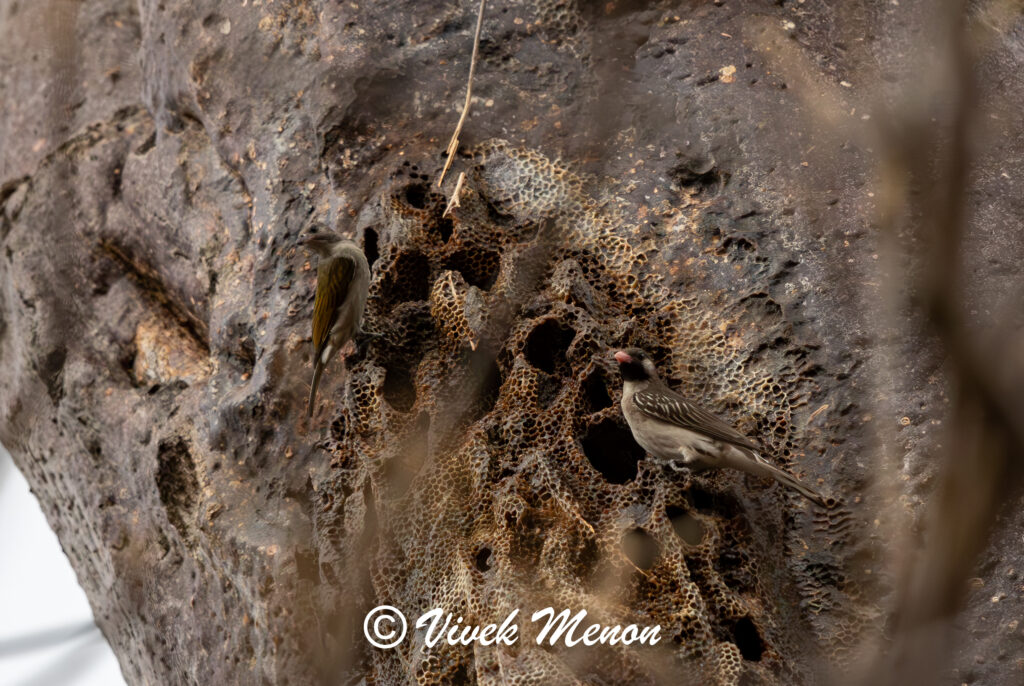
The smoke causes the bees to desert their nest and gather further away in a tight swarm on a tree branch. The men then use their axes to fell down the tree and chop open the bees’ nest to fill their buckets with oozing combs of honey. Empty wax combs, brood combs and scraps of wax are gathered and left behind for the honeyguide. When the honey collectors have left the site, honeyguides fly down to feed on the wax. Typically, several honeyguides of more than one species benefit from the efforts of the men. Camera traps at honey harvesting sites reveal that Lesser and Scaly-throated Honeyguides also come to feed on the wax put out by the Yao honey hunters.
To increase their chances of being guided by a honeyguide, Yao honey hunters signal to honeyguides using a special sound, which is a loud trill followed by a grunt (brrr-hm). They regard this as the best way to attract a honeyguide and to keep its attention while they follow it. This special call has been learned from their forefathers over generations. Other tribes in other parts of Africa use different distinct calls to communicate with honeyguides. A study that experimentally swapped honey-hunting calls between different parts of Africa showed that honeyguides learn the distinct calls that their local honey hunters use to communicate with them. This effective communication between the species makes honeyguides more likely to interact with a cooperative human (and get more wax as reward), and humans with a cooperative honeyguide (and get more honey). This honeyguide-human relationship has evolved through natural selection or social learning. However, this habit has already vanished in many parts of Africa. In much of South Africa, honey hunters are rare, and although the birds continue to call to us, few people answer the call.
The FitzPatrick Institute of African Ornithology, University of Cape Town, runs a research project on the ecology and evolution of the honeyguide-human relationship. Readers can contribute to this project by submitting their sightings of Greater Honeyguides to Fitzpatrick Institute website www.honeyguiding.me. This will help put together one of the most intriguing nature puzzles of interspecies collaboration.

REFERENCES
About honeyguides. http://www.honeyguiding.me/index.php?doc=About-honeyguides
Andreanidis, A. 2016. Scientific names of southern African birds explained: Is it all Greek to you? UK: AuthorHouse.
Cram, D.L., Lloyd-Jones, D.J., van der Wal, J.E.M., Lund, J., Buanachiique, I.O., Muamedi, M., Nanguar, C.I., Ngovene, A., Raveh, S., Boner, W. & Spottiswoode, C.N. 2023. Guides and cheats: producer–scrounger dynamics in the human–honeyguide mutualism. Proceedings of the Royal Society B 290: Art. 20232024. https://doi.org/10.1098/rspb.2023.2024
Fincham, J.E., Peek, R. & Markus, M.B. 2017. The Greater Honeyguide: Recciprocal signalling and innate recognition of a Honey Badger. Biodiversity Observations 8: Art. 12. https://journals.uct.ac.za/index.php/BO/article/view/410
Hollmann, J.C. 2015. Bees, honey and brood: southern African hunter-gatherer rock paintings of bees and bees’ nests, uKhahlamba-Drakensberg, KwaZulu-Natal, South Africa. Azania: Archaeological Research in Africa 50: 343-371. https://doi.org/10.1080/0067270X.2015.1079378
Kingdon, J. 1977. East African mammals: an atlas of evolution in Africa. Vol. 3,
Part A (Carnivores). London: Academic Press.
Lynch, C. D. 2000. Beast, bird and bees: A trophic association? Culna 55: 7-8.
Short, L.L., Horne, J.F.M. & Kirwan, G. M. 2020. Yellow-rumped Honeyguide (Indicator xanthonotus), version 1.0. In: del Hoyo, J., Elliott, A., Sargatal, J., Christie, D.A. & de Juana, E. (Eds), Birds of the World. Ithaca, NY, USA: Cornell Lab of Ornithology. https://doi.org/10.2173/bow.yerhon1.01
Spottiswoode, C.N. 2017. The Fitzpatrick report: One good turn: Exploring honeyguide-human mutualism. African Birdlife 5(3): 22-28.
Spottiswoode, C.N., Lund, J. & Lloyd-Jones, D.J. 2022. Honeyguides. Current Biology 32(20): R1072-R1074. https://doi.org/10.1016/j.cub.2022.08.076
Spottiswoode, C.N. & Woode, B.W. 2023. Culturally determined interspecies communication between humans and honeyguides. Science 382(6675): 1155-1158. https://doi.org/10.1126/science.adh4129
van der Wal, J.E.M., Afan, A.I., Anyawire, M. et al. 2023. Do honey badgers and greater honeyguide birds cooperate to access bees’ nests? Ecological evidence and honey-hunter accounts. Journal of Zoology 321: 22-32. https://doi.org/10.1111/jzo.13093
Vernon, C.J. & Dean W.R.J. 2005. Greater Honeyguide Indicator indicator. In: Hockey, P.A.R., Dean, W.R.J. & Ryan, P.G. (Eds), Roberts – Birds of Southern Africa. 7th ed. Cape Town: The Trustees of the John Voelcker Bird Book Fund, pp. 123–124.
Vernon, C.J. & Dean W R J. 2005. Lesser Honeyguide Indicator minor. In: Hockey, P.A.R., Dean W.R.J. & Ryan P.G. (Eds), Roberts – Birds of Southern Africa. 7th ed. Cape Town: The Trustees of the John Voelcker Bird Book Fund, pp. 124–125.
Vernon, C.J. & Dean, W.R.J. 2005. Brown-backed Honeyguide Prodotiscus regulus. In: Hockey, P.A.R., Dean, W.R.J. & Ryan, P.G. (Eds), Roberts – Birds of Southern Africa. 7th ed. Cape Town: The Trustees of the John Voelcker Bird Book Fund, pp. 127–128.
Whittall, E. 1968. The Honeyguide. Bokmakierie 20: 73.
Winkler, D.W., Billerman, S.M. & Lovette, I.J. 2020. Honeyguides (Indicatoridae), version 1.0. In: Billerman, S.M., Keeney, B.K., Rodewald, P.G. & Schulenberg, T.S. (Eds), Birds of the World. Ithaca, NY, USA: Cornell Lab of Ornithology. https://doi.org/10.2173/bow.indica1.01



Comments are closed.