

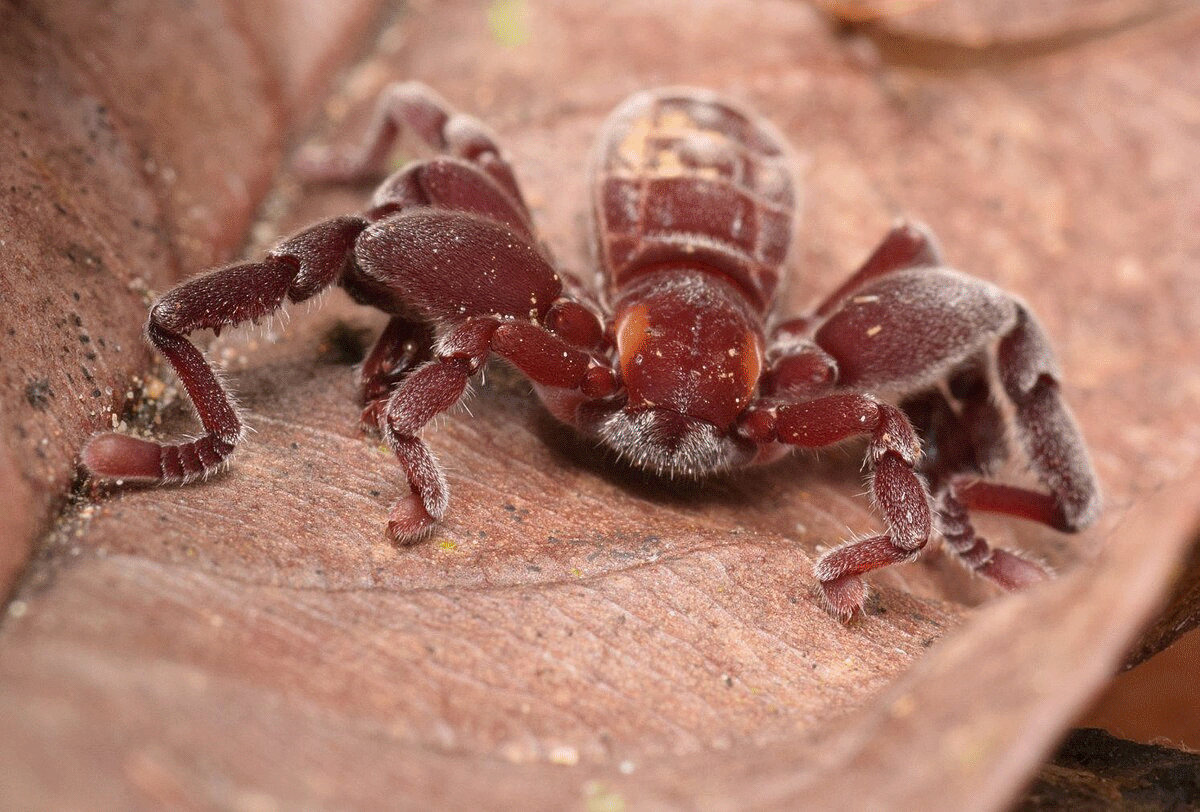
In primeval forests of West Africa and Central America, as well as in the dark and hidden corners of caves in Texas, plods along a little-known, enigmatic, small and blind arachnid in search of prey. It belongs to the smallest arachnid order, the Ricinulei, and is commonly referred to as a hooded tick-spider. Looking like a mix between a stout-bodied spider, a tick, a World War II tank and just a dash of harvestman, it tracks its victim by chemical scent and minute vibrations. When near, it lunges and grasps its imminent meal with two claws at the tips of the short arms protruding from the bottom of its thickly-armoured body. Then, raising an armoured hood at the front of its cephalothorax it reveals its prey’s demise, a pair of claw-like mouthparts designed to rip it apart so that the arachnid can feed on the liquids contained within. This, of course, sounds quite terrifying. And if you were a small soft-bodied arthropod such as a termite or springtail, this could very well end badly for you. But, at only around 5–10 mm in length and being completely non-venomous, these fearsome little arachnids are completely harmless to a human.
Every facet of these strange arachnids is fascinating. Starting with their discovery, the first ricinuleid specimen was described in 1837 by noted English geologist William Buckland from a fossil found in an ironstone nodule from the ~300-million-year-old Coal Measures of Coalbrookdale, Shropshire, in England. Due to the specific morphology of that particular species bearing a single median furrow down its abdomen, giving it the distinct appearance of having beetle elytra, which are the hardened protective casings over the membranous wings of beetles, it was erroneously identified as a type of an ancient weevil and named Curculioides. One year later, in 1838, the first living representative of Ricinulei was described as a harvestman by a French entomologist Félix Édouard Guérin-Méneville from a specimen collected in West Africa. In the following years a small number of both extant and fossil species were discovered by various scientists, although it wasn’t until 1884 that the Curculioides fossil described by Buckland was finally recognized as a type of arachnid and placed within the Anthracomartidae, a family of extinct arachnids often found in the Carboniferous Coal deposits. In a footnote in his 1902 paper, a British zoologist named Reginald Innes Pocock noted for the first time the similarities between Buckland’s fossil and the living species of hooded tick-spiders. Then in 1904, two Danish scientists, Hans Jacob Hansen and William Sørensen, published a seminal work, separating the hooded tick-spiders from the harvestmen and establishing the Ricinulei as a separate order for the former. Then finally Pocock, in a monograph on fossil arachnids published in 1911, placed all the fossil tick-spider species together with their present-day relatives, unifying the extinct and extant Ricinulei.
This now meant that the misidentified fossil hooded tick-spiders, once thought to be extinct, were still very much alive, cementing the Ricinulei as a Lazarus taxon. The biblical reference applies to organisms that were first described as fossils, and though to be extinct, only to subsequently be rediscovered as living, thus ‘resurrecting’ them. Such is the famous example of the coelacanth. Originally thought to have gone extinct approximately 66 million years ago in the Late Cretaceous, a living population of this fish was discovered off the coast of South Africa after Marjorie Courtenay-Latimer, a museum curator, spotted a coelacanth specimen among the catch of a local fisherman in 1938.
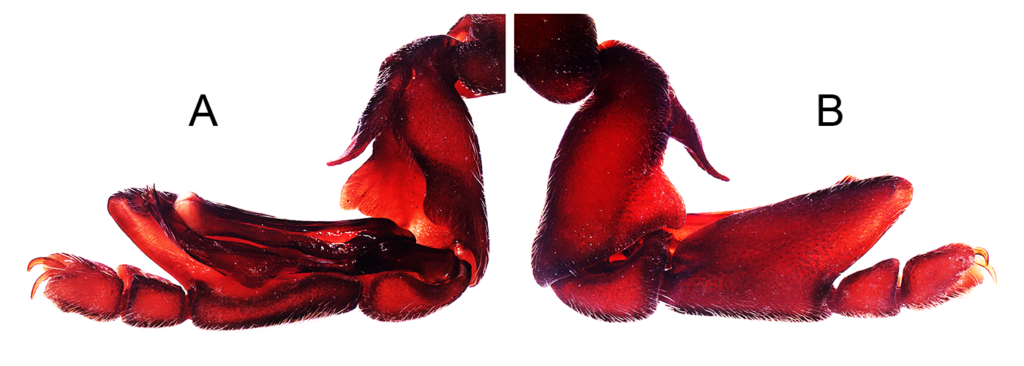
Regarding their morphology, hooded tick-spiders possess a number of truly unique and strange adaptations. Foremost is the cucullus, a hinged plate at the front of the cephalothorax that can be raised or lowered and acts as a shield, protecting the arachnid’s claw-like jaws called chelicerae. Among arachnids, this structure is unique to the Ricinulei, and is what the ‘hood’ in their common name refers to. The second part of the hooded tick-spider name refers to how the two parts of their bodies (the cephalothorax at the front and the abdomen at the back) seem to be fused together like those of a tick. This is due to a fascinating mechanism possessed by ricinuleids that allow them to ‘hook’ their abdomens into their front carapace, thus hiding their vulnerable and flexible waist called the pedicel. During mating and egg-laying these arachnids can freely release their front and back body segments, allowing the male to both load his genital apparatus with sperm, as well as giving him access to the female’s reproductive opening during mating. Another unique morphological trait of the Ricinulei is the nature and position of the male’s sperm transfer apparatus, which is located, bizarrely, near the tips of the third pair of his walking legs. These structures are often just as complex as those found in the pedipalps of male spiders and each species’ unique morphology acts as a type of ‘lock-and-key’ during mating. During the act, the male will climb atop the female and latch on with two front pairs of his walking legs, then reach around from behind the female’s back with the third pair of legs and use the specialized structures at their tips to transfer a sperm-packet, called a spermatophore, to the female.
Despite lacking true image-forming eyes, hooded tick-spiders are still very much capable of reacting to changes in light intensity due to the presence of specialized light-sensitive regions on their carapace. However, they mainly rely on detection of mechanical vibrations and chemical signals for environmental awareness. To this end, the second pair of their walking legs are elongated and act in the same capacity as antennae in insects. The grasping and manipulation of prey is done with a pair of short appendages, called pedipalps, bearing small pincers at their tips. All arachnids have pedipalps, and each arachnid order’s pedipalps are uniquely adapted to serve a particular function. The pedipalps of scorpions and pseudoscorpions, for example, form multi-segmented grasping claws, while in spiders they often act as another pair of walking legs until a male spider matures and their pedipalps develop specialized bulbous mating organs at their tips. But, unlike the majority of arachnids where the pedipalps emerge from the front of the carapace and in front of the first pair of walking legs, ricinuleid pedipalps emerge from behind the mouthparts and below the first pair of walking legs. This allows them to manoeuvre prey below their bodies and up towards their mouthparts.
As strange as this arachnid’s morphology is, it has remained virtually unchanged for over 300 million years. If you could go back in time to a Carboniferous forest you would be able to find these very arachnids, with the only major difference being that some species possessed true eyes, were somewhat bigger and could be found wandering on the lower trunks of trees, instead of under deep leaf litter. Their body plan has survived the splitting of the Gondwanan supercontinent, the Carboniferous Rainforest Collapse, the great demise of the Permian/Triassic extinction, the Triassic/Jurassic and the famous Cretaceous/Paleogene extinction, which ended the reign of the dinosaurs. While the trilobites vanished and Tyrannosaurus rex fell, these armoured little arachnid tanks adapted and survived, switching from living on the bark of Carboniferous trees to exploiting niches well suited for their morphology, in the subsoil beneath the rainforest floor or in the complete darkness of subterranean caverns.
There are currently 104 known extant hooded tick-spider species, making the Ricinulei the smallest and arguably one of the most enigmatic arachnid orders. But more than that, they are true living fossils that allow scientists to glimpse the ancient biology of the Carboniferous period. They are a living link to a world that vanished some 300 million years ago.
Image Captions


References
Botero-Trujillo, R., Davis, S.R., Michalik, P. & Prendini, L. 2022. Hirsutisoma grimaldii sp. nov., a ca. 99-million-year-old ricinuleid (Primoricinulei, Hirsutisomidae) from Cretaceous Burmese amber with a corticolous, scansorial lifestyle. Palaeoentomology 5(5): 493–504. https://doi.org/10.11646/palaeoentomology.5.5.11
Botero-Trujillo, R., Sain, C.E. & Prendini, L. 2021. Systematics of the “Giant” Ricinulei (Ricinoididae: Ricinoides) of West Africa, with descriptions of five new species and comparative morphology of the male copulatory apparatus. Bulletin of the American Museum of Natural History 448(1): 1–68. https://doi.org/10.1206/0003-0090.448.1.1
Botero-Trujillo, R. & Valdez-Mondragón, A. 2016. A remarkable new species of the magnus species-group of Cryptocellus (Arachnida, Ricinulei) from Ecuador, with observations on the taxonomy of the New World genera. Zootaxa 4107: 321–337. https://doi.org/10.11646/zootaxa.4107.3.2
Buckland, W. 1837. The Bridgewater treatises on the power, wisdom and goodness of God, as manifested in the creation. Treatise IV. Geology and mineralogy considered with reference to natural theology. Vol. 2. London, William Pickering. https://doi.org/10.5962/bhl.title.36097
Dunlop, J.A., Penney, D. & Jekel, D. 2023. A summary list of fossil spiders and their relatives. In: World Spider
Catalog. Natural History Museum Bern, ver. 23.5. http://wsc.nmbe.ch (accessed 18.12.2025)
Guérin-Méneville, F.E. 1838. Note sur l’Acanthodon et sur le Cryptostemme, nouveaux genres d’Arachnides. Revue Zoologique 1: 10–14.
Hansen, H.J. & Sørensen, W. 1904. On two orders of Arachnida. Cambridge University Press, Cambridge. https://doi.org/10.5962/bhl.title.13898
Harvey, M.S. 2002. The neglected cousins: what do we know about the smaller arachnid orders? Journal of Arachnology 30: 357–372. https://doi.org/10.1636/0161-8202(2002)030[0357:TNCWDW]2.0.CO;2
Legg, G. 1976. The external morphology of a new species of ricinuleid (Arachnida) from Sierra Leone. Zoological Journal of the Linnean Society 59: 1–58. https://doi.org/10.1111/j.1096-3642.1976.tb01007.x
Legg, G. 1977. Sperm transfer and mating in Ricinoides hanseni (Ricinulei: Arachnida). Journal of Zoology, London 182: 51–61. https://doi.org/10.1111/j.1469-7998.1977.tb04140.x
Pocock, R.I. 1902. Eophrynus and allied Carboniferous Arachnida. Geological Magazine, New Series (4) 9(10): 439–448, 487–493. https://www.biodiversitylibrary.org/item/96113#page/491
Pocock, R.I. 1911. A monograph of the terrestrial Carboniferous Arachnida of Great Britain. Monographs of the Palaeontographical Society 64: 1–84. https://doi.org/10.1080/02693445.1911.12035553
Selden, P.A. 1992. Revision of the fossil ricinuleids. Transactions of the Royal Society of Edinburgh, Earth Sciences 83: 595–634. https://doi.org/10.1017/s0263593300003333
Valdez-Mondragón, A. & Francke, O.F. 2013. Two new species of ricinuleids of the genus Pseudocellus (Arachnida: Ricinulei: Ricinoididae) from southern Mexico. Zootaxa 3635: 545–556. https://doi.org/10.11646/zootaxa.3635.5.4
WRC (World Ricinulei Catalog) 2022. World Ricinulei Catalog. Natural History Museum Bern. http://wac.nmbe.ch (accessed 18.12.2025)




Comments are closed.