

The story of the Independent Order of True Templars foundation stone in the Batho exhibition
Which drink do you prefer, dear reader, liquor or tea? Making a choice is not always an easy one, but the story behind the Independent Order of True Templars (IOTT) foundation stone in the National Museum’s exhibition on Bloemfontein’s Batho township, is all about making a choice in favour of tea. If you prefer tea, then this story is for you.
The foundation stone once belonged to the IOTT Emmanuel Hall in Cook Avenue, Batho. In 2013 the small hall, which was completed in 1932, had deteriorated to such an extent due to neglect and vandalism that the Museum intervened and managed to obtain the stone for the Batho exhibition. The historical building, which is partly in ruins, faces an uncertain future, but behind the building and its foundation stone is a story about man’s age-old battle between staying sober and getting drunk – an ongoing battle which will probably outlive the Emmanuel Hall.
The history of this organisation, jokingly called the ‘I Only Take Tea’-brigade (‘IOTT’), dates back to 1851 when the Order of Good Templars (OGT) was founded in Utica, New York, by Daniel Cody. The OGT was one of a number of organisations founded in the 19th century that were committed to promoting temperance or total abstinence. As a secret society, the OGT’s structure was modelled on Freemasonry, and it used similar rituals and regalia, including secret passwords and grandiose titles. The organisation also drew inspiration from the Knights Templars, hence the word ‘Templars’ in its name. Both male and female members were admitted and initially the OGT made no distinction on racial grounds. All members pledged never to use alcohol and they actively campaigned for prohibition which, according to them, was necessitated by the growing social scourge of alcoholism.
Due to a series of political disputes, a faction broke away from Cody’s OGT and established itself as the Independent Order of Good Templars (IOGT). Ironically, the new order soon overshadowed the original OGT, and by 1900 it was the largest secret society in the temperance movement. Each member organisation of the mother body organised itself in local units called ‘lodges’ or ‘temples’ and the member organisations stood under the leadership of a ‘Chief Templar’. Apart from its strong presence in the USA and Britain, the order also spread to many other countries, colonies and territories, including Germany, the Netherlands, Portugal, France, Norway, Sweden, Ceylon (Sri Lanka), Australia, New Zealand, the Cape Colony. In 1902 the OGT changed its name to the International Order of Good Templars, which was an indication of the organisation’s global appeal.
The IOGT’s strong insistence on non-racialism and shared lodges for blacks and whites was not acceptable to all members. This happened to be the case in the Southern states of America, and also in some British colonies, including the Cape Colony. Consequently, a major split occurred in the 1870s on the issue of racially divided lodges. Caving in to pressure, the mother body allowed separate lodges for blacks and whites where such a need was voiced. Because of the policy of racial segregation in what later became the Union of South Africa, the same division manifested itself there. In South Africa the Independent Order of Good Templars became the body for whites and a separate organisation, namely the Independent Order of True Templars (IOTT), was founded for black people.
Since its introduction in the Cape Colony in 1876, the IOTT managed to secure a loyal following among the black population in Natal, Transvaal and the Orange Free State. Many blacks, especially clergy, became increasingly concerned about the widespread brewing and misuse of traditional African beer known as jwala. As a result temples were established in most of the bigger towns and cities, including Bloemfontein. During the late 1890s the local IOTT, based in Bloemfontein’s biggest black township, Waaihoek, counted more than eighty members. The local IOTT became increasingly active in the 1920s, also in Batho, which was established in 1918 as a new township for Bloemfontein’s black population. Women felt particularly attracted to the IOTT and they organised themselves in women’s groups known as the Bands of Hope. Apart from adhering to the original objective of promoting a sober lifestyle – in other words, preferring tea to liquor – the various Band of Hope branches (e.g. the Ascension Band of Hope and the Lily of Macedonia Band of Hope) also became involved in other social issues, such as caring for needy members of the community. Men were also involved in the Bands of Hope, and during the early 1930s a well-known Batho personality, Z.P. Selebano, served as Superintendent of the Bands of Hope.
Because of its growing membership the local IOTT felt the need for a bigger venue where meetings and other gatherings could be held. After a double stand in Cook Avenue in the Four-and-Six section of Batho had been secured, the building of the new hall started in all earnest. The Bloemfontein Town Council assisted financially, as well as with the provisioning of building materials at cost price. The foundation stone of the new hall, named the Emmanuel Hall, was officially laid on 19 June 1932 by the then Mayor, R.C. Streeten. The Bloemfontein paper The Friend reports that the laying of the stone was a festive event with brass bands and members of the various temples, Band of Hope members, and jubilant school children taking part in a procession to the new building. The proceedings were attended by many local dignitaries, including R.J. Cooper, manager of the Native Affairs Department, and T.M. Mapikela, headman of the Bloemfontein townships. In his speech the Mayor commended IOTT members for their efforts in fighting alcoholism and warned against “the evils of alcoholic liquors and brews”.
The highlight of the proceedings was, of course, the official unveiling of the foundation stone. A jubilant mood made way for a moment of silence when the crowd caught sight of the neat sandstone slab. The inscription, neatly carved in stone, reads as follows:
EMMANUEL HALL I.O.T.T.
This stone was laid by His Worhsip the Mayor
R.C. Streeten Esq.
on 19 June 1932
A.J. Leeuw: Mookamedi G.S.
Z.P. Selebano: President B.O.H.
Proverbs 20 verses 1, 2 & 13
The ceremony was closed with the handing of a silver trowel to the Mayor. Afterwards the guests joined him and other dignitaries for, as you could have guessed, a cup of tea.
The local chapter of the IOTT still exists, but membership is dwindling and the organisation, which is inter-denominational, experiences financial problems. Because of a lack of funds the IOTT is not in a position to repair the dilapidated Emmanuel Hall. According to a member, Elizabeth Sebudi, young people show a lack of interest in the IOTT during this time when such an organisation is desperately needed. According to Elizabeth alcoholism and other forms of substance abuse are a growing problem among Bloemfontein’s youth. But, for the time being, all she and other mostly elderly members of the IOTT can do is to stay committed, prefer tea to liquor, and live up to the templars’ universal motto of ‘Faith, Hope and Charity’.
References
Schoeman, K. 1980. Bloemfontein: die ontstaan van ‘n stad, 1846-1946. Cape Town: Human & Rousseau.
The Friend, 27.11.1924, 28.3.1932, 25.6.1932, 10.1.1933.
Umteteli wa Bantu, 5.1.1935, 8.6.1935, 24.8.1935, 17.6.1939.
www.archiver.rootsweb.ancestry.com/th/read/SOUTH-AFRICA-CAPE-TOWN/2008-01/1201007780.html (15.7.2016).
www.blog.templarhistory.com/2010/04/independent-order-of-good-templars.html (15.7.2016).
www.iogt.us/iogt.php (15.7.2016).
www.slideshare.net/Bantsijang/independent-order-of-true-templars.html (4.8.2016).
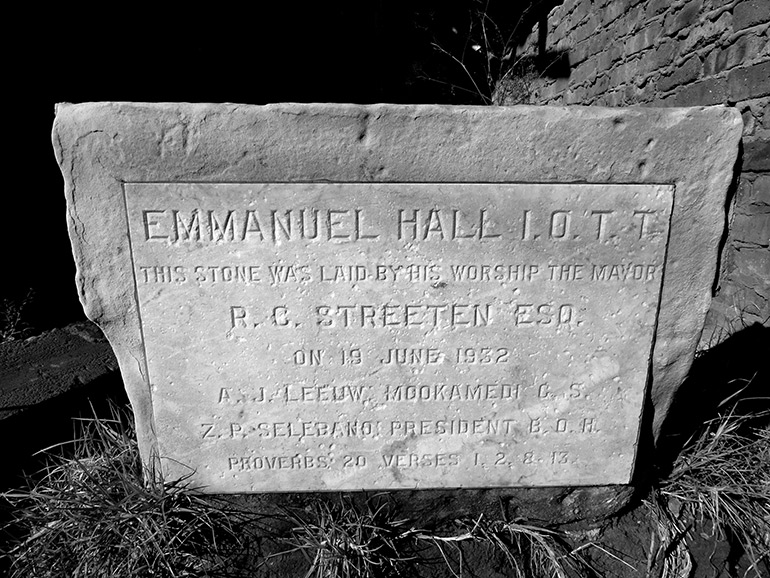
The IOTT foundation stone. (Photo: National Museum)
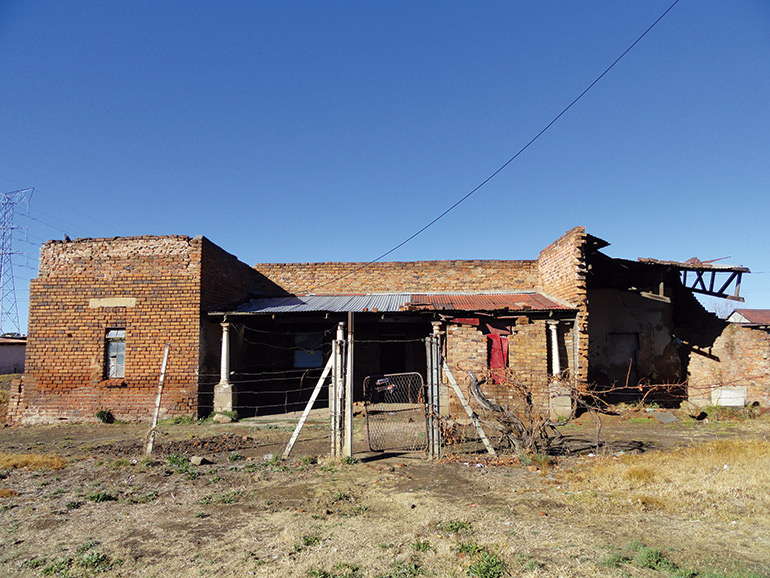
The Emmanuel Hall, Cook Ave., Batho, 2013. The foundation stone is visible on the right-hand side of the garden gate. (Photo: National Museum)

Two members of the IOTT wearing their customary sashes, early 1940s. (Photo: National Museum)
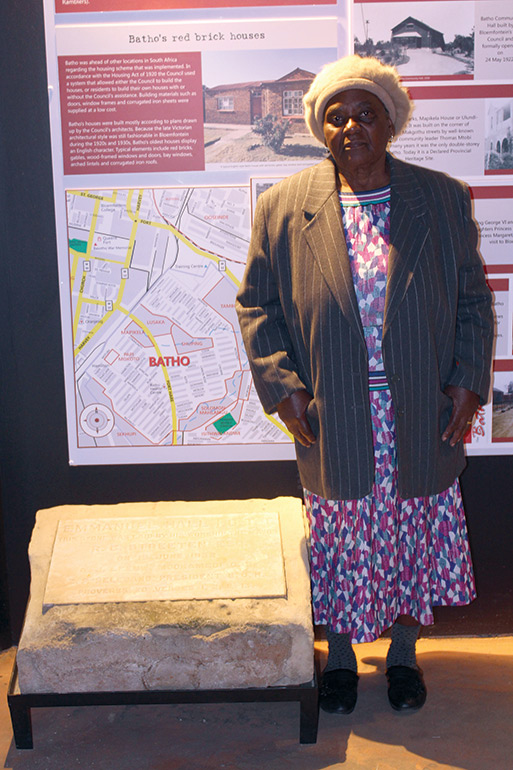
Elizabeth Sebudi next to the IOTT foundation stone in the Batho exhibition, 2016. (Photo: National Museum)



Comments are closed.