

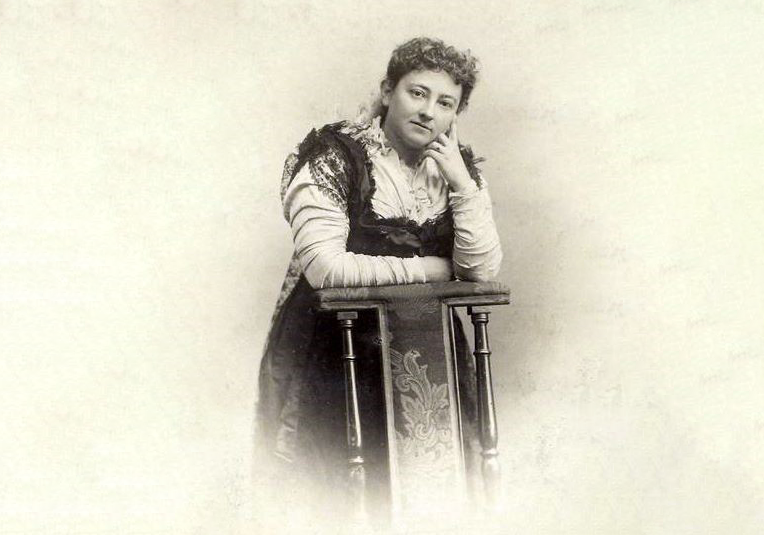
December 11, 2020 marks the centenary of the death of well-known South African writer and women’s rights advocate, Olive Schreiner. She passed away on December 11, 1920 at the relatively young age of 65. Schreiner may be described as a “rebel with many causes” who felt herself severely restricted by the conventions of the Victorian age. As a curious reader and an independent thinker Schreiner became interested in feminism, women’s rights, racism, pacifism, socialism, religion and agnosticism. These issues, most of which were certainly not foremost on the mind of the typical Victorian woman, were later explored in her novels and political works.
Schreiner’s parents were poor and, as a result, she had a harsh and unsettled childhood. To support herself she travelled from farm to farm in the Karoo and sold her services as governess to various families. Her unconventional ideas often brought her into conflict with her employers. To stave off depression she turned to writing. It was during her stay with one of the Karoo farm families that she found inspiration for writing her most famous novel, The Story of an African Farm. Published in 1883, the story deals with the lives of three characters on a Karoo farm. The book explored controversial themes such as premarital sex, pregnancy out of wedlock and feminism. Because of widespread prejudice against female writers she published the book under the pseudonym Ralph Iron. Ironically, the highly acclaimed book brought Schreiner international fame almost overnight and it became a best seller in Europe and America.
Emboldened by her novel’s success Schreiner did not allow society’s prejudice against female writers to deter her from further writing. Books such as Dreams (1891), Trooper Peter Halket of Mashonaland (1897), Closer Union (1909) and Woman and Labour (1911) boldly reflected her freethinking on causes close to her heart. For example, she was vehemently opposed to British imperialism and colonialism and argued for political rights for women and black people. Needless to say, her ideas and convictions were not welcomed by all, least of all by the ruling political classes. The backlash was severe: during the Anglo-Boer (South African) War (1899-1902) the British burned her house and manuscripts and she was forced to live in a British army camp for the duration of the war. Shortly before the outbreak of World War I, Schreiner went to England for medical treatment. She only returned to South Africa in 1920 and died the same year in a boarding house in Wynberg, Cape Town.
Olive Schreiner was light years ahead of her time and, sadly, most of the causes she championed were addressed only after 1994 when the new political dispensation dawned in South Africa. The National Museum honours Olive Schreiner for speaking up for righteousness during a time when it was not acceptable for women to do so.



Comments are closed.