

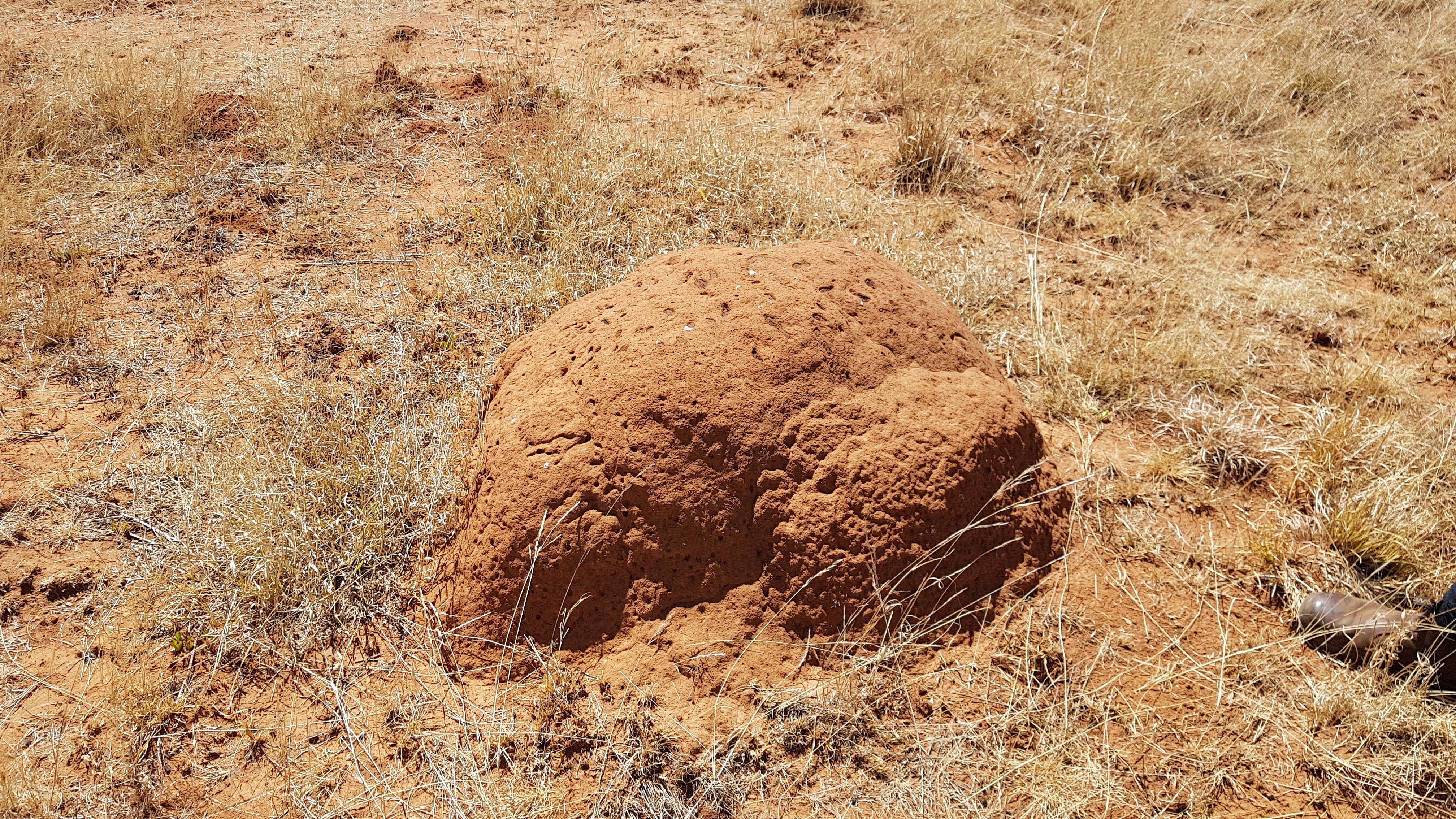
Most of us are familiar with termite nests. Just imagine driving along the roads in the Free State, seeing hundreds of termite nests in the fields next to the road. In these nests are not only termites, but also mites. Some mites are free-living in the nests, sometimes catching a ride on termites to carry them around in the nest.
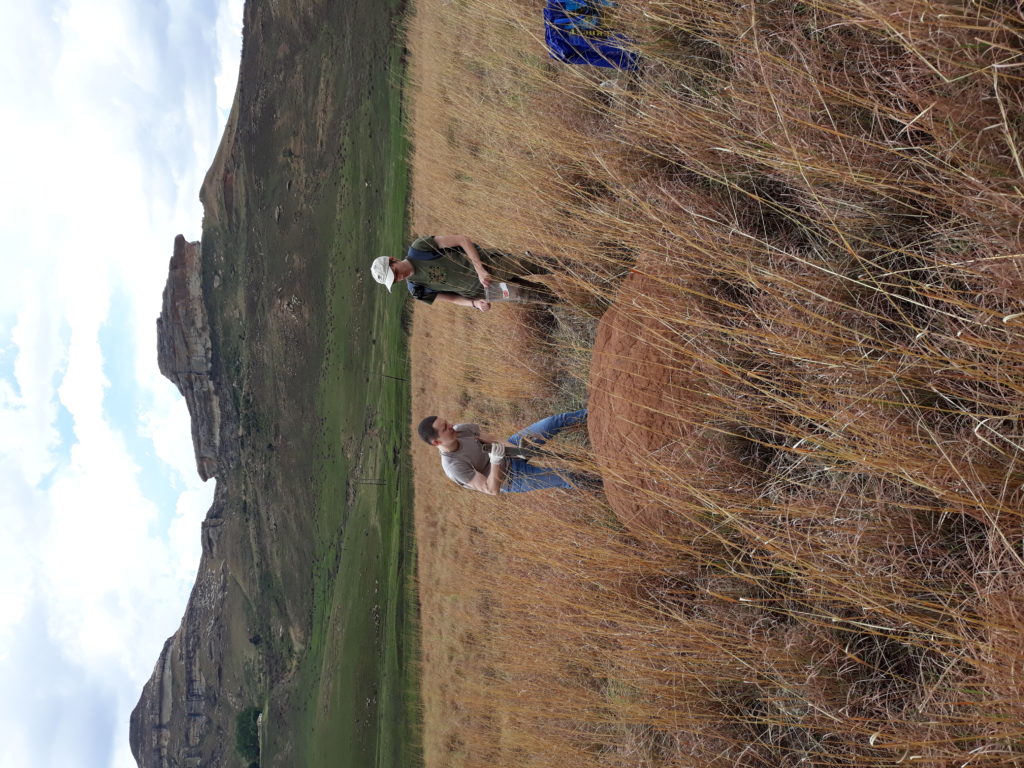
Termite nests have been described as ‘nutrient hotspots’ and the soil of the nests often has higher nitrogen, calcium and magnesium concentrations and a higher pH and clay percentage than the surrounding soil. Inside the nests, humidity is high and temperatures are buffered – favourable conditions for most soil-living mite species. Nests are packed with food, especially fungi, resulting in more mites (mostly fungi-eating species) inside nests compared to surrounding soils. Despite this unique habitat, oribatid mites in termite nests have rarely been studied. Oribatida, or ‘beetle’ mites, are small (0.2-1.4 mm) with eight legs and a hard body, occurring in soil as decomposers. A few papers have been published between 1978 and 1990 about oribatid mites in termite nests in Turkmenistan, Uzbekistan and India, but no studies existed in South Africa. A collaborative project with Dr Lizel Hugo-Coetzee (National Museum) and Prof. Alexander Khaustov and Dr Sergey Ermilov (Tyumen University, Russia) was launched in 2016 to study mites in termite nests in South Africa.
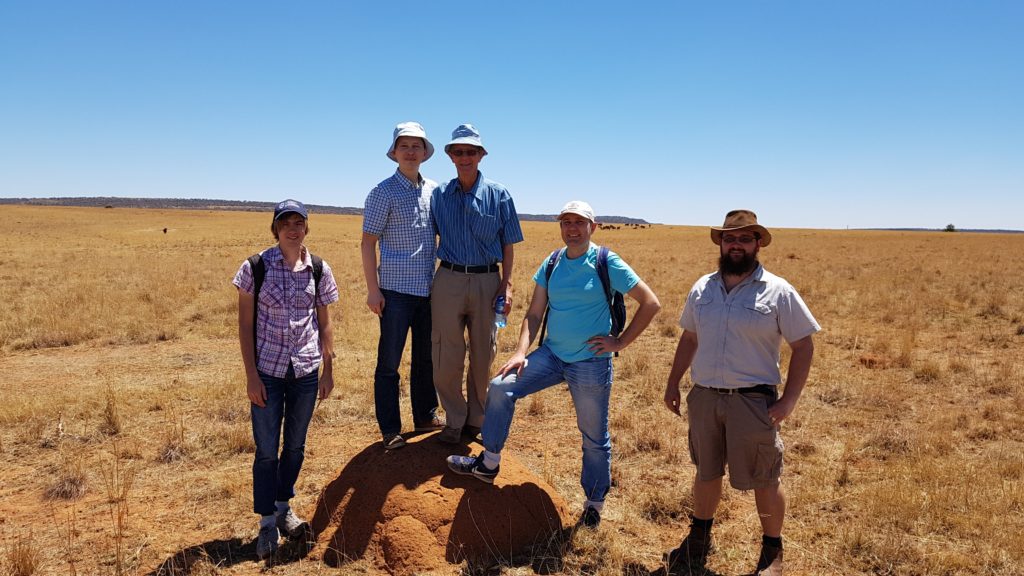
Samples were taken from nests (20 samples), and surrounding soil (20 samples), for comparison, in the Franklin Game Reserve (Naval Hill), Bloemfontein, Faan Meintjes Nature Reserve, near Klerksdorp, and Golden Gate Highlands National Park. The most abundant termite nests were those of the snouted harvester termite, Trinervitermes trinervoides.
Until now nine papers (see References) have been published in which one new mite genus (Coetzeella) and 10 new species are described from nests: Ausoribula termitophila, Ausoribula bloemfonteinensis, Ceratobates monosacculatus, Coetzeella navalensis, Lamellarea koki, Licnodamaeus navalhillensis, Licnodamaeus sacculatus, Lohmannia lerallana, Oribatula franklisensis, Saltatrichus louiseae. A total of 25 species have been recorded from nests.

Interestingly, the number of individuals and number of species in nests differed among the three different sites. In Golden Gate, 19 individuals and four species were sampled, while in Faan Meintjes Nature Reserve 751 individuals and nine species and in Franklin Game Reserve 436 individuals and 20 species were sampled. It is possible that recent fires in Golden Gate resulted in lower numbers at that site. Also, oribatid mite communities are different between soil and nests. For example, some species were recorded only in the nests or in the soil, and some species had a very high number of individuals in the nests but very low numbers in the soil. It became evident that the following oribatid species prefer termite nests: Ausoribula bloemfonteinensis, Ausoribula termitophila, Bipassolozetes bidactylus, Coetzella navalensis, Saltatrichus louiseae and Transoribates agricola.

This is very valuable data to use in management plans of nature reserves and it also increases our knowledge of the biodiversity around us.
References
Bayartogtokh, B., Ermilov, S.G., Hugo-Coetzee, E.A. Khaustov, A.A. 2018. Contribution to the knowledge of the oribatid mites genus Licnodamaeus Grandjean, 1931 and synonymy of Licnodamaeolus Covarrubias, 1998 (Acari, Oribatida, Licnodamaeidae). Systematic and Applied Acarology 23(1), 42-60.
Ermilov, S.G., Hugo-Coetzee, E.A., Khaustov A.A. 2017. Contribution to the knowledge of the oribatid mite genus Lamellarea (Acari, Oribatida, Lamellareidae). Systematic & Applied Acarology 22(11), 2008–2022.
Ermilov, S.G., Hugo-Coetzee, E.A., Khaustov, A.A. 2017. Oribatid mites (Acari, Oribatida) inhabiting nests of the termite Trinervitermes trinervoides (Sjöstedt) in the Franklin Game Reserve (Bloemfontein, South Africa), with description of a new species of the genus Ceratobates (Tegoribatidae). Systematic and Applied Acarology 22(10), 1715-1732.
Ermilov, S.G., Hugo-Coetzee, E.A., Khaustov, A.A. 2017. Contribution to the knowledge of oribatid mites of the family Lohmanniidae (Acari: Oribatida) from South Africa. Systematic and Applied Acarology 22(5), 666-682.
Ermilov, S.G., Hugo-Coetzee, E.A., Khaustov, A.A. 2017.Two new species of the genus Ausoribula (Acari, Oribatida, Oribatulidae) from termitaries of South Africa. Acarologia 57(3), 643-650.
Ermilov, S.G., Hugo-Coetzee, E.A., Khaustov, A.A. 2017. Coetzeella navalensis gen. nov. sp. nov. (Acari; Oribatida; Oppiidae) from South Africa. Systematic & Applied Acarology 22(3), 403-409.
Ermilov, S.G., Hugo-Coetzee, E.A., Khaustov, A.A., Theron, P.D. 2019. Oribatid mites (Acari, Oribatida) inhabiting termite nests in the Faan Meintjes Nature reserve (South Africa). Systematic and Applied Acarology 24(9), 1783-1798.
Ermilov, S.G., Hugo-Coetzee, E.A., Khaustov A.A. & Khaustov, V.A. 2021. New faunistic data on oribatid mites (Acari, Oribatida) inhabiting the soil and termite nests in the Franklin Game Reserve, Bloemfontein, South Africa. Zoologicheskii Zhurnal 100(4), 374-384.
Ermilov, S.G., Hugo-Coetzee, E.A., Khaustov A.A. & Khaustov, V.A. 2021. New faunistic and taxonomic data on oribatid mites (Acari, Oribatida) inhabiting soil and termite nests in the Golden Gate National Park (eastern South Africa). International Journal of Acarology, Doi.org/10.1080/01647954.2021.1879262



Comments are closed.