

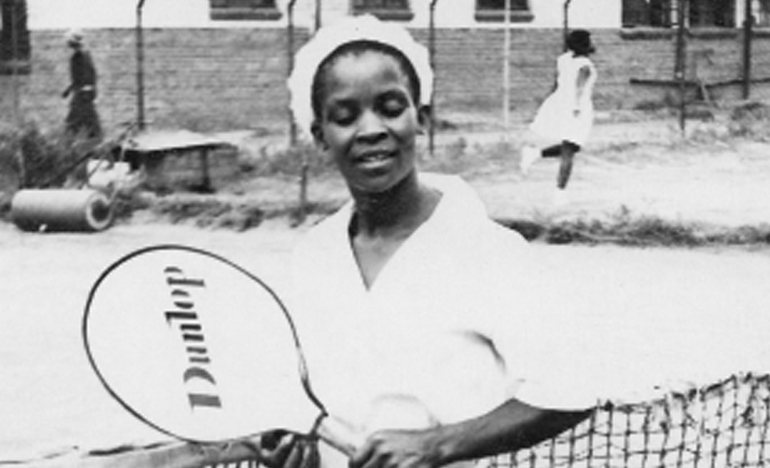
With the recent passing of Miss Matlhaodi Rahab Kgomo, an important era in the history of Bloemfontein came to an end. In addition to being one of the last of her generation to have witnessed the visit of the British Royals to Bloemfontein in 1947, which in her case was sealed with a gift of a cup and saucer, Rahab Kgomo was one of the pioneers who contributed to the establishment and further development of a distinct tennis tradition within the black communities of the Free State in general and Greater Bloemfontein/Mangaung in particular. Another tennis legend from Kgomo’s era was the late Gobuiwang Junia [‘Zero’] Tlhobelo who passed away 10 years ago. Miss Tlhobelo gained her nickname because of her prowess and ability to defeat the toughest opponents in the game and held the women’s singles title of the South African National Lawn Tennis Union in the 1960s.
 As far back as 1987, Stangen News, an in-house publication of the Standard General Insurance Company where Rahab was employed, reported that the Batho-born athlete ‘excelled in tennis and dancing, winning trophies in several cities in South Africa.’ In addition, they reported her accomplishments in athletics, basketball and in church- and other welfare- based activities.
In the year of her birth (1932), the Oriental Tennis Club in Waaihoek (established in 1892, and probably the first such club amongst black people in the Free State), would have celebrated its 40th anniversary. Similarly an unnamed tennis club established by a number of Waaihoek women in 1903 and who from the onset were seen ‘practising this fashionable pastime on the ground between the location and the goal’ on a daily basis, would have been in the process of preparing to celebrate 30 years of involvement in what historian Elizabeth Wilson has termed the ‘love game’.
In faraway Jagersfontein, the Coloured People’s Tennis Club (CPTC) and closer to home the Universal Tennis Club in Heatherdale in the year of Kgomo’s birth could look back on 20 and 18 years of sustained activity respectively. In the case of the former town, this was achieved despite the CPTC only having access to one unfenced court that was in need of repairs. Further, the former St. Phillips Tennis Club in Bloemfontein, which was active during 1920 and on occasion played an Easter Tournament against Thistles of Beaconsfield (Kimberley), would have looked back to at least a decade of competition.
 This prolific growth in interest and active participation and the appearance of ‘location players’ in the latest tennis fashions, was at the heart of complaints by some members of the white citizenry that regular activities such as afternoon tea, tennis, hockey, and ‘at homes’” [amongst blacks] were undermining their efforts to secure enough manual labourers and domestics.
Indeed, there was a feeling in some circles that these activities and almost limitless leisure time were detrimental to the social and racial order and that it might even lead to social disorder.
For the participants, however, participating in Western sports such as tennis, was more than sport. Active participation provided not only an opportunity for players to show their prowess, but also [as noted by historian Andre Odendaal in a different context], to assert their ‘own self-conscious class position’ and to ‘show their fitness to be accepted as full citizens’. Indeed, as far back as 1892 the members of the Oriental Tennis Club in Waaihoek motivated their request for land for the construction of a tennis court as not only aimed at practicing their favourite sport, but also as an initiative to ‘make us more united with our white brethren’.
On a national level, interest in organised tennis amongst the Coloured and African communities grew exponentially from the start of the 20th century. Following a call for the formation of a United Coloured Lawn Tennis Association issued by tennis players in Kimberley in 1911, various provincial bodies were formed. Amongst these were the Transvaal Coloured Lawn Tennis Association (1914), Eastern Province Coloured Lawn Tennis Association (1918), Transvaal Eurafrican Teachers Tennis Association, which was active around 1919, and the Western Province Coloured Lawn Tennis Association established in 1920. These developments resonated far beyond the boundaries in question. Research to determine developments in the Free State is an on-going activity.
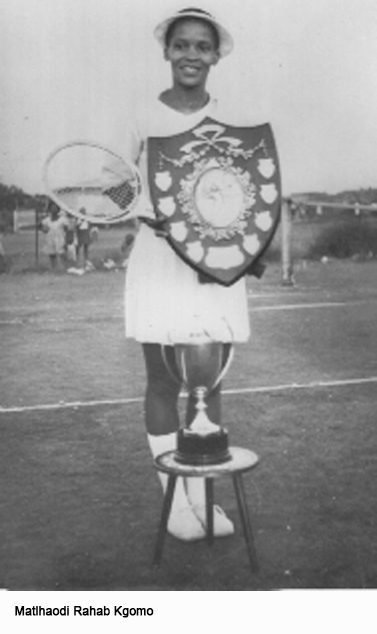 Two years after Miss Kgomo’s birth, the black community of Greater Bloemfontein area were serviced by fourteen clubs. These were Batho; Mangaung; Orangia; Royal Standard; Losareng; Serumola Lawn; Thaba ‘Nchu; Try Again; YMCA; Turkeys; Universal; Happy Hearts; Orange Blossoms and Rosebuds. Based on the available information, the Oriental Lawn Tennis Club was no longer in existence at the start of the 1930s. Membership of these clubs varied from three , (apparently one family who shared the same surname and home address) to 27 active players. The Young Men’s Christian Association (YMCA) Club with 27 members in 1934 was by far the biggest club.
Most of the Batho clubs had both a Coloured and African membership, whereas the four Heatherdale clubs (Universal; Happy Hearts; Orange Blossoms and Rosebuds), were essentially Coloured. In total the black tennis fraternity comprised 125 active players. Given these numbers and what was known of their standard of play, prompted John Mancoe, the compiler of the first Bloemfontein Bantu and Coloured People’s Directory, published in 1934, to remark that
“the Bloemfontein Bantu people have attained a high standard of sportsmanship in the tennis field and there is no doubt that they could stand the test against some of our European clubs.”
References
Botes, S.M., 2014, Bloemfontein gedurende die bewind van president F.W. Reitz, 1889–1895: ’n kultuurhistoriese studie, PhD Dissertation, University of the Free State.
Cleophas, F. & Van der Merwe, F., 2010, “The African Political Organisation’s contribution to South African sport, 1909–14”; African Journal for Physical, Health Education, Recreation and Dance (AJPHERD), Vol. 16, No. 1 (March); pp. 159–177.
Haasbroek, J., 1997, “Die sosiale en vermaaklikheidslewe van die swart inwoners van Waaihoek, Bloemfontein tydens die Oranjerivierkolonie-tydperk (1900–1910)”, Navorsinge van die Nasionale Museum Bloemfontein, vol. 13, Part 4 (September), p. 150.
Mancoe, J. 1934. Bloemfontein Bantu and Coloured People’s Directory. Bloemfontein: AC. White.
Odendaal, A., “South Africa’s Black Victorians: Sport, race and class in South Africa before Union”, in J.A. Mangan, Profit, Pleasure and Proselytism: British Culture and Sport at Home and Abroad, London: Cass.
Schoeman, K., 1980, Bloemfontein: Die ontstaan van ’n stad, 1846–1946. Cape Town: Human & Rousseau; p. 220.
“Redoubtable Rahab”, Stangen News, 5 August 1987.
Wilson, E., 2015, Love Game – A History of Tennis from Victorian Pastime to Global Phenomenon, London: Serpent’s Tail.


Comments are closed.