


Wonderwerk Cave is situated midway between Daniëlskuil and Kuruman on the R31 along the eastern slopes of the scenic Kuruman Hills in the Northern Cape Province. Its rich archaeological legacy including prehistoric rock art continues to captivate archaeologists and historians even after over 85 years of intensive excavation and research.
The Northern Cape is South Africa’s largest, driest and least populated province, yet it offers visitors an immense variety of natural and cultural landmarks. Holidays to the Kgalagadi, Namaqualand, Augrabies Falls or the Richtersveld can be enhanced by stopping at several important heritage sites along the way. One such point of attraction is Wonderwerk Cave, scenically situated along the eastern edge of the Ghaap Plateau.
Wonderwerk Cave is an ancient solution cavity within the dolomitic Ghaap Plateau Formation, which underlies the characteristic Asbestos Hills banded ironstone. The latter is the World’s premium source of tiger’s eye, a lustrous semi-precious gemstone. The formation of the cave may date back to 2.4 billion years, as evidenced by the presence of fossilised stromatolites in the cave’s dolomites, which are some of the earliest forms of life. Wonderwek Cave has a rather simple structure, extending as a fairly level, nearly straight tunnel for more than 140 metres into the mountainside.
Arguably more fascinating than Wonderwerk Cave’s geological history is its archaeological heritage. Hominids have lived in and utilised the cave for almost two million years. During historical times in the early 20th century, the cave served as the temporary home of the farm owner Mr P. Bosman and his family until their farmhouse was built. The cave was known for a thick layer of bat guano, which extraction for the fertilizer market continued until the 1940s, when stone age tools were discovered among the organic material. Archaeological excavations began soon after and are continuing to this day. The importance of the cave’s archaeological sequence soon became clear, and the cave was eventually declared a national monument in 1993. The site is currently under the custodianship of the McGregor Museum in Kimberley.
The earliest evidence of a hominid presence at Wonderwerk Cave are Oldowan hand axes likely manufactured by Homo habilis roughly 1.8 million years ago. The transition to the use of more refined Acheulean stone tools occurred around 1.1 – 1.5 million years ago. The site also yields the earliest known evidence of the controlled use of fire, dating to around 800,000 years ago.
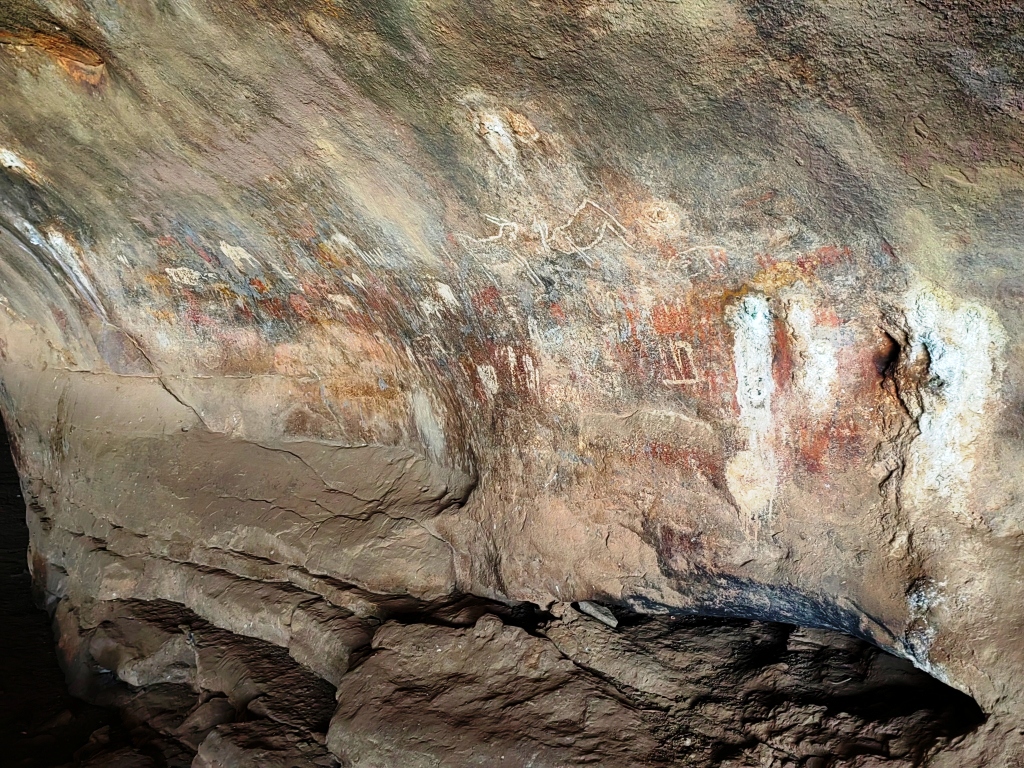
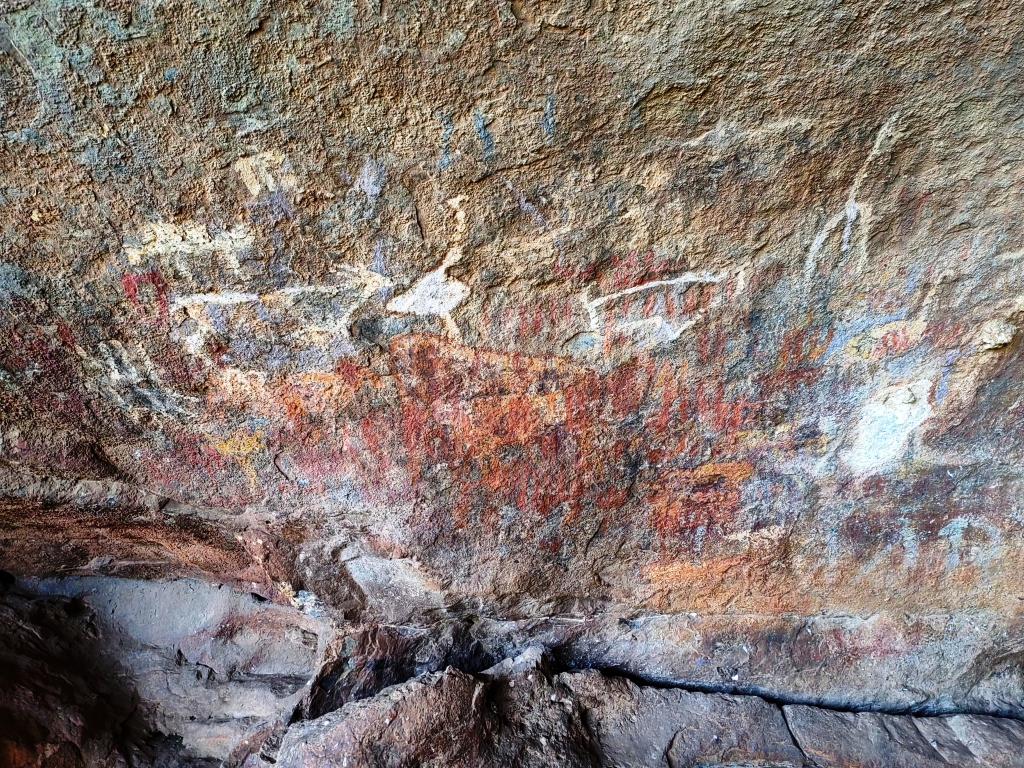
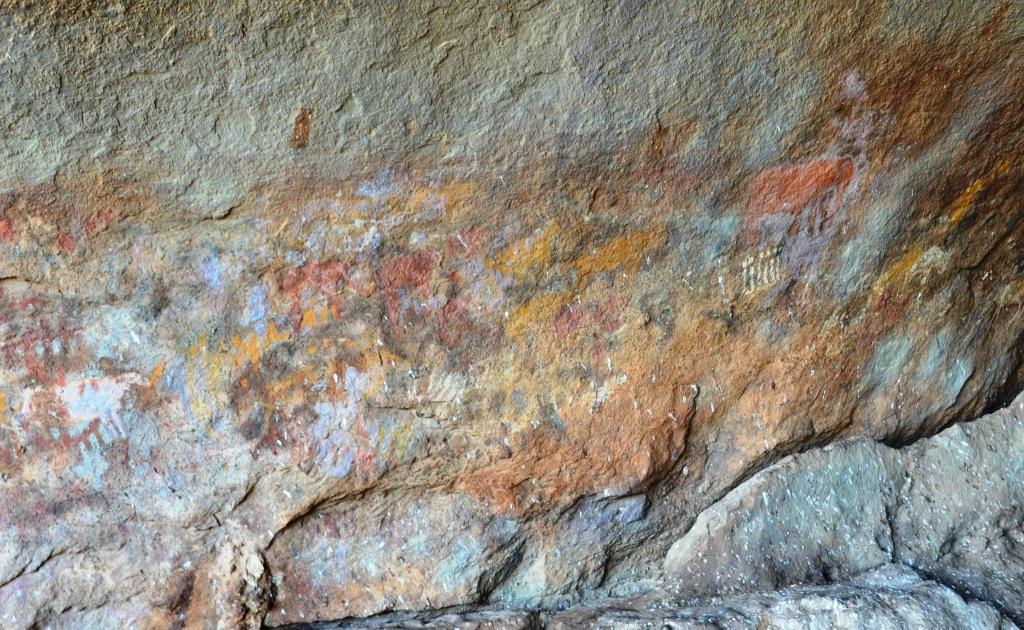
During the Later Stone Age from about 30,000 years ago up to historical times, San hunter-gatherers and later Khoe herders adorned the walls of the cave with varied, colourful imagery. Some engraved stone fragments or art mobilier (portable art) have also been excavated here. The most significant example depicts the hindquarters of a zebra with man-made incisions that possibly represent arrow or spear wounds. This may reflect a ritual practice where objects are used to enact a real-world scenario with the intention of it becoming true, in this case a successful hunt.
The coarse and uneven rock face makes the application of fine-line brush paintings difficult, as demonstrated by a comparatively crude style of images. The later abstract Khoe finger paintings are similar to other examples of this technique in South Africa and consist mostly of comb-shaped geometrics. Animals depicted in the rock art of Wonderwerk Cave include the elephant, giraffe, eland, ostrich, antelopes and felines.
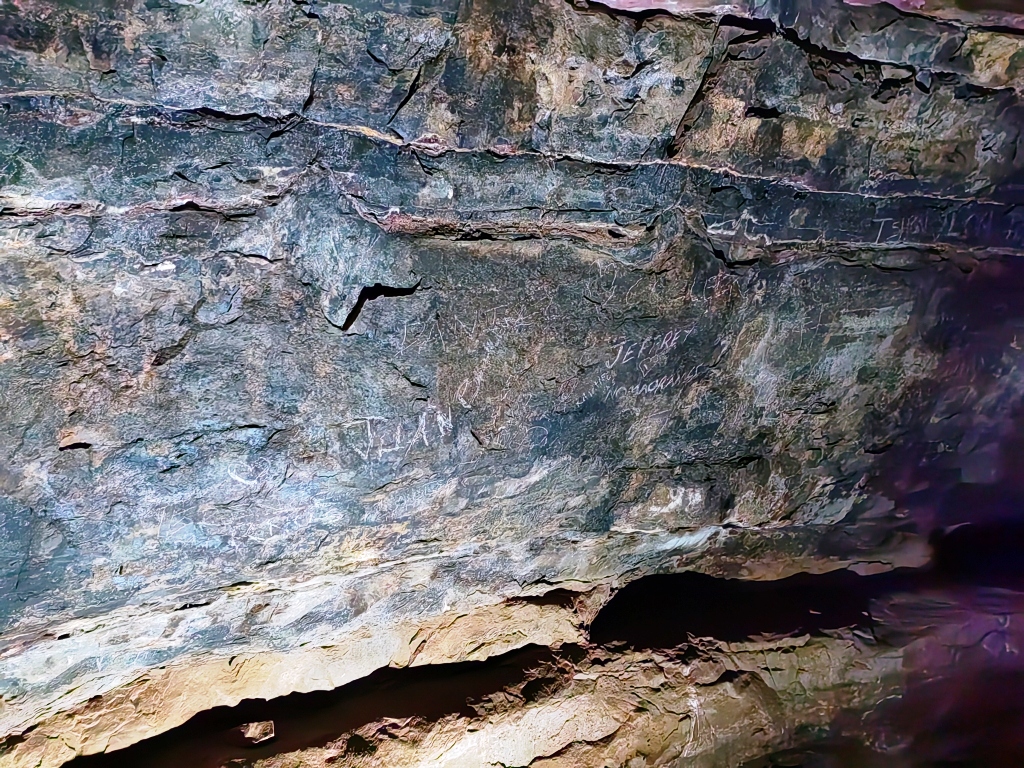
Graffiti and vandalism were noted as a problem at Wonderwerk Cave as early as 1906. Unfortunately, a lack of knowledge about the cultural value of the art compounded by unrestricted access led to a large scale desecration of the imagery. In 1993, just when the cave gained the national monument status, a forensic artist Stephen Townley Bassett embarked on a cleanup process to remove much of the graffiti and dust accumulation. His endeavour was largely successful, with much of the imagery now more clearly visible than before. A barricaded raised boardwalk was constructed in 2016, which leads visitors all the way to the end of the cave while protecting the rock art.
Visitors to Wonderwerk Cave are required to pay a nominal fee at reception, where the museum provides valuable information about the site.
APPROPRIATE BEHAVIOUR AT ROCK ART SITES
- Never touch the art.
- Never spray liquid onto the rock art.
- Never write, make scratches or marks on the rock art or the rock surface within 10m of the rock art.
- Never step on rock art, including engravings.
- Do not kick up dust in a rock art site.
- Make sure your bags or clothing do not touch or rub against the rock art.
- Do not take any archaeological artefacts from the rock art site.
- Please supervise children and other uninformed individuals; the rock art is fragile, irreplaceable and of tremendous historical and cultural value.
- Visit rock art sites with a trained guide or an informed person where possible.
Sources
Horwitz, L.K. & Chazan, M. 2015. Past and present at Wonderwerk Cave (Northern Cape Province, South Africa). African Archaeological Review 32: 595–612. https://doi.org/10.1007/s10437-015-9208-5
Lewis-Williams, D. & Dowson, T.A. 1989. Images of power: Understanding Bushman Rock Art. Johannesburg: Southern Book Publishers.
Thackeray, A.I., Thackeray, J.F., Beaumont, PB. & Vogel, J.C. 1981. Dated rock engravings from Wonderwerk Cave, South Africa. Science 214(4516): 64–67. https://doi.org/10.1126/science.214.4516.64
List of Figures





Comments are closed.