

The Queen Anne pistol was a flintlock that derives its name from the era in which it first appeared. While any gun from the years 1702 to 1714 could technically be called a “Queen Anne”, it is the turn-off pistol (barrels unscrew at the breech) that has become synonymous with the name.
Unlike most firearms of this era, which were loaded from the muzzle, the turn-off barrel enabled the Queen Anne pistol to be loaded from the breech end. This meant it could take a slightly oversized ball instead of an undersized ball that had to be patched for muzzle-loading. It was said that this breech-loading system made the gun shoot ‘harder’ because upon ignition the larger ball was forced through the bore and this made for a more gas-tight seal and in turn gave more power (velocity) to the projectile. In muzzle-loading, the ball is often bruised and deformed when ramming it down the muzzle. This of course was not the case in this type of loading, thus offering better accuracy. Also, turn-off pistols were frequently rifled, further increasing their accuracy and the range of the gun.
The accuracy of the turn-off pistol was proved on 13 September 1642 when Prince Rupert, nephew of King Charles I of England, demonstrated the capabilities of his screw-barrelled pistols to his uncle by shooting at a weathercock on the roof of a church some 180 feet (roughly 55 meters) away. The bullet pierced the tail of the cock. The king was astounded and declared it a lucky accident, whereupon the prince promptly repeated it with his other pistol.
Another mechanical advantage the Queen Anne pistol offered over other firearms of the time was the combined breech and lock, i.e. the lock plate and the lower grip tang were forged in one unit with the breech. The internal parts of the lock were screwed and fastened to this solid structure. The main spring was attached to the lower grip tang, and this made for a very sturdy and sound mechanism. In theory it was possible that, if one of these pistols was dropped and the wood broke off completely the pistol would still be operable. This would not have been possible with the more common side-lock pistols of the period.
It was the combination of accuracy, speed and durability that made the turn-off pistol such a favourite. Pirates and highwaymen were especially noted for the large number of guns that filled their pockets, hung from their belts, or were tied to ribbons. There was no time for re-loading once a ship had been boarded or a fight had begun, and it was therefore a good idea to have several shots available. Even the notorious Captain Jack Sparrow carried a Queen Anne pistol! At the end of the movie Pirates of the Caribbean: On Stranger Tides, the character of Jack Sparrow hands a turn-off pistol to Angelica, saying “One pistol. One shot.”
In 1807, Reverend Alexander Forsyth invented the percussion system which rapidly eclipsed the flintlock. One of the great virtues of the percussion design was that pistols could be manufactured to any size, even very small pieces were easily stowed in a pocket. As the century progressed, the larger and longer-barrelled guns (like the one used by Prince Rupert) became more and more refined until they were the most popular designs of pocket pistol. Also known as “muff pistols”, they were made especially for ladies, to conceal in their hand-muffs, from which the gun could easily be drawn to stop any villain in his tracks.
The caplock system was also much simpler than the flintlock mechanism, with fewer parts, making the overall contour smoother and less likely to catch and tear a pocket or leave the owner struggling to free the gun while his target gets away. Moreover, this simpler device also greatly reduced production costs, therefore rendering guns affordable by more people during the industrial revolution. Gunmakers all over the world jumped at the opportunity to meet the ever-growing demand, churning out thousands of these single-shot pocket pistols.
There are seven Queen Anne-type pistols in the National Museum’s firearm collection: Three have flintlock mechanisms and four featuring the caplock system (all .45 calibre).
How to load a turn-off pistol
To load this type of pistol one first unscrews the barrel from the chamber (hence the name turn-off pistol) before filling it to the brim with black powder. In doing so the shooter will always obtain the same charge, thus increasing the accuracy of his/her shooting. A ball is then placed securely on top of the chamber’s cup and the barrel screwed tightly back in place.
The barrel is tapered from the breech to the muzzle, another nifty feature to ensure that the ball does not roll out through the barrel. The ball therefore stays in place and holds the black powder in the chamber without any wadding.
References
Barkes, R. 2016. Ladies’ deadly little beauty in ManMAGNUM, Vol.41: 16–18.
Peterson, H.L. 1962. The book of the gun. London: Paul Hamlyn.
http://americansocietyofarmscollectors.org/wp-content/uploads/2013/05/B028_Chalapis.pdf (21.09.2017).
http://firearmshistory.blogspot.co.za/2015/05/queen-anne-pistols.html (18.09.2017).
http://www.gentlemenoffortune.com/arms.htm (18.09.2017).

The Queen Anne pistol (G2702) became synonym with the so-called turn-off pistols – pistols with barrels that unscrewed at the breech. (Photo: National Museum)
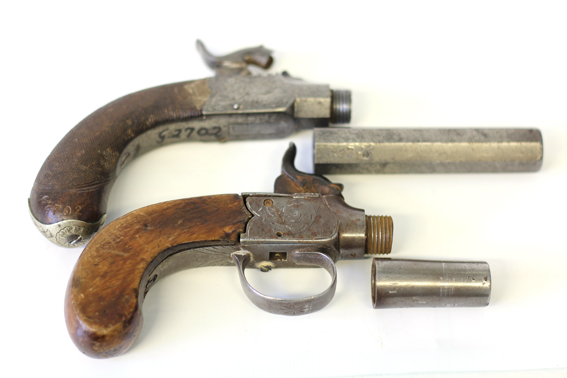
The barrels of the Queen Anne pistol varied in sizes; a longer barrel (top, G2702) enhanced accuracy while a shorter barrel (bottom, G3161) made the pistol less noticeable. (Photo: National Museum)
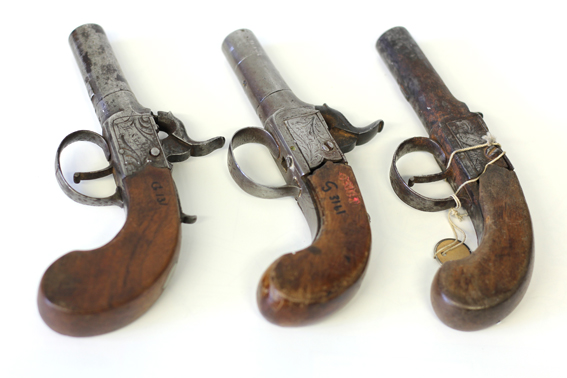
Flat-sided grips (fltr G131, G3161, G499) were cut from planks with little or no shaping and decoration to further cut down on manufacturing costs. (Photo: National Museum)
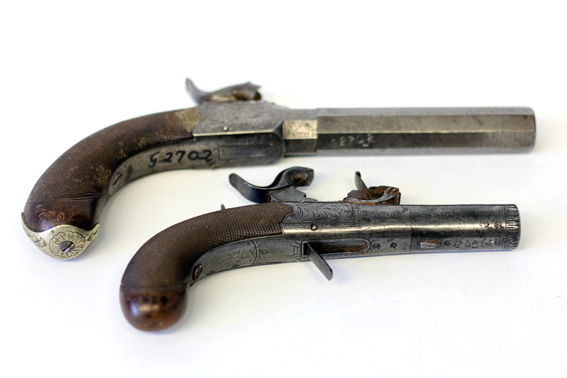
Another clever development found on some pocket pistols (top to bottom G2702, G134) was a folding trigger that popped out only as the gun was cocked to make the gun even smaller, and streamlined it for a quick draw from the pocket. (Photo: National Museum)
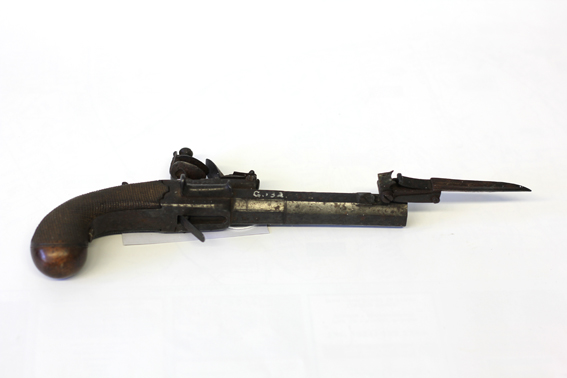
Some pistols (G132) even had “extras” like spring bayonets. This tiny dagger folded back along the underside of the barrel until a latch was released and a spring swung it out into stabbing position. However, with a blade little more than 5 cm, it was probably seldom used for stabbing. (Photo: National Museum)
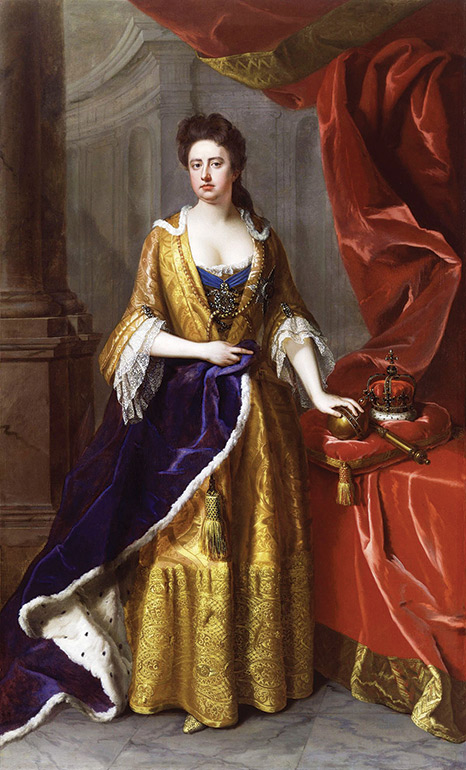
Queen Anne, the last of the Stuart monarchs and the first sovereign of Great Britain, reigned from 1707 to 1714. (Photo: www.wikipedia.org)
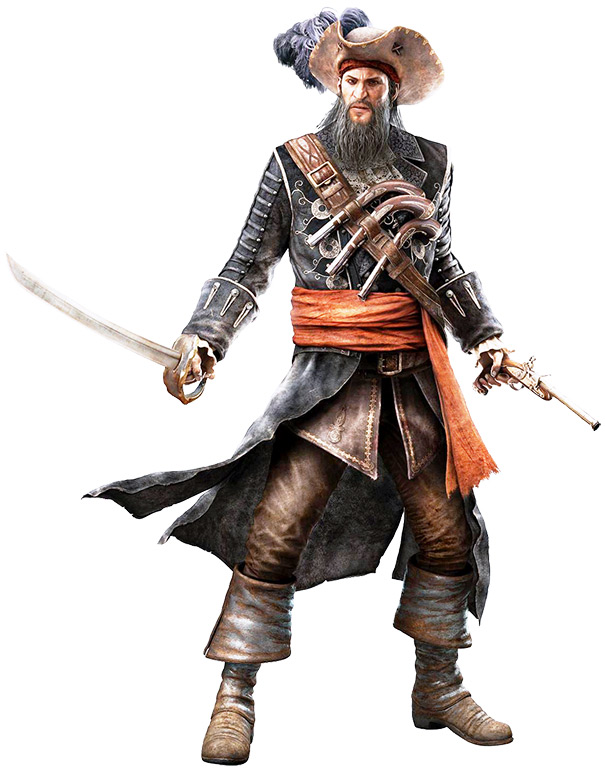
The Queen Anne pistol was a favourite with the pirates, as can be seen in this illustration of Blackbeard, a legendary English pirate who operated around the West Indies and the eastern coast of the American colonies during the early 18th century. Note the Queen Anne pistol in his left hand, as well as the three other pistols tucked in his belt, ready for action. (Photo: http://assassinscreed.wikia.com)



Comments are closed.