

In 1958 the Bloemfontein Group of artists (hereafter BG) was formally established under the leadership of Prof. Frik Scott, with the support of his wife Dora. The founding members of the group were Frans Claerhout (1919–2006), Reneé le Roux (b. 1927), Alexander Podlashuc (1930–2009), Eben van der Merwe (b. 1932) and Marianne Podlashuc (1932–2004). Within a ten-year period the Group expanded to include Mike Edwards, Fayetta and Neville Varney, Arthur Cantrell and Walter Westbrook (all joining in 1961), and Iris and Stephan Ampenberger, who joined in 1963. The founding members of the BG, created the group with the intention of sharing ideas, producing art together, and expressing their frustrations with what they understood as the narrow-minded and conservative Free State art world.
The geographical position of Bloemfontein as the central city of South Africa might suggest it as an obvious focal point for national cultural activity. However, art life in the Free State has seldom evinced much dynamism. Local art societies, the Orange Free State Art Society and the Free State branch of the South African Art Society, had tended to be extremely conservative and unadventurous, and the advantages of the location of its main city were never exploited. The BG intended to hold exhibitions that challenged the limitations of Bloemfontein’s embryonic art scene. While their individual artworks differed in visual appearance, they shared a modernist sense of painting practice. The BG worked together for about ten years.
The BG played a vital role in the establishing of an artistic environment in the Free State. The artworks the BG showcased revealed European influences that contained elements of abstract and expressionistic painting techniques. This can be seen in the works of Frans Claerhout, Renée le Roux, Eben van der Merwe and Iris Ampenberger (1916–1981). These techniques were not often practised in the Free State and were quite unfamiliar to Bloemfontein art enthusiasts and artists.
Most sections of the Bloemfontein art community were somewhat narrow-minded. The lack of an art museum contributed to this conservatism, and the two art societies within this small artist community, guided by their ‘elitist’ members, did not change this mindset. Locally, the Bloemfontein Group’s work was not seen as noteworthy enough to form part of local exhibitions. On a national level their work was received with high praise. With the support of local art patrons (the Scotts’) the BG continued to work together and despite of the resistance from local art societies their careers flourished nationally and abroad. Only during the late 1970s was some of the BG members’ work included in the annual exhibitions of the societies.
Prof. Scott and his wife Dora continued to support the BG and all their endeavours. Scott passed away in 1976. His wife and children then established the F.P. Scott Trust with 24 artworks produced by the BG. On the 30th anniversary of the formation of the BG, the Trust donated these 24 artworks to the National Museum. It was the first collection of artworks exclusively by Free State artists and became the first collection of artworks at Oliewenhuis Art Museum when it opened in 1989.
The mockery and satirical images of Marianne Podlashuc provided an indication of the Group’s frustrations, but also reflected the determination of like-minded kindred spirits to change their environment regardless of being excluded. This defined the BG as the avant-garde leaders in the Bloemfontein art community. Ars Brevis, vita longa (“Art is brief, life is long”) becomes an iconic image, as it provides insight into the Orange Free State art society. The title of this drawing is like a symbolic stance expressing what the society stood for.
Yolanda de Kock completed her M.A. dissertation Donation and Trust: The Bloemfontein Group and the Free State Art Scene, 1950–1989 in August 2017. The dissertation is an analysis of the Free State (formerly Orange Free State) art scene at that time, conducted primarily through an account of the Bloemfontein Group.
References:
Berman, E. 1994. Art and artists of South Africa: an illustrated biographical dictionary and historical survey of artists since 1875. South Africa: Southern Book publishers.
De Kock, Y. 2017. Donation and Trust: The Bloemfontein Group and the Free State Art Scene, 1950-1989. MA dissertation, University of the Witwatersrand.
Scott, F. 2012. Stylistic Links: The Bloemfontein Group and other South African Artists. Unpublished catalogue. Oliewenhuis Art Museum.
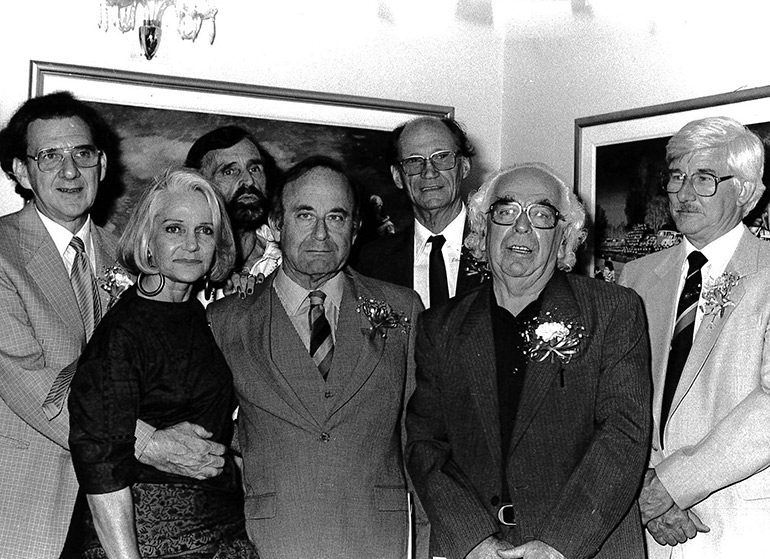
The Bloemfontein Group in 1988 at their 30-year anniversary exhibition at Oliewenhuis Art Museum. Back from the the left: Eben van der Merwe, Arthur Cantrell, Walter Westbrook and Mike Edwards. Front from the left: Renée le Roux, Alexander Podlaschuc and Frans Claerhout. (Photo: Oliewenhuis Art Museum)
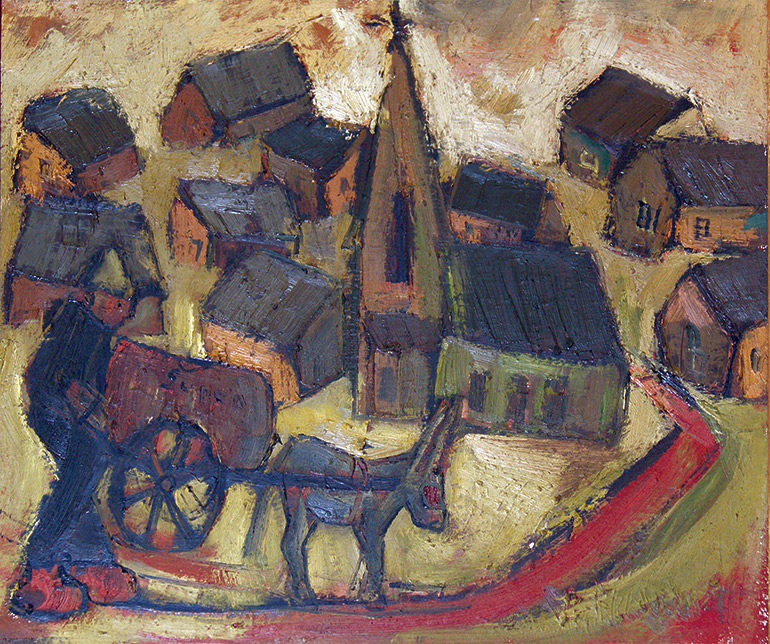
Frans Claerhout, Church, Oil on board, 59 x 50 cm. (Photo: Oliewenhuis Art Museum)
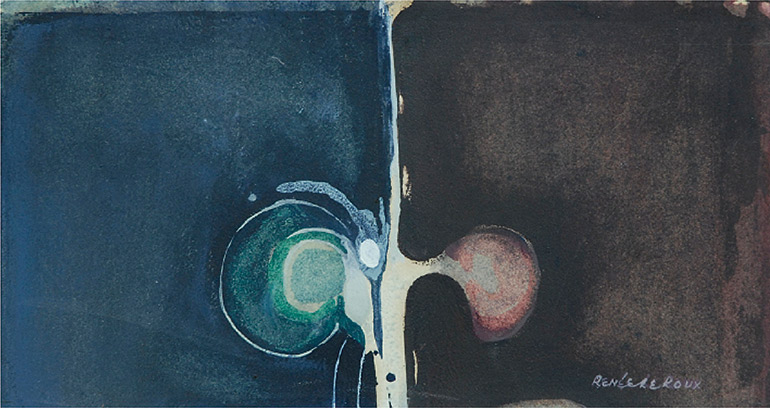
Renée le Roux, Abstract, Water colour on paper, 16 x 35 cm. (Photo: Oliewenhuis Art Museum)
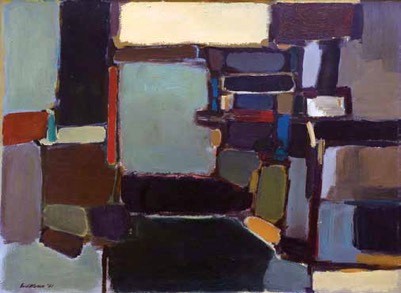
Eben van der Merwe, Autumn landscape, Oil on board, 78 x 61.5 cm. (Photo: Oliewenhuis Art Museum
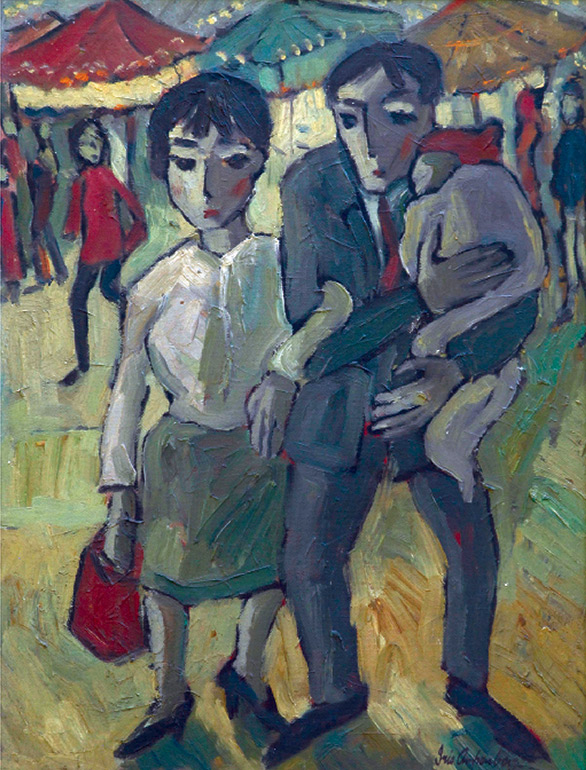
Iris Ampenberger, Young Couple, Oil on board, 60.5 x45.5 cm. (Photo: Oliewenhuis Art Museum)
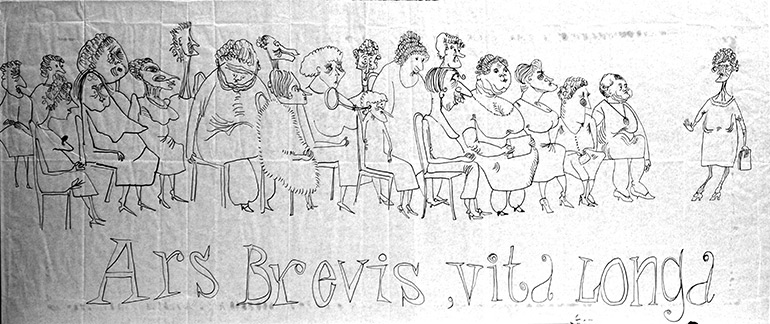
Marianne Podlashuc, Ars Brevis vita longa, Pen on tracing paper, 29 x 69cm. (Photo: Fred Scott private art collection)

Comments are closed.