


Since the early 19th century collecting bird eggs was a popular hobby for naturalists worldwide. Many private collections were later donated to museums for curation. Egg collecting and the study of eggs is known as oology which is one aspect of ornithological research. Egg collectors mostly collect eggs from birds’ nests for their own private collections. In some instances these collection holders donate their collections to natural history museums to curate these egg collections. Several South African museums today have egg collections, some small and several held large collections. This article gives a brief overview of egg collecting, highlights some examples of eggs in the National Museum Ornithology collections and outlines current practices regarding bird nests and eggs for photographic documentation.
This practice started in Britain and the United States around the 1800s and later expanding worldwide. Most collectors will observe bird and breeding behaviour and then collect or “rob” the total clutch, later curating the eggs for their private collections. Not all collectors keep detailed notes on their collections. Such notes, if kept, contain valuable data concerning breeding biology, locality details and dates of collection that can later be used by researchers. So popular was this hobby that egg collectors used to trade with other collectors to add to their collections. Unfortunately, these collectors went to extreme lengths to collect bird eggs and this has impacted negatively on bird populations. In the UK there were cases of egg collectors prosecuted by law and imprisoned for up to 6 months. One collector was imprisoned six times, and later fell to his death when climbing a tree to reach a nest. Poetic justice indeed! In 2005 and 2021 there were still cases of illegal egg collecting in the UK. Today egg collection is prohibited by legislation in many countries including South Africa, and most of the private egg collections have been donated to museums for curation.
Preparation of eggs for private and museum collections
Once an egg is collected the first step is to empty the shell of its contents. This process is known as “blowing”, and entails drilling holes into the shell with a sharp object. This can be done at both ends or in middle of the egg. Blowing pipes are used to blow the contents out. In earlier times collectors even had special blowing kits for this process. The egg is then washed using a syringe filled with water or a soapy solution. Once this is completed the egg is stored in its collection locality, in specifically designed cabinets or drawers. Cotton wool is used to line the egg compartment for storage. The final step is to record the details of the egg, usually written with Indian black ink, and most collectors also capture the egg clutch details on a catalogue card for storage.
Only a few South African museums have egg collections that are curated. These are: Ditsong Museum (more than 1600 clutches), Durban Museum (more than 1730 clutches), and smaller collections at East London Museum and Iziko Museums. Although the collection in the National Museum, Bloemfontein, is relatively small (540 clutches of about 280 species), it includes egg clutches not only from southern Africa but also from abroad. Importantly, most of them have significant historical value and were collected from the 1870s to the 1940s. Most of the egg clutches have European origins and were acquired when the National Museum was established in the early 1900s. These egg collections have great historical value regarding the year of collection, name of collector and most importantly the historical locality data.
In my description of some egg clutches in our collection, I discuss the historical origins as well as the distributional record of value of the collection. The clutches are from Europe, Asia, Australia and southern Africa. Some examples are such species as Steppe Eagle (from Russia), Manx Shearwater (a small albatross species) and the Common Pheasant (from the UK). Here follow a few interesting foreign clutches in the collection.
Common Murre or Guillemot
A clutch of 3 eggs that originate from “Barra Head” – the southernmost island of the Barra Island archipelago of the Outer Hebrides in Scotland. Common Guillemots are a large Auk species occurring in the low Arctic waters in the northern Atlantic and Pacific oceans. They spend most of their time at sea, coming to land to breed in large colonies on rocky cliff shores or islands. Their eggs are large and pointed at one end. These pear-shaped eggs are called pyriform shaped eggs. The shape allows the egg to spin on its axis in an arc when disturbed. This prevents the egg from falling out of its nest and offers more stability for nests on the cliff face.
Razorbill or Razor-billed Auk
The only egg in this collection originates from the Shetland Islands in the Northern Atlantic between Great Britain, the Faroe Islands and Norway. The Razorbill has a parrot- like bill with sharp edges (an adaptation to hold onto captured fish) and is similar to the Guillemots in that it is a colonial sea bird. They occur in the sub Antarctic waters of the Atlantic Ocean and nest on open cliff ledges, in cliff crevices or among rock boulders. Their eggs are an ovoid-pyramidal shape in a cream colour with dark brown blotches.
Great Bustard
The egg in the Great Bustard collection is of Russian origin, but this bird occurs in open grassland areas in North Africa, central Europe and eastern Asia. These species have what is known as a lekking breeding system, where a single male breeds with up to 5 females. The male has an interesting display behaviour towards the females. It puffs up its plumage, perhaps to make itself look bigger. One to three olive or tan coloured eggs are laid on a shallow scrape on the ground near the lekking location. Different nests can be 9 metres apart.
Southern Cassowary
The only egg in the Southern Cassowary collection originates from Australia. The Southern or Australian Cassowary is a large flightless bird (related to the African Ostriches), with a distribution range that includes Indonesia, Papua New Guinea and northern Australia. They nest on the ground on plant material layered like a mattress of up to 10cm thick and 100 cm wide. Their clutches have 3 or 4 eggs with a granular surface. They are initially bright pea-green, fading with age.
Jacana eggs from the Cottrell collection
These eggs were donated by a collector from Lesotho, and after examination it was determined that some of the eggs in this collection were collected by the natural history collector J. Cottrell. Cottrell lived in Lesotho from 1911 to 1930, where he was an inspector of schools who later moved to Zambia. His collection consists of egg clutches of African and Lesser Jacana, ducks, geese and owl species collected from 1927 to 1954. They were collected from South Africa and the upper Zambezi River area in Zambia. Some of these egg clutches still have their catalogue cards and have significant historical value.
Conclusion and current practices
Today egg collecting by public collectors is prohibited by law. In South Africa researchers require permits and most museum ornithologists do not collect eggs from birds’ nests, unless it is essential for their research. Donations are still received, for example Martial Eagle eggs were donated to the National Museum after the female abandoned the nest that was situated in a cellular phone tower. Current practices mandate that staff of these mobile networks no longer visit occupied towers until the nestlings have successfully fledged.
Egg collections are also referred to for illustrating birds’ eggs in books and field guides. The collector’s notes and descriptions are useful for species breeding biology that are published in reference books and field guides. The first book published on South African bird eggs, using museum egg collections, was that by Priest, entitled Eggs of southern African birds, published in 1948 and revised in 1971. The images of the eggs were drawn on colour plates accompanied by descriptions of the eggs, the clutch sizes and sizes of the eggs, nest sites and breeding season. In 2001 Warwick Tarboton published A guide to the nests and eggs of southern African birds, which was revised in 2011. This guide used photographs of museum egg collections and, for the first time, photographs of actual bird nests containing eggs or nestlings.
The current trend is to document nests photographically and submit the images to virtual museum platforms (such as INatuaralist) for digital curation. This is a less harmful way of “collecting eggs” and can be a much more rewarding hobby. Caution must be taken to avoid any disturbance to the nest. Ground nesting birds such as Crowned Lapwing and Spotted Thick-knee build their nests mostly exposed on the ground. Some birds such as the Plain-backed Pipit and Cape Teal conceal their nests amongst tufts of grass or in thick grass. Other birds’ nests are mostly in trees, concealed by branches and leaves, such as the Streaky-headed Seedeater and Cape Canary, or on krantzes (Bearded Vulture). Others, such as the Pied Crow, have adapted to using man-made structures.
In conclusion, it is always important to put the bird’s wellbeing first and to avoid any unnecessary disturbances at nest sites. Today researchers must obtain ethical clearance from their institutions to do breeding biology studies on birds’ nests and certain measures are put in place to minimize disturbances at the nests they monitor. Locations of nest sites, especially Red Data or raptor species, must never be shared on social media because unauthorised visitation to the nest site can cause a disturbance.
References
Allan, D.G & McInnes, A.M. 2002. A catalogue of birds’ eggs in the Durban Natural Science Museum. Durban Museum Novitates. 27: 3 – 27.
Cole, E. 2016. Handle with care: historical geographies and difficult cultural legacies of egg-collecting. University of Glasgow. United Kingdom. Unpublished PhD thesis.
Golembiewski, K. 2016. The lost Victorian art of egg collecting. The Atlantic (https://www.theatlantic.com/scuience/archive/2016/03/the-lost-victorian-art-of-egg-collecting/475476/)
Gunning, J.W.B. 1911. Transvaal Museum collection of South African bird’ eggs. Annals of the Transvaal Museum. 3: 20 – 28.
Moffett, R. 2014. A biographical dictionary of contributors to the natural history of the Free State and Lesotho. Sun Press. Bloemfontein.
Tarboton, W.R. 2011. Roberts nest & eggs of southern Africa. Trustees of the John Voelcker Bird Book Fund: Cape Town.
Winterbottom, J.M. 1971. Priest’s Eggs of southern African birds. Winchester Press: Johannesburg.
https://en.wikipedia.org/wiki/Razorbill
https://en.wikipedia.org/wiki/Guillemot
https://en.wikipedia.org/wiki/Greatbustard
https://en.wikipedia.org/wiki/Southerncassowary
https://en.wikipedia.org/wiki/Oology
 Figure 1: A three egg clutch of the Common Murre or Guillemot in the egg collection of the National Museum.
 Figure 2: The ovoid-pyramidal shape of the Razorbill egg in the egg collection of the National Museum.
 Figure 3: The egg of the Great Bustard from Russian origin in the egg collection of the National Museum.
 Figure 4: A two egg clutch of the Southern Cassowary from Australia in the egg collection of the National Museum.

 Figure 5: An African Jacana egg clutch of the Cottrell collection from the upper Zambezi river area in Zambia. The catalogue card with its collection details is dated 9 March 1935.
 Figure 6: A ground nesting Crowned Lapwing with camouflaged eggs on a scrape on the ground.
Photographer – Dawie de Swardt.
 Figure 7: The Spotted Thick-knee is mostly a nocturnal species which also lay its eggs on a bare patch on the ground between small stones or animal droppings. Photographer – Dawie de Swardt.
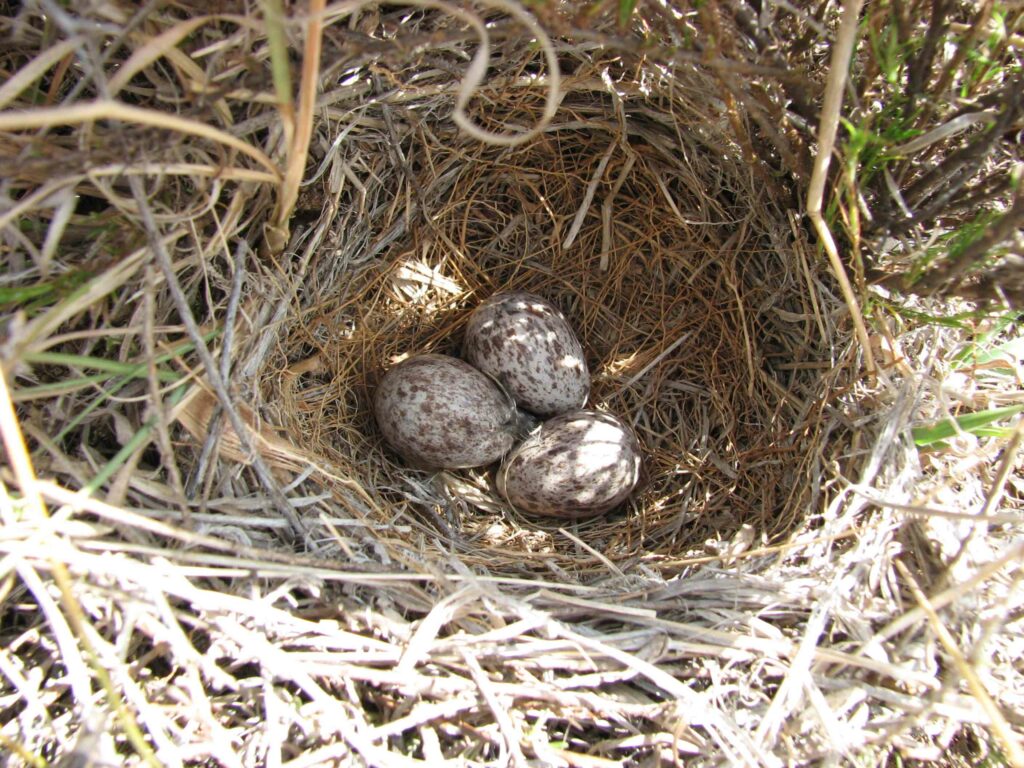 Figure 8: Ground living passerine species such as the Plain-backed Pipit concealed their nests between grass tufts and rocks on a hilly slope or in grassland. Photographer – Dawie de Swardt.
 Figure 9: Ducks and teals mostly use nest sites away from water like this seven egg clutch of a Cape Teal nest well concealed in the grass. Photographer – Dawie de Swardt.
 Figure 10: A Streaky-headed Seed-eater nest with blue eggs concealed by the foliage of a bush.
Photographer – Dawie de Swardt.
 Figure 11: A clutch of a Cape Canary camouflaged by the foliage of a bush. Photographer – Dawie de Swardt.
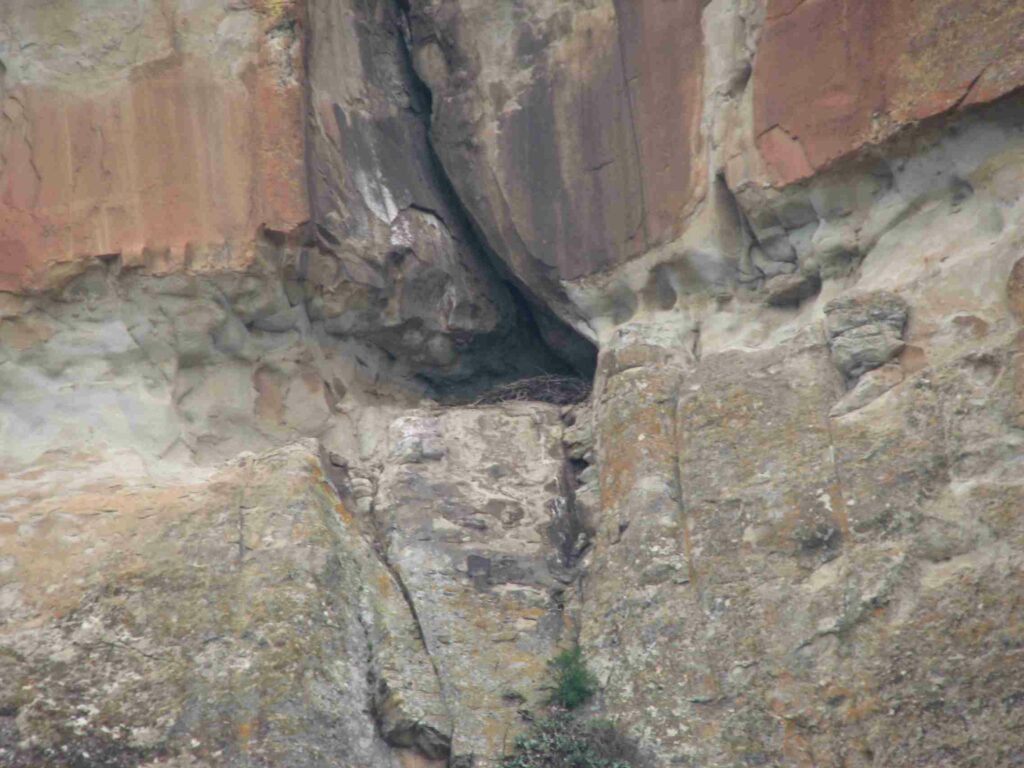 Figure 12: This is one of the last natural nest site of Bearded Vulture in the Free State photographed during October 2007 in the Fouriesburg area. Photographer – Dawie de Swardt.
 Figure 13: Pied Crows is known to use wires and other material to build their nests in man-made structures – this nest was built in a wind mill. Photographer – Dawie de Swardt.



Comments are closed.