

Liberation struggle stories from Batho
The National Museum, through the Batho Community History Project, is focusing on the oral testimonies of the people of Batho. Stories that are emerging cover many issues including liberation heritage. The oral testimonies of Kedisaletse Ellen Koloti and Tsietsi Elliot Koloti show how painful this history can be. This article focuses on the life of the late Khuduga Edwin Koloti, also known as ‘Boda’ by his friends and family, or ‘Commander Dipanana’ by his fellow Umkhonto we Sizwe (MK) soldiers.
The 1976 Soweto students riots remain part of an important time in the history of South Africa. Like many young men and women in the late 1970s to middle 1980s in Bloemfontein, Khuduga joined the ANC as a student. He joined the liberation struggle in almost the same way as another unsung hero from Batho, Lehlohonolo Cambridge Moloisane. While Khuduga was able to return to South Africa before 1994, Lehlohonolo was killed in Lesotho during the Maseru Massacre of 1982.
Khuduga was the eighth of ten children of Ishmael and Motshidisi Koloti. Khuduga once told his brother Tsietsi that he wanted to follow in the footsteps of his father Ishmael, a soldier during the Second World War. Ishmael returned home to Bloemfontein with burn injuries and as a result spent a long time at the National Hospital, in Bloemfontein.
Khuduga attended Sehunelo Secondary School, a well-known school in Batho. Khuduga was possibly politically influenced while at Sehunelo due to the level of political activities there. His father tried to dissuade him by explaining that he had gained nothing from the war, but Khuduga was not deterred. Batho and other surrounding townships in the late 1970s to 1980s had a volatile atmosphere. Students from Sehunelo were seen marching to Vulamasango school in Rocklands, and Khuduga’s family saw him taking part. However, when he was asked about the riots, he said: “I am not part of that.” However, when the Special Branch started searching for rioters they also raided his family home in Molokoane Street one night around 1977.
The memory of that night still causes pain to his sister Kedisaletse. When the police kicked the door open Khuduga hid in a laundry basket covered with clothes. The resemblance between the Koloti brothers resulted in the police arresting Khuduga’s younger brother, Radimakatso. Kedisaletse remembers that they assaulted him and took him away, leaving the family without any explanation. After the police left, Khuduga went to hide at his cousin’s home in Rocklands. Kedisaletse and another brother Lebogang braved the curfew laws and went looking for Radimakatso at the nearest hospital, Pelonomi. Upon their arrival they found the police who had beaten their brother, standing guard at his ward. One of the black nurses told them to go in regardless of the presence of the police. They found Radimakatso so badly beaten that they thought he would not survive.
The coloured neighbours of the Koloti family, the Hendricks, advised Khuduga’s mother to move him elsewhere or hide him. Arrangements were made and one Sunday afternoon Khuduga was taken to Thaba Nchu. However, he returned on the Wednesday and on the Friday took a taxi, informing his sister that he would return. Kedisaletse did not know where he went, but that was the last time she saw him until he returned after the CODESA negotiations, just before the first democratic elections. According to Tsietsi, Khuduga told him that he had found a job and would see him soon.
Strangers in neat formal suits once visited Khuduga’s family to inform them that he was in Tanzania and was safe. The strangers introduced themselves as relatives of the Kolotis, but none of them were recognised. They told the Kolotis that he would be seen when the time was right. The Kolotis family concluded that the strangers must be from the ANC. The news brought relief and joy because they were at last sure that Khuduga was alive.
While Radimakatso was on a work trip in Lesotho he met MK soldiers and through them was able to contact Khuduga. The message that he sent home was simply that he was okay. Khuduga narrowly escaped the Maseru Massacre of 1982 by being sent to Mozambique merely a month before the South African Defence Force killed 42 people in an attempt to stamp out the ANC in Lesotho. During his short stay there he received further military training.
Khuduga was then sent to Angola, to stay in Kakulama, the main training center of MK. After the completion of his training he was appointed as crew commander of a unit consisting of four soldiers. They were deployed to the outposts for over a year and then withdrawn to the main base where he was promoted to commander of a platoon consisting of 30 soldiers. It was during his time as commander that another MK camp, the Moses Mabidha Training Camp, was opened. After a period of four to five years Khuduga was promoted to Company Commander in Moses Mabidha Camp. In 1986 he went to the Soviet Union to receive further training. Due to political pressure as a result of the ‘non-aggression’ agreement between Angola and South Africa signed in December 1988, the MK soldiers were divided into two groups and moved out of Angola. One group went to Uganda, while Khuduga’s group went to Tanzania. Shortly afterwards they were sent to Zambia where Khuduga and another MK soldier were sent to infiltrate South Africa via Mozambique.
From the early 1990s until the end of the CODESA talks Khuduga operated in Durban and served in peace-keeping units. When his child and the woman he loved were killed in a bomb attack just before the 1994 elections, he decided to return to Bloemfontein. After the elections he joined the South African National Defence Force and was stationed at De Brug, an army camp just outside Bloemfontein.
Shortly before his death Khuduga wrote autobiographical notes about his turbulent political and military life. He died at the age of 41 on 29 March 2001 after a short illness.
References
Callinicos, L. 2004. Oliver Tambo: Beyond the Engeli Mountains. Cape Town: David Phillip Publishers.
Interviews in Batho, Bloemfontein: Kedisaletse Ellen Koloti, 16.2.2015; Tsietsi Elliot Koloti, 20.8.2015.
Koloti, K.E. My biography (undated).
Letsatsi, P. 2014. Batho’s Liberation Heritage – The story of Lehlohonolo Cambridge Moloisane. Culna 69: 36–37.
www.pressreader.com/south_africa (24.8.2015).
www.sahistory.org.za/topic/umkhonto_wesizwe_mk_exile (24.8.2015).
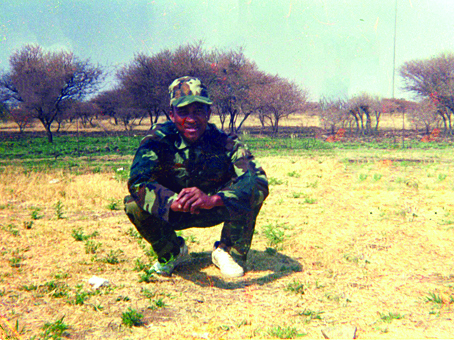
Khuduga as an MK soldier while in exile.
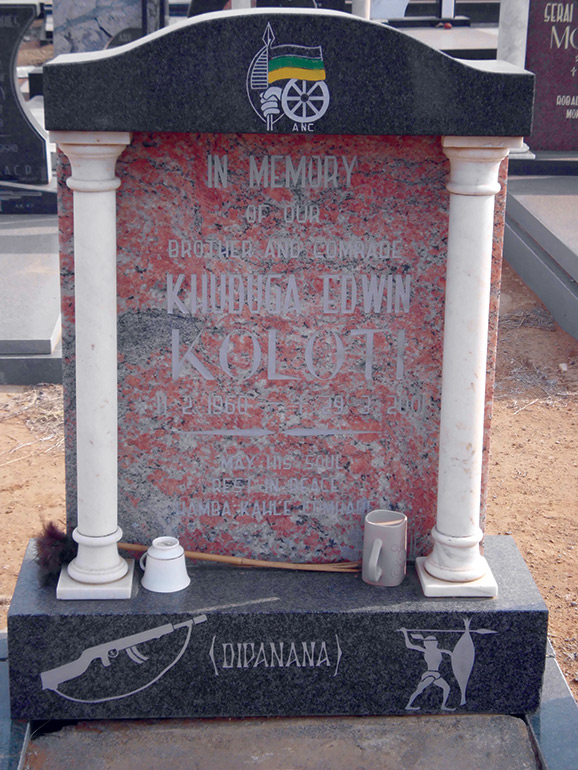
Khuduga was buried at Heroes Acre, Phahameng Cemetery, in Phahameng, Mangaung. On the base of the tombstone, “DIPANANA” is written to show his MK name.

Comments are closed.