

Selected works by Phumulani Ntuli and Thalente Khomo from the ArtBankSA Contemporary Collection
Beyond Walls: Emerging Contemporary Voices, currently on show at Oliewenhuis Art Museum, draws from the ArtBankSA Contemporary Collection to stage an encounter with some of the most urgent enquiries in South African art practice today: questions of intergenerational knowledge transmission, cultural custodianship, contested memory, and the continuous formation of identity.
Amongst the works in this exhibition, two artworks demand particular attention, not because they are the loudest, but because they are the most deliberately quiet. Phumulani Ntuli and Thalente Khomo share an instinct for refusal: both place figures before us whose identities remain inaccessible, and in doing so, they open onto something far larger than portraiture. Their work invites viewers to negotiate their own relationship with inheritance, memory, and the fragile brevity of life. Confronting not only the vulnerability of the figures depicted, but also their own. It is this shared gesture, what this article terms the Refused Gaze, that threads through both artists’ works and anchors the discussion that follows across three interconnected themes: memory, the gaze and the frivolity of life.
Memory: What Remains, What Is Refused, What Endures
Memory, in both Khomo and Ntuli’s artistic practices, is never a passive or straightforward act of recollection. It is physical, contested, institutionalised, and irreversible. Both artists treat memory as something that marks rather than simply records, that scars as much as it preserves.
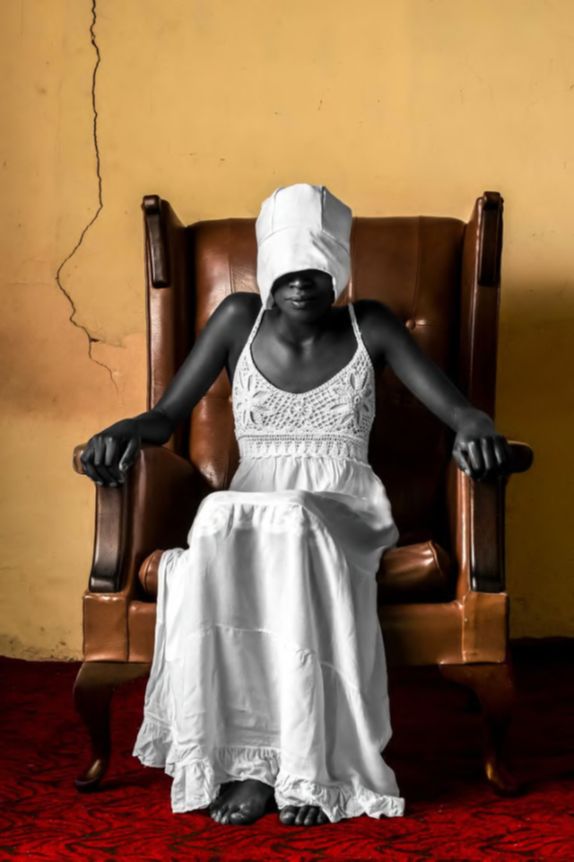
Khomo’s poignant Introspection: Usofa Kagogo (2021) moves through personal traumatic memory, the loss of a beloved grandmother. The brown leather chair at the centre of the composition is no longer merely furniture; it has become what we might call a memory-object, a material residue of a relationship, holding the shape of someone who no longer occupies space in the world. Khomo has spoken of how objects that held deep significance in her childhood carry entirely different emotional weight once the person who gave them meaning is gone. Memory here adheres to surfaces from armrests to the patterned carpet, to the body of the figure who occupies the chair yet her identity cannot quite be seen. That the artist positions herself as subject compounds this layering; the photograph is simultaneously an act of recollection and a restaging of loss, each return to the image rewriting the memory it claims to preserve. As van Dijck observes, “memories effectively are rewritten each time they are activated… Every memory, therefore, is a new memory because it is shaped (or reconsolidated) by the changes that have happened to our brain since the memory last occurred to us” (van Dijck 2007: 32). Khomo enacts precisely this, the photograph does not retrieve a fixed past but reconstitutes it, adding new layers of grief and meaning each time it is encountered.
This quality of memory is active, accumulative, and emotionally charged. Anna-Lena Werner’s argument supports that trauma in art “act[s] as a link, offering multiple curatorial possibilities and unexpected relations that may emerge only by situating specific artworks within a context of trauma and its aftermath” (Werner 2020: 225). Werner’s observation matters here because Khomo’s photograph does not merely depict loss, it solicits it, drawing the viewer into a shared space of mourning where private grief becomes available for collective witnessing.
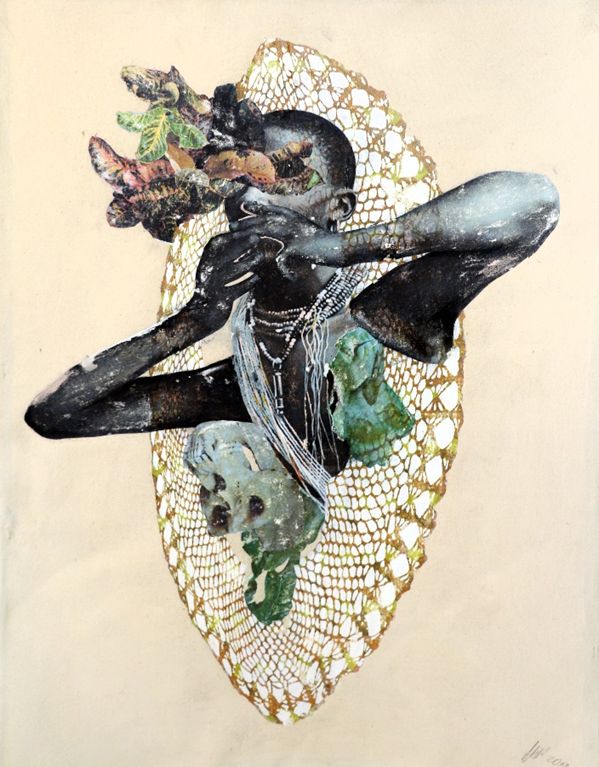
Phumulani Ntuli’s layered mixed-media collage, Homage to Ghassan Kanafani – A hand in the grave – Scene two – Subject unknown II (2019), approaches memory from an entirely different and equally charged position. Where Khomo works from the interior of personal experience, Ntuli works from the contested terrain of literary, collective, and public memory. His work pays homage to A Hand in the Grave, a short story by a Palestinian author Ghassan Kanafani, written in 1962 and translated from Arabic into English by Hilary Kilpatrick (Kanafani 1999). The tale unfolds how two medical students, Nabil and Suhail, who were unable to afford human skeletons required for their anatomy class. A skeleton cost 75 lire, an amount neither of their families could pay. Faced with the indifference of institutional structures to their poverty, the two students resorted to robbing graves, digging up human remains to continue their studies (Kanafani 1999: 89–98).
That this is a work of fiction rather than documented event does not diminish Ntuli’s engagement with memory, it deepens it. Kanafani’s story, though invented, has accumulated the cultural weight of collective memory precisely because it names something true about structural dehumanisation, the commodification of deceased, and the unsympathetic demeanour of institutions to the poor and the marginalized, a stark reality of what many South Africans still experience today.
Ntuli’s title — Scene two — Subject Unknown II is significant here: he does not illustrate Kanafani’s narrative but extends it, constructing what might be understood as an imagined continuation. The anonymous figure Ntuli introduces adorned with beadwork, obscuring their face with indigenous plant material, bearing the institutional label Subject Unknown—represents a second scene that Kanafani never wrote, a layer of memory built upon the memory of the story itself. In staging this continuation, Ntuli shifts the register from the Palestinian literary memory toward the specific violence of the colonial archive: the African body rendered into specimen, simultaneously hypervisible as object of study yet stripped of personhood and interiority.
Achille Mbembe’s analysis of colonial archives speaks directly to this. Drawing on Foucault and Derrida, Mbembe argues that archives do not transparently document historical reality but construct particular versions of the past through practices of selection, classification, and exclusion, determining not merely what gets preserved but how the past itself can be known and narrated (Mbembe 2002, 2015). Colonial archives systematically erased indigenous knowledge systems and marginalised African perspectives, producing archival silences that persist into the present. To be institutionally remembered as Subject Unknown is not preservation; it is a specific, calculated form of erasure, and Ntuli’s refused legibility is a direct response to that logic.
Neither artist is innocent of memory’s distortions. Khomo’s overexposed white dress performs what recollection does: certain details become too bright, too charged, losing factual precision whilst gaining overwhelming emotional intensity. Ntuli’s photographic transfer technique works in a similar way, layers of mediation accumulate between viewer and subject, signalling that memory is never transparent but always processed through the technologies and institutions that claim to preserve it. The crack running down Khomo’s yellow wall is itself a scar, grief and time physically inscribed into domestic space, just as certain losses permanently alter the shape of identity. Khomo’s medium, photograph in museum etching, makes this irreversibility explicit: etching is scored into surface, impossible to undo. Ntuli’s refusal of legibility performs the same logic from the opposite direction, if memory can mark and wound, it can also be withheld.
Memory, as both Khomo and Ntuli demonstrate, is never formed in isolation, it is always shaped by who is looking, from where, and with what authority. The grandmother’s chair holds meaning because someone loved it; that meaning shifts the moment an indifferent eye replaces a loving one. Memory and the gaze are not separate processes, they are entangled from the start.
The Gaze reconsidered: Opacity, concealment and the right not to be known
The gaze is one of the most extensively theorised concepts in the history of art and visual culture, and perhaps the most contested. Kathryn Woodward’s study of the politics of visibility frames the gaze not simply as the physical act of seeing but as a mediation between interior experience and exterior power: it “opens up possibilities of understanding the dynamics of looking and the interconnections between who is seen, who is looking and how the person who is seen sees themselves, which raises questions about the relationship between the inner world of feelings and desires and the social world of social and political power systems and social institutions” (Woodward 2015: 42). Woodward’s context of the gaze, that looking is never innocent and never merely optical. From Berger’s foundational argument that the relationship between viewer and viewed is structured by power rather than perception alone (Berger 1972), to Mulvey’s theorisation of how visual culture positions subjects as objects of a controlling look (Mulvey 1975), the dominant trajectory of gaze scholarship has been preoccupied with asymmetry: who looks, who is looked at, and what that arrangement produces.
Both frameworks matter. Yet both rest on an assumption worth pressing: that the subject of the gaze is present, available, visible, surveilled, objectified and classified, whether willingly or not. What Khomo and Ntuli propose is something altogether different. Their figures in the artworks do not submit to being seen, nor do they simply look back. They withdraw. They conceal. They assert what the Martinican philosopher Édouard Glissant termed the right to opacity, the righteous refusal to be fully known, classified, or rendered transparent to the systems that demand legibility (Glissant 1997). Glissant wrote against the colonial compulsion to understand and categorise everything it encountered, arguing that opacity is not ignorance or absence but a sovereign that claims the right of the marginalised and colonised to remain unknowable on their own terms.
The question Khomo and Ntuli’s works pose is, therefore, not who is gazing, but who is withholding themselves from the gaze and why. The concealment of the subjects in both works is deliberate, conceptual and autonomous. It is not passivity. It is agency.
In Khomo’s Introspection: Usofa Kagogo (2021), this refusal operates in an intimate and spiritual. The figure occupying the grandmother’s chair is formally arranged or curated by Khomo. Hands on the armrests, posture upright and unhurried, yet the white cloth covering the head makes her face entirely inaccessible. The viewer is invited to look but cannot be met in return. Rather than engaging the viewer’s eye, the figure turns inward, withdrawing from the field of access entirely. The white clothing and head covering carry specific cultural weight in many African traditions, marking ancestral connection, mourning, and the threshold between the living and the dead. The opacity here is not defensive, but rather protective. A boundary between worlds that the viewer simply does not have the authority to cross. Khomo’s refusal of the gaze is melancholic and spiritual, the figure withholding itself not from hostility but from the quiet impossibility of being fully known across that threshold.
Ntuli’s Homage to Ghassan Kanafani – A hand in the grave – Scene two – Subject unknown II (2019) enacts opacity in a far more structurally and politically explicit way. The composition is arranged entirely within the visual logic of the Wunderkammer, the cabinet of curiosities that functioned historically as a technology of colonial looking, a system for collecting, organising and displaying objects and bodies from colonised territories for European classification and consumption.
Ntuli’s work portrays a subject with skulls, delicate lace, almost like a halo, and beadwork around the neck. Yet the central figure actively ruptures this composition by obscuring the face with plant material, refusing the full visibility of the figure that ethnographic and classificatory looking has always demanded. Ntuli’s photographic transfer technique extends, as noted earlier, this refusal of the gaze further. Photography has served historically as one of the primary instruments of colonial documentation, used to catalogue African bodies as specimens, rendering them simultaneously hyper visible as objects of study and invisible as persons. By transferring a photograph onto canvas and then concealing the face, Ntuli accumulates layer upon layer of mediation, making the subject present yet fundamentally inaccessible.
The title Subject Unknown is the institutional language of the colonial archive, the museum label and the anatomical catalogue. Despite the culturally specific beadwork that marks the figure as belonging to particular communities and living traditions, yet they remain unnamed and unclassified. This element aligns with Glissant’s opacity enacted structurally, the right to remain unknowable asserted directly against the colonial compulsion to categorise, to make legible, to possess through knowledge (Glissant 1997).
Across their different registers of refusal both art works insist that opacity is not absence. Both figures are present emphatically, even commandingly so. Khomo’s figure occupies the grandmother’s chair with quiet authority; Ntuli’s figure holds the centre of the composition with unmistakable weight. The refused gaze, in both works, is not a failure of visibility. It is its most powerful reversal.
Yet beneath the politics of memory and gaze, both works carry a quieter, more unsettling conceptual undertone; one that has been present all along without announcing itself. It is mortality hovering at the limits of both artworks that invites the viewer to engage with both; to find oneself and, eventually, confront the brevity of life itself.
The frivolity of life: Mortality, transience and what remains
Western art history has long placed the viewer before their own mortality, not morbidly, but philosophically. The vanitas painting, a distinctly northern European genre of the 16th and 17th centuries, has never been simply a catalogue of decay. As Petit observes, still life painting of that period could be classified across a range of types—kitchen scenes, floral arrangements and game pieces—but it was the vanitas that carried the most concentrated symbolic weight, representing “the fragility and brevity of life” through carefully chosen objects: skulls, hourglasses, wilting flowers, maps and globes that gesture toward human knowledge and its limits (Petit 1988: 17). These were images that held worldly abundance and its futility in the same frame, asking the viewer to reckon with both simultaneously.
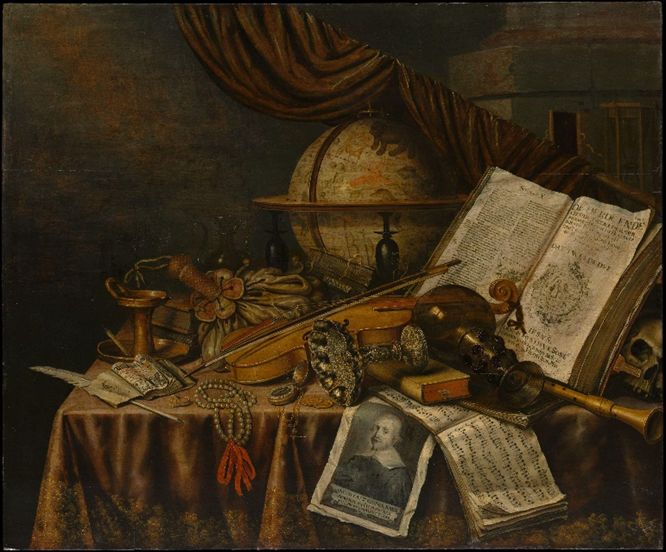
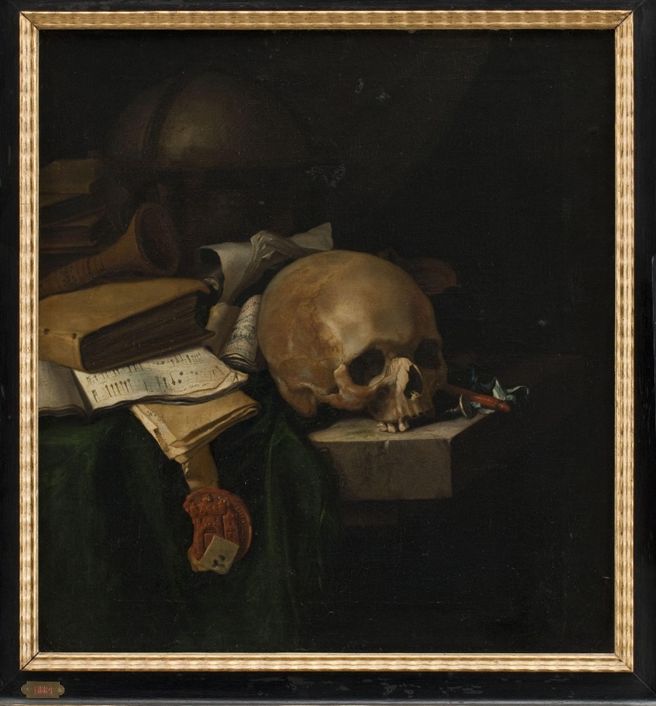
The cabinet of curiosities, another great collecting impulse of the same period, approached this same philosophical tension from a different position. Given the very nature of such collections that gathered animals, shells and stones, “in which the transitoriness of all earthly things is emphasized, and which culminates in … a picture of the Last Judgment” (Impey & MacGregor 1985: 162), mortality was not incidental to the Wunderkammer but intrinsically embedded in it. Both practices emerged from the same cultural moment and the same animating tension: the desire to accumulate and master the world alongside an acute awareness that the world, and the self within it, would not last. As Evans and Marr observe in their study of early modern collecting culture (Evans & Marr 2006: 1), this impulse is rooted in a far older Aristotle’s claim in his Metaphysics (Ross 1924) that the desire for knowledge is inseparable from the passion of wonder, a wonder that begins, always, in the encounter with what exceeds our grasp.
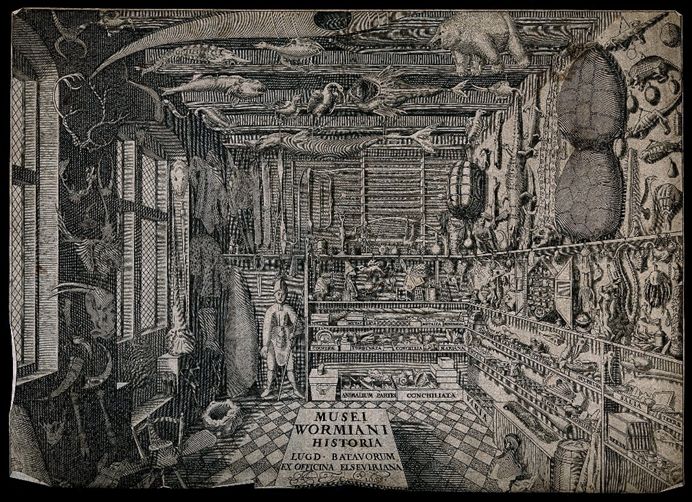
It is within this tradition that Ntuli’s Homage to Ghassan Kanafani – A hand in the grave – Scene two – Subject unknown II (2019) works, though it does so with a critical awareness that the tradition itself requires. The Wunderkammer, as Carrier demonstrates, did not distinguish between artwork, natural specimen and human remain in the way the modern museum does (Carrier 1987: 83). A typical cabinet might contain fossils, ethnographic objects, weapons, and preserved human and animal bodies within the same display logic in which the boundary between person and specimen, between the living and the collected dead, had not yet hardened into its modern form. Ntuli’s composition inhabits precisely this collapsed boundary. The skull nestled amongst beadwork and delicate lace within his Wunderkammer arrangement is not merely a vanitas symbol, it is a conceptual stance. It asks what it means that African bodies were absorbed into this collecting tradition not as subjects with interiority and personhood, but as specimens available for arrangement, study and display. The frivolity of life, in Ntuli’s work, is not the cultivated melancholy of the wealthy collector meditating on his own mortality. It is the specific, structural fragility of a life that an institution has already decided does not need a name.
Khomo’s engagement with mortality is more intimate but no pressing. The grandmother is gone, irretrievably, permanently so and all what remains is a chair, a cracked wall, a figure who occupies the space of absence without filling it. Life, in Introspection: Usofa Kagogo (2021), is rendered entirely through its aftermath: through the objects and spaces it leaves behind, enduring long after the life that made them meaningful. The overexposed white dress carries something of the vanitas register too – things becoming too bright, too luminous, on the verge of dissolution. The figure glows against the ochre wall, hovering between solidity and disappearance. What Carrier says of the museum’s preserving impulse that it endeavours to “arrest the effects of time” by treating objects as “historical records” (Carrier 1987: 83) finds its limit here. The chair is preserved; the grandmother is not. The institution can etch the object into permanence but cannot recover the relationship that made it matter.
Both works arrive at the same uncomfortable truth: that the frivolity of life is not a philosophical concept. It is the condition that both artists and the subjects they portray inhabit. To be alive is to be temporary, and to be temporary is to be vulnerable to loss, to grief, to the disregard of institutions that outlast individuals. Neither Khomo nor Ntuli resolves this condition. They hold it, quietly and without consolation, before the viewer, asking not that we look away, but that we remain with what the refused gaze has always known: what cannot be seen is not necessarily what has been forgotten.
Written by Yolanda de Kock
References
Berger, J. 1972. Ways of seeing. London: BBC and Penguin Books.
Carrier, D. 1987. The display of art: An historical perspective. Leonardo 20(1): 83–86. https://doi.org/10.2307/1578216
Evans, R.J.W. & Marr, A. (Eds) 2006. Curiosity and wonder from the Renaissance to the Enlightenment. Aldershot: Ashgate Publishing.
Glissant, É. 1997. Poetics of relation. Translated by B. Wing. Ann Arbor, MI, USA: University of Michigan Press. https://doi.org/10.3998/mpub.10257
Impey, O.R. & MacGregor, A. 1985. The origins of museums: the cabinet of curiosities in sixteenth- and seventeenth-century Europe. Oxford: Clarendon Press; New York: Oxford University Press. https://archive.org/details/originsofmuseums0000unse
Kanafani, G. 1999. Men in the Sun and other Palestinian stories. Translated by H. Kilpatrick. Boulder: Lynne Rienner Publishers.
Mbembe, A. 2002. The power of the archive and its limits. In: Hamilton, C. et al. (Eds), Refiguring the archive. Cape Town: David Philip. https://www.researchgate.net/publication/289892182
https://diversions.constantvzw.org/wiki/images/6/60/The_power_of_the_archive_A._Mbembe.pdf (accessed 25 March 2026)
Mbembe, A. 2015. Decolonizing knowledge and the question of the archive. Public lecture, Wits Institute for Social and Economic Research. http://wiser.wits.ac.za/system/files/Achille%20Mbembe%20-%20Decolonizing%20Knowledge%20and%20the%20Question%20of%20the%20Archive.pdf (accessed 25 March 2026)
Mulvey, L. 1975. Visual pleasure and narrative cinema. Screen 16(3): 6–18. https://doi.org/10.1093/screen/16.3.6
Petit, D. 1988. A historical overview of Dutch and French still life painting: A guide for the classroom. Art Education 41(5): 14–19. https://jstor.org/stable/3193074
Ross, W.D. 1924. Aristotle’s Metaphysics. Oxford: Clarendon Press. https://ia802806.us.archive.org/30/items/aristotlesmetaph0001aris/aristotlesmetaph0001aris.pdf
van Dijck, J. 2007. Mediated memories in the digital age. Redwood City, Ca., USA: Stanford University Press.
Werner, A.-L. 2020. Let them haunt us. Transcript Verlag. https://www.researchgate.net/publication/356004386
Woodward, K. 2015. The Politics of In/Visibility. Basingstoke: Palgrave Macmillan. https://link.springer.com/book/10.1057/9781137319302



Comments are closed.