


The Department of Archaeology at the National Museum, Bloemfontein, is involved in several projects aimed at reconstructing the behaviour and biology of past human populations, from the start of the archaeological record in the Pliocene period up into the ethnographic present of southern Africa. Much of the research in our department focuses on fieldwork, which typically involves going out to find new sites to excavate, with the aim of exploring past environments and cultures through the study of collections of material remains – often the waste of past human activity. The process of finding the right sites to dig, however, can be more challenging and risky than you might think.
Nuances of this process are caricatured in the recent Netflix movie ‘The Dig’, set in the 1930s, wherein the owner of a property with an archaeological site on it – Mrs Edith Pretty – asks a self-trained excavator Basil Brown to dig the biggest mound in her garden as she had “a feeling about this one”. Mr Brown disagreed with the idea, explaining that the biggest mound dipped gradually in the middle, indicating that it was previously looted. Despite the scientific logic in Mr. Brown’s explanation, it became evident that Mrs Pretty’s instincts were indeed correct, with the mound she originally wanted excavated revealing an Anglo-Saxon ship burial, reflecting the often unpredictable nature of archaeological sites.
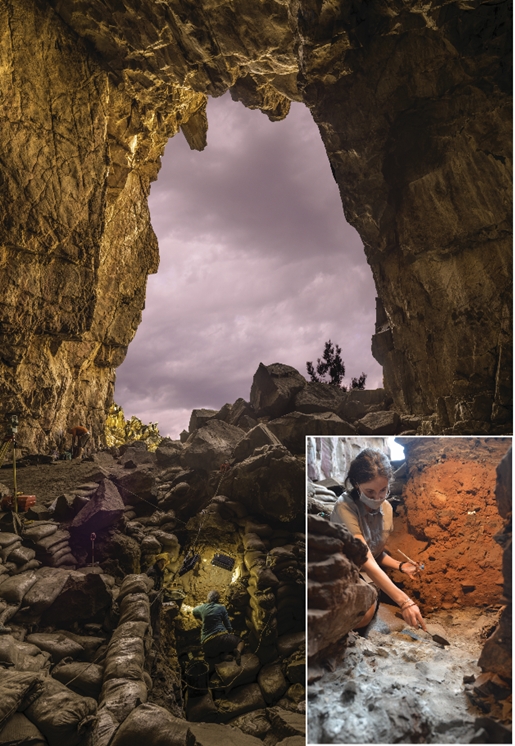
These days, archaeological projects involving excavation are almost always high-risk-high-reward, meaning that they require much investment with little guarantee that high-impact results will be acquired, but that spectacular discoveries are possible. For instance, excavations of Blombos Cave in the southern Cape – a relatively small rock shelter with no evidence of older archaeology on the surface – ended up yielding some of the earliest evidence for symbolic behaviour in the world. Although archaeologists can make some predictions about the scientific prospects of a site based on where it is located, and based on the presence of visible archaeological material, we cannot know what lies beneath the surface of the ground before starting to dig. For instance, if a cave is close to resources like water (and the different animals that are attracted to water on the landscape), and suitable rocks to make stone artefacts out of, there is a relatively greater likelihood that the cave will contain archaeological material from the past, but this is not guaranteed. This uncertainty adds a dimension of excitement to fieldwork, but can also make new projects challenging to justify to funding organizations supporting the research. Archaeological excavations require extensive planning and great expense with respect to time, finances and expertise, while there is little or no guarantee that a significant scientific discovery will be made.
Excavations are also destructive – their invasive impacts on sensitive archaeological deposits cannot be reversed. For instance, if a mistake is made in the digging of an archaeological site, we cannot put the material back in the ground and do it all again correctly. This makes it challenging to justify to permitting agencies, like Heritage Western Cape in South Africa, why one should be granted permission to dig an archaeological site, with no concrete evidence that the destructive activities will advance scientific understanding of the past.
Apart from the archaeologists themselves, archaeological field projects also generally involve diverse teams of often high-profile scientists, including but not restricted to geologists, zoologists, physicists, botanists and physical anthropologists. In terms of personnel, therefore, field projects can be difficult to coordinate or justify in advance, in terms of prospective scientific output and impact, particularly when a new project is initiated at a previously unexcavated site.
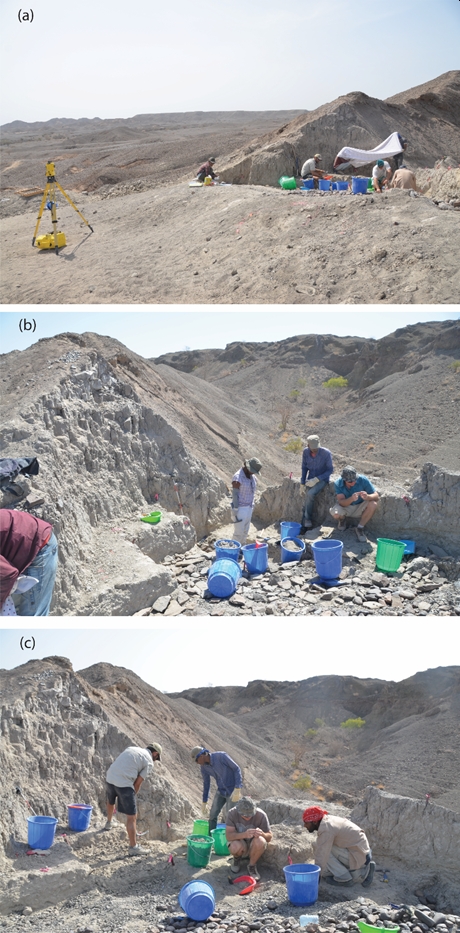
At the site of Simons Cave, which is a field project coordinated in the Department of Archaeology at the National Museum, we recently used some new digital technologies that helped us assess the archaeological potential, and to make an informed decision whether to dig or not to dig this particular site. Simons Cave is on the west coast of South Africa, ~230 km north of Cape Town, and is a rock-shelter site in the Table Mountain Sandstone geological formation, approximately 8km south of the town of Lambert’s Bay and ~2 km inland from the current western coastline.
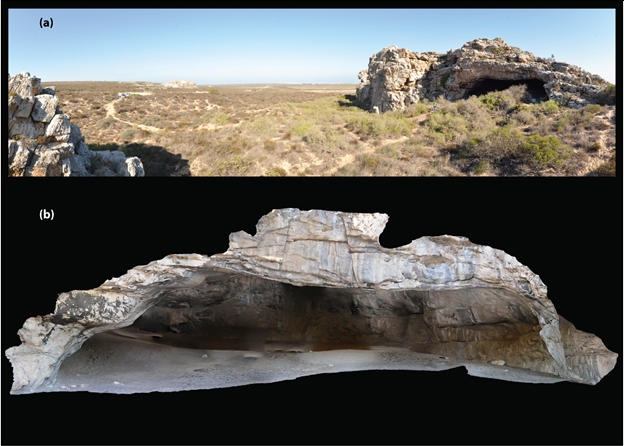
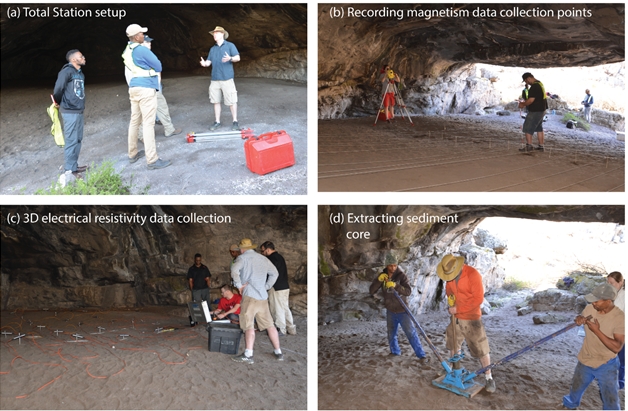
We undertook two separate field seasons at Simons Cave, in 2018 and in 2020. During the 2018 field season, a small team drilled two narrow, ~5 cm in diameter, sediment cores from within the cave for preliminary sedimentological and archaeological investigations. The cores were packaged and sealed, and transported to Germany for processing by scientists in a laboratory. Samples were collected from the cores for luminescence and radiocarbon dating. These are methods that archaeologists use to estimate how long ago people occupied the cave. In this way we could assess how old the archaeology was at Simons Cave, and how important it was, before actually digging the site.
We also undertook a complementary geophysical survey at the site of Simons Cave. We assessed the archaeological deposits at Simons Cave with electrical resistivity and magnetic susceptibility. Electrical resistivity is a way of assessing how strongly a material (e.g. sediment or rock in the case of archaeological sites), resists or conducts the flow of electric current. Magnetism is a way of assessing the magnetic susceptibility of sediments, and provides indications of whether the sediments were burned by fires in the cave, in the past. Archaeologists can use this information to assess the depth of the deposit (how much sediment accumulated over time in the site), and whether people were in the cave making fires that burned the sediments in the past (evidence for human activity), without actually digging these sediments. Using these data in combination with the drilling cores mentioned above, we were able to reconstruct some key aspects of the archaeological deposits at Simons Cave, without actually excavating the site.
After we had undertaken this reconnaissance work at Simons Cave, we had enough information to persuade permitting agencies that we needed to dig the site. We could also use this information to approach funding agencies, and make the argument to them that excavating the site of Simons Cave could yield important information that would broaden scientific understanding of the human past. Therefore, in 2020 we undertook a preliminary systematic excavation of Simons Cave, with a larger scientific field team involved.
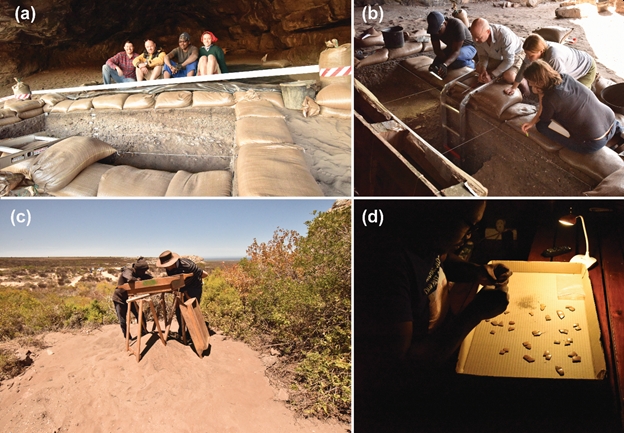
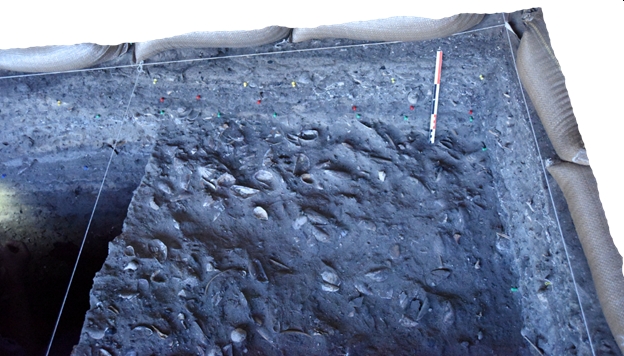
As a result of our reconnaissance and preparation for the work at Simons Cave, we had a successful excavation season. Excavation revealed the entire sequence to be archaeological, and to consist of evidence of human occupation dating to more than one hundred and forty thousand years ago. This will be some of the earliest evidence for our ancestors occupying coastlines, in South Africa, and we plan to go back to the site of Simons Cave for more archaeological excavations in the future.




Comments are closed.