

“The South-Eastern quarter of the town, bounded roughly by the Natal Line and the Cape Line shall be the area where a hygienic Native township shall be developed.” This is how Bloemfontein’s mayor, Mr D.A. Thomson, referred to the Free State capital’s new township in his annual report for 1919–1920. In 1918, Bloemfontein’s Town Council officially decided that a new township or ‘location’ – the customary name for a residential area reserved for black people – had to be developed east of the Johannesburg–Cape Town railway line. The Council felt that Waaihoek, Bloemfontein’s oldest location, was overcrowded and that most of its houses had become unsuitable for human habitation. In addition, Bloemfontein’s white residents felt that Waaihoek had grown too close to the white ‘Town’ (Waaihoek was about ten minutes’ walk from Hoffman Square) and the Council wanted to use a part of Waaihoek, specifically the area near Harvey Road, as the site for Bloemfontein’s new power station.
As a result, it was decided that Waaihoek and two other smaller locations, namely Kaffirfontein and the No. 3 Location (also known as Railway Location), would be demolished, and that “all the Africans” would be moved “across the railway”, to quote councillor, Arthur G. Barlow. By that time, Bloemfontein’s black residents knew what was meant by ‘across the railway’ or ‘on the other side of the railway’ because it was there that the new location was taking shape.
While Bloemfontein’s new location – widely considered the Union of South Africa’s first model location – was being laid out according to the latest town planning principles, and people began to settle there, it was still without a name. To decide on a name, the Council’s Native Affairs Committee, of which Barlow was the chairperson, requested the Native Advisory Council (later renamed the Native Advisory Board) to suggest a name for the new location. The latter consisted mainly of so-called blockmen (ward councillors) of the locations, and acted as a channel between the location residents and the Superintendent of Locations who, in turn, reported to the Native Affairs Committee.
During a meeting of the latter, held in June 1919, the Superintendent of Locations, Mr G.P. Cook, informed the Committee that the Native Advisory Council had suggested “the name of ‘Mendi’ as suitable for the new Location”.Speaking on behalf of location residents, the Native Advisory Council felt that the new location’s name had to honour the victims of the SS Mendi (hereafter Mendi; apparently named after the Mendi or Mende people of Sierra Leone), the troopship which sank during the First World War (1914–1918) on 21 February 1917. A total of 616 South Africans, of whom 607 were black men, perished in South Africa’s worst wartime maritime disaster.
Due to a shortage of labourers to work behind the front lines in France, Britain requested South Africa to provide men for the purpose. The Mendi, a passenger steamship reclassified as a troopship, left Cape Town for Plymouth, England, on 16 January 1917 with 823 members of the 5th Battalion of the South African Native Labour Corps (also known as the South African Native Labour Contingent; hereafter SANLC). It carried the last contingent of the SANLC which consisted of 805 black troops, five white officers, 17 white non-commissioned officers and 33 white crew members. From Plymouth the Mendi sailed to the French harbour town of Le Havre, but en route tragedy struck.
At about 04:57 on the morning of 21 February, the SS Darro, an empty meat ship bound for Argentina, was sailing at full speed in thick fog and, near the Isle of Wight, slammed into the Mendi’s forward hold. Severely damaged, the ship sank after only 20 minutes. Sadly, the crew of the Darro neither attempted to lower the ship’s rescue boats nor tried to rescue survivors in any other way. Most of the South Africans died of hypothermia or drowned as they could not swim. The majority of the victims hailed from rural Pondoland in the Eastern Cape.
According to survivors, the South Africans met their fate with great dignity. The chaplain, Reverend Isaac Wauchope Dyobha, tried his best to calm the panicked men. In a loud voice he said: “Be quiet and calm, my countrymen. What is happening now is what you came to do…you are going to die, but that is what you came to do…so let us die like brothers” [shortened version]. Legend has it that the men were so inspired by the Reverend’s boldness that they sang and stamped the death dance together while the Mendi disappeared into the icy sea.
Needless to say, news of the Mendi disaster captured the imagination of both black and white South Africans. The names of those who perished, particularly the Pondoland chiefs, including Henry Bokleni, Dokoda Ndamase, Mxonywa Bangani and the heroic Reverend Dyobha, became synonymous with bravery and patriotism. The courage displayed by Reverend Dyobha and his compatriots became legend in South African military history and also became an integral part of the oral tradition of many black South Africans. The potent political symbolism of the Mendi tragedy and the heroism of its victims were certainly not lost on Bloemfontein’s black residents, hence the request to name their new location after the Mendi.
Did the Native Affairs Committee heed their request? According to the minutes of the meeting of the latter held on 16 June 1919, it discussed the proposal and “after discussion it was resolved to recommend to the Council that the new Location be named ‘Batho Town’ which means the people’s town.” The new location was thus named Batho – as it is still known today – but Bloemfontein’s black population decided to honour the Mendi’s victims in other ways, including annual commemoration services and memorial scholarships.
Abel Dilape, one of Batho’s blockmen, argued that “something must be done to commemorate those sons of Africa who lost their lives in the ‘Mendi’.” At the first commemoration of the end of the First World War in 1919, Batho’s residents took part in a peace procession through the town and the location. The Friend newspaper reported that it was unanimously decided to include in the procession a special vehicle to represent the Mendi and that local “members of the Labour Corps will be on this vehicle” in remembrance of the SANLC members who perished at sea two years earlier.
Photo descriptions:
1) SS Mendi (Photo: wikipedia.org)
2) Map depicting the last voyage of the SS Mendi. (Photo: www.wikipedia.org)
3) Surviving members of the South African Native Labour Corps being inspected by King George V in France. (Photo: www.wikipedia.org)
4) Bronze statue commemorating the victims of the SS Mendi, Atteridgeville, Pretoria. (Photo: (Photo: www.wikipedia.org)
References
Abrahams, J.C. Mendi memories (unpublished manuscript).
Barlow, A.G. 1952. Almost in confidence. Cape Town: Juta & Co.
Free State Provincial Archives: MBL 1/2/4/1/3, Minutes of a meeting of the Native Affairs Committee, 16.6.1919; MBL 3/1/19, Mayor’s minute 1919–1920.
Haasbroek, H. 2003. Die Adviserende Naturelleraad 1913–1923: baanbrekerswerk in Bloemfontein, Culna 58: 29-30.
Schoeman, K. 1980. Bloemfontein – die ontstaan van ’n stad, 1846–1946. Cape Town: Human & Rousseau.
The Friend, 2.8.1919.
The Friend, 21.2.1934.
Umteteli wa Bantu, 11.11.1933..
Sullivan, H. The legend of the S.S. Mendi, The New Yorker, 21.2.2017,
https://www.newyorker.com/news/news-desk/the-legend-of-the-s-s-mendi.html (19.09.2017).

1) SS Mendi (Photo: www.wikipedia.org)

2) Map depicting the last voyage of the SS Mendi. (Photo: www.wikipedia.org)
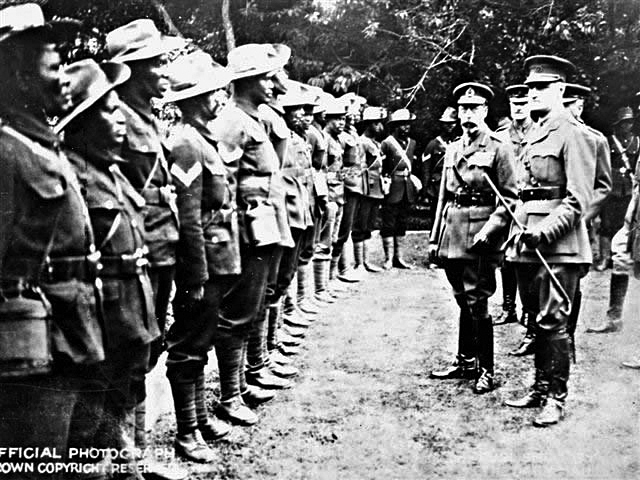
3) Surviving members of the South African Native Labour Corps being inspected by King George V in France. (Photo: www.wikipedia.org)
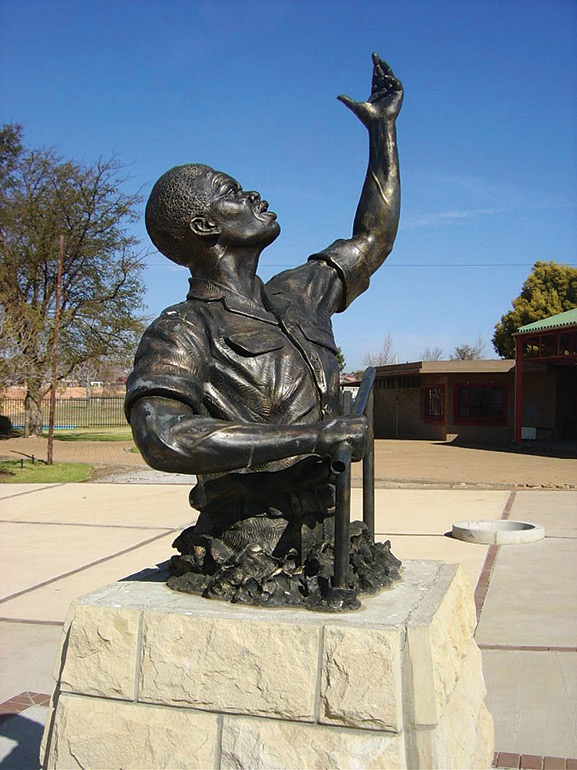
4) Bronze statue commemorating the victims of the SS Mendi, Atteridgeville, Pretoria. (Photo: www.wikipedia.org)



Comments are closed.