

ArtBankSA commemorates Human Rights Day through the lens of photographer Thando Mama, Izingqi Zesikhumbuzo (2016–2017), housed in ArtBankSA’s contemporary collection
On 21 March 1960, sixty-nine people were killed outside the Sharpeville police station in what became one of the most widely documented atrocities of the apartheid era. The photographs circulated almost immediately, bodies on the ground, the scale of state violence made undeniably visible. South Africa commemorates Human Rights Day on this date for good reason. The Sharpeville Massacre marked a turning point not only in the history of organised resistance against the apartheid’s pass laws, but in how that resistance was remembered: through image, through site, through the slow institutional work of commemoration in the post-apartheid South Africa.
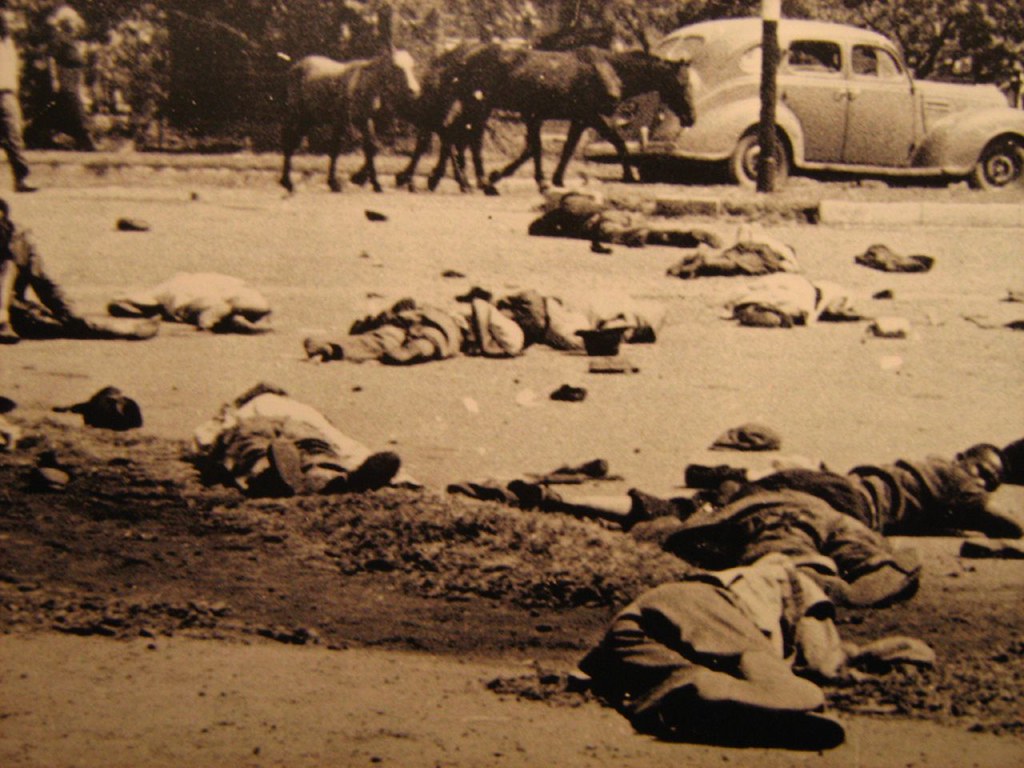
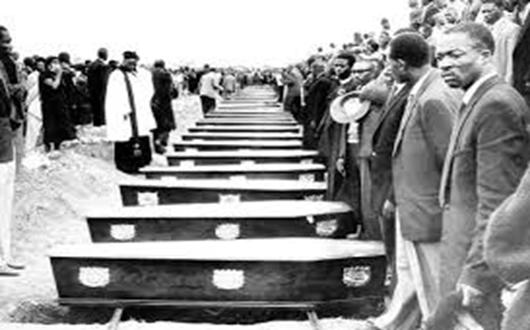
Commemoration of the apartheid’s traumatic legacies was, at the turn of the new democracy, channelled largely through monuments, heritage sites and museums, with the explicit aim of promoting social cohesion and a shared national identity. Leslie Witz’s Museum Times documents that post-apartheid South Africa witnessed the establishment of at least 50 new museums, the vast majority constructed to display violence and suffering under apartheid (Witz 2022: 23). These commemorative spaces emerged as deliberate responses to entrenched historical silences, addressing forced removals, worker exploitation, political imprisonment, and resistance movements. Purpose-built institutions like the Apartheid Museum could be designed from the outset to centre previously suppressed narratives and position the liberation struggle as foundational rather than supplementary. Witz identifies, however, a central contradiction that bears on older institutions and heritage sites: museums concerned with the conservation and management of the past simultaneously become places of contesting and reshaping history (Witz 2022: 24). His caution that excessive reshaping risks perpetuating contradictions at the heart of the museum (Witz 2022: 2) applies with equal force to the question of public monuments, where the tension between preservation, transformation and erasure remains far from resolved.
The Sharpeville Garden of Remembrance is one such purpose-built memorial: a deliberate effort to hold the event in public consciousness and to give those who were silenced a continued presence in the landscape. It offers a particular kind of commemorative resolution: a site where the moral clarity of the experience and the identities of those harmed are sufficiently represented for institutional acknowledgement. Not all heritage sites carry this clarity, and in the spaces where it is absent or contested, the questions of whose memory, whose rights and whose heritage become most pressing.
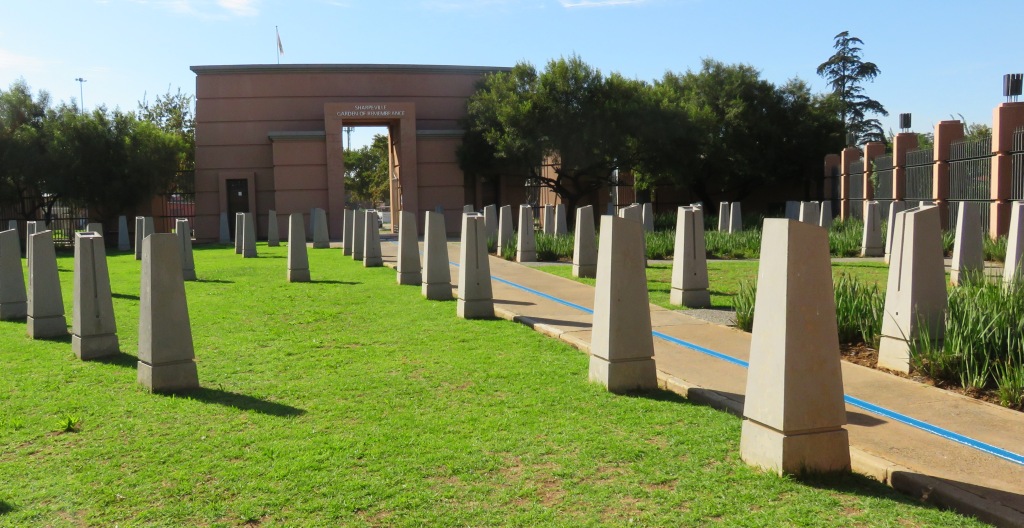
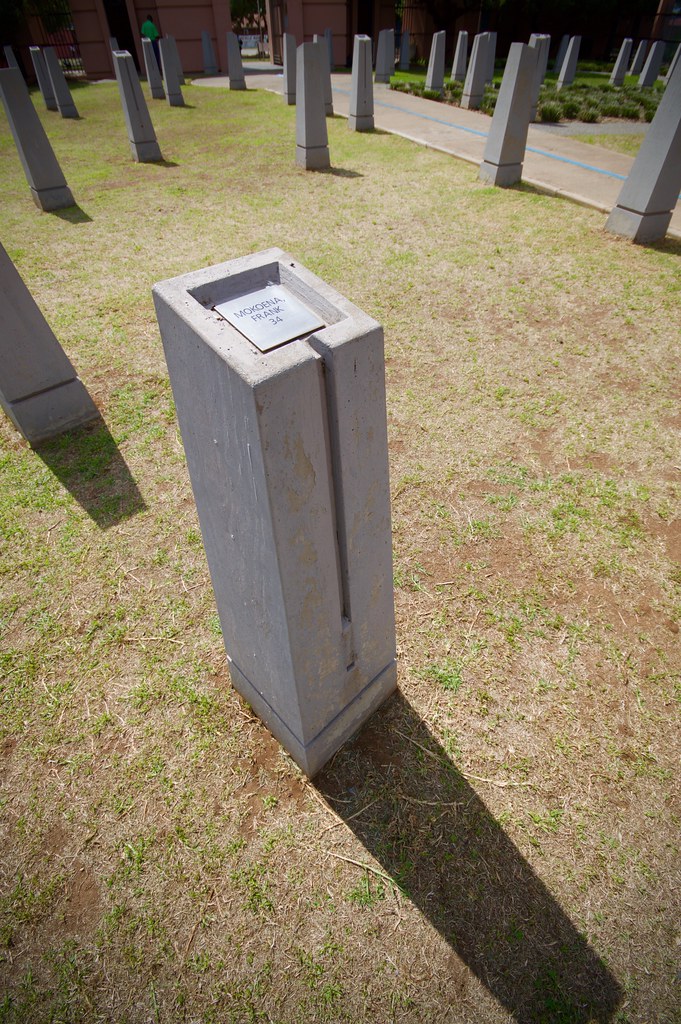
Memory and legacy are rarely as settled as a commemorative date or a memorial garden implies. Monuments and heritage sites do not simply preserve the past, they provoke dialogue and, at times, sharp disagreement. They determine whose suffering is rendered legible, whose histories are accorded public space, and whose claims on collective memory are considered worth sustaining. The questions running through this article take shape here: whose rights are exercised in determining what gets remembered, whose memory deserves public inscription, and whose heritage is at stake when those determinations are made. This article examines concepts of memory, heritage, and monuments through the work of South African photographer Thando Mama, Izingqi Zesikhumbuzo (2016–2017), who stages a sustained creative encounter with precision that official commemoration has largely missed.
Monuments, memory and public heritage
Sabine Marschall (2010: 10) argues that monuments and memorials serve social and psychological needs for individuals and groups that are not always compatible with the political needs of the state, or of those who initiate the memorialisation of persons and events in a specific way. When the state determines what gets commemorated and how, the question of whose memory is actually being served does not disappear, it sharpens.
The Sharpeville Garden of Remembrance makes this tension visible. Pitja’s research into the memorial precinct reveals that despite the government’s intention to redress the wrongs of the past, the community most directly affected was neither consulted nor involved in its planning and construction. Some members of the public found certain design elements, including the plinths in the memorial garden, culturally extraneous and alien to most South African traditions. Once, the memorial was closed on the anniversary of the massacre itself, leaving ordinary people unable to access a site ostensibly built in their memory (Pitja 2022: 46). A monument with apparent moral clarity can still reproduce the exclusions it claims to remedy.
Monumental decay: The Ntaba kaNdoda Monument in the Ciskei
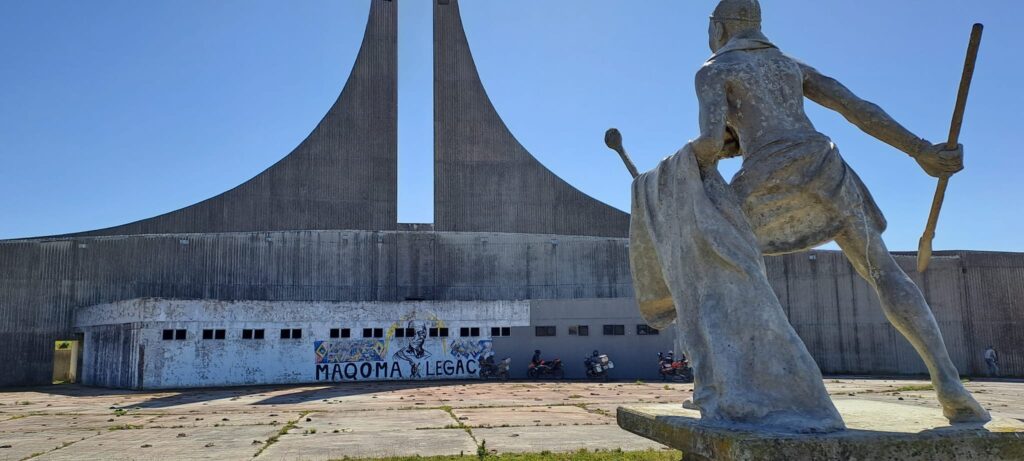
The Ntaba kaNdoda Monument in the Eastern Cape sits at the opposite end of this commemorative spectrum. Unveiled in 1981 by former Ciskei President Dr Lennox Leslie Wongama Ngweyesizwe Sebe to give architectural authority to Bantustan pseudo-nationhood, this structure was never subject to any formal discussion, community engagement or public reckoning in the post-apartheid period. Vegetation pushes through cracked concrete and graffiti marks the monument walls (Fig. 5). South Africa moved on, leaving the dilapidating building to deteriorate further in oblivion, which is itself a form of decision.
These are the conditions that South African photographer Thando Mama entered when he made Izingqi Zesikhumbuzo in 2016–2017, a photographic piece that refuses the silence and returns Ntaba kaNdoda to view. Where the Sharpeville Garden of Remembrance represents a state-initiated commemorative response, however contested, Ntaba kaNdoda remains unacknowledged, its layered histories still buried beneath a crumbling structure, which nobody has chosen to preserve or remove. Whose memory does that silence serve? Whose heritage does it erase? These are the questions Mama’s work forces into the open.
Thando Mama and Izingqi Zesikhumbuzo
Mama’s relationship with Ntaba kaNdoda is not that of an outside observer. Growing up in the Eastern Cape, he heard stories of the mountain through school literature and songs at family gatherings. The monument’s shadow, he writes, remains ever-present not only in his own psyche but in the minds of the local community (Mama 2021: 47). This proximity gives his practice an authority that a purely archival approach cannot claim. The site is, for him, simultaneously a place of personal memory, collective history and unresolved haunting.
Before the Bantustan quasi-state claimed it, the mountain carried a far older significance. Ntaba kaNdoda had long been a sacred place for the Khoe, San and amaXhosa peoples, embodying a spirituality and independence that preceded British colonialism in the Eastern Cape (Mama 2021: 49). The mountain’s name reaches back to the Khoe chief Ndoda, killed in the 18th-century conflict with the amaXhosa under King Rharhabe; over generations the place accumulated a folkloric tradition rooted in the history of contest and reverence (Mama 2021: 49). The Bantustan monument must be understood against this depth.
By the late 1970s, at the height of apartheid’s separate development programme, Dr Lennox Sebe commissioned a national monument for the Republic of Ciskei at this site. Drawing on Vail (1989), Mama argues that Sebe envisioned the structure as a holy place for the people of Ciskei, which would arise as a new country (Mama 2021: 49). The Xhosa nationalism Sebe sought to foster came at a cost. Hodgson’s (1987) scholarship, which Mama engages directly, raises the possibility that the construction of the monument erased subtle layers of history at the site, among them its longstanding significance as a place of sacredness, even as it claimed to honour the mountain’s heritage (Mama 2021: 49). The monument endured as a symbol of nationhood, but once built over older, quieter meanings it had no interest in preserving.
Pierre Nora’s framework of lieux de mémoire sharpens this analysis. Memory sites, Nora (1989) argues, become necessary when living memory can no longer sustain itself when the transmission of the past through daily practice, and communal experience breaks down and must be fixed in objects, monuments and institutions. The Ciskei monument follows this pattern, but with a critical inversion: the memory it crystallised was not a community’s heritage reaching toward preservation, but a state-fabricated nationalism imposed onto a landscape already filled with competing histories. Marschall’s (2006: 165) observation that it is often the forgotten stories and narratives of neglected communities that form the true foundation of national or communal identity points to what the monument deliberately obscured. Rothberg’s (2010: 7) notion of noeuds de mémoire, or “knots of memory”, captures what Ntaba kaNdoda actually holds: multiple, incompatible collective memories entangled without resolution, the official nationalist narrative wound around the Khoe, San and amaXhosa histories it attempted to suppress.
Connerton’s (1989) analysis of how commemorative encounters work, or fail to, extends this further. When people gather at a memorial or move through a heritage space, this act transmits images of the past that legitimate a present social order; remembrance and social reproduction are inseparable. The difficulty at Ntaba kaNdoda is that the social order this monument was built to legitimate no longer exists, and the communities it claimed to speak for largely rejected it even at the time. The memories a monument asks its visitors to share must, at some level, already be shared, and at Ntaba kaNdoda, they have never been. By the early 1990s, following the collapse of the Ciskei government, the structure was looted and vandalised; after 1994, with no place in the post-apartheid government’s commemorative programme, neither conservation nor preservation was implemented (Mama 2021: 50). Mama describes the result plainly: a ghost memorial, abandoned, stripped, and sitting in persistent disjuncture with the present (Mama 2021: 50). Despite its physical deterioration, he insists the memorial still holds potential for recollection as the memories it carries cannot simply be blotted out of collective consciousness (Mama 2021: 50).
This disjuncture is the ground on which Mama’s visual practice operates. He approaches the monument not to recreate past events but to undertake what he describes as a critical mediation of the socio-political and metaphysical histories interconnected within the site (Mama 2021: 47).
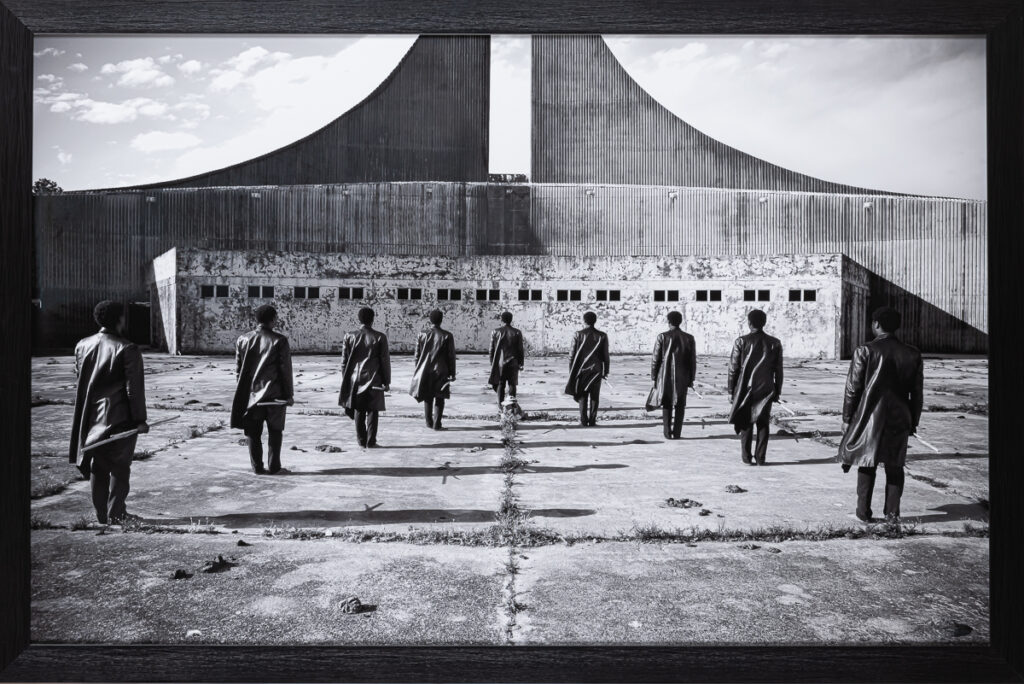
Izingqi Zesikhumbuzo (2016–2017) represents a more structurally direct register of this practice, the monument captured in its physical, palpable presence rather than through the spectral blur of Mama’s pinhole series (Mama 2021: 64). Nine figures, draped in what seems to be black jackets, stand in deliberate formation before the decaying structure. Their arrangement carries the weight of ceremony and collective witnessing; their jackets signal cultural continuity, a quiet insistence that the communities this monument was built to suppress remain present. The building behind them is visibly deteriorating, concrete weathered, vegetation reclaiming the paving, yet it has not been removed, nor formally preserved, nor publicly acknowledged. Mama (2017: 67) describes his practice as holding remembrance together as a collective action, piecing together the challenged histories of the ever-fading memories of Ntaba kaNdoda.
Izingqi Zesikhumbuzo does exactly that: it neither resolves the monument’s history nor turns away from it. South Africa has largely moved between two inadequate positions when confronting the monumental legacy of colonialism and apartheid preservation, which risks legitimising the original intent of such structures, and removal, which risks erasing material evidence of harm. Mama’s photograph refuses both. It sets an encounter that the monument itself could never produce: one where the communities whose histories were buried beneath it return to witness what was built in their name. Whose rights were served when this monument was erected? Whose memory does its abandonment erase? Whose heritage hangs in the silence between the crumbling walls and the post-apartheid landscape that has chosen, thus far, to look away?
Conclusion
Human Rights Day asks South Africans to remember. What this article has tried to show is that remembering is never a straightforward act, it is always shaped by decisions about whose suffering counts, whose histories are granted public space, and whose heritage is considered worth preserving. The Sharpeville Massacre gave us a date, a set of photographs, and eventually a memorial garden. These are not nothing. But as Pitja’s research into the Sharpeville Garden of Remembrance makes clear, even the most morally legible acts of institutional commemoration can reproduce the exclusions they set out to remedy.
The Ntaba kaNdoda Monument in the Eastern Cape received no such institutional attention at all. Built to serve an apartheid fiction, it was left to decay when that fiction collapsed, not demolished, not preserved, not publicly acknowledged. The mountain beneath it holds centuries of Khoe, San and amaXhosa history that the Bantustan state neither invited nor honoured. Those histories did not disappear when the Ciskei government fell. They remain, as Mama (2021: 50) writes, buried in a monument that post-apartheid South Africa has largely chosen to leave in its blind spot.
Thando Mama’s Izingqi Zesikhumbuzo refuses that choice. His photographs do not resolve what the monument should become, nor do they ask the state to act. They stage something the monument itself never could: a return of the communities whose histories were concealed under it, bearing witness on their own terms. His concept of demonumentalisation, using creative practice to work against fixed, authorised memory without physically altering a structure offers a way of engaging with South Africa’s difficult monumental discourse that sits outside the preservation-versus-removal debate entirely. This debate, as this article has argued, is too narrow to accommodate what these sites actually hold.
Whose rights, whose memory, whose heritage? These questions do not resolve neatly, and Mama’s practice does not pretend they do. What it offers instead is the refusal of amnesia, an insistence that the contested, interwoven and unresolved histories of places like Ntaba kaNdoda remain part of the living work of human rights, long after the dates on the commemorative plaques have passed.
References
Connerton, P. 1989. How societies remember. Cambridge: Cambridge University Press. https://doi.org/10.1017/CBO9780511628061
Hodgson, J. 1987. Ntaba kaNdoda: Orchestrating symbols for national unity in Ciskei. Journal of Theology for Southern Africa 58(1): 18–31.
Labode, M. & Levin, M.K. 2016. Reconsideration of memorials and monuments. History News 71(4): 7–11. https://www.jstor.org/stable/44605954
Mama, L.V.J. 2017. “Forgetting Ntaba kaNdoda”: Reciting performative memories at the Ntaba kaNdoda Monument. MFA thesis. Grahamstown: Rhodes University. https://researchrepository.ru.ac.za/handle/123456789/8004
Mama, T. 2021. Reciting performative memories: Spectral photography at the Ntaba kaNdoda monument and mountain. de arte 56(1): 46–70. https://doi.org/10.1080/00043389.2021.1995679
Marschall, S. 2006. Transforming the landscape of memory: The South African commemorative effort in international perspective. South African Historical Journal 55(1): 165–185. https://doi.org/10.1080/02582470609464936
Marschall, S. 2010. Landscapes of memory: Commemorative monuments, memorials and public statuary in post-apartheid South Africa. Leiden: Brill Publications.
Nora, P. 1989. Between memory and history: Les Lieux de Mémoire. Representations. 26(Special issue: Memory and Counter-Memory): 7–24. https://doi.org/10.2307/2928520
Pitja, E. 2022. Exploring ephemeral memorial landscapes in Sharpeville. MA Dissertation. Johannesburg: University of Johannesburg. https://hdl.handle.net/10210/503382
Rothberg, M. 2010. Introduction: Between memory and memory. From Lieux de mémoire to Noeuds de mémoire. Yale French Studies 118/119: 3–12. https://www.jstor.org/stable/41337077
Vail, L. 1989. The creation of tribalism in Southern Africa. London: University of California Press.
Widrich, M. 2014. Performative monuments: The rematerialisation of public art. Manchester: Manchester University Press.
Witz, L. 2022. Museum times: Changing histories in South Africa. Oxford: Berghahn Books. https://www.berghahnbooks.com/title/WitzMuseum




Comments are closed.