

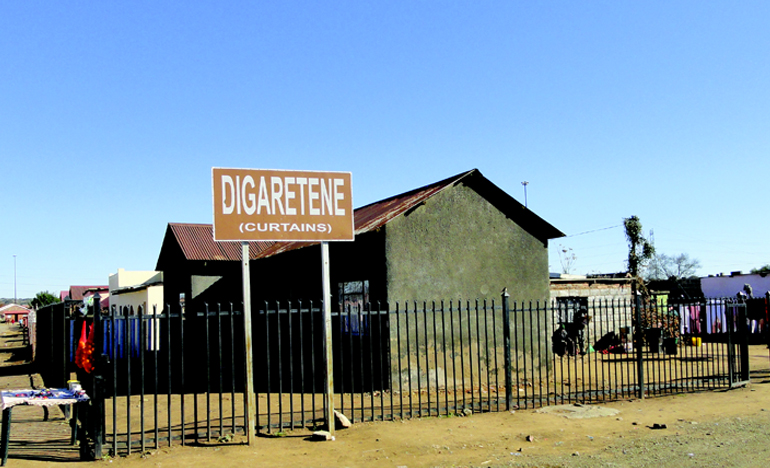
Digaretene and the 1947 royal visit in Bloemfontein: an oral history overview
The narrative of Digaretene in Bochabela Township, East of Bloemfontein, dated back to 1947 when the British Royal family – King George VI, his wife Queen Elizabeth and their two daughters, Princess Elizabeth (the current Queen Elizabeth) and Princess Margaret – visited South Africa.
King George VI and his Royal family visited Bloemfontein as part of their tour of South Africa. The reason for the visit was to thank South Africa for the support that the country gave Britain during the Second World War [WWII]. The Municipality of Bloemfontein organized the construction of 24 houses, 12 built in Abdurahman Street and 12 built in Nyokong Street. Through oral history interviews, the interviewees stated that the houses were indeed built to cover up the area called ‘Kaffirfontein’ which was in proximity to the area where the 24 houses were built. Henceforth, the name Digaretene [curtains] was given to that area because of the houses that became ‘curtains’ in covering Kaffirfontein from the King’s sight.
There is no available year wherein the Digaretene area (which consists of Abdurahman Street and Nyokong Street) was officially established. The name itself came into being due to the Royal visit, as explained above. On the 4th February 1947 the Native Administration Department, in their report on housing allocation, noted: “A deputation of nearly 200 women from the Location called at the Native Administration Office a few days ago and demanded accommodation. They threatened to start a shanty town behind the koppie above Kaffirfontein”.
 This report shows that the shanty town referred to was the area where the two streets of Digaretene are located. Further, it brings to our attention the dire need of accommodation that black people had back in those days. The popular narrative regarding Digaretene is that the houses were built by the Municipality, to conceal the Kaffirfontein area, which was after Digaretene.
Moreki (2018) stated the following: “Now, the people were told about his visit before he arrived. Then the Municipality [of Bloemfontein] said, no, in the location there are places that are not nice. Then they decided to develop some of those areas where the convoy had to pass through. They decided that he was going to use the main road so that the people can see him” … “These houses in Digaretene, they built them then, now, they built them and said those houses they built, will conceal the houses that were in Karfontein”.
The above extract from an interview shows that the people held on to the belief that the houses were built to cover Kaffirfontein from the sight of King George IV and his Royal family. They were not necessarily built because of any accommodation needs; the name does suggest that at that time, the pressing issue that had faced the Municipality was that they wanted to conceal Kaffirfontein because the King perhaps would have been disappointed to witness the living conditions there.
Kaffirfontein was established in 1861, the second location in Bloemfontein. The increase in numbers of black people caused the white inhabitants to feel dissatisfied and threatened, and on 3 June 1861 the City Council decided to group the “non-white” section of the population separately in three locations: one for the Fingos and Barolong near the hill to the right of Kaffirfontein, one for the Khoikhoi and coloured people on the border of the town in the direction of Thaba Nchu, and a third for all others at the base of Signal Hill.
Many black people who were unable to build a house of the quality expected at Waaihoek were forced to establish themselves at the Kaffirfontein location. According to Lande (2018): “There were no streets, sir. There were no streets at all; some houses would be close together whilst elsewhere it was one house and so forth. That place was like that, yes. The houses were scattered apart… Just like in the farms, it used to look like how the houses were like in the farm, yes”.
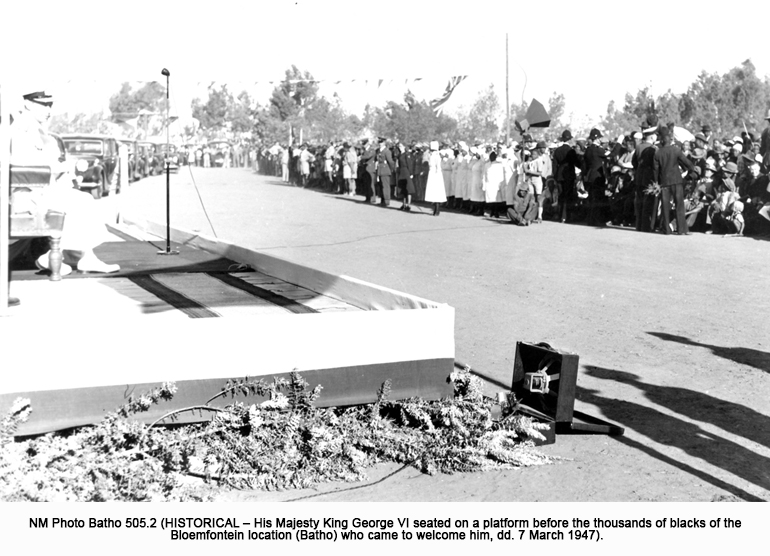
The minutes of the meeting of the Native Advisory Board, held in the Board room, Batho Location, on Thursday the 23rd January 1947, captured the following: “The king will arrive in Bloemfontein on the 7th of March 1947. He will be welcomed on behalf of the Province and also on behalf of the city. At 3 pm he will attend a Garden party and at 5 o’clock he will meet the African people on the Recreation Grounds”.
The following account is from Ms Rahab Kgomo, who was present at the event. She vividly recalls her memories of the royal visit: “I ran in Harvey Road, I passed the [St. Patrick’s] Mission and there I went running on the tar road until I entered ‘Masenkeng’ [sports ground in Batho] and they [municipal officials] hooted that they [royal family] have arrived”. The ‘Masenkeng’ ceremony was attended by King George VI, Queen Elizabeth and their daughters, Princess Elizabeth [Queen Elizabeth II] and Princess Margaret, among others. At the end of the ceremony the Queen handed a turquoise teacup to Rahab as a token of appreciation.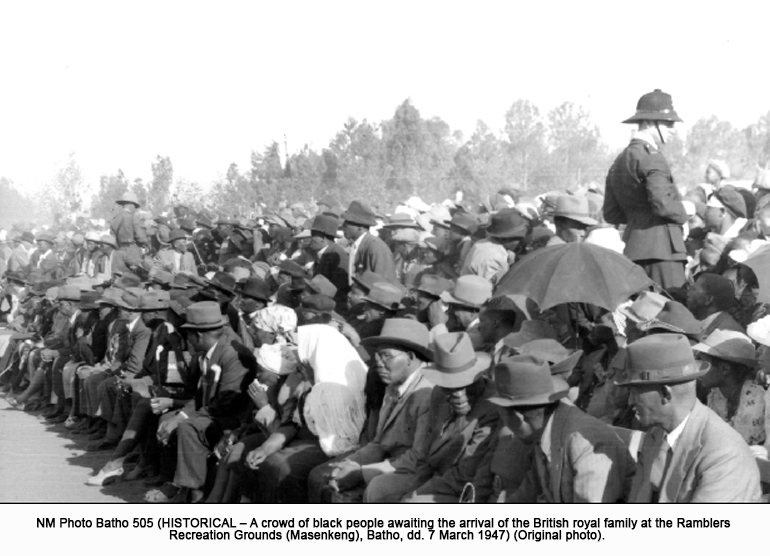
Oral history plays a vital role in capturing community history, that can be used to save heritage sites and the very same history can assist in marketing a community for international and local tourists to visit that area. It has been pointed out that the houses became the shield that concealed ‘Kaffirfontein’ from King George VI and his Royal family’s sight.
References:
MBL1/2/4/1/43, Minutes of an ordinary meeting of the Native Advisory Committee, February 1947.
MBL1/2/4/1/43, Minutes of an ordinary meeting of the Native Advisory Committee, February 23 January 1947.
Interview in Batho, Bloemfontein: A. Lande, 28/05/2018.
Interview in Digaretene, Bloemfontein: B.B. Moreki, 17/01/2018.
Sekete, A.M. 2004. The history of the Mangaung (black) township, Unpublished M.A. mini-dissertation, University of the Free State.


Comments are closed.