

“It is better to die for an idea than to live for an idea that will die”

A reflection on the legacy of Onkgopotse Abram ‘Ramothibi’ Tiro in the context of the history of liberation education.
Every age has its own sages and visionaries, men and women who face the demands of their time with courage and determination while leaving their footprints in history. Onkgopotse was an outstanding man who challenged the apartheid regime and was seen as a formidable enemy by the state. Considering his humble beginnings and rise to become a student activist, and the many hats he wore in the various organizations he served, his ultimate goal was the liberation of all South Africans.
Abram Onkgopotse ‘Ramothibi’ Tiro was born on 9 November 1945 in a small town of Dinokana near Zeerust in Ngaka Modiri Molema District, North West Province. Onkgopotse was raised by a single mother, Moleseng Anna ‘MmaAbram’ Tiro. He was his mother’s firstborn followed by his two sisters (Tsholofelo and Mmatiro) and two brothers (Mogomotsi and Mookami). MmaAbram was a domestic worker in Emmerentia, a suburb of Johannesburg in Gauteng Province. Onkgopotse’s childhood was difficult, his mother and his extended family who brought him up were people of limited means. They struggled to put him and his siblings through school.
Onkgopotse’s uncle Ned Onkgopotse Tiro, after whom Abram was named, and his aunt, Bafedile Masoba, had a profound influence on his upbringing and honed his leadership skills. Abram Onkgopotse spent some time with his uncle and helped him run a bakery.
Abram began his schooling at Ikalafeng Junior Primary School and later went to Keobusitse Senior Primary School, Motswedi Secondary School, and Barolong High School in Mafikeng. He matriculated in 1968 and passed with first-class marks. From 1957 to 1960, for three full years in Dinokana there was no schooling due to riots. During that period, Onkgopotse worked full-time at a manganese mine, where he earned 75c a week and later R3 when he was promoted.
After completing his schooling, Onkgopotse enrolled for a degree in Humanities at the University of the North (Turfloop), currently the University of Limpopo. In his final year, he was elected as the president of the Student Representative Council (SRC). During the graduation ceremony in 1972, Onkgopotse harshly criticised the Bantu Education Act of 1953. That speech became known as the “Turfloop Testimony”. He was expelled from the university because of his controversial speech that angered the authorities at the university.
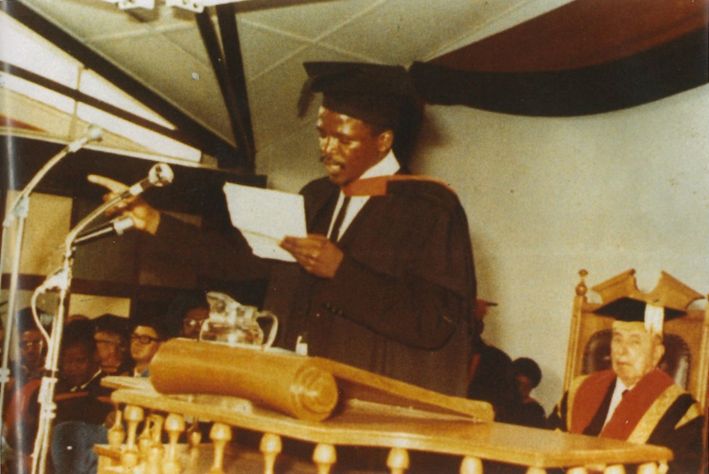
Despite demonstrations by students under the SRC, Tiro was not readmitted. One of his earlier encounters with the administration as SRC President was when they wanted to delete two of his articles, which they considered “objectionable”, from the student diary: the South African Student Organisation (SASO) Policy Manifesto and the Declaration of Students’ Rights. The university administration seized the diaries and detached the articles. After the diaries were returned to the student body, the students burned them.
Onkgopotse’s expulsion from Turfloop had consequences that the university’s administration could not have foreseen. In May 1972, a series of strikes started at black campuses across the country in support of him, all major black campuses joining a solidarity strike in less than one month, and on 2 June 1972, students at the University of Cape Town demonstrated in support of Onkgopotse.
In 1973, Onkgopotse became involved in the activities of the Black Consciousness Movement (BCM). He not only participated in the first major protest in 1972 at Turfloop but was also at the center of the action. When the SASO/Black People’s Convention (BPC) leaders were banned in 1973, he took over as SASO’s permanent organizer. He was elected as the president of the Southern African Students’ Movement (SASM), an affiliate of the All-African Students’ Union.
After his expulsion from Turfloop, Onkgopotse was offered a post to teach history at Morris Isaacson High School in Central Western Jabavu, Soweto. It was during this brief period there that he established his place in the history of the freedom struggle.
Onkgopotse introduced his pupils to the philosophy of the BCM and launched a campaign to encourage students to question the validity and content of the history textbooks approved by the Department of Bantu Education. When his presence at Morris Isaacson High School became known, the authorities were alarmed.
Morris Isaacson High School became known as the “cradle of resistance” and produced student leaders like Teboho ‘Tsietsi’ Mashinini, Murphy Morobe, and Khotso Seatlholo, to name a few who headed the Soweto riots in 1976. Onkgopotse was actively involved in the formation of the SASM, which along with the SASO were affiliates of the BCM and aimed to influence the student politics in southern Africa. In 1972, he was elected Honorary President of the movement at a congress in Lesotho. However, it did not take long for the apartheid government to force school headmasters to fire students who were employed after their expulsion from universities. After six months at Morris Isaacson, the principal was coerced into dismissing Onkgopotse.
Onkgopotse travelled all over southern Africa, including Lesotho, Swaziland and Botswana, and won great support for the Black Consciousness philosophy. However, when he learned in late 1973 that the police were planning to arrest him, he fled to Botswana, where he played a leading role in the activities of the SASM, SASO and BPC. He led a simple life at the Roman Catholic Mission in Kgale, a village about 20 km from Gaborone (the capital city of Botswana) but was influential in establishing contacts with militant revolutionary groups such as the Palestine Liberation Organisation in 1973.
On 1 February 1974, while still in Botswana, Onkgopotse was filling out an application form to continue his studies at UNISA when a student handed him a package purportedly sent by the International University Exchange Fund. When Onkgopotse opened it, a parcel bomb exploded, killing him instantly.
Onkgopotse was the first South African freedom fighter who was hunted by the apartheid government beyond South African borders to have him assassinated with a parcel bomb.
Lawrence Mphafe was the student who was asked to deliver a parcel to Onkgopotse. Along the way, the parcel emitted a “weird rattling sound” that caused Lawrence to inspect it. The parcel was from the International University Exchange Fund (IUF) in Geneva, Switzerland, and was addressed to Mr Abraham O Tiro, St Joseph’s College, Private Bag 13, Kgale, Gaborone, Botswana.
Lawrence delivered the parcel as instructed and was thanked by Onkgopotse, who suggested that he could have offered him a cold drink, but he had just finished it during lunch earlier. As Lawrence left, about 30 meters away he bumped into the principal of St Joseph’s College, Father John Corrigan, exchanging greetings as they passed each other. After a few steps there was a loud blast. They both turned back and their eyes locked.
The room in which Onkgopotse attempted to open the parcel bomb looked unbelievable. There were holes in the wall and the floor, and the furniture was wrecked. The explosion was so fierce that it shattered windows, partially destroyed the ceiling, dented aluminum pots, and blew an iron stove with so much force that it cracked and flew to the other end of the room. Onkgopotse was disemboweled and his face disfigured. It seemed that Onkgopotse attempted to shield his face with his hands; however, the bomb severed and crushed his hands so finely that they were never found.
Onkgopotse was buried in Botswana because the South African apartheid regime would not allow his body to be brought to his home in Dinokana village. With the support of the Azanian People’s Organisation (AZAPO), Onkgopotse’s family requested assistance from the Truth and Reconciliation Commission (TRC) in bringing his remains back to South Africa for reburial. On 20 March 1998, AZAPO president, Mosibudi Mangena, Onkgopotse’s mother Mrs Moleseng ‘MmaAbram’ Tiro, and family members received Onkgopotse’s remains at the border post between South Africa and Botswana. He was finally laid to rest at Dinokana village on 22 March 1998.
Gordon Winter, a journalist working for the South African intelligence forces during the apartheid years, revealed in his book ‘Inside BOSS: South Africa’s secret police’ that Onkgopotse was killed by the Z-Squad, a covert unit of the Bureau of State Security (BOSS). The TRC failed to investigate his death.
Mr Moeketsi Israel Lesia stated: “So, I had to go around and look for information in terms of affiliation. So, initially, one was reserved around Black Conscious Movement (BCM) because in 1973 when I was at Petersburg one became aware of BCM and SASO (South African Student Organisation) through the influence of the University that was called Turfloop. So, one used to get material from SASO and BCM and one studied this material but also issues that affected one. The one that was a bit sensitive was the death of Tiro who was the BCM leader at Turfloop, Onkgopotse Tiro. Who was assassinated in Botswana, he left the country and was then assassinated through a letter bomb. So, one became sensitive around the issues but also the reactions that was prevailing in the country”.
A remarkable man, Onkgopotse Abram Ramothibi Tiro, who fought for the liberation of South Africans, sacrificed his life in the course of conscientising students about freedom. Heroes like him will never be forgotten. You are honored Mr Onkgopotse Abram Tiro for your contribution to the freedom struggle of South Africa.
References
Abram Onkgopotse Ramothibi Tiro, Did you know Onkgopotse Tiro facts. http://www.motswedingfm.co.za/sabc/home/motswedingfm/noticeboard/details?id=e6e73202-b817-4ac2-9a5f-209ab87f868d&title=Abram%20Onkgopotse%20Ramothibi%20Tiro(accessed 27/2/2024)
Abram Ramothibi Onkgopotse Tiro. South African History Online. https://www.sahistory.org.za/people/abram-ramothibi-onkgopotse-tiro (accessed 27/2/2024)
Heffernan. A. 2019. Limpopo’s legacy: Student politics and democracy in South Africa. Johannesburg: Wits University Press. https://doi.org/10.2307/j.ctvc16j21
Tiro, G. 2019. Parcel of Death, The biography of Onkgopotse Abram Tiro. Johannesburg: Pan Macmillan.
Private Collection: Oral Interview: Moeketsi Israel Lesia, Bloemfontein, 17 July 2012.
Winter, G. 1981. Inside BOSS: South Africa’s secret police. Penguin. https://www.goodreads.com/en/book/show/9946663 (accessed 27/02/2024)

Comments are closed.