

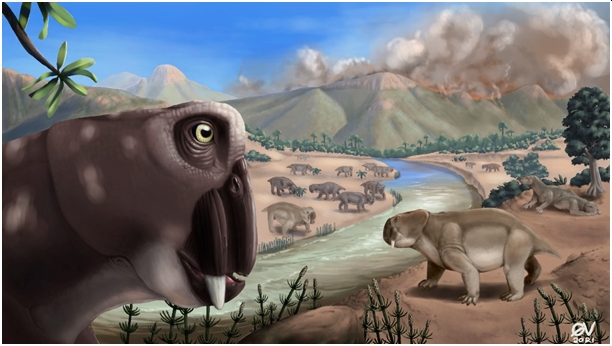
Illustration showing Lystrosaurus during the end-Permian mass extinction, by Gina Viglietti.
Our planet’s worst mass extinction event occurred 252 million years ago when massive volcanic eruptions caused catastrophic climate change. The vast majority of animal species went extinct, and when the dust settled, the planet entered the early days of the Age of Dinosaurs. Scientists are still learning about the patterns of how and why certain animals went extinct and others survived. In a new study published in the Proceedings of the National Academy of Sciences, USA, researchers found that while extinctions happened rapidly in the oceans, life on land underwent a longer, more drawn-out period of extinctions.
These new findings are part of a collaboration that includes researchers from the National Museum, Bloemfontein.
“People assumed that because the marine extinction happened over a short period of time, life on land should have followed the same pattern, but we found that the marine extinction may actually be a punctuation to a longer, more drawn-out event on land,” says Pia Viglietti, a postdoctoral researcher at Chicago’s Field Museum and the lead author of the PNAS study.
Part of why scientists have focused on marine extinctions for clues as to what happened on land is that there’s a more complete fossil record of life underwater. If you want to become a fossil, dying by water, where your body will rapidly become covered by sediment, is a good way to make that happen. As a result, palaeontologists have known for a while that 252 million years ago a mass extinction hit at the end of the Permian period, and within 100,000 years, more than 85% of the species living in the ocean went extinct. And while that seems like a long time to us, that’s very quick in geologic time. The marine version of the end-Permian extinction took up 100,000 years out of the entire 3,800,000,000 years that life has existed—the equivalent to 14 minutes out of a whole year.
To learn what happened to life on land the authors examined fossils from 588 four-legged fossil animals that lived in what’s now South Africa’s Karoo Basin at the time of the Permian mass extinction. The researchers created a database and separated the fossils by age, grouping together specimens by 300,000-year time intervals. This approach allowed the researchers to quantify the appearance and disappearance of different species and look at the bigger picture of life over time, rather than just relying on individual specimens to tell the whole story.
One of the species that helped reveal patterns of extinction and recovery was Lystrosaurus, an herbivorous early mammal relative. “Thousands of Lystrosaurus fossils have been found right after the extinction in what we call the post-extinction ecosystem. Palaeontologists have traditionally thought that this animal just took over in the extinction aftermath, but this study supports earlier research that Lystrosaurus was pre-adapted to the post-extinction environment. It managed to adapt when so many other species could not” says Jennifer Botha, a co-author of this study, based at the National Museum, Bloemfontein in South Africa.
Examining fossils like Lystrosaurus showed the researchers that the Permian extinction looked very different on land than it did in the oceans—it was a much longer, more drawn-out affair. Using the earlier comparison, if the history of life on Earth were compressed into a single year and the end-Permian extinction killed 95% of the ocean’s animals in a matter of 14 minutes, the land extinction would have taken ten times as long, about two hours and twenty minutes.
Understanding what happened in the end-Permian mass extinction gives us clues about the rise of the dinosaurs—many of the ancient mammal relatives went extinct, leaving ecological vacancies that dinosaur ancestors evolved to fill. But the end-Permian extinction also provides insights into the mass extinction event that the Earth is currently undergoing due to climate change and habitat destruction.
“Past mass extinctions give us clues on how organisms will adapt to geologically rapid climate change. This is particularly relevant in today’s world as we are currently living through another mass extinction” says Botha. “The ecosystems that we as humans are affecting today will take many thousands if not millions of years to recover”.
This study was contributed to by the following:
National Museum, Bloemfontein authors:
Jennifer Botha, Elize Butler, Bobby Eloff, Joël Mohoi, William Molehe, Nthaopa Ntheri, Thabang Ntsala, and John Nyaphuli.
Iziko, Wits, UK and USA authors:
Pia A. Viglietti, Roger B.J. Benson, Roger M.H. Smith, Christian F. Kammerer, Zaituna Skosan, Annelise Crean, Sheena Kaal, Nolusindiso Mtalana, Sibusiso Mtungata, Paul October, Georgina Skinner, Mike Strong, Hedi Stummer, Frederik P. Wolvaardt, and Kenneth D. Angielczyk.

Some of the researchers and fossil finders involved in the study, left to right, William Molehe, Thabang Ntsala, Pia Viglietti, Roger Smith, Jennifer Botha, Rose Prevec, Nthaopa Ntheri and Bobby Eloff.
Text: Dr Jennifer Botha


Comments are closed.