


Pre-Devonian in origin, the Pseudoscorpiones are one of the oldest extant lineages and over the past 392 Ma have diverged into more than 3400 known species in 26 families. Most are less than five millimetres in length, though they range from less than one millimetre in some Chthoniidae to just over ten millimetres in females of Garypus titanius Beier, 1961. They superficially resemble true scorpions, but lack the elongated tail and sting.They do, however, share the six-segmented pedipalps, with the tibia and tarsus modified into a chela (claw) with a movable finger.
The chelae (or grasping claws) house some of the pseudoscorpion’s most sensitive sensory structures and are used primarily for environmental awareness and subduing and manipulation of prey. Like most other arachnids, pseudoscorpions have poor eyesight and rely primarily on the sensory input of different types of tactile hairs of their bodies for environmental awareness. Being covered in these tactile hairs, the pedipalps thus extend the physical reach of the pseudoscorpion, allowing it even greater environmental awareness. Members of the suborder Iocheirata also possess venom teeth on either one or both of the grasping claws’ fingers, making the pseudoscorpiones one of only three arachnid orders that possess venom, the other two being the true spiders (Araneae) and scorpions (Scorpiones). The claws of most pseudoscorpions furthermore possess a myriad of tiny teeth along the inner margins of the claw fingers, making them very effective in both prey capture and manipulation. Lastly, some species also use their claws when sizing up an opponent or during their courtship dances. With opponents the pseudoscorpions come face to face, both extending their claws outward to their sides to try and intimidate each other. The winner is usually the one with the bigger claws. During courtship, male pseudoscorpions will often grasp the female’s claws with its own and then guide her along during his courtship dance.
Studying these creatures you soon realise that there are almost as many unique claw morphologies as there are species. Many species that inhabit the leaf litter of forest floors, for example the Pseudotyrannochthoniidae and Geogarypidae, have narrow and elongate claws best suited to extend their sensory range when navigating and hunting in this dark environment. Others, such as the Gymnobisiidae, have more compact claws with the teeth arranged on flexible lamellae and the venom tooth on the fixed finger modified into a multi-tooth structure. The Feaellidae, a sister group to all the other families, have chelae with barely any teeth and no venom apparatus.
One of the better-documented habits of pseudoscorpions is their phoretic association with many flying insects, whereby the pseudoscorpion attaches itself to a host insect by grasping it with its chela, and travels along with its host to a new location where it would then detach. Since this is only an occasional behaviour most pseudoscorpion species that engage in phoresis do not have chelae specifically modified to prevent damage to the host when grasping, often leaving scars on the host’s cuticle where the pseudoscorpion was attached. But what if you depend on your host for survival? Would it not then be beneficial to reduce any potential damage? Indeed it would. Examples of this can be seen with the bee-associated pseudoscorpions of the Ellengsenius genus, where they survive by feeding on parasites within beehives. Thus if a bee colony moves the pseudoscorpions have to tag along with them without causing damage to their flying partner, since an injured worker bee may not be able to keep up with the rest of the hive. Thus, to prevent injury to their bee hosts the associated pseudoscorpions have chelae modified with both a ventral cured movable finger and a groove on the anterior of the fixed chelal finger. Together these modifications allow the pseudoscorpion to effectively grasp around the bee’s leg and not directly onto the leg, possibly causing damage by crushing the exoskeleton of the leg.
Many more such modifications exist. Some pseudoscorpions have chelae ornamented with pines, tubercles, deep indentations and even large protruding structures. The functions of many of these modifications are yet to be determined, but each will undoubtedly be fascinating.
REFERENCES
BEIER, M. 1947. Zur kenntnis der Pseudoscorpionidenfauna des Südlichen Afrika, inbesondere der Südwest- und Südafrikanischen trockengebiete. Eos 23: 285-339.
HARVEY, M. S. 1992. The phylogeny and classification of the Pseudoscorpionida (Chelicerata: Arachnida). Invertebrate Taxonomy 6: 1373-1435.
LEWIS, R. J. 1903. On an undescribed species of Chelifer. Journal of the Quekett Microscopical Club 8: 497-498.
TULLGREN, A. 1907. Chelonethiden aus Natal und Zululand. In: Wirén, A. (Ed.). Zoologiska studier tillagnade Professor T. Tullberg. Almquist and Wiksells, Uppsala. 216-236.
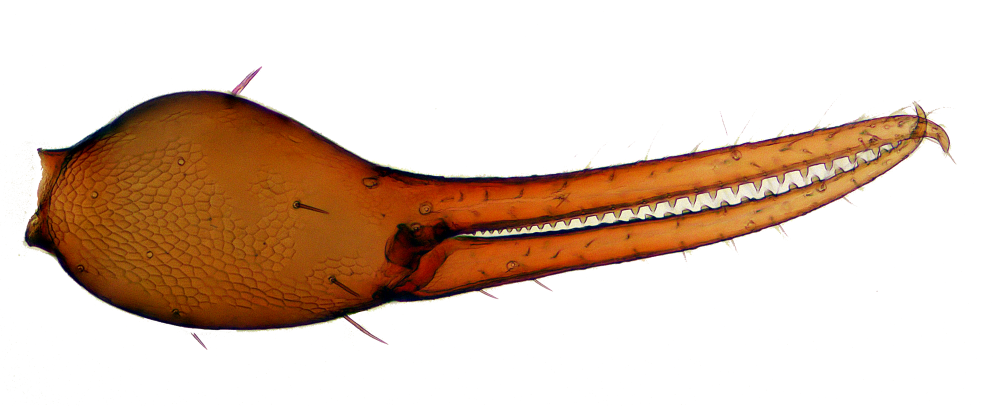
The claws of the pseudoscorpion family Pseudotyrannochthoniidae are elongate and narrow allowing them greater environmental awareness while navigating in dense leaf litter. [Photo: J.A. Neethling]
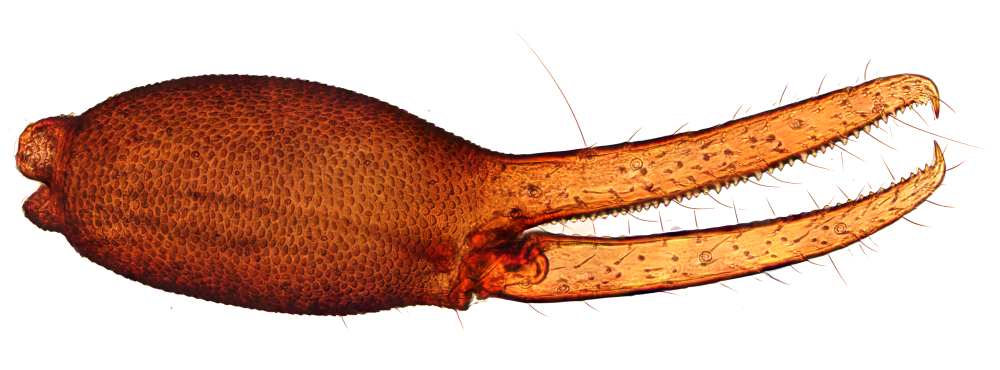
The claws of Geogarypus flavus (Geogarypidae) are also elongate and afford them the same benefits as those of the pseudotyrannochthoniids. The two large spikes at the tips of the fingers are the venom teeth. [Photo: J.A. Neethling]
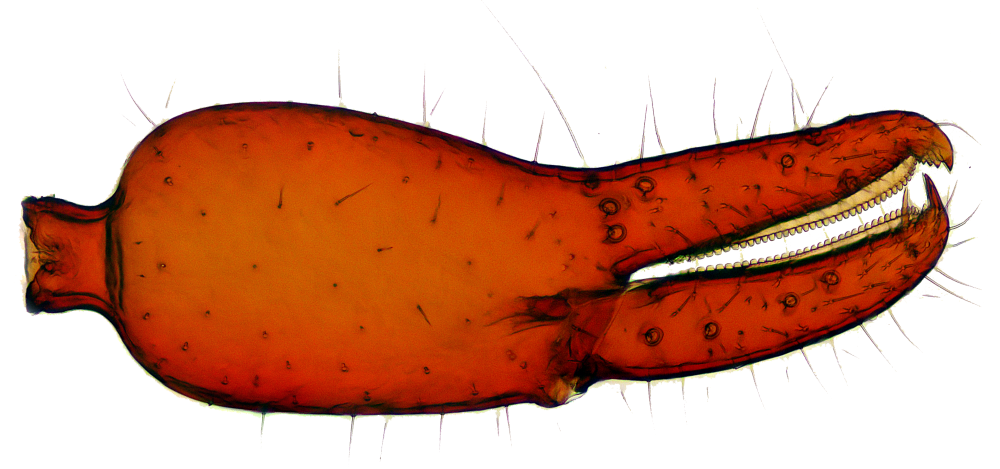
The claws of Gymnobisium quadrispinosum (Gymnobisiidae) are interesting in that they showcase a number of unique morphological adaptations. The most prominent among these being two-fold: The inner teeth are soft, rubbery and raised on flexible sheets called lamellae and the venom tooth at the tip of the fixed finger has been adapted into a robust multi-tooth structure without venom.[Photo: J.A. Neethling]

The claws of Feaella capensis (Feaellidae) are strange in that they are very reduced in both size and complexity, possessing almost no prominent teeth. [Photo: J.A. Neethling]

The claw of Ellingsenius sculpturatus (Cheliferidae) has adapted to both have an indentation at the inner frontal edge of the fixed finger as well as a gap between fingers, even when the claw is closed. This is to help the pseudoscorpion grip around its host (the honey bee) during phoresis without it causing any damage to the host’s leg. [Photo: J.A. Neethling]

Comments are closed.