

Herpetofauna of the Oviston, Commando Drift and Tsolwana nature reserves in the arid interior of the Eastern Cape Province, South Africa
Werner Conradie1, 2, *, Brian Reeves 3, Neil Brown4 and Jan A. Venter5
1 Port Elizabeth Museum (Bayworld), Humewood, Port Elizabeth, South Africa.
2South African Institute for Aquatic Biodiversity, Grahamstown, South Africa.
3 Scientific Services, Eastern Cape Parks and Tourism Agency, Southernwood, East London, South Africa.
4 Department of Geography, The Pennsylvania State University, 201 Walker Building, University Park, PA, United States of America.
5 School of Natural Resource Management, George Campus, Nelson Mandela Metropolitan University, George, South Africa.
* Corresponding author. E-mail:werner@bayworld.co.za
ABSTRACT
Herpetofauna of the Oviston, Commando Drift and Tsolwana nature reserves in the arid interior of the Eastern Cape Province, South Africa Indago 32: XX-YY. The results of herpetofaunal surveys of Oviston, Commando Drift and Tsolwana nature reserves in central and northern Eastern Cape, South Africa are presented. Visual encounter survey methods and standard Y-shape trap arrays were used to conduct surveys from 2014 to 2015. A total of 58 species (12 amphibians and 44 reptiles) were recorded and 130 quarter degree grid cell unit records were documented, of which 44% represented the first records for the units. The final species counts for Oviston were 33 reptile and 10 amphibian species, for Commando Drift 14 reptile and eight amphibian species, and for Tsolwana 25 reptile and eight amphibian species. The species collected were encountered in three ecoregions, namely Nama-Karoo, Grassland/Savanna and Cape temperate adapted species. None of the species encountered are regarded as threatened.
Keywords: Amphibia, Reptilia, karroid, conservation, biodiversity
INTRODUCTION
Southern Africa is considered to have one of the highest reptile diversities in the world (Branch 2006). Within this area, Greater South Africa (including Lesotho and Swaziland) has the highest reptile diversity with 435 species and subspecies (Bates et al. 2014; Jacobsen et al. 2014; Petzold et al. 2014; Whiting et al. 2015). Although South Africa is fairly well-studied from a herpetofaunal perspective, new species are still being described (frogs: Channing 2012; Conradie 2014; Channing & Baptista 2013; Channing et al. 2013; reptiles: Jacobsen et al. 2014; Whiting et al. 2015).
Some areas remain poorly surveyed, especially the Northern Cape, North West and Eastern Cape provinces (Bates et al. 2014). Within the Eastern Cape, much work has been done in the southern and western regions of the province (e.g. Branch & Braack 1987) while the northern and central areas associated with the former homelands of the Ciskei and Transkei remain poorly surveyed. Venter & Conradie (2015) produced a comprehensive checklist of the herpetofauna occurring along the Wild Coast (in the former Transkei) and alluded to the possibility that gaps in species distributions were due to under-sampling rather than a reflection of real distribution patterns.
This study forms part of a long-term program run by Eastern Cape Parks and Tourism Agency (ECPTA), in collaboration with the Port Elizabeth Museum, to survey a selection of provincial nature reserves and biodiversity stewardship sites in the Eastern Cape. These surveys focused on three reserves in the arid interior of the Eastern Cape (i.e. Oviston, Command Drift and Tsolwana). No formal surveys have been undertaken in these reserves and their presence in the herpetological literature appears to be limited to a short note on predation and distribution of Nucras lividia (A. Smith, 1838) in Commando Drift NR (Burger & Hahndiek 1993; see also Burger 2014).
The objectives of this study were to provide an annotated list of amphibians and reptiles occurring in the three provincial nature reserves, and to assess the presence of species of special conservation concern (threatened and endemic species).
STUDY AREAS
Tsolwana NR (7 800 ha) and Commando Drift NR (5 700 ha) are located in the central portion of the Eastern Cape, east of the town of Cradock. Oviston NR (32 000 ha) is situated in the northern part of the province, on the border with the Free State and Northern Cape provinces and near the town of Venterstad (Fig. 1). The three reserves are all situated above the Great Escarpment (elevations generally greater than 1 000 m a.s.l.), underlain primarily by sandstones of the Karoo Supergroup (Katberg Formation of the Beaufort Group), interspersed with igneous intrusions (dolerite) and Quaternary alluvial deposits (Council for Geoscience 1997), and generally experience semi-arid conditions. Average annual rainfall for Oviston and Commando Drift is approximately 450 mm or less, and Tsolwana NR receives slightly more with averages of about 600 mm (WorldClim data, see Hijmans et al. 2005). The reserves are characterised by warm summers and cold winters (with occasional winter frost) and precipitation occurs mostly as summer thunderstorms (ECPB 2007; ECPB 2009a,b).
Tsolwana NR is situated in the Great Kei River Catchment, Commando Drift NR in the Great Fish River Catchment, and Oviston NR in the Orange or Gariep River Catchment. The northern boundary of Oviston NR is the Gariep Dam, situated on the Orange River. The terrestrial extent of this reserve fluctuates greatly with the level of the dam. Commando Drift NR also features a large dam on the Tarka River, and when full accounts for approximately 750 ha of the core of the reserve.
The three reserves occur within the Nama-Karoo Biome and its ecotone with the Grassland Biome (as defined by Mucina & Rutherford 2006). Vegetation types mentioned below also refer to the latter publication. Tsolwana NR is predominantly vegetated by Karoo Escarpment Grassland. Queenstown Thornveld occurs in the north of the reserve while the mesa (isolated flat-topped hill) in the southeast is covered by Tarkastad Montane Shrubland. Commando Drift NR is vegetated by Eastern Upper Karoo vegetation in the southern sector of the reserve and by Tarkastad Montane Shrubland in the north. A small area along the Tarka River in the south is vegetated by Southern Karoo Riviere vegetation. The predominant vegetation type is Eastern Upper Karoo, with Besemkaree Koppies Shrubland in higher-lying areas.
MATERIALS AND METHODS
Surveys were conducted on the following dates: Tsolwana NR, 1 to 10 March 2014 (Venter et al. 2015); Commando Drift NR, 21 February to 2 March 2015; and Oviston NR, 20 to 28 November 2015 (Reeves & Conradie 2015). We used a combination of visual encounter survey methods and standard Y-shaped trap arrays (each trap array consisted of three 10-m-long, 50-cm-high drift fences positioned in a Y-shape with four pitfall traps, at the ends and middle, and two one-way funnels per fence, similar to Maritz et al. 2007) (Fig. 2).
Diurnal and nocturnal collecting (using headlamps or flashlights at night) was conducted by actively searching specific microhabitats, including beneath rocks and decaying logs. Advertisement calls of frogs were recorded in the field using either an Olympus VN-3500PC Voice Recorder or NAGRA ARES-ML recorder with an external Sony F-V4T microphone, and compared to the library of vocalizations provided by Du Preez & Carruthers (2009). All specimens were captured by hand or net (e.g. tadpoles), photographed and then released (except for voucher samples) at the original capture site. Specimens were humanely euthanised using tricaine methanesulfonate (MS222) solution (Conroy et al. 2009) via injection (reptiles) or submersion (frogs), after which they were formalin-fixed for 48 h and transferred to 50% isopropanol solution for long-term storage in the herpetological collection of the Port Elizabeth Museum (PEM). Specimens were identified using field guides and recent publications (Petzold et al. 2014; Channing & Baptista 2013; Du Preez & Curruthers 2009; Marais 2004; Channing 2001; Branch 1998). Nomenclature was based on Frost (2015) for amphibians and Uetz & Hošek (2015) for reptiles, with updates where necessary. Conservation status was based on the latest IUCN assessments, and updated evaluations for amphibians (Measey 2011) and reptiles (Bates et al. 2014) of the region. Additional records were sourced from the Southern African Frog Atlas Project (Minter et al. 2004), the Southern African Reptile Conservation Assessment project (Bates et al. 2014), museum records, and literature records pertaining to the study area. Records with appropriate supporting evidence (voucher specimens or photographs from which positive identifications could be made) were included in the final species checklist.
RESULTS AND DISCUSSION
A total of 12 amphibian species representing four families and nine genera (Table 1) and 44 reptile species (17 snakes, 25 lizards, 3 terrapins) representing 14 families and 31 genera (Table 2) were recorded from the three reserves. This represents a near-complete list of species expected to occur in these reserves according to the respective atlases (~14 amphibian species according to Minter et al. [2004] and ~50 reptile species according to Bates et al. [2014]). Species richness was similar to that recorded at other arid reserves, namely Karoo National Park (eight amphibian and 59 reptile species; Branch & Braack 1989) and Rooipoort NR (seven amphibian and 30 reptile species; Conradie et al. 2010). No ‘conservation concern’ (e.g. threatened) amphibian or reptile species were recorded within the protected areas surveyed, although the historical presence of Giant Bullfrogs (Pyxicephalus adspersus Tschudi, 1838) at Oviston NR is of regional importance.
From a zoogeographical perspective, species observed were associated mainly with three biomes (assignments according to Branch & Braack 1989): Nama-Karoo, Grassland and Savanna. Some of the observed species can be designated as Cape temperate species: Cacosternum nanum Boulenger, 1887, Crotaphopeltis hotamboeia (Laurenti, 1768), Duberria lutrix (Linnaeus, 1758), Hemachatus haemachatus (Bonnaterre, 1790), Nucras lalandii (Milne-Edwards, 1829), Psammophis crucifer (Daudin, 1803), Psammophylax rhombeatus rhombeatus (Linnaeus, 1758), Sclerophrys capensis Tschudi, 1838, Tetradactylus tetradactylus (Daudin, 1802) and Trachylepis homalocephala (Weigmann, 1828), others as Grassland/Savanna species: Pseudocordylus microlepidotus fasciatus (Smith, 1838) and Trachylepis punctatissima (Smith, 1849), and the remainder as arid-adapted species associated with the Nama-Karoo: Chondrodactylus bibronii (Smith, 1846), Homopus femoralis Boulenger, 1888, Pachydactylus oculatus Hewitt, 1927, Poyntonophrynus vertebralis (Smith, 1848), Trachylepis sulcata sulcata (Peters, 1867) and Vandijkophrynus gariepensis (Smith, 1848).
A total of 130 quarter-degree-grid-cell unit (QDGC) records were obtained, of which 44% (29% amphibians and 48% reptiles) represent first records for the respective units (Table 3). These increases in known distribution are similar to the overall 37% reported by Venter & Conradie (2015) for other poorly surveyed areas in the Wild Coast region of the Eastern Cape.
Species accounts
In the accounts that follow, only specimens collected during the current surveys are discussed. Examples are illustrated in Figs 3–5. Distribution details and common names used are drawn for the most part from Minter et al. (2004) and Bates et al. (2014). Additional material used to compile the final checklist is listed but was not examined. Abbreviations used: TM – Ditsong National Museum of Natural History (formerly Transvaal Museum), USEC/H – University of Stellenbosch Ellerman Collection Herpetology, PEM – Port Elizabeth Museum (A – amphibian, R – reptile, T – tadpole), SAM – South African Museum, VM – Animal Demography Unit Virtual Museum (http://vmus.adu.org.za ). SUL – snout-urostyle length, SVL – snout-vent length, TL = tail length.
CapeNature database lists a H. haemachatus from Oviston NR with the accession number PEM R4994 which was mapped in the recent reptile atlas (Bates et al. 2014). This number was in fact assigned to Agama aculeata aculeata from Oviston NR and no other H. haemachatus from Oviston NR is present in the PEM collection. We thus cannot confirm the presence of this species in the reserve and have omitted it from our checklist.
Amphibia
Bufonidae
Sclerophrys gutturalis (Power, 1927) Guttural Toad
Material collected. – Oviston NR (PEM A11626–7, 30°39’47”S 25°35’35”E, two juveniles 30.0–30.3 mm SUL).
Comments. – Previously Amietophrynus (Frost et al. 2006) and recently transferred to Sclerophrys (Ohler & Dubios 2016). Specimens were collected under rocks near water at Broekspruit River, a southern tributary of the Orange River. These are the first records south of the Orange River between the upper Vanderkloof Dam (3025AC) and Aliwal North (3026DA). According to Poynton & Broadley (1988), this species is associated with moist savanna. It occurs along the wooded banks of the middle and lower Gariep/Orange River (Du Preez et al. 2004). The species may have benefited from the building of the dam, which allowed for more suitable conditions along the upper Orange River. Most of the other Eastern Cape records are from the area around Aliwal North and east of Mthatha, as well as along the coast to East London.
Sclerophrys capensis Tschudi, 1838 Raucous Toad
Material collected. – Oviston NR (PEM A11628, 30°39’47”S 25°35’35”E, juvenile 36.8 mm SUL), Commando Drift NR (PEM A11490, 32°06’5 S 26°14’5”E, female, 73.7 mm SUL; PEM A11491, 32°44’01”S 26°01’02”E, female, 65.1 mm SUL), Tsolwana NR (PEM A11130, 32°11’20”S 26°27’30” E, juvenile, 25.9 mm SUL; PEM A11131, 32°09’54”S 26°29’01” E, female 60.0 mm SUL).
Additional material. – Oviston NR (PEM A1802).
Comments. – New replacement name for Amietophrynus rangeri (Ohler & Dubios 2016). Specimens were collected in close proximity to water sources, either under rocks or in traps.
Poyntonophrynus vertebralis (Smith, 1848) Southern Pygmy Toad
Material collected. – Commando Drift NR (PEM A11496–8, 32°6’43”S 26°21’5”E, females, 31.8–36.8 mm SUL).
Additional material. – Oviston NR (PEM A1796, 1801).
Comments. – Collected in late February 2015 after heavy afternoon rains at Commando Drift NR. Recorded from Oviston NR after heavy rains.
Vandijkophrynus gariepensis (Smith, 1848) Karoo Toad
Material collected. – Oviston NR (PEM A11629, 30°42’01”S 25°45’58”E, female 64.6 mm SUL), Commando Drift NR (PEM A11502, 32°51’06”S 26°13’03”E, female 67.8 mm SUL; PEM A22603, 32°06’35”S 26°02’07”E, female 56.3 mm SUL; PEM A11504, 32°51’06”S 26°01’33”E, female 53.6 mm SUL), Tsolwana NR (PEM A11143–4, 32°09’59”S 26°29’07”E, two juveniles 21.1–21.3 mm SUL).
Additional material. – Oviston NR (PEM A1797, 1803, 3575, 3576, 3580).
Comments. –Two subspecies are recognized, a karroid species, V. g. gariepensis and a montane grassland species, V. g. nublicolis. Despite concern over the validity of the latter subspecies (e.g. Branch & Braack 1989; Branch 1990; Bates & Haacke 2003), its status remains equivocal and a modern phylogenetic study is required to resolve its status.
Hyperoliidae
Kassina senegalensis (Duméril and Bibron, 1841) Bubbling Kassina
Material collected. – Commando Drift NR (PEM A11494–5, 32°51’06”S 26°01’33”E, two females 42.4–42.8 mm SUL), Tsolwana NR (PEM A11138–9, 32°29’05”S 26°29’32”E, two females 33.7–35.9 mm SUL; PEM T672 (five tadpoles), 32°10’48”S 26°29’22”E, 30.7–94.9 mm total length).
Additional material. – Oviston NR (PEM A1789–90).
Comments. – Associated with Savanna and Grassland and extending only marginally into arid areas.
Pipidae
Xenopus laevis (Daudin, 1802) Common Platanna
Material collected. – Commando Drift NR (PEM A11505, 32°06’35”S 26°02’07”E, female 58.0 mm SUL), Tsolwana NR (PEM A11145–7, 32°10’48”S 26°29’22”E, three juveniles 25.0–26.0 mm SUL; PEM T673 (three tadpoles), 32°10’48”S 26°29’22”E, 42.2–49.4 mm total length).
Additional material. – Oviston NR (PEM A4225).
Comments. – Common and widespread species associated with most freshwater bodies from Malawi to southern South Africa. Furman et al. (2015) recognized five distinct genetic lineages but lacked samples from the eastern and central parts of the Eastern Cape. Recent studies (Measey pers. comm.) have identified an additional new lineage from the coastal Eastern Cape which includes samples from Tsolwana NR. Interestingly, samples from Commando Drift NR (less than 50 km west of Tsolwana NR) are part of another, previously identified, lineage. This pattern of lineages may be congruent with the ecotone between Nama-Karoo and Grassland biomes, in a similar pattern to the distribution of Amietia fuscigula and A. delalandii.
Pyxicephalidae
Amietia fuscigula (Duméril & Bibron, 1841) Cape River Frog
Material collected. – Oviston NR (PEM A11623–4, 30°39’47”S 25°35’35”E, two juveniles, 30.1–32.2 mm SUL).
Additional material. – Oviston NR (PEM A4069).
Comments. –We assign our specimens from Oviston NR to A. fuscigula based on the following characters: broader head than A. delalandii and a distinct absence of facial markings above the jaw line. Species boundaries of the three South African river frog species, i.e. A. fuscigula, A. poyntoni and A. delalandii (see below), remain poorly defined, and although the review of Channing & Baptista (2013) resolved some taxonomic issues, the distributional limits of the various species now recognised were not addressed. These authors noted Eastern Cape material from the Bamboesberg range aligned genetically with their concept of A. fuscigula; this locality is in close geographical proximity to our sample from Oviston NR, thereby supporting our assignment of material to this species.
Amietia delalandii (Duméril & Bibron, 1841) Eastern River Frog
Material collected. –Tsolwana NR (PEM A11128, 32°08’31”S 26°28’22”E, female, 65.8 mm SUL; PEM A11129, 32°11’5”S 26°27’10”E, juvenile, 25.1 mm SUL; PEM T674 (1 specimen), 32°10’48”S 26°29’22”E, 26.4 mm total length).
Comments. –We assign our specimens from Tsolwana NR to A. delalandii (as opposed to the other alternative, A. poyntoni) based on a more pointed head compared to the broader head of A. fuscigula and unique facial markings as defined by Channing & Baptista (2013: as A. quecketti) and Channing et al. (2016: as A. delalandii). One specimen observed at Commando Drift NR was tentatively assigned to the same species based on a more pointed snout. Amietia angolensis, previously considered a widespread species, is now restricted to Angola (Channing & Baptista 2013).
Cacosternum boettgeri (Boulenger, 1882) Common Caco
Material collected. – Commando Drift NR (PEM A11492, 32°07’15”S 26°02’01” E, female 21.8 mm SUL; PEM A11493, 32°06’35”S 26°02’07”E, female 19.2 mm SUL), Tsolwana NR (PEM A11132, 32°09’05”S 26°29’32”E, male 30.4 mm SUL; PEM A11133–5, 32°09’05”S 26°29’32”E, three females 20.2–23.2 mm SUL; PEM T670 (14 tadpoles), 32°08’31”S 26°28’23”E, 15.5-32.4 mm total length).
Additional material. – Oviston NR (PEM A4382).
Comments. – Recent published work identified three cryptic species in the C. boettgeri group occurring in South Africa, namely C. australis, C. rhythmum and C. thorini, and alluded to further cryptic diversity within this group (Channing et al. 2013; Conradie 2014). Recorded at Oviston NR after heavy rains.
Cacosternum nanum Boulenger, 1887 Bronze Caco
Material collected. –Tsolwana NR (PEM A11136–7, 32°09’53”S 26°28’58”E, subadults 11.2–16.6 mm SUL).
Comments. – A high altitude subspecies, C. n. parvum, was elevated to species status, rendering C. nanum a monotypic species (Channing et al. 2013). We assign our species to C. nanum based on larger size, well developed subarticular tubercles, and advertisement call (compared to C. parvum). Specimens were collected in sympatry with C. boettgeri at Tsolwana NR. The absence of C. nanum in the arid western reserves suggests a Cape temperate association.
Tomopterna tandyi Channing & Bogart, 1996 Tandy’s Sand Frog
Material collected. – Oviston NR (PEM A11625, 30°43’51”S 25°43’51”E, subadult 30.6 mm SUL), Commando Drift NR (PEM A11499–500, 32°06’43”S 26°02’15”E, males 40.8–44.8 mm SUL; PEM A114501, 32°04’41”S 26°01’04”E, female 49.3 mm SUL), Tsolwana NR (PEM A11140, 32°11’05”S 26°27’10”E, juvenile 21.8 mm SUL; PEM A11141, 32°10’58”S 26°27’13”E, juvenile 31.7 mm SUL; PEM A111412, 32°09’03”S 26°29’27”E, juvenile 32.4 mm SUL; PEM T671 (five tadpoles), 32°09’29”S 26°26’42”E, range 36.6–45.6 mm total length).
Additional material. – Oviston NR (PEM A1755, 1762, 1771, 1792, 1799, 1800, 2052, 4307, 4308, 4310, 4311).
Comments. – Distinguished from closely related T. cryptotis by genetics and call (Channing & Bogert 1996). None of the material collected was calling, but we tentatively assign our Eastern Cape populations to this species. Species boundaries in northern Eastern Cape Province need to be investigated further to determine the range of T. cryptotis in the province.
Pyxicephalus adspersus Tschudi, 1838 Giant Bullfrog
Additional material. – Oviston NR (PEM A3152).
Comments. – The record for this species at Oviston NR dates back to 1973, based on a specimen collected by K. Coetzee. No additional collections were made during the current surveys. Although this species was regionally assessed as Near Threatened in 2004 (Minter et al. 2014), it was subsequently downgraded to Least Concern due to its widespread global distribution (IUCN SSC Amphibian Specialist Group 2013). However, there remain conflicting views on the taxonomic status of some populations in Africa (Scott et al. 2014), and localised threats are known to have adversely affected other populations and reduced the size of their ranges (Botts et al. 2012).
Reptilia
Pelomedusidae
Pelomedusa galeata (Schoepff, 1972) Southern Marsh Terrapin
Material collected. –Tsolwana NR (PEM R20715, 32°09’29”S 26°26’42”E, juvenile 77.4 mm total length).
Additional material. – Oviston NR (SAM ZR–43805; a shell is also on exhibit at the Oviston NR educational centre), Commando Drift NR (PEM R11740).
Comments. – Petzold et al. (2014) revised this group and re-instated the name P. galeata for populations in southern and eastern South African. The species is expected to be more widespread in the central and northern Eastern Cape, but there seems to be a lack of data from the province (Bates et al. 2014).
Testudinidae
Homopus femoralis Boulenger, 1906 Greater Dwarf Tortoise
Material collected. – Tsolwana NR (VM 191130, 32°10’06.9”S 26°29’25.1”E, photographed and released).
Additional material. – Oviston NR (SAM ZR–48746), Commando Drift NR (PEM R11739; SAM ZR–48043, 48815).
Comments. –Replaced by Homopus areolatus and Homopus boulengeri below the escarpment in southern Eastern Cape Province.
Stigmochelys pardalis (Bell, 1828) Leopard Tortoise
Material collected. – Oviston NR (VM 191132, 30°39’46.8”S 25°53’34.8”E; VM 191142, 30°43’59.5”S 25°43’38.9”E), Commando Drift NR (VM 19144, 32°03’55.3”S 26°00’54.4”E), Tsolwana NR (observed only).
Comments. – Found from the Cape to Ethiopia, and common and widespread in most parts of South Africa, especially the southern and western Eastern Cape (Branch 2008). Absent from the old Transkei (Branch et al. 1995). It seems that this species, like the toad S. gutturalis, has benefited from the building of the Gariep Dam, which has allowed it to spread eastwards along the upper Orange River.
Gekkonidae
Chondrodactylus bibronii (Smith, 1846) Bibron’s Gecko
Material collected. – Oviston NR (PEM R21873, 30°39’46.8”S 25°35’34.8”E, male 84.9 mm SVL; PEM R21899, 30°38’35.2”S 25°33’45.8”E, subadult male 74.7 mm SVL; PEM R21900, 30°45’38”S 25°45’08”E, female 92.7mm SVL; PEM R 21911, 30°39’46.8”S 25°35’34.8”E, female 82.0 mm SVL), Commando Drift NR (PEM R21314, 32°06’57”S 26°02’59”E, female 78.4 mm SVL; PEM R21315, 32°06’57”S 26°02’59”E, male 89.2 mm SVL; PEM R21316, 32°06’05”S 26°01’45”E, male 87.7 mm SVL; PEM R21317, 32°06’05”S 26°01’45”E, male 83.2 mm SVL; PEM R21318, 32°02’51”S 26°00’8”E, male 91.2 mm SVL).
Additional material. – Oviston NR (PEM R5000, 5007, 5065), Commando Drift NR (PEM R8183).
Comments. – Common and widespread in the more arid parts of the country, reaching its most easterly distribution around Commando Drift NR in central Eastern Cape. Apparently absent from the grasslands of eastern and northern Eastern Cape Province. Collected from buildings and among large boulders during the survey.
Pachydactylus capensis (Smith, 1846) Cape Gecko
Material collected. – Oviston NR (PEM R21878, 30°45’10.4”S 25°44’45.2”E, male 44.6 mm SVL; PEM R21901, 30°45’38.0”S 25°45’8.4”E, female 37.5 mm SVL), Commando Drift NR (PEM R21319, 32°05’06”S 26°01’22”E, sub-adult female 27.5 mm SVL).
Additional material. – Oviston NR (PEM R5076), Commando Drift NR (PEM R8184).
Comments. – Specimens were collected in open habitat under medium-sized rocks. Absent from the eastern and southern parts of the Eastern Cape Province.
Pachydactylus mariquensis Smith, 1849 Common Banded Gecko
Material collected. – Tsolwana NR (PEM R20703, 32°09’34”S 26°28’00.4”E, male 32.6 mm SVL).
Additional material. – Oviston NR (PEM R5068; SAM ZR–43790).
Comments. – The specimen from Tsolwana NR was collected under a small rock in degraded thicket riverbed, while the Oviston NR specimen was found on an old fence pole. This species is rare in the central Eastern Cape Province, but elsewhere in the southern parts of South Africa it is widespread, although some populations may be disjunct.
Pachydactylus oculatus Hewitt, 1927 Golden Spotted Gecko
Material collected. – Oviston NR (PEM A21902, 30°44’58.0”S 25°36’22.9”E, juvenile 36.3 mm SVL), Tsolwana NR (PEM R20704, 32°09’59”S 26°29’09”E, juvenile 19.7 mm SVL; 20705, 32°09’12”S 26°27’26”E, male 31.1 mm SVL; 20706–8, 32°10’45”S 26°29’42”E, 2 males, one juvenile 37.3–39.1, 15.6 mm SVL).
Comments. – Often confused with the more common and widespread P. maculatus. We based our identifications on the fact that the dorsal dark spots are distinctly white-edged compared to absent in P. maculatus (Branch 1998). Tsolwana NR is near the type locality of P. oculatus (= Tarkastad) while Oviston NR is near the type locality of P. m. albomarginatus (= Norvals Pont). Unpublished molecular work indicates that the latter may not be a valid species (Bauer pers. comm.) and should remain a junior synonym of P. oculatus. Examination of the type material of P. m. albomarginatus by De Waal (1978) confirmed its synonymy with P. oculatus rather than with P. maculatus (Loveridge1947; Kluge 2001).
Agamidae
Agama aculeata aculeata Merrem, 1820 Western Ground Agama
Material collected. – Oviston NR (PEM R21869, 30°43’20.8”S 25°44’27.0”E, female 81.9 mm SVL; PEM R21887, 30°45’10.4”S 25°44’45.2”E, male 78.3 mm SVL).
Additional material. – Oviston NR (PEM R4994; TM 47872), Commando Drift NR (PEM R6536).
Comments. – Two subspecies are present on the border of the Eastern Cape and Free State Provinces. We assign our specimens to the nominate subspecies (rather than Agama aculeata distanti) based on the smooth head scales and the fourth toe being longer than the third toe. Abundant at Oviston NR.
Agama atra Daudin, 1802 Southern Rock Agama
Material collected. – Oviston NR (PEM A21862, 30°45’10.4”S 25°44’45.2”E, juvenile 60.7 mm SVL; PEM R21870, 30°44’51.8”S 25°45’20.3”E, juvenile 45.8 mm SVL; PEM R21889, 30°44’58.0”S 25°36’22.9”E, subadult female 67.1 mm SVL; PEM R21890, 30°43’45.2” S 25°44’49.4”E, juvenile 68.4 mm SVL; PEM R21891, 30°38’35.2”S 25°33’45.8”E, male 98.8 mm SVL; PEM R21896, 30°45’38.0”S 25°45’8.4”E, juvenile 45.8 mm SVL; PEM R21909, 30°39’46.8”S 25°35’34.8”E, male 87.9 mm SVL), Commando Drift NR (PEM R21312, 32°06’57”S 36°02’59”E, male 88.6 mm SVL; PEM R21313, 32°06’40”S 26°02’30”E, female 77.4 mm SVL), Tsolwana NR (PEM R20690, 32°09’34”S 26°28’00”E; PEM R20691, 32°10’49”S 26°29’21”E, male 90.2 mm SVL; PEM R20698, 32°10’46”S 26°29’40”E, male 87.6 mm SVL).
Additional material. – Oviston NR (PEM R4999, 10174; SAM ZR-43792TM 47869, 47871, 47874).
Scincidae
Acontias gracilicauda Essex, 1925 Thin-tailed Legless Skink
Additional material. – Oviston NR (PEM R5081).
Comments. – No new material collected during the current surveys.
Trachylepis capensis Smith, 1849 Cape Skink
Material collected. – Oviston NR (PEM R21868, 30°43’20.8”S 25°44’27.0”E, female 56.1 mm SUL; PEM R21881, 30°44’16.3”S 24°43’38.8”E, male 66.3 mm SVL, PEM R21906, 30°45’10.4”S 25°44’45.2”E, male 72.4 mm SVL), Commando Drift NR (PEM R21327, 32°05’16”S 26°01’33”E, male 50.9 mm SVL; PEM R21328, 32°05’16”S 26°01’33”E, male 61.9 mm SVL; PEM R31329, 32°02’27”S 26°00’09”E, juvenile 36.3 mm SVL), Tsolwana NR (PEM R20726, 32°08’35”S 26°26’05”E, juvenile 36.9 mm SVL; PEM R20727, 32°10’58”S 26°27’13”E, male 79.6 mm SVL; PEM R20728, 32°09’54”S 26°28’57”E, subadult male 47.6 mm SVL).
Additional material. – Oviston NR (PEM R6506, 6556).
Trachylepis homalocephala (Weigmann, 1828) Red-sided Skink
Material collected. – Tsolwana NR (PEM R20729, 32°09’57”S 26°29’05”E, male 56.6 mm SVL; PEM R20730, 32°09’29”S 26°26’42”E, juvenile 30.1 mm SVL).
Comments. – Venter & Conradie (2015) reported this species to be more widespread in the old Transkei than previously documented.
Trachylepis punctatissima (Smith, 1849) ……..Speckled Rock Skink
Additional material. – Oviston NR (PEM R5013, 11308).
Comments. – No new material collected during the current surveys.
Trachylepis sulcata sulcata (Peters, 1867) Western Rock Skink
Material collected. – Oviston NR (PEM R21866, 30°43’20.8”S 24°44’27.0”E, female 65.7 mm SVL; PEM R21867, 30°43’20.8”S 24°44’27.0”E, female 61.8 mm SVL; PEM R21871, 30°44’47.5”S 25°44’52.2”E, male 64.7 mm SVL; PEM R21872, 30°45’01.4”S 25°43’21.0”E, male 61.5 mm SVL; PEM R21875, 30°39’46.8”S 25°35’34.8”E, female 77.0 mm SVL; PEM R21884, 30°44’51.8”S 25°45’20.3”E, male 62.4 mm SVL; PEM R21893, 30°45’38.0”S 25°45’8.4”E, male 57.0 mm SVL; PEM R21903, 30°43’29”S 25°43’54.3”E, female, 74.3 mm SVL), Commando Drift NR (PEM R21330, 32°06’57”S 26°02’59”E, sub-adult male 41.2 mm SVL, PEM R21331, 32°02’50”S 26°01’07”E, juvenile, 28.6 mm SVL; PEM R21332, 32°06’10”S 26°01’48”E, female 65.9 mm SVL).
Additional material. – Oviston NR (PEM R5009, 5016, 5064, 5078; SAM ZR-43791, 43802, 43803), Commando Drift NR (PEM R8182).
Comments. – A common rupicolous skink that reaches its eastern limits in the Commando Drift NR area.
Trachylepis varia (Peters, 1867) Variable Skink
Material collected. – Tsolwana NR (PEM R20692, 32°08’35”S 26°26’50”E, subadult male 39.9 mm SVL; PEM R30731, 32°09’44”S 26°28’52”E, male 51.1 mm SVL; PEM R20732, 32°09’53”S 26°28’58”E, subadult male 36.2 mm SVL).
Comments. – Recorded only from Tsolwana NR and not the other two reserves, where it is replaced by T. variegata.
Trachylepis variegata (Peters, 1870) Variegated Skink
Material collected. – Oviston NR (PEM A21864, 30°43’20.8”S 24°44’27.0”E, male 44.1 mm SUL; PEM R21865, 30°43’20.8”S 24°44’27.0”E, gravid female 49.5 mm SUL; PEM R21876, 30°45’10.4”S 25°44’45.2”E, gravid female 47.8 mm SUL; PEM R21877, 30°45’10.4”S 25°44’45.2”E, male 42.6 mm SUL; PEM R21879, 30°39’46.8”S 25°35’34.8”E, gravid female 43.2 mm SUL; PEM R21882, 30°44’58.0”S 25°36’22.9”E, gravid female 46.3 mm SUL; PEM R21892, 30°45’38.0”S 25°45’8.4”E, male 45.3 mm SUL), Commando Drift NR (PEM R21333, 32°06’57”S 26°02’59”E, male 44.8 mm SVL; PEM R21334, 32°06’57”S 26°02’59”E, female 35.6 mm SVL; PEM R21335, 32°04’28”S 26°19”E, male 45.3 mm SVL; PEM R21343, 32°02’51”S 26°00’08”E, male 41.2 mm SVL).
Additional material. – Oviston NR (PEM R4989, 5008).
Comments. –We follow Broadley (2000) and treat this taxon as a monotypic species. Our specimens had three keels per dorsal scale, compared to five as in Trachylepis punctulata, previously considered a subspecies of T. variegata.
Lacertidae
Nucras holubi (Steindachner, 1882) Holub’s Sandveld Lizard
Material collected. – Oviston NR (PEM R21898, 30°45’10.4”S 25°44’45.2”E, male 49.3 mm SVL; PEM R21914, 30°45’10.4”S 25°44’45.2”E, male 45.5 mm SVL; PEM R21915, 30°43’54.4”S 25°43’51.1”E, female 53.8 mm SVL)
Additional material. – Oviston NR (PEM R5079, 5067).
Comments. – This species occurs marginally in the Eastern Cape, with only two known localities in the province (Oviston NR and Burgersdorp).
Nucras lalandii (Milne-Edwards, 1829) Delalande’s Sandveld Lizard
Material collected. –Tsolwana NR (PEM R20702, 32°10’48”S 26°29’23”E, juvenile 38.0 mm SVL).
Comments. – Occurs in high altitude grassland at Tsolwana NR, but also found in fynbos elsewhere.
Nucras livida (Smith, 1828) Karoo Sandveld Lizard
Additional material. – Commando Drift NR (PEM R 8186).
Comments. – No new material collected during the current surveys.
Pedioplanis burchelli (Duméril & Bibron, 1839) Burchell’s Sand Lizard
Material collected. – Tsolwana NR (PEM R20709; 32°10’42”S 26°29’46”E, male 49.6 mm SVL; PEM R20710, 32°10’44”S 26°29’44”E, male 53.1 mm SVL).
Additional material. – Oviston NR (TM 47873).
Comments. – Found at high altitude (1720 m) in Tsolwana N.R. Its occurrence at Oviston NR could not be confirmed during the present study.
Pedioplanis lineoocellata pulchella (Gray, 1845) Common Sand Lizard
Material collected. – Oviston NR (PEM R21880, 30°45’1.4”S 25°43’21.0”E, male 51.2 mm SVL; PEM R21904, 30°45’22.7”S 25°43’59.5”E, male 48.2 mm SVL), Commando Drift NR (PEM R21320, 32°04’26”S 26°01’06”E, juvenile 32.9 mm SVL; PEM R21321, 32°04’26”S 26°01’06”E, male 44.5 mm SVL; PEM R21322, 32°06’35”S 26°02’03”E, female 48.8 mm SVL; PEM R21323, 32°04’35”S 26°00’57”E, male 49.8 mm SVL; PEM R21324, 32°04’03”S 26°00’08E”, juvenile 28.2 mm SVL), Tsolwana NR (PEM R20711, 32°09’59”S 26°29’07”E, male 42.8 mm SVL; PEM R20172, 32°09’34”S 26°28’00”E, juvenile 27.2 mm SVL; PEM R20713, 32°09’33”S 26°26’28”E, juvenile 27.5 mm SVL; PEM R20714, 32°10’49”S 26°29’21”E, female 43.5 mm SVL).
Additional material. – Commando Drift NR (PEM R8187).
Comments. – Three subspecies have been proposed for the P. lineoocellata group based on morphological differences (Branch 1998). Although a recent genetic study indicates that certain subspecies are not valid, Pedioplanis l. pulchella continues to be treated as a valid subspecies (Edwards 2013). We assign our specimens to Pedioplanis l. pulchella based on the smaller (compared to Pedioplanis l. lineoocellata), non-overlapping, smooth dorsal scales (see Branch 1998).
Pedioplanis namaquensis (Duméril & Bibron, 1839) Namaqua Sand Lizard
Material collected. – Oviston NR (PEM A21863, 30°44’03.6”S 25°43’39.3”E, female 49.8 mm SVL; PEM R21874, 30°39’46.8”S 25°35’34.8”E, male 50.0 mm SVL; PEM R21886, 30°45’10.3”S 24°44’45.9”E, female 47.9 mm SVL; PEM R21894, 30°45’38.0”S 25°45’08.4”E, male 46.4 mm SVL; PEM R21913, 30°38’35.2”S 25°33’45.8”E, male 48.5 mm SVL; PEM R21919, 30°04’43.6”S 25°43’39.3”E, male 46.3 mm SVL), Commando Drift NR (PEM R21325, 32°05’05”S 26°01’25”E, juvenile 33.0 mm SVL; PEM R21326, 32°06’10”S 26°01’48”E, subadult female 34.6 mm SVL).
Additional material. – Oviston NR (PEM R5005), Commando Drift NR (PEM R8185).
Comments. – Found only in the most arid reserves (Oviston and Commando Drift).
Cordylidae
Cordylus cordylus (Linnaeus, 1758) Cape Girdled Lizard
Material collected. –Tsolwana NR (PEM R20695–6, 32°09’30”S 26°27’26”E, both male 51.9–61.6 mm SVL).
Comments. – Found in shale rock at Tsolwana NR.
Karusasaurus polyzonus (Smith, 1843) Southern Karusa Lizard
Material collected. – Oviston NR (PEM R21885, 30°43’39”S 25°43’54.3”E, juvenile 67.1 mm SVL; PEM R21895, 30°45’38.0”S 25°45’08.4”E, male 96.5 mm SVL; PEM R21908, 30°38’35.2”S 25°33’45.8”E, female 97.6 mm SVL; PEM R21910, 30°39’46.8”S 25°35’34.8”E, male 103.9 mm SVL).
Additional material. – Oviston NR (TM 47870, 47875; USEC/H–1943, 2543), Commando Drift NR (USEC/H-2575).
Comments. – Previously part of the genus Cordylus (Stanley et al. 2011). Found among large boulders at Oviston NR during the current study.
Pseudocordylus microlepidotus fasciatus (Smith, 1838) Karoo Crag Lizard
Material collected. – Tsolwana NR (PEM R20721, 32°10’033”S 26°29’54”E, male 145.7 mm SVL).
Comments. – Common on north-facing cliffs at Tsolwana NR, in sympatry with Pachydactylus oculatus and Pedioplanis burchelli above 1500 m a.s.l. Pseudocordylus m. fasciatus and P. m. subviridis have been recorded in parapatry in the Winterberg and Stormberg ranges (Bates 2005). We assign our specimens to P. m. fasciatus as the lateral temporals are in 2-3 rows compared to the single row in Pseudocordylus melanotus subviridis (Branch 1998).
Gerrhosauridae
Tetradactylus tetradactylus (Daudin, 1802) Cape Long-tailed Seps
Material collected. – Oviston NR (PEM R21905, 30°45’10.4”S 25°44’45.2”E, male 50.3 mm SVL + 138 mm TL), Tsolwana NR (PEM R20723, 32°10’58”S 26°27’13”E, unsexed 60.0 mm SVL + 143.4 mm TL; PEM R20724, 32°11’20”S 26°27’30”E, unsexed 54.6 mm SVL + 179 mm TL; PEM R20725, 32°09’05”S 26°29’32”E, unsexed 56.1 mm SVL + 125 mm TL).
Comments. – Found in Themeda triandra grassland at both reserves. Hewitt (1926) described T. bilineatus from Burgersdorp based on apparently minor morphological and colouration differences, but Branch (1990) subsequently synonymised it with T. tetradactylus. However, genetic studies indicate that T. bilineatus may be a valid species (Measey et al. pers. comm.).
Varanidae
Varanus albigularis albigularis Daudin, 1802 Southern Rock Monitor
Material collected. – Oviston NR (VM 191131, 30°38’35.0”S 25°31’27.3″E, male), Commando Drift NR (PEM R21336, 32°05’58”S 26°01’38”E, juvenile 240 mm SVL), Tsolwana NR (observation only).
Comments. – The specimen collected at Oviston NR was in very poor condition, possibly due to the severe drought the area was experiencing in 2015. Commando Drift NR harbors a large and healthy population of rock monitors. In addition to the material collected at Commando Drift, a further four individuals were caught or observed during the survey. Only one specimen was observed in Tsolwana NR, but it escaped down a burrow.
Varanus niloticus (Linnaeus, 1758) (Water Monitor)
Additional material. –Oviston NR (SAM ZR-47840).
Comments. – Branch (1991) noted that there were no historical records from the upper Orange River in the early 20th century, and wondered whether the species had recently colonised the area.
Typhlopidae
Rhinotyphlops lalandei (Schlegel, 1839) Delalande’s Beaked Blind Snake
Material collected. –Tsolwana NR (PEM R20722, 32°10’47”S 26°29’25”E, 217 mm SVL + 4.0 mm TL).
Additional material. – Oviston NR [PEM R5011, 30°39’S 25°34’E].
Colubridae
Crotaphopeltis hotamboeia (Laurenti, 1768) Red-lipped Snake
Additional material. – Oviston NR (specimen on exhibit at the Oviston NR education centre).
Comments. – No specimens were collected during the current study.
Dasypeltis scabra (Linnaeus, 1758) Rhombic Egg-eater
Material collected. – Oviston NR (PEM R21912, 30°45’10.4”S 25°44’45.2”E, subadult female 188 mm SVL + 32 mm TL, 197 ventrals, 52 subcaudals).
Additional material. – Oviston NR (PEM R8797).
Comments. – A juvenile (PEM R21912) was collected from a trap situated in karroid plains next to a rocky area. Although common and widespread, it seems there is a clear sampling gap for this species in the central Eastern Cape Province.
Lamprophiidae
Aparallactus capensis Smith, 1849 Black-headed Centipede-eater
Material collected. – Tsolwana NR (PEM R20693, 32°11’40”S 26°28’08”E, female 224 mm SVL + 44 mm TL, 166 ventrals, 40 subcaudals).
Boaedon capensis (Dumeril, 1854) Common House Snake
Material collected. – Oviston NR (PEM R21907, 30°45’10.4”S 25°44’45.2”E, female 365 mm SVL + 75 mm TL, 206 ventrals, 61 subcaudals).
Additional material. – Oviston NR (PEM R11427–8; SAM ZR–43785).
Duberria lutrix lutrix (Linnaeus, 1758) Common Slug-eater
Material collected. – Tsolwana NR (PEM R20697, 32°08’37”S 26°26’44”E, female, 237 mm SVL + 47 mm TL, 136 ventrals + 41 subcaudals).
Comments. –A common and widespread species associated with the higher rainfall areas of the country, and absent from the more arid Oviston and Commando Drift nature reserves.
Lamprophis guttatus (Smith, 1843) Spotted Rock Snake
Material collected. – Tsolwana NR (PEM R20699, 32°09’36”S 26°26’23”E, female 174 mm SVL + 30 mm TL, 194 ventrals, 52 subcaudals).
Comments. – Collected during early morning in the open close to a rocky ridge.
Lycodonomorphus rufulus (Lichtenstein, 1823) Brown Water Snake
Material collected. – Tsolwana NR (PEM R20700, 32°09’36”S 26°26’23”E, female, 357 mm SVL + 154 mm TL, 177 ventrals + 95 subcaudals).
Comments. –Collected in a trap close to the Swart Kei River.
Prosymna sundevallii (Smith, 1849) Sundevall’s Shovel-snout
Additional material. – Oviston NR (SAM ZR–43797).
Comments. – No new material collected during the current surveys.
Psammophis crucifer (Daudin, 1803) Cross-marked Grass Snake
Material collected. – Tsolwana NR (PEM R20716, 32°09’34”S 26°28’01”E, juvenile 167 mm SVL + 49 mm TL, 176 ventrals, 78 subcaudals).
Comments. – A juvenile was collected under a small rock in degraded veld.
Psammophis notostictus Peters, 1867 Karoo Sand Snake
Material collected. – Oviston NR (PEM R21888, 30°45’10.1”S 25°44’45.2”E, gravid female 475 mm SVL +175 mm TL, 174 ventrals, 84 subcaudals, PEM R21897, 30°43’29”S 25°43’54.3”E, subadult female 335 mm SVL + 128 mm TL, 169 ventrals, 86 subcaudals), Tsolwana NR (PEM R20717, 32°09’44”S 26°28’52”E, female 204 mm SVL + 65 mm TL, 185 ventrals, 84 subcaudals).
Additional material. – Oviston NR (PEM R5090, 11371, 11374; SAM ZR-43789).
Comments. – As with other arid-adapted reptile species (e.g. Pachydactylus mariquensis, Pedioplanis namaquensis, Trachylepis sulcata sulcata), P. notostictus reaches its eastern geographical limits around Tsolwana NR in central-northern Eastern Cape. Absent from grassland in the central and coastal Eastern Cape Province.
Psammophis trinasalis Werner, 1902 Fork-marked Sand Snake
Additional material. – Oviston NR (PEM R8699, 10940, 7041; SAM ZR–43794, 43799).
Comments. – No new material was collected during the current surveys. This species has been recorded at only three localities (Aliwal North, Burgersdorp and Oviston) in the Eastern Cape Province, but it is widely distributed to the north (Maritz 2014). Broadley (2002) elevated Psammophis leightoni trinasalis to full species, but its status is under investigation (B. Maritz pers. comm.).
Psammophylax rhombeatus rhombeatus (Linnaeus, 1758) Spotted Grass Snake
Material collected. – Oviston NR (PEM R21883, 30°43’45.2”S 25°44’49.4”E, subadult female 251mm SVL + 65 mm TL, 163 ventrals, 61 subcaudals), Tsolwana NR (PEM R20718, 32°10’48” S 26°29’23”E, juvenile 216 mm SVL + 68 mm TL, 162 ventrals, 71 subcaudals; PEM R20719, 32°09’36”S 26°26’23”E, juvenile 245 mm SVL + 70 mm TL, 171 ventrals, 69 subcaudals; PEM R20720, 32°09’53”S 26°28’56”E, juvenile 215 mm SVL + 62 mm TL, 161 ventrals, 71 subcaudals).
Additional material. – Oviston NR (PEM R8795).
Comments. – All specimens collected were of the striped grassland phase.
Pseudaspis cana (Linnaeus, 1758) Mole Snake
Additional material. – Oviston NR (PEM R5011; TM 39120, 47881).
Comments. – No new material was collected during the current surveys.
Elapidae
Aspidelaps lubricus lubricus (Laurenti, 1768) Coral Cobra
Additional material. – Oviston NR (PEM R10924).
Comments. – No new material was collected during the current surveys.
Naja nivea (Linnaeus, 1758) Cape Cobra
Material collected. – Oviston NR (VM 191145; 30°41’57.1”S 25°45’50.1”E, juvenile), Tsolwana NR (PEM R20701, 32°10’58”S 26°27’13”E, female 1465 mm SVL + 233 mm TL, 234 ventrals, 53 subcaudals).
Comments. – In the Eastern Cape this widespread species is found only in arid areas and is absent from the eastern grasslands.
Viperidae
Bitis arietans arietans (Merrem, 1820) Puff Adder
Material collected. – Oviston NR (shed skin), Tsolwana NR (PEM R20694, 32°08’48”S 26°26’37”E, male 695 mm SVL + 129 mm TL, 125 ventrals, 51 subcaudals).
Comments. – Common and widespread throughout the Eastern Cape.
CONCLUSION
The Nama-Karoo is poorly studied (Pienaar 2002). Acocks (1953) suggested that the Karoo was grassier in the past and that its current state is the result of degradation due to extended over-utilisation by domestic herbivores (see also Roux et al. 1983). However, this view has now been challenged by a number of authors (see Milton & Hoffman 1994, Mucina et al. 2006) who attribute changes in the vegetation primarily to other factors such as drought. Regardless of the relative contribution of herbivory to the current state of the Karoo, it remains likely that grazing ungulates affect the quality of habitat for other taxa. In order to develop sound land management policies, the effect of different grazing systems on the diversity, structure and resilience of vegetation must be determined (Mucina et al. 2006).
Protected areas are not immune to overgrazing and are not guaranteed to function as refugia for herpetofauna. Protected area managers are often required to focus on the management of large mammals and it is not always clear how their decisions in this regard impact on other elements of biodiversity. In arid environments, indigenous and domestic herbivores may have similar effects on species assemblages. For example, Gebeyehu & Samways (2002) showed that indigenous mammals within Mountain Zebra National Park had the same effect on grasshoppers as domestic cattle outside the reserve, and that it was the level of defoliation and trampling rather than herbivore type that impacted on grasshopper diversity and abundance. In contrast, other taxa may be resilient to herbivore-mediated changes to rangeland conditions. For example, the intensity of livestock grazing had no effect on the structure and composition of ant communities in the Mojave Desert USA (Nash et al. 2004). There are few comparable studies on the impacts of herbivore utilisation on herpetofaunal assemblages. Nasseri et al. (2010) found that the impact of African Elephants on vegetation was beneficial to herpetofaunal diversity. Clearly, more work is required to understand the relevance of protected areas and the consequences of management decisions in the Nama-Karoo for the conservation of herpetofaunal diversity.
Our study provides the first near-complete checklist for amphibians and reptiles from protected areas in the arid interior of the Eastern Cape. However, there are still gaps due to both spatial and temporal under-sampling. The results presented here constitute only one sampling trip per protected area, conducted in either early or late summer, possibly leading to species being missed due to non-breeding or inactivity. It remains important that further surveys and monitoring are conducted in order to increase sampling effort and to capture seasonal differences in species assemblages and densities. Monitoring at regular intervals in order to measure the effect of land use or climate change on populations is recommended.
ACKNOWLEDGMENTS
Field work at Commando Drift and Tsolwana NRs was supervised by J.A.V., who was then a staff member of the Eastern Cape Parks and Tourism Agency. Students and staff from The Pennsylvania State University’s Parks & People study-abroad program provided valuable field assistance at these two reserves. Field work at Oviston NR was facilitated by B.R. We thank Bandile Ngcetane, Kgoborwane Morowane and the staff of Oviston NR for supporting the survey. Luthando Sikade (PEM/ NRF Interns), Nokuthula Kom (PEM/NRF Interns), Owen Franco (NMMU American exchange student) and Leandri Gerber provided field assistance during the Oviston NR survey. The study was supported financially by the Eastern Cape Parks and Tourism Agency. René Navarro (Avian Demography Unit, University of Cape Town) provided SAFAP and SARCA data. Collection and handling of specimens was in accordance with Bayworld/Port Elizabeth Museum ethical standards.
REFERENCES
ACOCKS, J.P.H. 1953. The veld types of South Africa. Memoirs of the Botanical Survey of South Africa. 28: 1-128
BATES, M.F. & HAACKE, W.D. 2003. The frogs of Lesotho: diversity and distribution. Navorsinge van die Nasionale Museum, Bloemfontein 19: 101-158.
BATES, M.F. 2005. Taxonomic history and geographic distribution of the Pseudocordylus melanotus (A. Smith, 1938) and P. microlepidotus (Cuivier, 1829) complexes (Sauria: Cordylidae). Navorsinge van die Nasionale Museum, Bloemfontein 21(4): 37-122.
BATES, M.F., BRANCH, W.R., BAUER, A.M., BURGER, M., MARAIS, J., ALEXANDER, G.J. & DE VILLIERS, M.S. 2014. Atlas and Red List of the Reptiles of South Africa, Lesotho and Swaziland. Suricata 1. South African National Biodiversity Institute, Pretoria.
BOTT, E.A., ERASMUS, B.F.N. & ALEXANDER, G.J. 2012. Methods to detect species range size change from biological atlas data: a comparison using the South African Frog Atlas. Biol. Conserve. 146: 72-80
BRANCH, W.R. 1990. Herpetofauna of the Cape Province, South Africa: New distribution records and zoogeography. J. Herpetol. Ass. Afr. 37: 17-44.
BRANCH, W.R. 1991. The Regenia Registers of `Gogga’ Brown (1869-1909). “Memoranda on a species of Monitor or Varan”. Early observations on the rock monitor Varanus albigularis, supplemented with additional notes on the biology of southern African monitors. In: Advances in Monitor Research, Eds. W. Bohme and H. G. Horn, Bonn, Mertensiella 2: 57-110.
BRANCH, W. R., BENN, G. A. & LOMBARD, A. T. 1995. The tortoises (Testudinidae) and terrapins (Pelomedusidae) of southern Africa: Their diversity, distribution and conservation. S. Afr. J. Zool. 30(3): 91-102.
BRANCH, W.R. 1998. Field Guide to the Snakes and Other Reptiles of Southern Africa. Third edition. Struik, Cape Town.
BRANCH, W.R. 2006. Priorities for systematic studies on southern African reptiles. Pp. 2-20. In: Branch, W.R., Tolley, K.A., Cunningham, M.J., Bauer, A.M., Alexander, G., Harrison, J.A., Turner, A.A. & Bates, M.F. (Eds). A plan for phylogenetic studies of southern African reptiles: proceedings of a workshop held at Kirstenbosch, February 2006. Biodiversity Series 5. South African National Biodiversity Institute, Pretoria.
BRANCH, W.R. 2008. Tortoises, Terrapins and Turtles of Africa. Struik, Cape Town.
BRANCH, W.R. & BRAACK, H.H.1987. Reptiles and Amphibians of the Addo Elephant National Park. Koedoe 30( 1): 61-111.
BRANCH, W.R. & BRAACK, H.H.1989. Reptiles and amphibians of the Karoo National Park: a surprising diversity. J. Herp. Ass. Afr. 36(1): 26–35
BROADLEY, D.G. 2000. A review of the genus Mabuya in south-eastern Africa (Sauria: Scincida). Afr. J. Herp 49(2): 87-110.
BROADLEY, D.G. 2002. A review of the species of Psammophis Boie found south of Latitude 12°S (Serpentes: Psammophiinae). Afr. J. Herp. 52(2): 83-119.
BURGER, M & HAHNDIEK, Q. 1993. Geographical distribution: Nucras tessellata livida. J. Herp. Ass. Afr. 42: 41.
BURGER, M. 2014. Nucras livida (Smith, 1828). Pp. 169-170. In: Bates, M.F., Branch, W.R., Bauer, A.M., Burger, M., Marais, J., Alexander, G.J. & De Villiers, M.S. (Eds). Atlas and Red Data List of the Reptiles of South Africa, Lesotho and Swaziland. Suricata 1.South African National Biodiversity Institute, Pretoria.
CHANNING, A. 2001. Amphibians of Central and Southern Africa. Cornell University, New York.
CHANNING, A. 2004. Tomopterna tandyi Channing and Bogert, 1996. In: Minter, L.R., Burger, M., Harrison J.A., Braack, H.H., Bishop, P.J. & Kloepfer, D. (Eds). 2014. Atlas and Red Data Book of the Frogs of South Africa, Lesotho and Swaziland. SI/MAB Series #9. Smithsonian Institution, Washington, DC.
CHANNING, A. 2012. A new species of Rain Frog from Namaqualand, South Africa (Anura: Brevicipitidae: Breviceps). Zootaxa 3381: 62-68.
CHANNING, A. & BAPTISTA, N. 2013. Amietia angolensis and A. fuscigula (Anura: Pyxicephalidae) in southern Africa: A cold case reheated. Zootaxa 3640: 501-520.
CHANNING, A., DEHLING, J. M., LÖTTERS, S., & ERNST, R. 2016. Species boundaries and taxonomy of the African river frogs (Amphibia: Pyxicephalidae: Amietia). Zootaxa 4155(1): 001-076.
CHANNING, A., SCHMITZ, A., BURGER, M. & KIELGAST, J. 2013. A molecular phylogeny of African Dainty Frogs, with the description of four new species (Anura: Pyxicephalidae: Cacosternum). Zootaxa 3701(5): 518-550.
CONRADIE, W. 2014. The King of the Dwarves: a new cryptic species of Dainty Frog (Anura: Pyxicephalidae: Cacosternum) from the eastern Great Escarpment of South Africa. Zootaxa 3785(3): 438-452.
CONRADIE, W., DOUCETTE-RIISE, S., VANHOOYDONCK, B., ENGELBRECHT, H., MEASEY, J. & TOLLEY, K. 2012. Herpetological survey of Rooipoort Nature Reserve, Northern Cape Province, South Africa. African Herp News 53: 35-41.
CONROY, C.J., PAPENFUSS, T., PARKER, J. & HAHN, N.E. 2009. Use of tricaine methanesulfonate (MS222) for euthanasia of reptiles. J. Amer. Ass. Lab. An. Sci. 48: 28-32.
COUNCIL FOR GEOSCIENCE. 1997. Geological map of the Republic of South Africa and the Kingdoms of Lesotho and Swaziland. Council for Geoscience, Pretoria.
DE WAAL, S.W.P. 1978. The Squamata (Reptilia) of the Orange Free State, South Africa. Mem. nas. Mus., Bloemfontein 11: 1-160.
DU PREEZ, L.H. & CARRUTHERS, V.C. 2009. A Complete Guide to the Frogs of Southern Africa. Struik Nature, Cape Town.
ECPB. 2007. Strategic Management Plan: Oviston Nature Reserve. Internal report, Eastern Cape Parks Board (now Eastern Cape Parks & Tourism Agency), East London.
ECPB. 2009a. Strategic Management Plan: Tsolwana Nature Reserve. Internal Report, Eastern Cape Parks Board (now Eastern Cape Parks & Tourism Agency), East London.
ECPB. 2009b. Strategic Management Plan: Commando Drift Nature Reserve. Internal Report, Eastern Cape Parks Board (now Eastern Cape Parks & Tourism Agency), East London.
FROST, D.R. 2015. Amphibian Species of the World: an Online Reference, Version 6.0, American Museum of Natural History, New York. Accessed 24 January 2016. (http://research.amnh.org/herpetology/amphibia/index.html)
FROST, D.R., GRANT, T., FAIVOVICH, J., BAIN, R.H., HAAS, A., HADDAD, C.F.B., DE SÁ, R.O., CHANNING, A., WILKINSON, M., DONNELLAN, S.C., RAXWORTHY, C.J., CAMPBELL, J.A., BLOTTO, B.L., MOLER, P.E., DREWES, R.C., NUSSBAUM, R.A., LYNCH, J.D., GREEN, D.M. & WHEELER, W.C. (2006) The amphibian tree of life. Bull. Amer. Mus. N. His. 297: 1-370.
GEBEYEHU, S. & SAMWAYS, M.J. 2002. Grasshopper assemblage response to a restored national park (Mountain Zebra National Park, South Africa). Biodiversity and Conservation 11: 283-304.
HIJMANS, R.J., CAMERON, S.E., PARRA, J.L., JONES, P.G. & JARVIS, A. 2005. Very high resolution interpolated climate surfaces for global land areas. Inter. J. Climate. 25: 1965-1978.
IUCN SSC AMPHIBIAN SPECIALIST GROUP. 2013. Pyxicephalus adspersus. The IUCN Red List of Threatened Species 2013: e.T58535A3070700.
JACOBSEN, N.H.G., KUHN, A.L., JACKMAN, T.R. & BAUER, A.M.. 2014. A phylogenetic analysis of the southern African gecko genus Afroedura Loveridge (Squamata: Gekkonidae), with the description of nine new species from Limpopo and Mpumalanga provinces of South Africa. Zootaxa 3846 (4): 451–501
KLUGE, A.G. 2001. Gekkotan lizard taxonomy. Hamadryad 36: 1-209.
LOVERIDGE, A. 1947. Revision of the African lizards of the Family Gekkonidae. Bull. Mus. Comp. Zool. 98: 1-469.
MARAIS, J. 2004. A Complete Guide to the Snakes of Southern Africa. Struik, Cape Town.
MARITZ, B. 2014. Psammophis trinasalis Werner, 1902. Pp. 380. In: Bates, M.F., Branch, W.R., Bauer, A.M., Burger, M., Marais, J., Alexander, G.J. & De Villiers, M.S. (Eds). Atlas and Red Data List of the Reptiles of South Africa, Lesotho and Swaziland. Suricata 1.South African National Biodiversity Institute, Pretoria.
MARITZ, B., MASTERSON, G., MACKAY, D. & ALEXANDER, G. 2007. The effect of funnel trap type and size of pitfall trap on trap success: implications for ecological field studies. Amphibia–Reptilia 28:321-328.
MEASEY, G.J. 2011. Ensuring a future for South Africa’s frogs: a strategy for conservation research. SANBI Biodiversity Series 19, South African National Biodiversity Institute, Pretoria.
MINTER, L.R., BURGER, M., HARRISON J.A., BRAACK, H.H., BISHOP, P.J. & KLOEPFER, D. (Eds). 2004. Atlas and Red Data Book of the Frogs of South Africa, Lesotho and Swaziland. SI/MAB Series #9. Smithsonian Institution, Washington, DC.
MUCINA, L. & RUTHERFORD, M. C. 2006. The vegetation of South Africa, Lesotho and Swaziland. Strelitzia 19. South African National Biodiversity Institute, Pretoria.
MUCINA, L., RUTHERFORD, M. C., PALMER, A.R. et al. 2006 Nama Karoo Biome. In: Mucina, L. & Rutherford, M.C. (Eds). The Vegetation of South Africa, Lesotho and Swaziland. Strelitzia 19. South African National Biodiversity Institute, Pretoria
NASSERI, N.A., McBRAYER, D.L. & SCHULTE, B.A. 2010. The impact of tree modification by African elephant (Loxodonta africana) on herpetofaunal species richness in northern Tanzania. Afr. J. Ecol. 49: 133-140.
OHLER, A. & DUBOIS, A. 2016. The identity of the South African toad Sclerophrys capensis Tschudi, 1838 (Amphibia, Anura). PeerJ 4:e1553.
PERERA, S.J., RATNAYAKE-PERERA, D. & PROCHES, S. 2011. Vertebrate distributions indicate a greater Maputaland-Pondoland-Albany region of endemism. South African Journal of Science 107(7/8): 1-15.
PETZOLD, A., VARGAS-RAMIREZ, M., KEHLMAIER, C., VAMBERGER, M., BRANCH, W.R., DU PREEZ, L., HOFMEYR, M. D., MEYER, L., SCHLEICHER, A., ŠIROKÝ, P. & FRITZ, U. 2014. A revision of African helmeted terrapins (Testudines: Pelomedusidae: Pelomedusa), with descriptions of six new species. Zootaxa 3795: 523-548.
PIENAAR, E. 2002. Vegetation on and adjacent to mesas in the Nama-karoo, South Africa. M.Sc. thesis, University of Stellenbosch, Stellenbosch.
REEVES, B. & CONRADIE, W. 2015. The amphibians and reptiles of Oviston Nature Reserve: A report on a rapid biodiversity survey conducted in November 2015. East London: Unpublished report, Eastern Cape Parks and Tourism Agency.
ROUX, P. W., & VORSTER, M. 1983. Vegetation change in the Karoo. Proceedings of the Annual Congresses of the Grassland Society of Southern Africa. 18(1): 25-29.
SCOTT, E., VISSER, J.D., YETMAN, C.A., OLIVER, L. &. BROADLEY, D.G. 2013. Revalidation of Pyxicephalus angusticeps Parry, 1982 (Anura: Natatanura: Pyxicephalidae), a bullfrog endemic to the lowlands of eastern Africa. Zootaxa 3599 (3): 201–228.
SKEAD, C.J. 2007. Historical incidence of the larger mammals in the broader Eastern Cape. Second edition. Nelson Mandela Metropolitan University, Port Elizabeth.
STANLEY, E.L., BAUER, A.M., JACKMAN, T.R., BRANCH, W.R. & MOUTON, P. LE FRAS N. 2011. Between a rock and a hard polytomy: Rapid radiation in the rupicolous girdled lizards (Squamata: Cordylidae). Mol. Phylo. Evol. 58 (2011): 53-70.
UETZ, P. & HOŠEK, J. (Eds). 2015. The Reptile Database. Accessed 13 August 2015. (http://www.reptile-database.org)
VENTER, A.J. & CONRADIE, W. 2015. A checklist of the reptiles and amphibians found in the protected areas along the South African Wild Coast, with notes on conservation implications. Koedoe 57(1): 1-25.
VENTER, J.A., PFEIFFER, M., CONRADIE, W., GIBISELA, Z. & NOMBEWU. N. 2015. The mammals, birds, reptiles, amphibians, spiders, and scorpions of Tsolwana Nature Reserve: A species inventory from a rapid biodiversity survey conducted in March 2014. East London: Unpublished report, Eastern Cape Parks and Tourism Agency.
WHITING, M.J., BRANCH,W.R., PEPPER, M. & KEOGH, J.S. 2015. A new species of spectacularly coloured flat lizard Platysaurus (Squamata: Cordylidae: Platysaurinae) from southern Africa. Zootaxa 3986(2): 173-192.
Table 1: Amphibian checklist for three conservation areas surveyed in the Eastern Cape, South Africa (shaded area represents new QDGC records). All species are classified as Least Concern (Bates et al. 2014).
| Species | Oviston NR | Commando Drift NR | Tsolwana NR | |||
| 3025DA | 3025DB | 3025DC | 3025DD | 3226AA | 3226AB | |
| Bufonidae | ||||||
| Sclerophrys gutturalis (Power, 1927) | X | |||||
| Sclerophrys capensis Tschudi, 1838 | X | X | X | |||
| Poyntonophrynus vertebralis (A. Smith, 1848) | X | X | ||||
| Vandijkophrynus gariepensis (A. Smith, 1848) | X | X | X | |||
| Hyperoliidae | ||||||
| Kassina senegalensis (Duméril and Bibron, 1841) | X | X | X | X | ||
| Pipidae | ||||||
| Xenopus laevis (Daudin, 1802) | X | X | X | |||
| Pyxicephalidae | ||||||
| Amietia fuscigula (Duméril & Bibron, 1841) | X | X | ||||
| Amietia delalandii (Duméril & Bibron, 1841) | X | X | ||||
| Cacosternum boettgeri (Boulenger, 1882) | X | X | X | |||
| Cacosternum nanum (Boulenger, 1887) | X | |||||
| Pyxicephalus adspersus Tschudi, 1838 | X | |||||
| Tomopterna tandyi Channing & Bogart, 1996 | X | X | X | |||
Table 2: Reptile checklist for three conservation areas surveyed in the Eastern Cape, South Africa (shaded area represents new QDGC records). All species are classified as Least Concern (Bates et al. 2014).
| Species | Oviston NR | Commando Drift NR | Tsolwana NR | |||
| 3025DA | 3025DB | 3025DC | 3025DD | 3226AA | 3226AB | |
| Pelomedusidae | ||||||
| Pelomedusa galeata (Schoepff, 1792) | X | X | X | X | ||
| Testuduninidae | ||||||
| Homopus femoralis Boulenger, 1888 | X | X | X | |||
| Stigmochelys pardalis (Bell, 1828) | X | X | X | X | ||
| Gekkonidae | ||||||
| Chondrodactylus bibronii (A. Smith, 1846) | X | X | X | X | ||
| Pachydactylus capensis (A. Smith, 1845) | X | X | X | X | X | |
| Pachydactylus mariquensis A. Smith, 1849 | X | X | ||||
| Pachydactylus oculatus Hewitt, 1927 | X | X | ||||
| Agamidae | ||||||
| Agama aculeata aculeata Merrem, 1820 | X | X | X | X | ||
| Agama atra Daudin, 1802 | X | X | X | X | ||
| Scincidae | ||||||
| Acontias gracilicauda Essex, 1925 | X | |||||
| Trachylepis capensis (Gray, 1830) | X | X | X | |||
| Trachylepis homalocephala (Wiegmann, 1828) | X | |||||
| Trachylepis punctatissima (A. Smith, 1849) | X | X | ||||
| Trachylepis sulcata sulcata (Peters, 1867) | X | X | X | X | X | |
| Trachylepis varia (Peters, 1867) | X | |||||
| Trachylepis variegata (Peters, 1869) | X | X | X | X | X | |
| Lacertidae | ||||||
| Nucras holubi (Steindachner, 1882) | X | X | ||||
| Nucras lalandii (Milne-Edwards, 1829) | X | |||||
| Nucras livida (A. Smith, 1838) | X | |||||
| Pedioplanis burchelli (Duméril & Bibron, 1839) | X | |||||
| Pedioplanis lineoocellata pulchella (Gray, 1845) | X | X | X | |||
| Pedioplanis namaquensis (Duméril & Bibron, 1839) | X | X | X | X | X | |
| Cordylidae | ||||||
| Cordylus cordylus (Linnaeus, 1758) | X | |||||
| Karusasaurus polyzonus (A. Smith, 1838) | X | X | X | X | ||
| Pseudocordylus microlepidotus fasciatus (A. Smith, 1838) | X | |||||
| Gerrhosauridae | ||||||
| Tetradactylus tetradactylus (Daudin, 1802) | X | X | ||||
| Varanidae | ||||||
| Varanus albigularis albigularis (Daudin, 1802) | X | X | X | |||
| Varanus niloticus (Linnaeus, 1762) | X | |||||
| Typhlopidae | ||||||
| Rhinotyphlops lalandei (Schlegel, 1844) | X | X | X | |||
| Colubridae | ||||||
| Crotaphopeltis hotamboeia (Laurenti, 1768) | X | |||||
| Dasypeltis scabra (Linnaeus, 1758) | X | |||||
| Lamprophiidae | ||||||
| Aparallactus capensis A. Smith, 1849 | X | |||||
| Boaedon capensis (Dumeril & Bibron, 1854) | X | |||||
| Duberria lutrix lutrix (Linnaeus, 1758) | X | |||||
| Lamprophis guttatus (A. Smith, 1843) | X | |||||
| Lycodonomorphus rufulus (Lichtenstein, 1823) | X | |||||
| Prosymna sundevalli (A. Smith, 1849) | X | |||||
| Psammophis crucifer (Daudin, 1803) | X | |||||
| Psammophis notostictus Peters, 1867 | X | X | X | |||
| Psammophis trinasalis Werner, 1902 | X | X | ||||
| Psammophylax rhombeatus rhombeatus (Linnaeus, 1754) | X | X | ||||
| Pseudaspis cana (Linnaeus, 1754) | X | |||||
| Elapidae | ||||||
| Aspidelaps lubricus lubricus (Laurenti, 1768) | X | |||||
| Naja nivea (Linnaeus, 1758) | X | X | ||||
| Viperidae | ||||||
| Bitis arietans arietans (Merrem, 1820) | X | X | X | |||
Table 3: Summary of the number of species and subspecies per reserve and the number of new quarter-degree grid cell (QDGC) records for South Africa.
| Oviston NR | Commando Drift NR
|
Tsolwana NR | |
| Number of reptile species | 33 | 14 | 25 |
| Number of QDGC records | 63 | 14 | 25 |
| Number of new QDGC records | 27 | 3 | 19 |
| Percentage new QDGC records (%) | 43 | 21 | 76 |
| Number of amphibian species | 10 | 8 | 8 |
| Number of QDGC records | 12 | 8 | 8 |
| Number of new QDGC records | 2 | 3 | 3 |
| Percentage new QDGC records (%) | 17 | 38 | 38 |
LIST OF FIGURES
Figure 1: Map indicating the position of the reserves studied and the quarter-degree grid cells involved (blue lines – major rivers; grey lines – provincial boundaries).
Figure 2: Typical Y-shaped trap array in the Oviston NR used to survey the herpetofauna.
Figure 3: Examples of amphibians collected. A – Sclerophrys gutturalis (Oviston NR), B – Poyntonophrynus vertebralis (Commando Drift NR), C – Kassina senegalensis (Commando Drift NR), D – Tomopterna tandyi (Commando Drift NR), E – Amietia quecketti (Tsolwana NR), F – Cacosternum boettgeri (Commando Drift NR).
Figure 4: Examples of reptiles collected. A – Homopus femoralis (Tsolwana NR), B – Pachydactylus mariquensis (Tsolwana NR), C – Agama aculeata aculeata (Oviston NR), D – Trachylepis variegata (Oviston NR), E – Nucrus holubi (Oviston NR), F – Karusasaurus polyzonus (Oviston NR).
Figure 5: Examples of reptiles collected (cont.). A – Tetradactylus tetradactylus (Tsolwana NR), B – Varanus albigularis (Commando Drift NR), C – Rhinotyphlops lalandei (Tsolwana NR), D – Dasypeltis scabra (Oviston NR), E – Lamprophis guttatus (Tsolwana NR), F – Bitis arietans (Tsolwana NR).
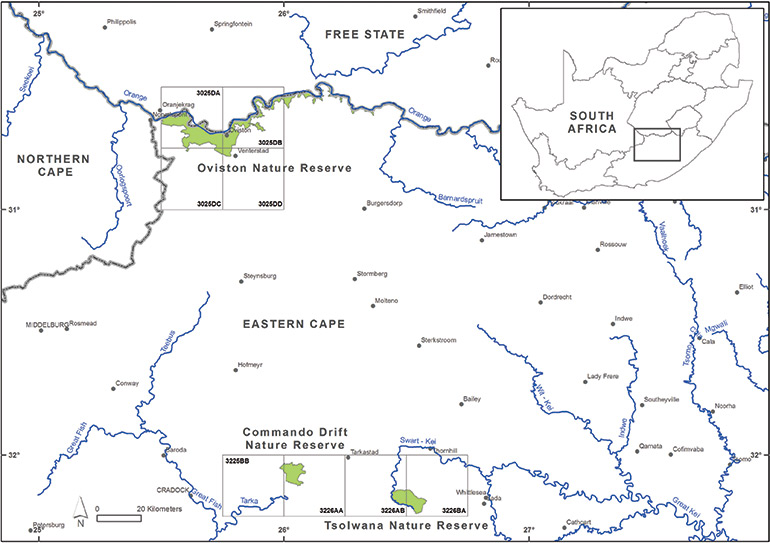
Figure 1: Map indicating the position of the reserves studied and the quarter-degree grid cells involved (blue lines – major rivers; grey lines – provincial boundaries).
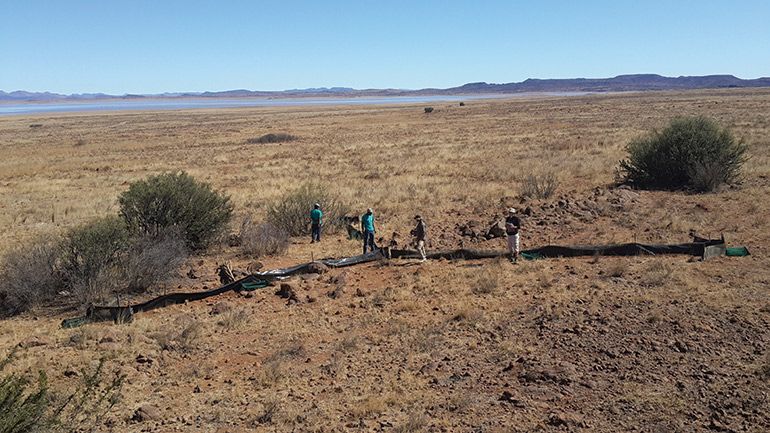
Figure 2: Typical Y-shaped trap array used to survey herpetofauna (Oviston NR).

Figure 3: Examples of amphibians collected. A – Sclerophrys gutturalis (Oviston NR), B – Poyntonophrynus vertebralis (Commando Drift NR), C – Kassina senegalensis (Commando Drift NR), D – Tomopterna tandyi (Commando Drift NR), E – Amietia delalandii (Tsolwana NR), F – Cacosternum boettgeri (Commando Drift NR).
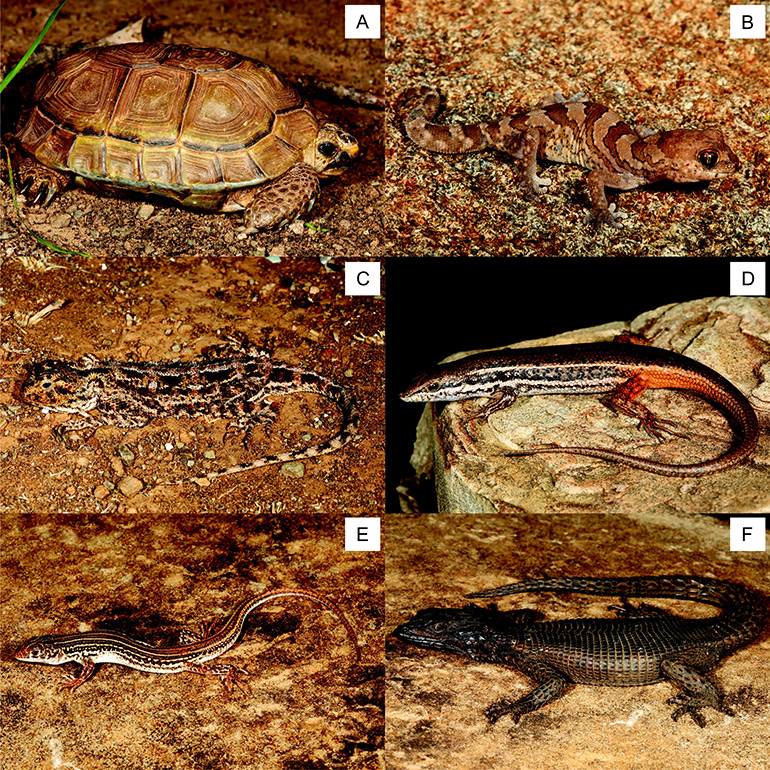
Figure 4: Examples of reptiles collected. A – Homopus femoralis (Tsolwana NR), B – Pachydactylus mariquensis (Tsolwana NR), C – Agama aculeata aculeata (Oviston NR), D – Trachylepis variegata (Oviston NR), E – Nucrus holubi (Oviston NR), F – Karusasaurus polyzonus (Oviston NR).
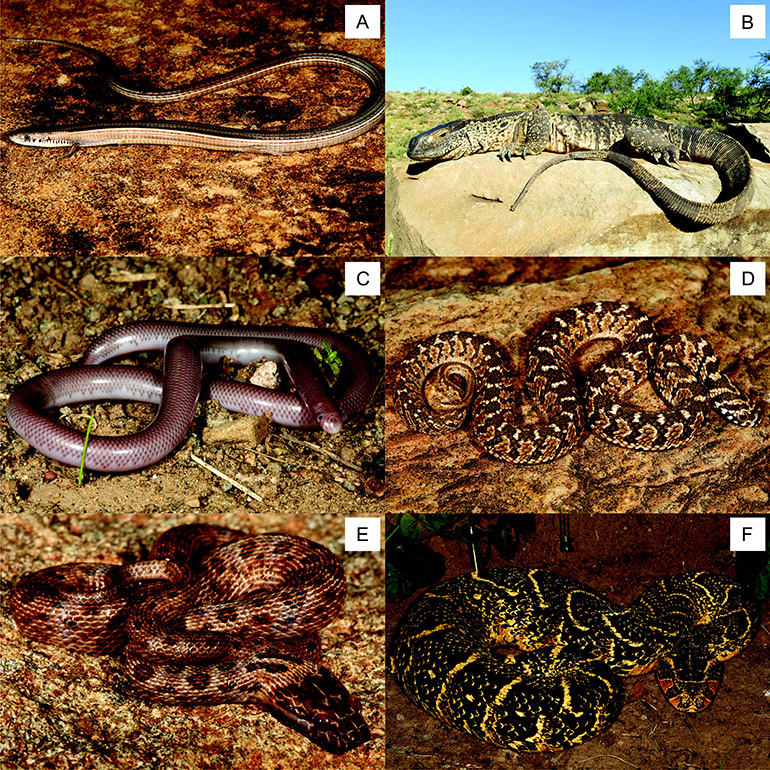
Figure 5: Examples of reptiles collected. A – Tetradactylus tetradactylus (Tsolwana NR), B – Varanus albigularis albigularis (Commando Drift NR), C – Rhinotyphlops lalandei (Tsolwana NR), D – Dasypeltis scabra (Oviston NR), E – Lamprophis guttatus (Tsolwana NR), F – Bitis arietans arietans (Tsolwana NR).



Comments are closed.