

It is often assumed that taxonomy, the science of naming and classifying organisms into organised groups, is relatively static, and that we already know how many species are expected to occur in every area of the world. However, for many groups of animals and plants, scientists are still uncovering and describing new species, particularly ‘cryptic species’ which are only subtly different from similar, related species. Although there are currently 136 species of frogs (68 endemics) in South Africa, this number has fluctuated, with 12 additions in just the last ten years as shown in the table below. This demonstrates that our knowledge about biodiversity is constantly evolving, partly due to novel techniques such as DNA barcoding (Hebert et al. 2003a, 2003b).
New species of South African frogs described in 2017–2025.
| Year | Scientific name | Common name | Distribution in South Africa | Reference |
| 2025 | Breviceps batrachophiliorium | Boston Rain Frog | Midlands, KwaZulu-Natal | du Preez et al. 2025 |
| 2024 | Cacosternum cederbergense | Cederberg Dainty Frog | Cederberg mountains, Western Cape | Angus et al. 2024 |
| 2020 | Tomopterna adiastola | Southern Tremolo Sand Frog | Northern South Africa | Channing & du Preez 2020 |
| 2019 | Tomopterna branchi | Namaqua Sand Frog | Buffels River, Namaqualand | Wilson & Channing 2019 |
| 2017 | Arthroleptella atermina | Riviersonderent Moss Frog | Riviersonderend mountain range, Western Cape | Turner & Channing 2017 |
| 2017 | Arthroleptella draconella | Drakenstein Moss Frog | Klein Drakenstein, Hawequas and Du Toitskloof mountains, Western Cape | Turner & Channing 2017 |
| 2017 | Arthroleptella kogelbergensis | Kogelsberg Moss Frog | Kogelberg Nature Reserve and Betty’s Bay, Western Cape | Turner & Channing 2017 |
| 2017 | Breviceps carruthersi | Phinda Rain Frog | Hluhluwe and Phinda, KwaZulu-Natal | Minter et al. 2017 |
| 2017 | Breviceps passmorei | Ndumo Rain Frog | North-eastern KwaZulu-Natal and south-eastern Limpopo | Minter et al. 2017 |
| 2017 | Capensibufo deceptus | Deception Peak Mountain Toadlet | Du Toitskloof Mountains, Western Cape | Channing et al. 2017 |
| 2017 | Capensibufo magistratus | Landdroskop Mountain Toadlet | Landdroskop, Groenlandberg, Limietberg and Jonaskop mountains, Western Cape | Channing et al. 2017 |
| 2017 | Capensibufo selenophus | Moonlight Mountain Toadlet | Akkedis Mountain, Maanskyn Nature Reserve and Koeël Mountain, Western Cape | Channing et al. 2017 |
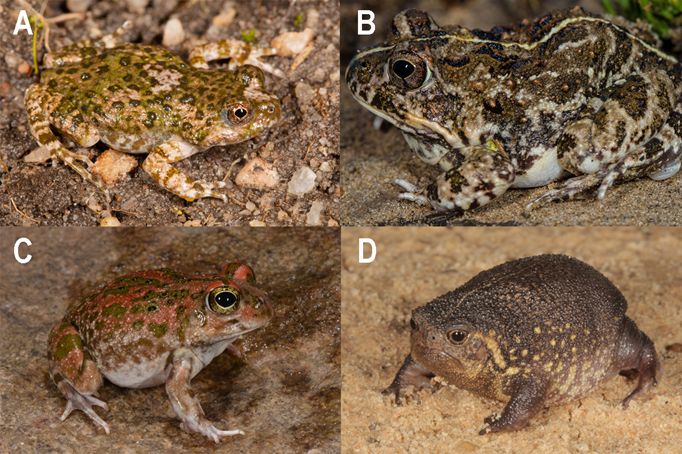
DNA barcoding is a method of organism identification using sequences of single short genes. These are then compared to sequences in reference repositories with the intent of matching them to those already associated with particular species. Thus the researchers can identify what species they have in hand even when they might not be able to differentiate it by looking at its morphology. The DNA barcoding technique is relatively simple yet highly effective and is regularly employed in South African taxonomic studies.

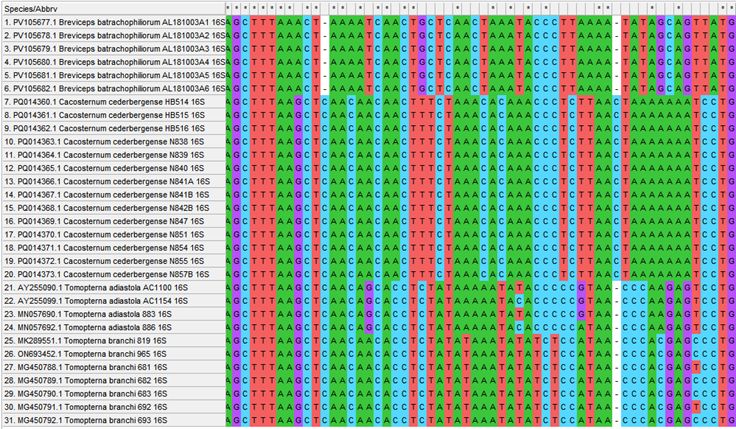
Sequences of the mitochondrial large subunit ribosomal rRNA gene (16S) publicly available for the four most recent new species, demonstrating the ‘barcoding’ approach. This gene is the most commonly used for frog phylogenetic research. Different nucleotide bases are shown in different colours: A = adenine, C = cytosine, G = guanine, T = thymine. Each species here is quite distinct with different individuals (rows) being similar to others of the same species. The two species of the same genus (Tomopterna adiastola and Tomopterna branchi) are most similar compared to any of the other species, but still exhibit some consistent differences.
More recently, DNA barcoding has been extended by ‘metabarcoding’ approaches, which include environmental DNA sequencing (eDNA). This method tackles the same short gene but this time not for a single organism, but rather for an environmental sample which may contain tissue samples from a wide variety of species. For example, amplifying a barcoding gene from a sample of water from a lake will allow us to determine the identity of a range of species that are present there, even when we are unable to physically find them in the environment. Frogs are often difficult to survey because of their camouflage and their tendency to hide themselves at most times of the day. This makes eDNA a highly useful technique for genetic research on frogs, which has the added advantage of being able to detect tadpoles that may otherwise be overlooked. A caveat of this kind of research is, however, that it relies heavily on a good representation of known sequences for each species in question, i.e., reference data should be available for every species of South African frog for unknown sequences to be matched against them and identified.
As part of a project evaluating the representation of different genes for currently recognised frog species, we are assessing publicly available sequences for all South African frog species in the global repositories GenBank and the Barcoding of Life Database. The country of origin for these specimens is another criterion being evaluated to determine whether South African frog variation is represented. Our initial results show that all South African taxa are represented by at least one gene, though some frog species are grossly underrepresented in general. We will also be extending this investigation to review the genetic research of frogs worldwide and to pinpoint trends in the discipline.
As scientific techniques and our knowledge-base grows, so too does our understanding of our natural resources and the species that inhabit the world around us. Our work at the National Museum seeks to aid this by identifying holes in the repositories of genetic sequences for South African frog species, with the aim of filling these gaps and adding to our understanding of these species while also being able to provide recommendations for future researchers. This may facilitate identification of new species in the future, using genes that are better positioned for answering particular questions regarding processes such as speciation.
On the Facebook group Free State Reptiles and Amphibians (including adjacent areas and Lesotho) (www.facebook.com/groups/FreeStateHerps), we curate a collection of frog and reptile distribution records for both Bloemfontein and the greater Free State area. These data have already allowed us to determine some changes in the species distribution across this region. We hope to continue bringing together citizen and professional science, and perhaps in the years to come there will be more frog species to report on.
References
Angus, O., Telford, N., Ping, T. & Conradie, W. 2024. A new species of Dainty Frog (Anura: Pyxicephalidae: Cacosternum) and the first endemic anuran to the Cederberg region of South Africa. Zootaxa 5512(1): 1–21. https://doi.org/10.11646/zootaxa.5512.1.1
Channing, A., Measey, G.J., de Villiers, A.L., Turner, A.A. & Tolley, K.A. 2017. Taxonomy of the Capensibufo rosei group (Anura: Bufonidae) from South Africa. Zootaxa 4232: 282–292. https://doi.org/10.11646/zootaxa.4232.2.11
Channing, A. & Du Preez, L.H. 2020. Taxonomic status of the cryptic sand frog, Tomopterna cryptotis (Anura, Pyxicephalidae). Alytes 37(3–4): 1–21. https://doi.org/10.5281/zenodo.16896262
du Preez, L.H., Netherlands, E.C. & Minter, L.R. 2025. A new Rain Frog (Anura: Brevicipitidae; Breviceps) from the KwaZulu-Natal Midlands, South Africa. African Journal of Herpetology 74(2): 188–209. https://doi.org/10.1080/21564574.2025.2478896
Hebert, P.D., Cywinska, A., Ball, S.L. & deWaard, J.R. 2003a. Biological identifications through DNA barcodes. Proceedings of the Royal Society of London. Series B: Biological Sciences 270: 313–321. https://doi.org/10.1098/rspb.2002.2218
Hebert, P.D., Ratnasingham, S. & deWaard, J.R. 2003b. Barcoding animal life: cytochrome c oxidase subunit 1 divergences among closely related species. Proceedings of the Royal Society of London. Series B: Biological Sciences 270: S96–S99. https://doi.org/10.1098/rsbl.2003.0025
Minter, L.R., Netherlands, E.C. & du Preez, L.H. 2017. Uncovering a hidden diversity: two new species of Breviceps (Anura: Brevicipitidae) from northern KwaZulu-Natal, South Africa. Zootaxa 4300: 195–216. https://doi.org/10.11646/zootaxa.4300.2.3
Turner, A.A. & Channing, A. 2017. Three new species of Arthroleptella Hewitt, 1926 (Anura: Pyxicephalidae) from the Cape Fold Mountains, South Africa. African Journal of Herpetology 66: 53–78. https://doi.org/10.1080/21564574.2017.1324918
Wilson, L. & Channing, A. 2019. A new sand frog from Namaqualand, South Africa (Pyxicephalidae: Tomopterna). Zootaxa 4609(2): 225–246. https://doi.org/10.11646/zootaxa.4609.2.2



Comments are closed.