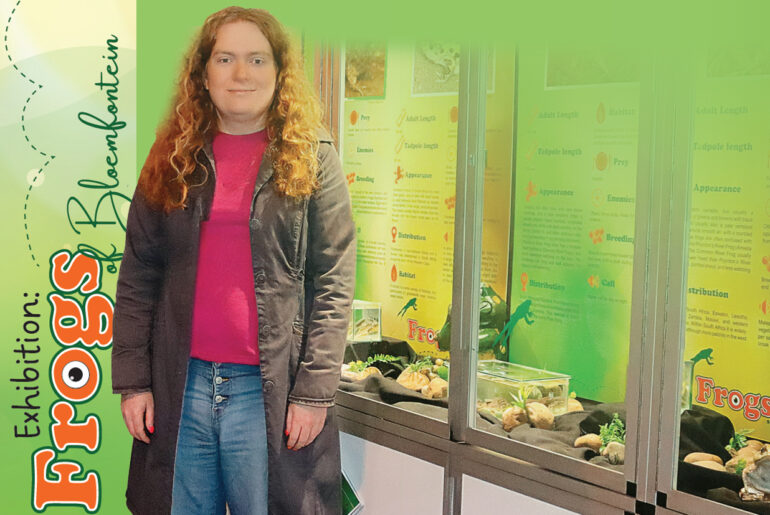
A new temporary frog exhibition went on display at the National Museum in July 2025. Visitors could find out more about the 12 species of frogs found in the Bloemfontein area and listen to audio of each species calls. The exhibition was curated by Dr Cora Stobie (Herpetologist) and designed by Ms Carien van Eck (Graphic Designer).
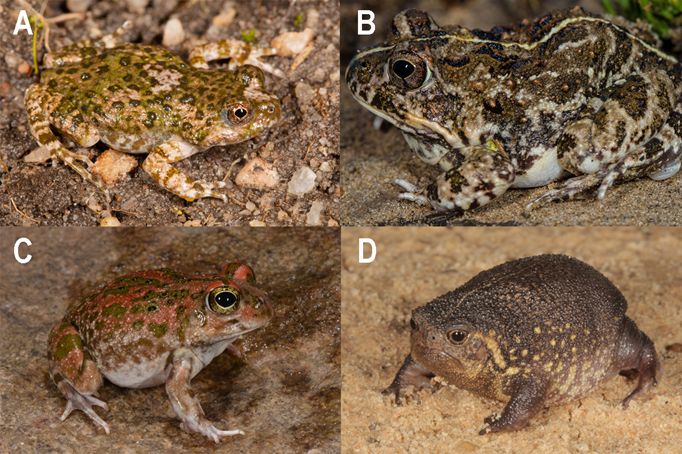
It is often assumed that taxonomy, the science of naming and classifying organisms into organised groups, is relatively static, and that we already know how many species are expected to occur in every area of the world. However, for many groups of animals and plants, scientists are still uncovering and describing new species, particularly ‘cryptic species’ which are only subtly different from similar, related species. Although there are currently 136 species of frogs (68 endemics) in South Africa, this number has fluctuated, with 12 additions in just the last ten years as shown in the table below.
The Common Girdled Lizard (Cordylus vittifer) is a rock-dwelling reptile found in the South African provinces of Free State, North West, Gauteng, Limpopo, Mpumalanga and KwaZulu-Natal, as well as in Eswatini and peripherally in Botswana and Mozambique. These lizards are characterised by a ‘girdle’ of thick protective scales, and the first row of scales behind the head forms a distinctive collar.
Have you seen a snake in your garden recently? We are fortunate to have about 120 species of snakes in South Africa. As part of a citizen science initiative, the National Museum’s Animal and Plant Systematics Department – Herpetology Division is managing a Facebook group called Free State Reptiles and Amphibians (including adjacent areas and Lesotho) which seeks to gather photographic and videographic records of all reptiles and amphibians found in this region.
As part of an investigation into the relationships of the crag lizards (genus Pseudocordylus), Dr Michael Bates and Mr Edgar Mohapi of the Department of Animal and Plant Systematics conducted several collecting expeditions in South Africa. Tissue samples from the specimens were used in genetic analyses to gain insight into the evolutionary relationships between the different populations. Several years later I was asked to assist with this project by expanding on the genetic analysis.