

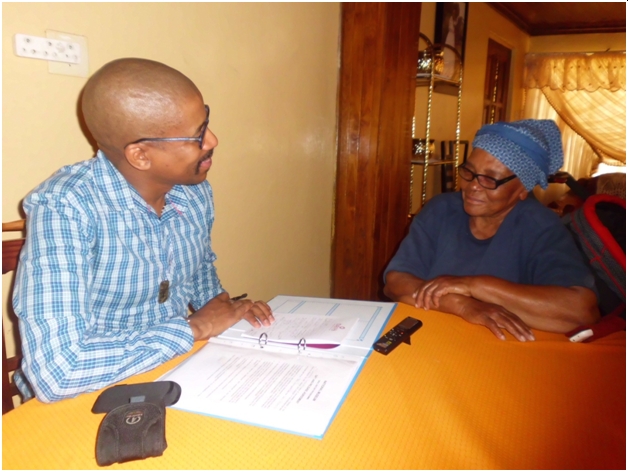
A typical interview set-up: Khotso Pudumo interviewing an elderly Batho resident. (Photo source: National Museum)
After the necessary preparations have been made, the work of an oral historian typically begins with the scheduling of an interview with an interviewee. On the day of the interview, the interviewer or oral historian is transported back in time by listening to the stories told by the interviewee. The interviewer emphatically “shares” and “feels” the interviewee’s joy, sorrow, disappointment and other emotions associated with memories that are being relived and verbalised. The interviewer tries to place himself or herself in the interviewee’s shoes: How does it feel to be on the run every day, trying to evade apartheid’s security police?; How does it feel when one’s house is raided in the early hours of the morning and one’s privacy rudely violated?; or, How does it feel to receive news that your only child was killed in action and his body is missing?
After the interview is concluded, the hard work of transcribing the recording starts. It is the responsibility of the interviewer to undertake this tedious task and it may take weeks to complete. This undertaking is made more challenging by an interviewee’s unique manner of speaking and use of “unknown” words, such as slang, acronyms and code language. When these words and phrases are transcribed, some mishaps and misunderstandings may occur. Added to this challenge are interviewees who suffer from speech impairments, such as stuttering, or interviewees who “swallow” the last part of their sentences.
Often some funny mishaps occur when the interviewer has to transcribe unfamiliar language. For example, during the apartheid era municipal policemen were commonly known as platkeps because of the shape of their caps. A police informant or “sell-out” was referred to as an impimpi. During the struggle years such terms were widely used by township residents and today these words are still being used. Another example: popular games played by township children, such as hopscotch, were known as “amper-scotch”. This term describes the simplified township version of the well-known children’s game. Through the years the term “amper-scotch” became twisted and pronounced as “appel-scotch”! The interviewer has to be alert to these variations and must be able to interpret them correctly. The transcribing process becomes even more complicated when the interviewer has to translate the original interview from the interviewee’s mother tongue, such as Sesotho and Setswana, into English.
Confusion is also caused by the manner in which the interviewee pronounces certain words. Because the English language has many synonyms and homophones, this often results in confusion which, in turn, affects the translating and transcribing of the interview. For example, when the word “annihilate” is said quickly it may sound like “are never late”! Recently an interviewee used the word “besmirch” to describe the behaviour of a close struggle comrade. When pronounced slightly differently, this word may be confused for another word which sounds the same but is, in fact, a slang word not usually used in decent company. Never underestimate the power of a single word to change the meaning of an entire sentence. In a transcription all inaudible or unclear speech is indicated as “unclear speech”.
Such are the joys and challenges of an oral historian! However, the transcribing of an oral history interview is a rewarding experience because people’s voices become words on paper. In the process the oral historian creates an important tangible record of a person’s life history.
Copies of transcriptions of interviews conducted by the National Museum’s oral historians are open for public use and are available in the Museum’s library.


Comments are closed.