

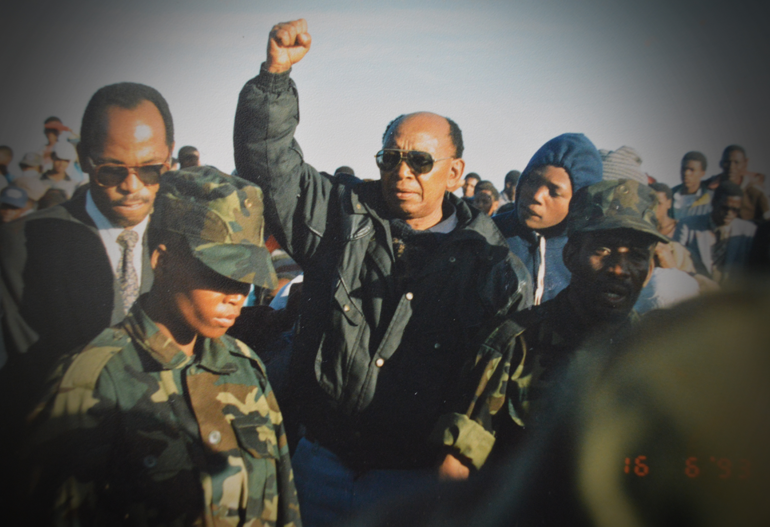
Caleb Humalebe Motshabi was born on the 5th of November 1923 in Bethanie [a location that used to exist in Waaihoek]. The third child of the late Solomon Batshabeng and Maria Panyane Motshabi, he grew up in the Batho Township in Mangaung and attended school at St Bernard Primary School where he completed his Standard Six during the 1930s.
Caleb’s niece, Mrs Nkone, said the following when asked how Caleb became involved in politics:
“Brother Caleb got involved in politics at a young age… He is the first person here in Bloemfontein who campaigned for politics.”
At the age of 16 years, at the outbreak of the Second World War, Caleb enlisted in the South African Army as a member of the Native Labour Contingent which rendered support services to the South African troops, as well as to fight the Nazis who were on a quest for world dominion. He saw action in various theatres of war, including Germany, Italy, and North Africa. After the war, he received a medal for services during the war (1939-45).
Mrs Mokhuane recalled:
“He went to war, the Hitler war of 1939 [Second World War]. When he returned from there, I do not remember the years but I forgot them… He was one of those first [black] people to go.”

After the end of the war, he returned home and three years later married Jane Tsholofelo Motale, his dedicated comrade-in-arms. In 1949 Caleb’s political activism formally started when he joined the African National Congress [ANC] in the Free State. He received his political baptism during the Defiance of Unjust Laws Campaign in 1952 when he, as the volunteer-in-chief for the Free State campaign, was detained for ten days without any option for a fine, for deliberately defying the racially-based laws. During this period, detainees were subjected to brutal physical abuse by the apartheid police.
Soon after, Comrade Caleb and his wife Jane were elected to the Free State Provincial Executive Committee of the ANC, and in this capacity, he participated in the Congress of the People’s convention at Kliptown, Johannesburg, in 195 where the historic Freedom Charter – a blueprint for a democratic South Africa which is today embedded in the country’s constitution – was adopted. Two years later, Motshabi led a very successful Bus Boycott in the Free State which, yet again, led to his detention.
Upon his release, Caleb and his fellow comrades immediately implemented the M-Plan – a plan drafted by Mandela to allow for a street-based organisation that would allow Congress volunteers to stay in daily touch with the people, alert to their needs, and able to mobilise them. This also served as a basis for the house-to-house distribution of political literature produced by both the Congress Alliance and the New Age, the then official mouthpiece of the South African Communist Party [SACP].
Mrs Mokhuane related that:
“… he used to sell the newspaper called New Age. He sold it at the taxi rank … there is this one other person I still remember who also did that; it was granny Mamotlakwana who stayed in Four and Six.”
Mrs Nkone, in turn, recalled:
“Yes, he sold New Age [Newspaper] and he would travel with a small suitcase. It was a disguise to fool the police for them not to know what he was doing. He took children medicines and had them in that small suitcase and wherever they [police] asked him… He would tell them that he sells children medicines … Those Lennon medicines, Haarlemensis, you see it?”
The 1960 Sharpeville massacre and the subsequent banning of all mass political organizations under a State of Emergency, resulted in Comrade Caleb’s re-arrest and detention without trial for the next five months. This notwithstanding, a year later, Caleb and Jane were blessed with the birth of their only daughter, Semakaleng Shirley. On the 16th of December 1961, the former Day of the Vow, Umkhonto We Sizwe [MK], the armed wing of the ANC, officially announced both its presence on the South African political scene and the start of the military struggle against apartheid Comrade Caleb played a crucial role in establishing and leading MK in the Free State and was central in the recruitment and dispatch of new recruits into exile for military training as cadres and soldiers of MK.
Mrs Nkone, in this regard, noted:
“He recruited a lot of children … My younger brother who is born after me, yes. He recruited a lot of people and some, they skipped the country. Others [young people Caleb recruited] skipped the country for the third and fourth time …”
In his capacity as MK Commander in the Free State, Comrade Caleb was re-arrested in 1963 and sent to Robben Island for 12 years.
Mrs Nkone recalled:
“Yes, in the 1960s brother Caleb was arrested afterwards. The police said he was the one who recruited those people. Those guys that were arrested before him denied knowing Caleb and even when the police said that the surname is the same, they said the surname is similar but they do not know him.”
On his release in 1975, Caleb was banished to Thaba Nchu where he continued to recruit, organise, and train cadres in preparation for the 1976 student uprising. Following his activities around the 1976 student revolt, Motshabi suffered successive detentions and bannings. This continued until the unbanning of all political organisations in 1990.
In 1993, a year before the advent of the ‘new’ South Africa, Jane, Commandant Motshabi’s wife, passed away without her having the privilege of seeing her husband becoming a member of the National Assembly in the country’s first non-racial parliament. Caleb remained a parliamentarian until his death in 2000. In addition to his duties as an MP, he served on the Central Committee of the Free State SACP and was a founding member and Chairman of the Free State MK Military Veterans Association (MKMVA).
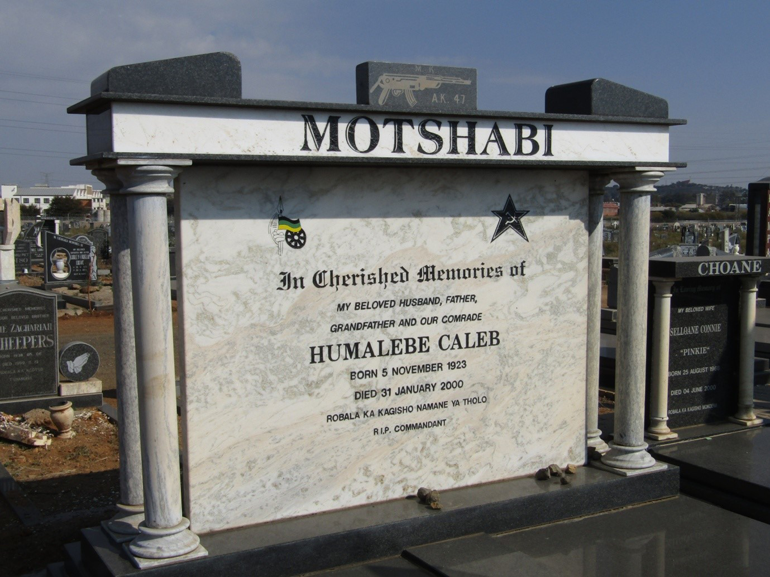
Five years before his death, Commandant Caleb remarried and started a new life with Lali Molema in 1995 and soon welcomed his second daughter, Dusty, into the world. He, however, passed away on the 31st of January 2000, leaving behind his wife Lali Motshabi, his two daughters, Shirley and Dusty, his brother Rantolo, two sons-in-law, and six grandchildren.
How should Caleb Motshabi’s contribution to the freedom struggle in general, and Batho in particular, be evaluated?
Mrs Nkone, with regards to Caleb’s standing within the Batho community, states:
“They are happy with what he did; he did a lot of things in Batho Location, Brother Caleb … He did a lot of work and he started politics at a young age and he recruited a lot of children and many children skipped the country. He was arrested for a long time, for 12 years in prison. He became something of the soldiers … commander of Mkhonto we Sizwe.”

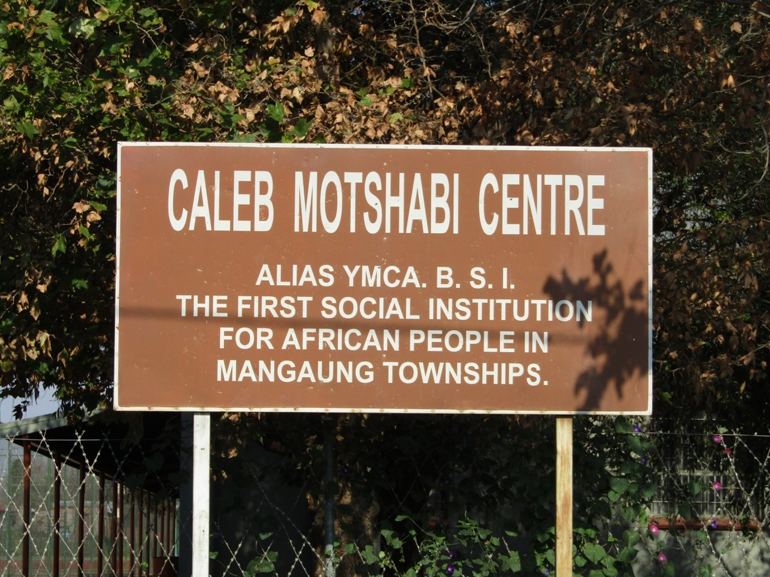
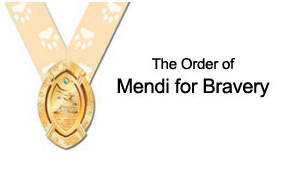
Bloemfontein honoured one of its most remarkable sons by renaming the former Batho Social Institute [BSI] to the Caleb Motshabi Centre in this honour on the 10th of April 1999. On the 8th of December 2015, Commandant Caleb was once again honoured when the President of the Republic of South Africa awarded him with the Order of Mendi for Bravery (Silver) for his excellent contribution to the fight for the liberation of the people of South Africa.
References:
Nelson Mandela by Oliver Tambo: Available from https://www.sahistory.org.za/archive/nelson-mandela-oliver-tambo accessed 14 October 2019
Obituary: Life of Commandant Caleb Motshabi
Oral Interview: Mamantele Victoia Mokhuane, Batho, Bloemfontein, 17 May 2019
Oral Interview: Magdalene Monye Nkone, Batho Bloemfontein, 24 May 2019
The Order of Mendi for Bravery in Silver: Available from http://www.thepresidency.gov.za/national-orders/recipient/caleb-motshabi accessed 14 October 2019

Comments are closed.