

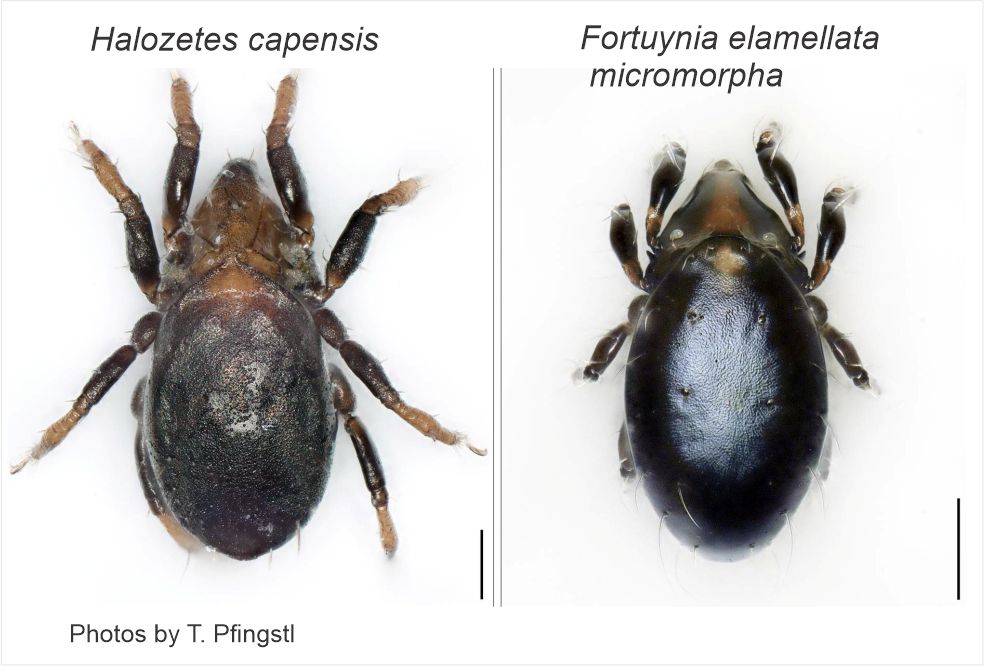
Figure 1. Microscope photographs of the intertidal mites Halozetes capensis and Fortuynia elamellata micromorpha (scale bar: 100 µm)
In a recent study (Pfingstl et al. 2022), molecular genetic tests of the COI gene were performed on two species of intertidal oribatid mites (Figure 1) to determine to what extent the genetics of various populations along the South African coast differ.
Halozetes capensis occurs on the south to south-east coast and specimens from De Hoop Nature Reserve, Kaaiman’s River near Wilderness, Nature’s Valley and Kayser’s beach near East London were used for genetic analyses. It was found that the gene structure of populations from the various localities differed from each other indicating no too little gene flow amongst populations. Fortuynia elamellata micromorpha occurs on the east coast and samples from Sheffield Beach, Umdloti, Umkomaas, Mtwalume and Port Edward were used for genetic studies. The genetics of populations among the different areas did not differ much, indicating that there is gene flow amongst them.
What are the reasons that the genetics of populations of H. capensis are so different amongst various localities, whereas populations of F. e. micromorpha are relatively similar? In other words, why are populations of H. capensis geographically so isolated with no gene flow between them, while it seems that there is high connectivity and therefore gene flow amongst populations of F. e. micromorpha? There are two possible environmental explanations, one current and one in palaeo-history.
Marine associated intertidal mites most likely disperse by drifting passively on ocean currents. Along the South African coasts are the Benguela Current on the west coast and the Agulhas Current on the east coast. The Agulhas current flows closely inshore from KwaZulu-Natal to the Eastern Cape, and F. e. micromorpha mites can easily be transported with this current to other coastal locations. On the other hand, the Agulhas current flows far offshore on the southern coast, possibly resulting in the isolation of H. capensis populations.
Paleoenvironmental processes may also have contributed to the genetic patterns we see today. During the last glacial maximum, about 22000 years ago, the water temperatures dropped and the Agulhas Current slowed down and may even have stopped flowing during winter. The distribution of populations of the warm adapted F. e. micromorpha may have been restricted to the north, but expanded again southwards when temperatures rose and the Current started moving again resulting in the similarity in their genetic structure. On the other hand, the cold-adapted H. capensis populations experienced no major temperature or ocean current shifts and persevered in their original populations.
See: Pfingstl, T.; Wagner, M.;Baumann, J.; Neethling, J.A.; Bardel-Kahr, I.; Hugo-Coetzee, E.A. 2022. Contrasting phylogeographic patterns of intertidal mites (Acari, Oribatida) along the South African shoreline. Organisms, Diversity & Evolution, published online: 18/04/2022. https://doi.org/10.1007/s13127-022-00557-9
Text: By Lizel Hugo-Coetzee


Comments are closed.