


Rachel Thoka was born around 1825, apparently in a West African country. As a young girl she was sold in the slave market in Cape Town to a white farmer, Sarel Griesel, whose wife wanted a young slave. In typical Afrikaner tradition of the time, the Griesels gave her a new name taken from the Bible, namely Rachel, and she learned to speak Dutch.
Although slavery was abolished in the Cape Colony on 1 December 1834, Rachel remained in the service of the Griesels and during the Great Trek (c. 1834–1838) travelled with them into the Transgariep (today Free State) and Natal. In February 1838, at the battle of Moordspruit on the banks of the Mooirivier in Natal, where about 1500 Zulu impis attacked and killed more than 530 unsuspecting Voortrekkers, Rachel saved the life of the three year old son of Field Cornet Schoeman by hiding with the child in a donga until the battle was over. This heroism earned Rachel the respect of the Voortrekker community and the name of Rachel ‘Mooirivier’. After the battles in Natal, Rachel left with a disillusioned group of Voortrekkers under Piet Pretorius who trekked back over the Drakensberg Mountains and settled in Potchefstroom. This group of Trekkers included Paul Kruger (later State President of the Zuid-Afrikaansche Republiek [ZAR] or Transvaal). In the 1840s Rachel became the domestic servant of Paul Kruger and later moved with him to Pretoria, where she married a Zulu man, Julie Mpinda.
Because of turmoil in the ZAR, Rachel moved to the Republic of the Orange Free State and became the servant of Reverend Colin Fraser of Philippolis. In 1871 she came to Bloemfontein with the Reverend’s son, Sir John Fraser, and later served in the household of Dr Otto Krause. During her days as a servant Rachel acquired several skills, including cookery, nursing and farming, and was also involved in the training of household duties to new and inexperienced domestic servants. She was also an experienced midwife and the first black woman who served in Bloemfontein’s National or Volks Hospital, which was completed in 1893. Rachel did not receive any formal education and could not read or write.
 In 1902, after the Anglo Boer War, Rachel and Julie settled in Waaihoek, one of the oldest black townships in Bloemfontein. Shortly after they arrived, her first husband died and a few years later Rachel married Abram Thoka in Bloemfontein’s Lutheran Church, with one of Dr Krause’s daughters as bridesmaid. In Waaihoek she was confronted by pass laws, permits and regulations, as well as restrictions on brewing sorghum beer. At this time, black and brown people in the Orange Free State had to carry pass documents. If they did not comply, they were arrested and fined. They experienced the pass laws as discriminating, humiliating and degrading and often refused to carry pass documents. In the townships the pass document was contemp- tuously referred to as the ‘dompas’ (stupid pass). The pass laws reminded Rachel of her days of slavery when she had to carry a pass, sometimes hung around her neck.
Faced with the oppressive pass laws, the black people of Waaihoek looked up to Rachel for leadership and advice. She was not only highly respected by the Afrikaners for her bravery during the Great Trek but also by the black people due to her experience, leadership abilities and status as midwife.
During the course of 1913 a group of Waaihoek women and a delegation of the South African Native Congress (later African National Congress or ANC) came to see Rachel and pleaded with her to lead the women of Waaihoek in the campaign against the dreaded pass laws. She declared: “I responded to my people’s call and decided to carry the burden of my people on my shoulders and lead them …”. A women’s committee was established in Waaihoek, and letters, memos and petitions were compiled and sent to the Town Council, Free State government, churches and sympathetic white people. The biggest grievance was ill-treatment by policemen during the enforcement of the pass laws. Nothing was, however, done to address the black people’s grievances. During a mass meeting in May 1913, the women of Waaihoek declared that they would forthwith refuse to carry passes until the law was repealed.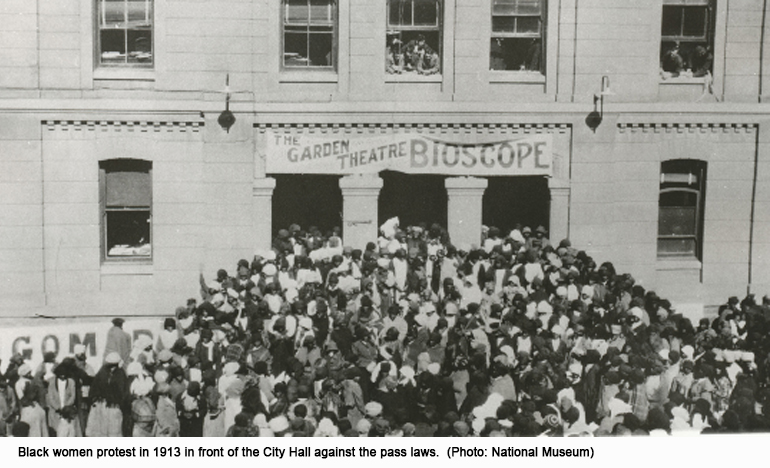
The matter was not resolved and a few days later the women tore up their passes in front of the police station in a show of defiance. As a result about 80 women were arrested. This was followed by a march of almost 500 Waaihoek women led by Rachel, who, in a show of further defiance, wore the Union Jack wrapped around her waist. Despite its seriousness, the march also had its humorous moments. At Hoffman Square, Rachel was chased by a wildebeest. Realising the danger of this, Constable Hartseer, one of Bloemfontein’s well-known black policemen, attempted to rescue Rachel. Rachel in turn thought that Constable Hartseer was attempting to arrest her and resisted. Attempts by the Constable to explain that he was merely trying to rescue Rachel from potential harm was met by a defiant “I can look after myself!”; much to the amusement and laughter of the other marchers.
The march continued until it reached the Magistrate’s office in St. Andrew Street where they demanded and secured the release of the arrested protestors. In addition, the magistrate advised the women to take their grievances to the Mayor. The marchers then redirected their march to the City Hall in Maitland Street (today Charlotte Maxeke Street). The subsequent negotiations with a group of City Councillors, however, produced no result. A few weeks after the march, the arrest of another female and the harsh and violent police behaviour as well as the whipping of a group of sympathisers who tried to free the hapless victim, resulted in a full-scale riot. A significant number of women were arrested, with the exception of Rachel. This, apparently, was motivated by the high regard that Rachel enjoyed within the greater Bloemfontein, especially from sections of the white community. Excluding her was, therefore, an attempt to prevent more riots and to prevent criticism and negative comment from the ranks of sympathetic white people and the press.
Seemingly protected by her status, Rachel continued the fight and together with others, demanded the release of all arrested women. Their actions were supported by a letter-writing campaign by a number of white Bloemfontein residents expressing their sympathy with their fellow citizens. Yet again, this campaign proved successful and the arrested women were released, with Rachel to welcome them. The subsequent negotiations with the Mayor of Bloemfontein and the Administrator of the Orange Free State about the abolition of the pass laws, as expected, failed. These laws were only finally abolished in 1986. Rachel remained committed to the struggle against the pass laws throughout the struggle years and during her stay in Waaihoek the city of Bloemfontein played host to many meetings and conferences of political, religious, civic and traditional organisations. Her home also became a frequent stop-over and place of accommodation for many conference delegates.
Rachel had six sons and one daughter, but one son died shortly after Rachel settled in Waaihoek. When Rachel died on 26 September 1940, at the age of about 116, the Afrikaner community of Bloemfontein donated a coffin. On 18 December 2005 the Western Cape Honours Award, the Order of the Disa, was awarded posthumously to Rachel ‘Mooirivier’ Thoka and received by her grandson, Isaac Thoka.
References
Free State Provincial Archives, Bloemfontein. A45 Dr Otto Krause Accession: Life history of old Rachel Thoka. A few biographical details in the form and manner as related by her.
Schoeman, K. 1980. Bloemfontein. Die ontstaan van ’n stad, 1846–1946: Human & Rousseau.
Thoka, IMB. Unpublished manuscript and correspondence, ES9/5/1/1/1, Erfenisstigting Archive, Heritage Centrum Pretoria.
Van den Vyfer, H. Life history of old Rachel Thoka, Archives News, September 1991.

Comments are closed.