

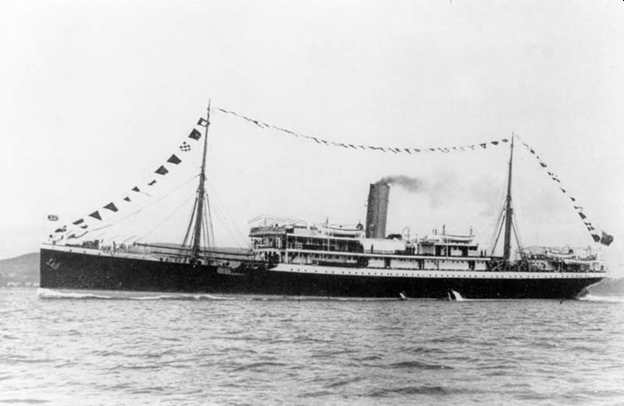
“Be quiet and calm, my countrymen. What is happening now is what you came to do…you are going to die, but that is what you came to do…so let us die like brothers”. These are the poignant words that Reverend Isaac Wauchope Dyobha reportedly spoke to calm the panicked troops on board the SS Mendi when it started to sink. Reverend Dyobha was the chaplain of the troopship which sank during the First World War (1914-1918) on 21 February 1917. A total of 616 South Africans, of whom 607 were black troops, perished in South Africa’s worst wartime maritime disaster. Why did black South African troops find themselves on a troopship in the English Channel? Due to a shortage of labourers to work behind the front lines in France, Britain requested South Africa – at that time a self-governing dominion of the British Empire – to provide men for the purpose.
The SS Mendi left Cape Town for Plymouth, England, on 16 January 1917 with 823 members of the 5th Battalion of the South African Native Labour Contingent. The contingent consisted of a total of 805 black troops, five white officers, 17 white non-commissioned officers and 33 crew members. From Plymouth the SS Mendi sailed to the French harbour town of Le Havre but en route tragedy struck. At about 04:57 on the morning of 21 February, the SS Darro was sailing at full speed in thick fog and, near the Isle of Wight, slammed into the SS Mendi’s forward hold. Severely damaged, the ship sank after only 20 minutes. Sadly, the crew of the SS Darro neither lowered the ship’s rescue boats nor did they try to rescue survivors. The majority of the victims, most of whom drowned or died of hypothermia, hailed from rural Pondoland in the Eastern Cape. According to survivors, the South Africans met their fate with great dignity.
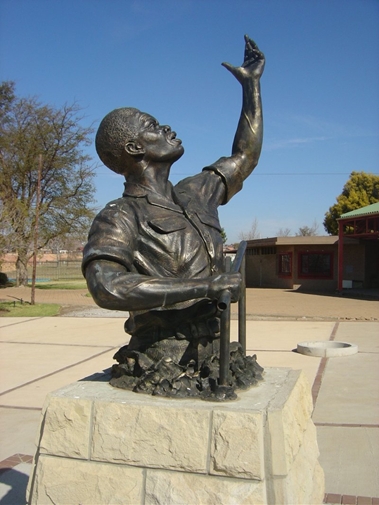
News of the tragedy captured the imagination of both black and white South Africans including the residents of Bloemfontein’s black townships. In fact, at that time a new township was being laid out for the “relocated” residents of the old Waaihoek location. The SS Mendi tragedy made such an impression on them that they suggested the new township should be named “Mendi”. However, officials of Bloemfontein’s whites-only Town Council considered the name inappropriate and they suggested it should be named “Batho Town” meaning “the people’s town”. Bloemfontein’s new township was thus named “Batho” – as it is still known today – but Batho’s residents decided to still honour the victims of the SS Mendi by means of annual commemoration services and memorial scholarships for black youth. How do you think should the victims of the SS Mendi be honoured today?
Text: Dr Derek du Bruyn


Comments are closed.