


On 19 May, the Minister of Sports, Arts and Culture, Zizi Kodwa, opened the South African pavilion at the 18th International Architecture Exhibition – La Biennale di Venezia in Italy. Among the exhibits is a replica of an engraved rock from the Rock Art Collection of the National Museum, Bloemfontein.
This year’s Biennale Architettura is entitled, The Laboratory of the Future, and is focused on the African diaspora. South Africa’s contribution is entitled, ‘The Structure of a People’, and explores how our indigenous knowledge systems could be used as possible solutions to global warming, over consumption of resources and migration. The principal curators are Architects Sechaba Maape (Afreetekture and University of Witwatersrand); Emmanuel Nkambule and Stephen Steyn, both from Tshwane University of Technology.
The Original Engraving
The original engraving (see Figure 1) was removed from the farm Boomplaats, near Lydenburg in Mpumalanga by E.C.N van Hoepen, while he was employed at the National Museum. The boulder contains 13 individual concentric circles, each consisting of 3 circles, connected by lines. These images are very similar to the remnants of stone structures in the Lydenburg area. Research has shown that these settlements were the creation of pre-colonial Later Iron Age farmers who did not have a common ethnic origin but over generations incorporated different groups and became known as Bokoni due to their location on the escarpment and their distinctive form of production and settlement (Delius et al 2012). The layout of their residential space is reflected in the motifs of the rock engravings (Maggs 1995). The Boomplaats Rock Engraving Site Complex contains the largest concentration of engravings made by pre-colonial Later Iron Age farmers and on 18 November 2022, the South African Heritage Resource Agency declared it a National Heritage Site.
The Replica
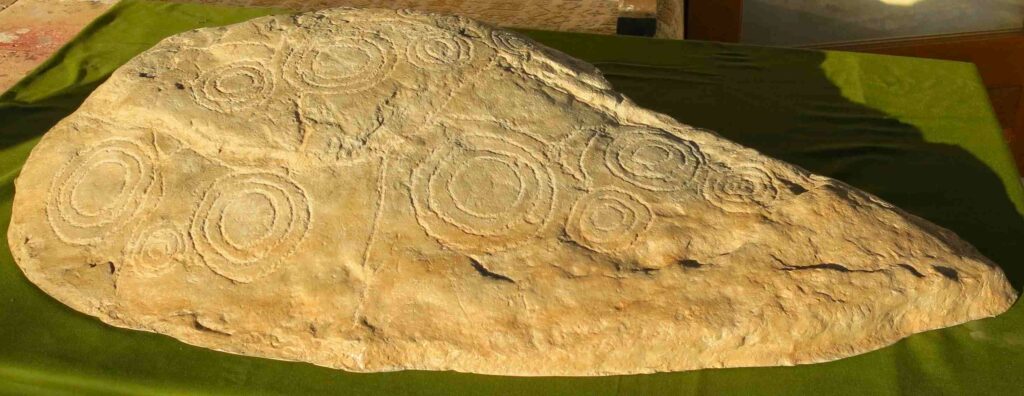 Lachlan Matthews from Vertebrate Designs created the replica, by taking a mould of the surface of engraved rock, using sing silicone rubber (mould max 30 from AMT) backed by fibreglass. The final product was almost identical to the original engraving (Figure 2).
The replica is on exhibit from 20 May to 26 November in the old brick halls of the Arsenale, the shipyard and naval base of the former Republic of Venice. The National Museum wishes the South African participants all the best.
Suggested Readings
Delius, P; Maggs, T & Schoeman, M. 2012. Old structures, new paradigms? Rethinking pre-colonial society from the perspective of stone-walled sites in Mpumalanga. Journal of South African Studies. 38(2): 399-414.
Maggs, T. 1995. Neglected rock art: The rock engravings of the agriculturalist communities in South Africa. South African Archaeological Bulletin. 50: 132-142.


Comments are closed.