


Scary monsters, zombies, pumpkins and candy…it must be Halloween. In keeping with the spirit of Halloween, we profile some of our scary looking friends from nature.
1. Giant isopod (Bathynomus giganteus)

Image credit: Giant isopod. A frontal view of Bathynomus giganteus, showing its large, highly reflective compound eyeshttps://en.wikipedia.org/wiki/Giant_isopod#/media/File:Bathynomus_giganteus.jpg
If you visit Taiwan, be sure to order a boiled Giant isopod with a side of rice when you at a seaside restaurant!
Scientist believe that the Giant isopod is a product of deep- sea gigantism. This gigantism has been attributed to the colder temperatures of their habitat when compared to their shallower- water relatives. In addition, the scarcity of food resources; reduced predation; and the increased presence of dissolved oxygen concentrations found in their deep sea habitat play a role. Giant isopods are carnivorous scavengers and they feed mostly on dead whales, fish, and squid.

The underside of a male Bathynomus giganteus, a species of giant isopod captured in the Gulf of Mexico in October 2002. NOAA – http://oceanexplorer.noaa.gov/explorations/02mexico/logs/oct13/media/isopod.html
2. Aye- aye (Daubentonia madagascariensis)

Image credit: Wild aye aye on a tree. nomis-simon https://www.flickr.com/photos/nomissimon/15819070729/
This long- fingered Lemur can be found primarily in Madagascar and is nocturnal and spends most of its life in the trees where it eats, sleeps and mates. The Aye- aye is an omnivore and is considered endangered primarily because they are killed due to superstition and because of habitat loss.
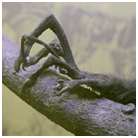
Image credit: Close-up of the hand of the Wild aye – aye showing the elongated digits and the thinner third digit. Dr. Mirko Junge University of Copenhagen Zoological Museum, Copenhagen, Denmark.
Unfortunately there are many superstitions about the aye – aye. It is believed that the aye- aye carries evil and if it points its fingers at a person, then that person is marked for death. As a result some people kill the animal and hang it up so that the ‘evil spirit’ may be carried away by travellers.
Education is key to stop such killings due to superstitions!
3. Greater spear-nosed bat (Phyllostomus hastatus)

Image credit: Greater Spear-nosed bat by Karin Schneeberger
The Greater spear- nosed bat may look scary but it plays an important role as they eat insects and other pests that are harmful to crops. They mostly inhabit the tropical regions in South America. One dominant male presides over a group and the average harem size is about 18 females.
#Halloween l #MuseumFromHome l #Museums


