

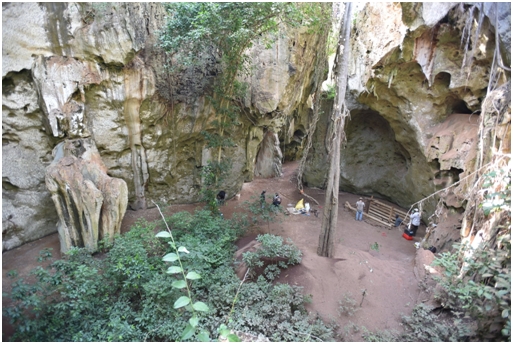
Overview of the cave of Panga ya Saidi. The boarded excavation on the right marks the locality where the burial was recovered. (photo by Mohammad Javad Shoaee).
While our continent is well-known for an early anatomical and cultural record associated with our species, human burials older than 30k years are scarce and often contentious among scientists. Little is known, therefore, about how our early ancestors responded to or interacted with the dead, making the origins and evolution of mortuary practises within our lineage ambiguous. In a new study published in Nature, scientists document the earliest evidence for human burial in Africa at a cave in southern Kenya named Panga ya Saidi, pushing the boundaries of human mortuary practices back in time and expanding the symbolic and behavioural contexts within which this practise emerged.
The discovery of the remains of a 3 year old child buried delicately in a shaft below several meters of intact sediments dated at their oldest to 78 000 years ago, which is slightly older than the famous Border Cave burial in South Africa, is revealing how early modern humans responded to the dead. An international group of researchers – directed by scientists from the Max Planck Institute for the Science of Human History (Jena, Germany) and the National Museums of Kenya (Nairobi) – and involving collaborating scientists from several other institutions including the National Museum in Bloemfontein, South Africa, has been excavating the site since 2010.
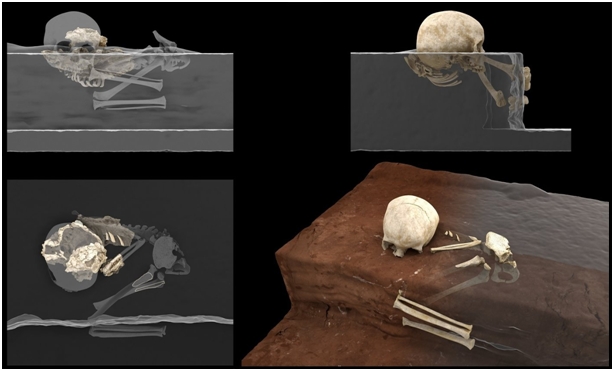
Virtual reconstruction of the Panga ya Saidi hominin remains at the site (left) and ideal reconstruction of the child’s original position at the moment of finding (right) (image by Jorge González/Elena Santos).
“As soon as we first visited Panga ya Saidi, we knew that it was special,” says Professor Nicole Boivin, principal investigator of the original project and director of the Department of Archaeology at the MPI for the Science of Human History. “The site is truly one of a kind. Repeated seasons of excavation at Panga ya Saidi have now helped to establish it as a key type site for the East African coast, with an extraordinary 78,000-year record of early human cultural, technological and symbolic activities.”
In the excavation season of 2017, a small pit feature was identified by the team of excavators, which had what looked like the tightly clustered bones of a small child partially exposed. The burial was exposed approximately three meters below the current cave floor, and the bones were highly fragile and challenging to remove from the deposits individually. This required an in situ removal of the complete burial and its encompassing sediment, for the purposes of a more meticulous excavation in a laboratory setting.
A major issue that emerges in discussions of the earliest human burials is the association of the shaft and body with the surrounding sediment and archaeology, and therefore the age of the find. “It was clear when we analysed the stone artefacts from the burial shaft that they had been incorporated from the immediately surrounding archaeological layers, and were distinct from younger assemblages at the site. This suggests that the burial is unlikely to be cut into older deposits from a more recent period, and that the body as well as the human act of burying it is indeed 78 000 years old” notes Dr. Will Archer, Head of the Department of Archaeology at the National Museum in South Africa (Bloemfontein), who collaboratively studied the stone artefacts from the site and the burial shaft.
The child burial was excavated from archaeological layers with stone artefacts typical of the African Middle Stone Age, which is a diverse but complex stone technology that is conventionally associated with early members of our species (modern humans), but that scientists have more recently argued to be linked to multiple hominin species in southern Africa. The child burial is also one of the rare instances of the direct association of Middle Stone Age artefacts with an anatomically modern human. “The association between this child’s burial and Middle Stone Age tools has played a critical role in demonstrating that Homo sapiens was, without a doubt, a definite manufacturer of these distinctive tool industries, as opposed to other hominin species,” notes Dr. Emmanuel Ndiema of the National Museums of Kenya (Nairobi).
After the 2017 excavation season the in situ shaft and burial were brought first to the National Museum in Nairobi and later to the laboratories of the National Research Center on Human Evolution (CENIEH) in Burgos, Spain, for further excavation, specialised treatment and analysis. “We started uncovering parts of the skull and face, with the intact articulation of the mandible and some unerupted teeth in place,” explains Professor María Martinón-Torres, director at CENIEH. “The articulation of the spine and the ribs was also astonishingly preserved, even conserving the curvature of the thorax cage, suggesting that it was an undisturbed burial and that the decomposition of the body took place right in the pit where the bones were found.”
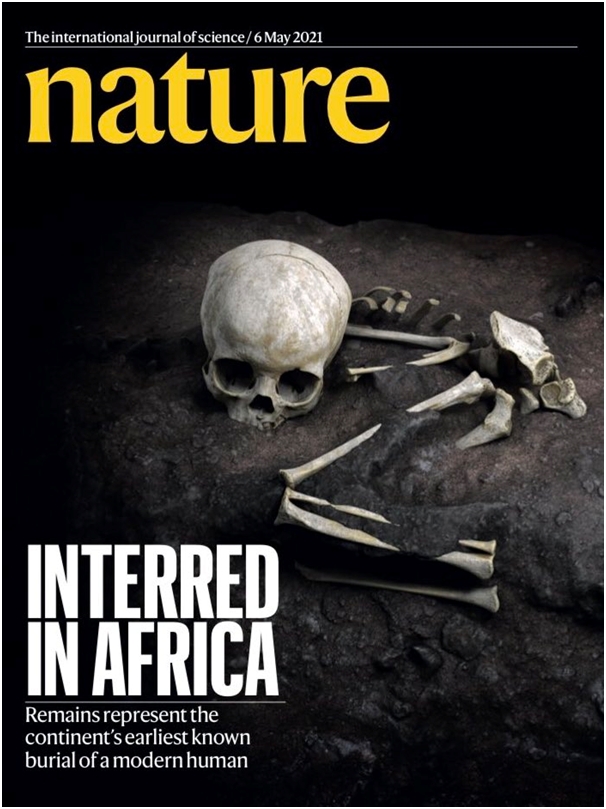
The study features on the cover of Nature:
https://www.nature.com/articles/s41586-021-03457-8
This study was contributed to by the following:
María Martinón-Torres, Francesco d’Errico, Elena Santos, Ana Álvaro Gallo, Noel Amano, Will Archer, Simon J. Armitage, Juan Luis Arsuaga, José María Bermúdez de Castro, James Blinkhorn, Alison Crowther, Katerina Douka, Stéphan Dubernet, Patrick Faulkner, Pilar Fernández-Colón, Nikos Kourampas, Jorge González García, David Larreina, François-Xavier Le Bourdonnec, George MacLeod, Laura Martín-Francés, Diyendo Massilani, Julio Mercader, Jennifer M. Miller, Emmanuel Ndiema, Belén Notario, Africa Pitarch Martí, Mary E. Prendergast, Alain Queffelec, Solange Rigaud, Patrick Roberts, Mohammad Javad Shoaee, Ceri Shipton, Ian Simpson, Nicole Boivin & Michael D. Petraglia
Text: Dr. Will Archer


Comments are closed.