

The so-called miser’s purse is known by many names: miser bags, ring or string purse, long purse and stocking purse to name but a few. This purse dates back to the late 18th century and was popular until the early 1900s.
A miser is a person who hoards things and spends as little money as possible. This is one of the reasons why the nickname “miser” was used for the purse, as its design allowed for the withdrawal of only a few coins at a time. Its design further ensured that coins were not easily lost. The purse was often worn hidden in the sleeve of a man’s shirt.
The shape of the purse is believed to originate from medieval times when it was common practice to carry coins in the toe of a stocking. However it also resembles a tube-shaped purse, fastened with rings at each end that was carried by men in the 16th century. The miser’s purse was a common accessory during the Victorian era (1837–1901) in England and was used by both men and women. In the 19th century, as today, there were many different ways for men and women to carry coins on their bodies. Carefully concealed pockets in men’s jackets and women’s skirts, for example, kept coins safe. Purses were the most popular for both sexes, and the miser’s purse was ever-present in 19th century Victorian culture.
The purse was narrow in the middle and closed on either end. A small slit in the middle section allowed the owner to drop coins or other small objects into either end of the tube. Two or more rings or sliders were used to close off the opening. These rings were made of steel, brass, mother of pearl, gold or silver. A typical 19th century purse was knitted or crocheted using “purse” or “netting” silk, although other materials such as leather, chain-link mesh, hair, and wool or velvet cloth, were sometimes used. Steel beads embellished many purses between 1850 and 1860 and were strung onto the knitting thread. Glass, gilt, or seed beads were also used. Colours chosen were often gradients blending into each other from dark to light, while the netting, knitting or crocheted techniques made them both durable and flexible for keeping coins and other small objects of value safe. Some of the motifs for miser’s purses included renderings of animals, crosses, and paisleys. Red, blue, and green were popular colours for miser’s purses, the latter especially for men. The length of the purse varied from 10.2 to 91.4 cm long.
Two shapes were prominent: one with both ends round and a tassel at each end, and the other with one round end with a tassel and one flat end with a fringe of beads or silk tassels. The design with one round and one square end was quite ingenious, since in poor lighting the correct coins could be withdrawn by feel. The square end might contain silver, and the round end, gold coins.
This purse was a popular gift and was made by women, but given to and used by both women and men. Women’s magazine writers frequently recommended miser’s purses as gifts for friends and family members for birthdays, holidays and other special occasions. The purses were also given to prospective suitors as tokens of affection in courtship. The highly-decorated purses were considered ideal items to sell at contemporary fundraising events or fancy fairs as they were eye-catching and inexpensive to make.
Miser’s purses are often found in the costume/textile collections of museums. The National Museum’s textile collection is no exception. The first example (accession number G12173) was donated to the Museum in 1961 by Mrs N.H. Kestell. It is a Victorian crocheted purse in faded green and brown decorated with cut steel beads. The square end has a looped fringe of cut steel beads, while the round end is decorated with a tassel, also from cut steel beads. This purse measures 27.5 cm in length.
Another example (G1692) was donated by Mrs J.H. de Villiers in 1956. According to the donor this purse was used during the Anglo-Boer War (1899–1902) and belonged to Willie Botha. It consists of green and old gold (a dull brownish-gold colour) alternating sections and is decorated with glass beads. A single metal ring is used to secure the purse. Each round end is decorated by glass bead tassels and the purse measures 23 cm in length.
A mauve coloured miser bag (G2990) is a slight variation on the common miser bag. It can also be classified as a string purse. This purse was donated to the Museum in 1966 by Mrs P. Marais. The two sections of the bag (where the coins were kept) are connected by strings rather than a narrow strip of fabric. These sections of knitted fabric can be opened by lifting the outward flap and pulling the pocket away from the middle, thus pulling the strings along with it. When an opening can be seen, covered by strings, one simply needs to push the strings aside to get to the concealed space. To close the space once again, you pull the strings that hold the two sections together away from either section, and this pulls the strings tightly together to secure the purse’s opening and its contents.
By 1880 miser’s purses had become less popular as commercial leather coin purses became available. However, needlework magazines, well into the early 20th century, continued to carry instructions for making them.
References:
Buck, A. 1970. Victorian costume and costume accessories. New York: Universe Books.
Camerlengo, L.L. 2010. The ubiquitous miser’s purse. M.A. dissertation in the history of the decorative arts and design. New York: Cooper-Hewitt.
Kinsler, G.B. 2017. The ingenious miser’s purse. Piecework, March/April: 50–52.
Norris, H. & Curtis, O. 1933. Costume & fashion: The nineteenth century. London: J.M. Dent and Sons Ltd.
Photo captions:

A mauve coloured string purse, a variation on the traditional miser’s purse (G2990). (Photo: National Museum)

This miser’s purse (G1692) was used by Willie Botha during the Anglo-Boer War and is decorated with glass beads. (Photo: National Museum)
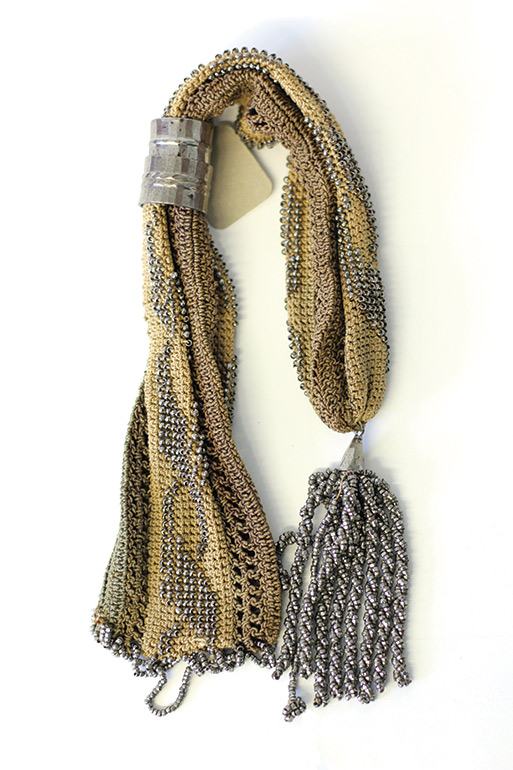
Victorian crocheted purse (G12173) decorated with cut steel beads. (Photo: National Museum)



Comments are closed.