

In China, for over a thousand years, tiny feet were symbols of feminine beauty, elegance and sexuality. If you were a Chinese woman living between the late Tang Dynasty (618-907) and 1949, small, slim, soft and pointed feet were a must have. When looking at photographs of curled, callused toes and gnarled bones it is difficult to see the beauty, but for a thousand years men adored these tiny feet lotus or lily feet, as they were called.
Foot shape and foot size became very important standards by which to judge a woman’s beauty. At the time most social classes saw big feet as shameful and small feet as something to be proud of. Feet longer than 4 cun (pronounced ‘tswnn’, the Chinese word for ‘inch’ that equals 3⅓ cm) were ranked as ‘iron lotuses’; a pair under 4 cun was called ‘silver lotuses’; and feet less than 3 cun were called ‘golden lotuses’.
It is said that the practice of foot binding was started by Emperor Li Yu (Southern Tang Dynasty 937-976) or possibly Emperor Yang of the Sui Dynasty (581-618). In order to please him, his concubines bound their feet into new moon shapes and danced on golden lotus flowers. Another legend has it that a Shang empress who was born with club feet insisted that all the women in the land have their feet bound to match hers.
The process of foot-binding was long and painful and started between the ages of three and seven years old. It was done by a female relative or a professional binder who would probably feel less sympathy for the girl, resulting in the best tightly bound feet. It was normally performed on a winter’s day as the cold helped numb the pain. The four smaller toes were bent back, and sometimes broken, to rest against the sole of the foot. A strip of cloth, about five centimetres wide and three metres long , was wrapped around the foot to manipulate it into becoming narrower and shorter. As the foot became smaller the heel and toes were pulled closer together, creating a curved arch. There were special small and tight shoes to help hold the foot in contraction during this “moulding” process. After two to three years of constantly tighter binding, the foot achieved the perfect shape and size, three to four inches (Chinese) long. The three most admired qualities of lotus feet were plumpness, softness and fineness.
Bound feet were also a symbol of wealth. These feet required constant care to prevent infections. Only rich girls could afford the daily maintenance bound feet required. Poorer girls often suffered fungal infections and even lost toes. Around 10% of girls died – mostly from gangrene or septicaemia. It was also difficult to walk with bound feet, which made working a problem. Therefore bound feet were reserved at first for families who could afford to support such a woman. However, by the 1600s this practice had spread to all classes except the extremely poor. Some felt that foot binding, which crippled women and made walking difficult, enabled men to control them. This led to the formation of the Anti-Foot Binding Society in the late 1800s. These women vowed never to have their daughters’ feet bound and to prevent their sons from marrying women with bound feet.
Chinese women with bound feet all wore special small embroidered slippers made especially for bound feet. The lotus shoe wasn’t really a shoe in the ordinary sense. The cloth was silk or satin, brightly coloured and elaborately decorated. These shoes were cone- or sheath-shaped and were intended to resemble a lotus bud. Some designs had heels or wedge-shaped soles. The heel needed to be full and round with the big toe coming to a narrow point. A girl’s mother would make her first pair of shoes 1 ½ to 2 inches (Chinese) long, from the best fabric she could afford, which was usually red. Red is considered a symbol of good luck and virtue, and is worn on special occasions. The sole of the shoe was very soft and padded. It was made of layers of cotton pasted onto a wooden board, which was then wrapped in cloth and stitched on to give a quilted look.
Young girls were taught to make their own shoes. Ideally a girl needed 16 pairs, four for each season. The absolute minimum number, however, was four. She would need a red pair for her wedding and these would be the most ornate. A pair with a purple upper and white lower edge was made to indicate several offspring. An almond pair signified a lucky date on the Chinese calendar. The last pair required was red sleeping slippers. Peddlers would visit women’s homes with the materials they need for making shoes. The fashion was so important that contests were held in which the shoes were judged on their small size and beautiful handiwork.
The embroidery on the shoes was hand sewn by the women who were to wear them, although the help of mothers and sisters was often enlisted. Commercial patterns were available, but many women made up their own designs, specific to region and individual personality. The lotus flower, a symbol of summer, purity and fruitfulness, was perhaps the most popular. Chinese characters, leaves, animals, fish and flowers were also used in embroidered decoration. The soles of the shoes were sometimes also embroidered. As many wealthy women spent their days sitting with their feet up, it was important that the soles of the shoes be just as attractive as the sides.
A delicate pair is housed in the Textile Collection of the National Museum. The shoes were donated to the Museum in 1989 and date back to the nineteenth century. They are handmade using orange raw silk and embroidered with flowers (possibly lotus flowers) in satin stitch.
It is estimated that over a billion Chinese women endured the practice of foot binding. Although it was outlawed in 1911, this practice continued in many remote areas until 1949 and the establishment of the Peoples Republic of China. Today a few elderly women in China still live with bound feet, although the last factory that made lotus shoes stopped manufacturing them in 1999.
The admiration for small feminine feet is not just a Chinese phenomenon, but is shared by many cultures. Foot binding was also practiced among women in Korea, Japan, Indonesia and Mongolia.
References
Rossi, W.A. 1977. The sex life of the foot and shoe. London. Routledge & Kegan Paul.
Chinese foot binding culture, three-inch golden lotus culture in Shanghai. www.chinahighlights.com/shanghai/article-discover-foot-binding.htm (28/07/2016)
Foot binding and lotus shoes. www.fashionencyclopedia.com/fashion_costume_culture/Early-Cultures-Asia/Foot-Binding-and-Lotus-Shoes.html(28/07/2016).
Foot-binding. https://en.wikipedia.org/wiki/Foot_binding(28/07/2016).
Lotus shoes. https://en.wikipedia.org/wiki/Lotus_shoes(28/07/2016).

Chinese Lotus shoe, 18th century. (Photo: www.wikipedia.org )

X-ray image of bound feet. (Photo: www.wikipedia.org)
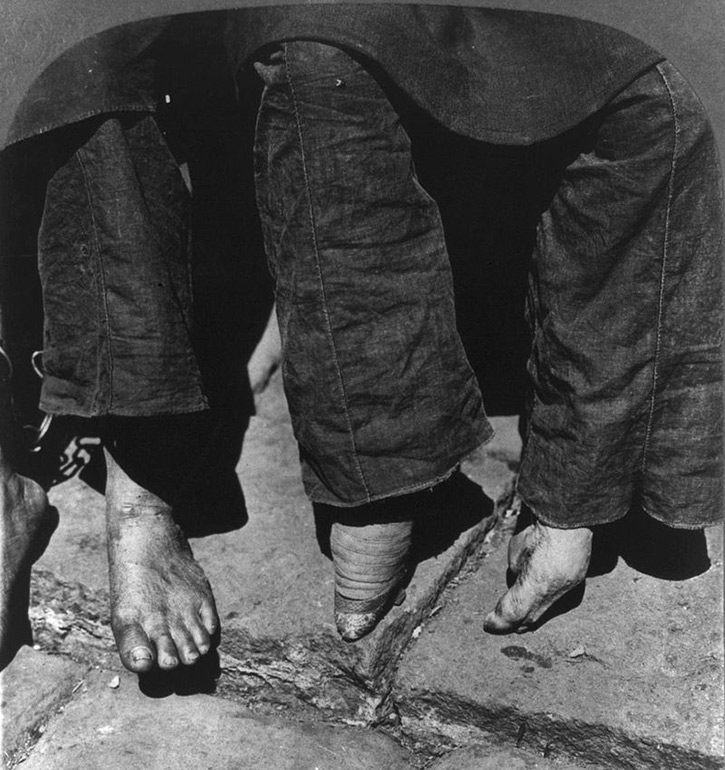
Lotus or lily feet on the right contrasted with the natural feet of Chinese women in Canton (now Guangzhou), China. (Photo: www.wikipedia.org)



Comments are closed.