

Ever wondered where the scientific or common name of a bird originated or where a bird species was first found and described? In South Africa, most people who are interested in birds are familiar or grew up with editions such as “Roberts” or other old bird books. Most of the information in such publications, including colour plates and sketches, is obtained from specimens collected in the wild and then curated as museum specimens. This article explores stories behind southern Africa’s early bird collectors and how museums procured bird specimens in the early days. Our information is drawn from the book “Warriors, dilettantes & businessmen” by the late Richard Dean, and from other sources.
Bird collectors and Museum collection expeditions in the early days
Natural history specimens were traditionally collected mainly for classification of species, naming of new species (type specimens) and even for selling to museums, which started to grow their holdings from privately owned collections. During the mid-1800s to early 1900s, bird collectors travelled to unexplored, sometimes dangerous areas in southern Africa. They often traded their specimens to museums; thus, the Transvaal Museum (currently the Ditsong National Museum of Natural History) had a budget to buy specimens from bird collectors. These days, most of the bird specimens added to museum collections are donated by the public who find birds killed by cars, flown into windows, or poisoned by pesticides.
The late Richard Brooke described the history of ornithology of southern Africa to occur in three collecting periods: from the 1650–1780 when specimens were all sent to Europe, from around 1781–1906 when methodical collecting of specimens took place, and after 1906 until the present when studies of bird biology became the focus of ornithologists and collectors. In South Africa during the Second Anglo-Boer War (1899–1902), there were several British Army officers who collected natural history specimens, especially birds (Fig. 1). These were kept in their own private collections, sold to other collectors, or sent to museums. Almost 21,000 birds and bird egg clutches were collected between 1880–1910 all over South Africa, where the British Army camped. The most productive collector during the Second Anglo-Boer War was Captain Gerard Edwin Barrett-Hamilton, who stationed in several army camps in the Free State and Northern Cape in 1901 and 1902 and collected more than 500 specimens in those areas. Also at the turn of the 20th century, the German Army operated in Namibia, where about 100 bird skins were collected. One of the species mostly occurring in Namibia is represented by a Rosy-faced Lovebird specimen collected in 1907, although its exact provenance is unknown.
In early days, bird collectors faced many challenges, including travelling by slow-moving ox wagons and reliance on additional fodder and water for the oxen. One of the well-known collectors, William Burchell—who allegedly accumulated 540 birds skins of 265 species during his stay in Cape Colony and a trek into the interior (1810–1815)—covered only about 36 kilometres daily. Much later, around the 1930s, motor vehicles started to be used for expeditions. One of the Transvaal Museum exploration parties known as the Vernay-Lang expedition to Botswana and Zimbabwe used a Dodge car with a 1.5-ton trailer (Fig. 2). This was one of Austin Roberts expeditions when he was appointed in 1910 first as a temporary zoological assistant and then Curator of Higher Vertebrates at the museum. Those field trips were very challenging, because rough roads and deep sand necessitated the crawling vehicles to use the first and second gear most of the time.
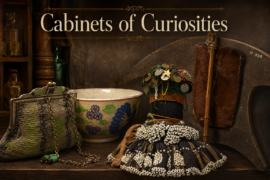
Birds were mostly collected in the field with shotguns, a technique still used today. Mist nets were also used for collecting birds, and this is still the best technique for collecting smaller specimens without damaging them. The material was preserved as mounted or skin specimens since the mid-1800s. Skins were ordinarily prepared during the expedition (Fig. 3) and were conserved using salt and a wide range of chemicals including arsenic, which resulted in early deaths of some museum-based ornithologists. Mounted birds in lifelike positions filled “Cabinets of curiosities”, which evolved later into more specialized displays fashionable in the houses of the landed gentry. Study skin specimens were kept in a standardised way still used today.
South African Museums and their collections today
The first natural history museum in South Africa was established 370 years ago, in 1656, just four years after the Dutch Vereenigde Oostindische Compagnie (VOC) had founded the Cape Colony in 1652. That was just a cabinet of curiosities in the VOC’s clay-and-timber Fort de Goede Hoop, filled with mammal skins and stuffed animals. There was also a mention of a stuffed Ostrich at the fort. Later, the second Governor of the Dutch Cape Colony Willem Adriaan van der Stel (1699–1707) established a museum in the Company’s Garden, which displayed many skeletons and stuffed animals. In 1823, Andrew Smith, an army doctor and an avid zoologist, came to the Cape Colony and started his private museum of natural history. Two years later in 1825, the first formal museum was founded in Cape Town and named South African Museum (now Iziko South African Museum). The establishment of natural history museums in other parts of the country followed much later in the century: the Albany Museum in 1855, National Museum (Bloemfontein) in 1877, Durban Natural History Museum in 1887, and the Transvaal Museum in 1892.
By the 1930s, the numbers of independent professional collectors decreased and museums like Transvaal and the Durban Natural Science museums started to undertake their own collecting expeditions. These two museums curate the largest ornithological collections, which also include several bird type specimens – individuals used for new species descriptions. Upon his appointment at the Transvaal Museum in 1910, Austin Roberts arranged and led several collecting expeditions to around Natal, to the Lebombo Mountains, Mozambique, the Kalahari Desert and South West Africa (now Namibia). He collected more than 30,400 birds and personally prepared many of the specimens, assisted by taxidermists and technicians in the field. He also named more than 400 new bird taxa, which are housed as type specimens at the Ditsong Museum. He was not a pure museum scholar but an ardent worker in the field, with bird eggs and nests included in his interests. This practice is still followed today, and most museum ornithologists include behavioural and genetic studies, and, when collecting specimens, take DNA samples and stomach contents for avian diet studies.
Today, Austin Roberts’s legacy survives in several editions of “Roberts Birds of Southern Africa”, which is a benchmark for contemporary southern African ornithology. The book was first published in 1940, and its 7th edition came out in 2015; detailed online species accounts of Roberts 8 are currently being updated in collaboration with Birds of the Word project (https://birdsoftheworld.org/bow/home). The “Austin Roberts Bird Sanctuary” in Pretoria, Gauteng is named in his honour. He is also commemorated in the name of the Roberts’s Warbler Oreophilais robertsi, which have a restricted range in eastern Zimbabwe and adjacent Mozambique.
Other well-known ornithologists / bird collectors in southern Africa were Phillip Clancey and Michael Irwin. Clancey collected more than 30,000 specimens for the Durban Natural Science Museum and was also skilled at preparing bird study skins. He undertook several expeditions around Africa, particularly to southern Mozambique from 1955–1971; he assembled the largest bird collection from that region. One of Clancey’s achievements was the discovery of the Lemon-breasted Canary Crithagra citrinipectus in Mozambique, which was described as a new species. Michael Irwin was the ornithologist at the National Museum of Zimbabwe responsible for the collection of nearly 90,000 specimens, the largest in Africa. His specimens originated mainly from Zimbabwe, Zambia, Botswana, Mozambique, Malawi and other African countries.
The current value of bird collections as distribution records – Free State examples
The National Museum was founded in 1877 and the Ornithology Department was only established in the early 1970s (https://nationalmuseum.co.za/ornithology). Tibor Farkas was the first ornithologist at the National Museum. He collected about 430 specimens mostly in the Free State and localities such as at the Gariep Dam area, where he surveyed birds. Farkas’ records of a Lilac-breasted Roller (Krugersdrift Dam) and Gurney’s Sugarbird (Kerkenberg) represents valuable historical distribution records for some species in the collection (Fig. 4).
Another example is Red-billed Buffalo Weavers, a species that was believed to be locally extinct in the Free State but some birds were collected on 28 November 1986 near the Vaal River west of the Bloemhof Dam, Hoopstad area. These specimens represent a historical record for this species, although recent vagrants have recently been reported in the Sandveld Nature Reserve during March 2020 (https://sabap2.birdmap.africa/species/779). Other early bird collectors in the Free State included previous directors of the National Museum Dr Egbert C.N. van Hoepen and Dr Abraham C. Hoffman (during the 1930s), and later Cor van Ee and Ian Sinclair. Van Ee was a taxidermist at the National Museum between 1947–1950 and then curator of the Bloemfontein Zoo until his retirement. Ian Sinclair is one of the top experts in seabirds, an adventurous traveller and the author of some 20 books on African birds, including the Sasol Birds of Southern Africa.
Today, the Ornithology Department of the National Museum still runs a programme of building a representative collection of Free State birds. The current aim is to obtain bird distribution records, especially for endemic and near-endemic species, which are important for monitoring the species range changes over time. The Ornithology collections has grown over the years and comprises today about 5300 skins and 2800 skeletons, as well as other items mostly from the Free State. The author has contributed about 4400 specimens to the collection since 1988, of which 3400 are skin specimens, mostly from the Free State.
For this article, I use three species as case studies to show the value of historical specimens, whether they occur at these localities today or not and / or were not recorded by the regional bird atlas projects. The Free State bird atlas project data collecting period was between 1983–1986. A map of bird collecting historical site records of selected Free State species overlain with current Sabap2 bird atlas records (http://sabap2.birdmap.africa; some coincide with Sabap1 project conducted in 1987–1991) illustrate the historical or new occurrences.
Lilac-breasted Roller Coracias caudatus
A specimen of this species was collected by Tibor Farkas near the Krugersdrift Dam area in March 1977, which represents its first record far out of its distribution range of the Kalahari thornveld area of the north-eastern Free State. Today, there are several observations of this species beyond its restricted range, and the species is now regularly reported in these parts of the Free State (Figs 5 & 6).
Barred Wren-Warbler Calamonastes fasciolatus
Kotie Heroldt collected a specimen of this species near the Vaal River in the Hoopstad area in November 1985, but that record was not included in the Free State Bird Atlas. The occurrence of this species was published in the Ostrich journal in 1986. Later in June 1990, the author confirmed this species occurrence in the Kalahari thornveld areas of the Free State after systematically conducted field trips and documented this species for the Sabap1 project. Today, this species range has expanded further into the thornveld habitats of the central Free State and a specimen has also been obtained from the Glen area near Bloemfontein (Figs 7 & 8).
Brimstone Canary Crithagra sulphurata
The map of this species distribution in Earle & Grobler (1987) Free State Bird Atlas showed erroneous records, and follow-up surveys done by the Ornithology Department during early 1990s demonstrated that this species was restricted only to the Zastron areas of the Free State, mostly in Leucosidea sericea (Oldwood) mountain areas. The current Sabap2 records suggest a wider range of the species extending to the Maletswai (Aliwal North) and probably further westwards from its original Eastern Cape distribution (Figs 9 & 10).
There are several species that have restricted ranges in the Free State due to their association with particular vegetation. Such examples include Magpie Shrikes (Kalahari thornveld), Chin-spot Batis and Black Cuckoo-shrike (Vredefort Dome habitats), to name a few. Species such as White-crested Helmet-shrike were first recorded during October 2014 for the Sabap2 project in the Vredefort area of the Free State and later during November 2019 in the same area, a new specimen record for the Ornithology collection.
Apart from the bird specimens collected from several localities in southern Africa over the decades, there was no formal mapping of distribution ranges prior to the 1980s. The first regional bird atlases started with the Bird Atlas of Natal in 1980 and were continued with other regional books. In 1987, the first broad-scale project (Sabap1) in southern Africa kicked in with a 5-year data collecting period, and later, in mid-2007, Sabap2 was launched and remains currently active. Today, the atlas project documents the bird distribution and monitors changes over time by comparing with historical museum records. Virtual platforms such as iNatuarlist, Macaulay Library of eBird and Observations.org enable both citizen scientists and scholars to submit their natural history photographs, so that killing of specimens to obtain distribution records is no longer needed or desirable.
Acknowledgements
Michael Brooks from University of Cape Town (Sabap2 project) produced the three distribution maps with the Museum specimen record overlays. Dr Sue Dean-Milton made copies of historical photographs originally published in the book “Warriors, dilettantes & businessmen” by the late Richard Dean available for this article. Janine Dunlop of Fitz Library, University of Cape Town assisted with references for this article.
References
Brooke, R.K. 1986. Historical sketch of Afrotropical ornithology. Revue de Zoologie Africaine 100: 7–12.
Brooks, M., Rose, S., Altwegg, R., Lee, A.T.K., Nel, H., Ottosson, U., Retief, E., Reynolds, C., Ryan, P.G., Shema, S., Tende, T, Underhill, L.G. & Thomson, R.L. 2022. The African Bird Atlas Project: a description of the project and BirdMap data-collection protocol. Ostrich 93(4): 223–232. https://doi.org/10.2989/00306525.2022.2125097
Clancey, P.A. 1980. S.A.O.S checklist of southern African birds. Johannesburg: South African Ornithological Society.
Cyrus, D. & Robson, N. 1980. Bird atlas of Natal. Durban: University of Natal Press.
Davies, K.C. & Hull, J. 1983. Burchell’s South African bird collection (1810–1815). Archives of Natural History 11(2): 317–342. https://doi.org/10.3366/anh.1983.11.2.317
De Swardt, D. 2020. Museum records shows that Red-billed Buffalo-weavers have become extinct in the Free State due to deforestation. Culna 74: 25–26.
De Swardt, D.H. 2016. White-crested Helmet-shrike in the Vredefort area, Northern Free State. Biodiversity Observations 7.4: 1–2.
Dean, W.R.J. 2017. Warriors, dilettantes & businessmen. Bird collectors during the mid-19th to mid-20th centuries in southern Africa. Cape Town: The John Voelcker Bird Book Fund.
Earle, R.A. & Grobler, N.J. 1987. First atlas of bird distribution in the Orange Free State. Bloemfontein: National Museum.
Farkas, T.B. 1981. Bird communities of the False Upper Karoo. Memoirs of the National Museum, Bloemfontein 16: 1–160.
Herholdt, J.J. 1986. The occurrence of the Barred Warbler in the Orange Free State. Ostrich 57: 114. https://doi.org/10.1080/00306525.1986.9634133
Moffett, R. 2014. A biographical dictionary of contributors to the natural history of the Free State and Lesotho. Bloemfontein: Sun Press.
Rudner, I. 1982. The earliest Natural History Museums and collectors in South Africa. South African Journal of Science 78: 434–437.
https://en.wikipedia.org/wiki/Austin_Roberts_(zoologist)
https://www.s2a3.org.za/bio/Biograph_final.php?serial=2357


Comments are closed.