


Dr Cora Stobie of the Herpetology Department recently investigated the increasing representation of female authors in the journal of the Herpetological Association of Africa (HAA). Her findings have been published in the Association’s newsletter African Herp News.
Although science degrees are currently being issued to both men and women in similar proportions, there remains an alarming difference in gender ratios for professional biological scientists. This gender imbalance in academia has been referred to as the “leaky pipe” problem where progression from junior to senior faculty leaks female scientists. This is particularly relevant currently as there is evidence that the COVID-19 pandemic is further reducing representation of female authors in many fields. The pandemic is therefore enhancing problems that were already an issue for female researchers, such as the division of work in managing familial and domestic activities.
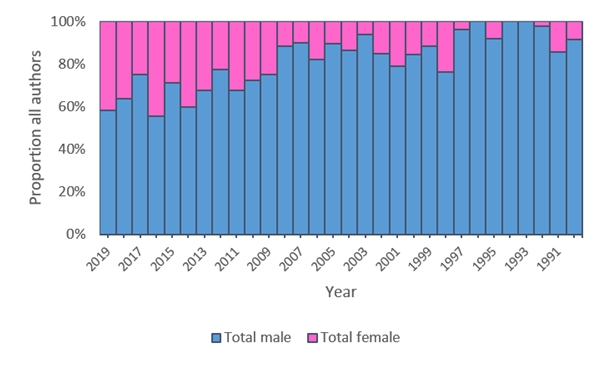
Image: Graph showing proportion of male (blue) and female (pink) authors publishing in the journal of the Herpetological Association of Africa (initially named Journal of the Herpetological Association of Africa, currently African Journal of Herpetology) over the last three decades (1990‒2019).
Herpetology as a discipline has been viewed historically as male-dominated, although recent studies have indicated changing trends, but sparse data is available to examine this in an African context. In a brief assessment of participation on the Facebook group Free State Reptiles and Amphibians, Cora found that of 567 individuals who posted photographs to the group, or had their photographs shared to the group, 45.8% used feminine pronouns, 54.0% masculine pronouns, and 0.2% non-binary pronouns.
Cora extended her investigation to herpetological publications by examining the authorship of 362 original research articles published in African Journal of Herpetology from 1990 to 2019, to evaluate trends over the last three decades. Authors were assigned to a gender based on Google searches for exact individuals together with use of titles, pronouns, given name or gender cues in photographs. This process assumed a binary gender distribution even though this was acknowledged as not being representative of reality, as gender is a complex construct. Data showed an improvement from 9% female representation in 1990 to a current average contribution of 32 to 40% per year in the last decade. Although this is below equality (50%), the improvement is heartening and shows that gender representation in this journal in particular is changing. Further analyses investigating differences in gender proportions by study taxa, and examining whether there is a difference in number of publication reads by gender, were also included. Because only a single flagship journal was investigated, the research cannot be broadly projected as being representative for African herpetology as a whole. However, the future looks optimistic and we look forward to seeing greater participation of female scientists going forward.
Article: Stobie, C.S. (2020). Increasing representation of women authors in the journal of the Herpetological Association of Africa (1990-2019). African Herp News 74: 44-54.


Comments are closed.