“The South-Eastern quarter of the town, bounded roughly by the Natal Line and the Cape Line shall be the area where a hygienic Native township shall be developed.” This is how Bloemfontein’s mayor, Mr D.A. Thomson, referred to the Free State capital’s new township in his annual report for 1919–1920.
A Baker garden with a touch of Jekyll: Early history (1903–1905) of the garden at Westminster Estate near Tweespruit, Free State, with special reference to the role played by the Duke of Westminster, Sir Herbert Baker and Gertrude Jekyll
Department of History, National Museum, Bloemfontein, P.O. Box 266, Bloemfontein, 9300, and Research Fellow, Department of History, University of the Free State, Bloemfontein
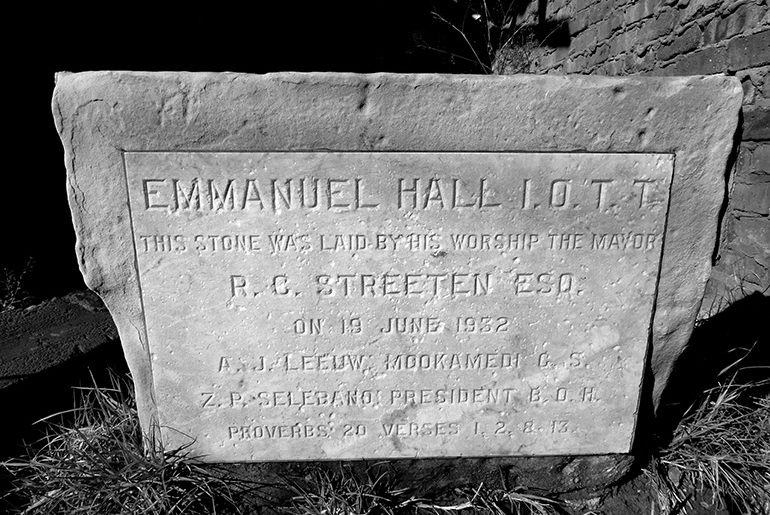
The story of the Independent Order of True Templars foundation stone in the Batho exhibition
Which drink do you prefer, dear reader, liquor or tea? Making a choice is not always an easy one, but the story behind the Independent Order of True Templars (IOTT) foundation stone in the National Museum’s exhibition on Bloemfontein’s Batho township, is all about making a choice in favour of tea. If you prefer tea, then this story is for you.
Batho, Bloemfontein’s oldest existing historically-black township, boasts a long gardening tradition. From the early 1920s, when the Town Council started moving Bloemfontein’s black residents from the old Waaihoek location to Batho, gardens were laid out on most properties.
Die geskiedenis herhaal homself soms op bisarre maniere. Een van die ontstellende gebeure van die aanloop tot dieTweede Wêreldoorlog (1939–1945) was die sogenaamde Kristallnacht toe stormtroepe van die Nazi-party in die nag van 9 November 1938 Joodse besighede, huise en sinagoges in verskeie Duitse stede en dorpe se vensters stukkend gegooi en die inhoud geplunder het. Die volgende dag was strate besaai met glasskerwe – vandaar die naam Kristallnacht of ‘nag van gebreekte glas’. In hierdie geval was die Duitsers die agressors.