

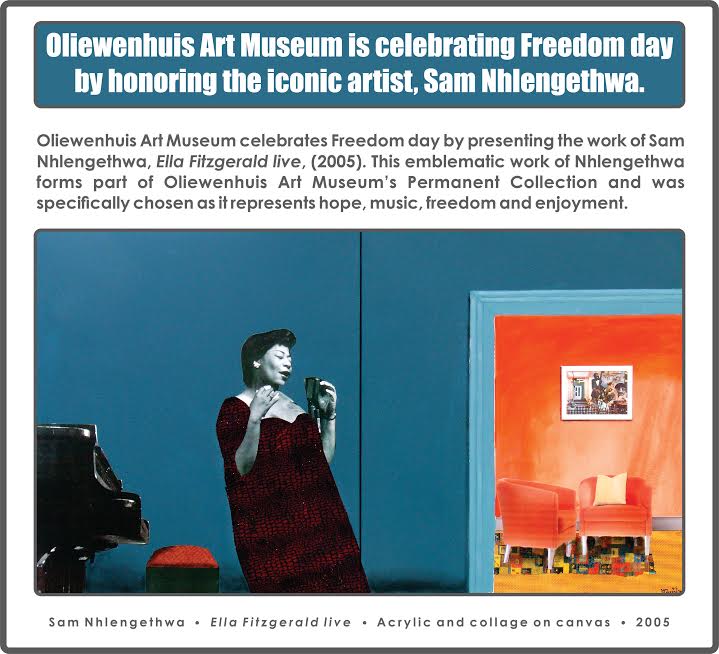
Oliewenhuis Art Museum celebrates Freedom day by presenting the work of Sam Nhlengethwa, Ella Fitzgerald live, (2005). This emblematic work of Nhlengethwa forms part of Oliewenhuis Art Museum’s Permanent Collection. This work was specifically chosen as it represents hope, music, freedom and enjoyment.
Sam Nhlengethwa is an icon within his own right and his art portrays decades of South African history. Nhlengethwa was born in Springs in 1955 and studied at the Rorke’s Drift Art Centre during the late 1970’s where he obtained a Fine Arts Diploma. He participated in extensive exhibitions locally and abroad during the 1980’s and 1990’s and in 1994 he won the prestigious Standard Bank Young Artist Award. Today Nhlengethwa is represented by The Goodman Gallery, possibly one of South Africa’s most reputable galleries.
Nhlengethwa’s unique visual vocabulary encompassed collage and montage for many decades. The uniqueness of his work is also located in his ever present passion for jazz music and he often portrays jazz icons in his work. His work is energetic, vibrant and when being viewed one ‘feels’ the inner city buzz of Johannesburg filled with music on the street and in the homes of people. Jazz music was part of Nhlengethwa’s upbringing as his two brothers both collected jazz music and his eldest brother was a jazz musician. Nhlengethwa was well known for painting jazz pieces as an avenue or outlet for expressing his love for music. “As I paint, I listen to jazz and visualise the performance. Jazz performers improvise within the conventions of their chosen styles. In an ensemble, for example, there are vocal styles that include freedom of vocal colour, call-and-response patterns and rhythmic complexities played by different members. Painting jazz allows me to literally put colour onto these vocal colours.”
“Jazz is rhythmic and it emphasises interpretation rather than composition. There are deliberate tonal distortions that contribute to its uniqueness. My jazz collages, with their distorted patterns, attempt to communicate all of this. As a collagist and painter, fortunately, the technique allows me this freedom of expression… What I am doing is not new though, as there are other artists before me who painted jazz pieces. For example, Gerard Sekoto, Romare Bearden and Henri Matisse.”
With her article, Sam Nhlengethwa: Portrayal of everyday, Rachell Marie Morillo has pointed out that “Nhlengethwa forged his distinctive visual style in the late 1970’s during the Apartheid regime, when the government was violently repressing the Black Conscious Movement and shifted his focus from making work that primarily focused on human suffering”. More importantly Morillo points out that his work portrays “moments that collectively form a picture of daily life and culture”. Nhlengethwa’s combination of collage and painting is not just a choice in style. Bringing together different materials and techniques “is a form of worlds colliding”, he says. He often works with archival images he finds in old posters, newspapers and magazines to recall the past. Nhlengethwa’s work is rhythmic, figures repeating over and over, each time adding more complexity, blending together different styles and voices to produce something unique of the moment. In these moments, there is a sense of freedom that opens up so many possibilities”.
Oliewenhuis Art Museum is proud to house such an iconic work of Sam Nhlengethwa.
Morillo, R. 2019. “Sam Nhlengetwha: Portrayal of the Everyday” (available at http:// https://theartmomentum.com/sam-nhlengethwa/, as accessed on 22 April 2020).
Anon. “Sam Nhlengetwha” (available at http://www.goodman-gallery.com/artists/sam-nhlengethwa, as accessed on 22 April 2020).
Text: Yolanda de Kock l Education Officer l Oliewenhuis Art Museum
#FreedomDay l #Day31ofLockdown l #LockdownArtGallery


Comments are closed.