Within the ArtBankSA collection, through annual acquisition cycles and Presidential Employment Stimulus Programme (PESP) art creating initiatives, an archive of photography-based artworks has been built. These artworks are more than traditional camera-to-print images, as the material life of the photograph through experimental and hybrid forms employed by the artist has resulted in new ways of presenting an image.
Moving beyond straightforward lens-based work, artists such as Alka Dass, Vanessa Tembane, Lusanda Ndita and Cheriese Dilrajh draw on personal domestic archives and their family histories, as well as historical threads of place as pinpoints for identity politics. These artists expand analogue processes to rethink the photograph as object in physical and digital forms.
From working with watercolour and screen-printing processes, to film-based prints and digital collages, these artists reconceptualise photography as tactile, layered and materially expressive. The process and hybridisation destabilises conventional documentary expectations and opens up new ways of engaging with memory, identity and the South African photographic archive.
Reclaiming the domestic archive and family narratives through additional processes
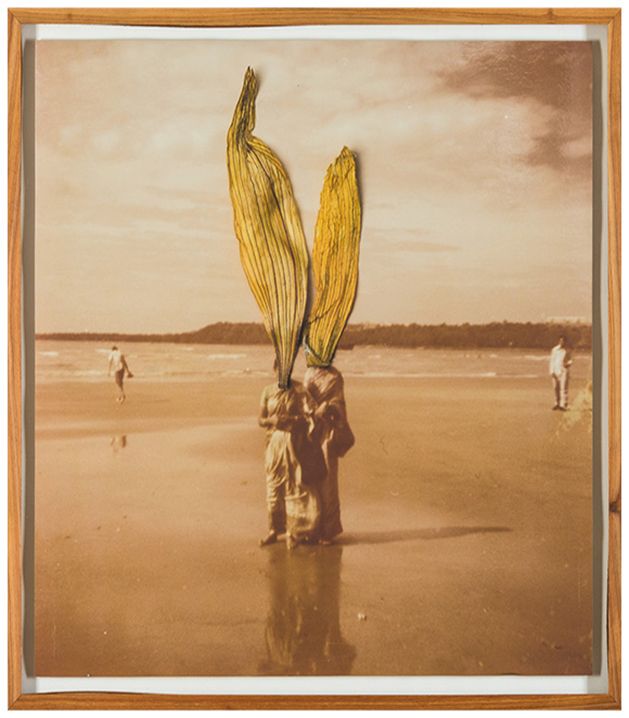
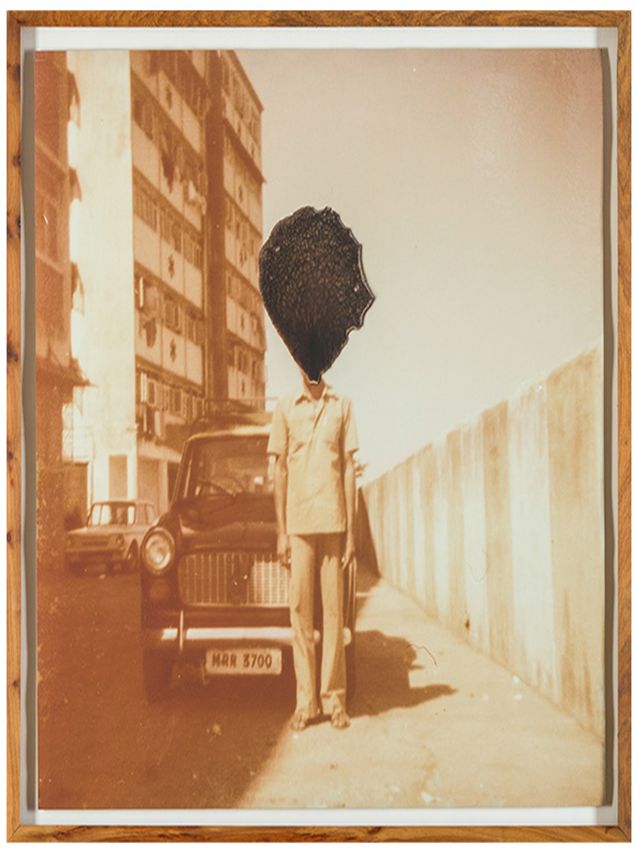
Transdisciplinary textile artist Alka Dass’ earlier work, which forms part of the ArtBank collection, employs methods of merging family analogue photographs with digital processes. In her pieces I had gone long without feeling sand between my toes, and smell of salt in my nose (Fig. 1) and A ruin with no location (Fig. 2), Dass works with flower pressing techniques and covers the faces of the people in the images. The people are relatives, or friends of family. In her interview to OATH magazine, Dass expressed:
“The pressed flowers are completely vulnerable. They are fragile, dry, and brittle, just like the old photographs onto which they’ve been placed … and the delicate histories those photographs carry into the present. I also feel the act of drying these pressed flowers is an act of archiving in itself. Most of these flowers are inextricably bound to my culture and are quite literally grown by my Nani’s hand.”
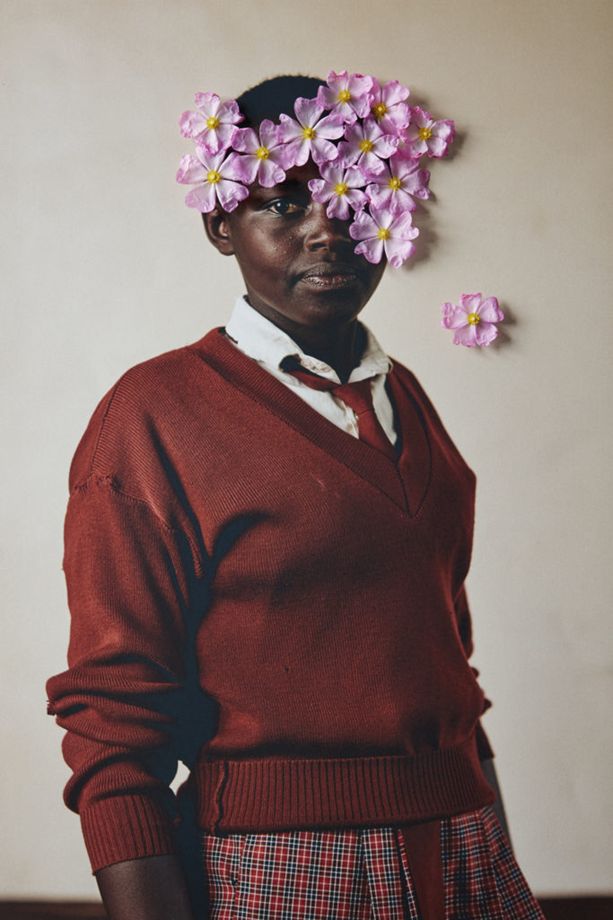
Contemporary photographers such as Lee-Ann Olwage have also used flowers as a way to soften and give life back to portraits and the people in them. Olwage explains (Fig. 3), “the flowers are used to create a playful world where girls are shown exuding pride and joy and in this way the flowers are also used to reclaim their futures and dreams and to re-imagine the narrative of child marriage.” Similarly, Dass’ use of flowers creates a new, second (perhaps, third) life, as she works and “re-processes” the once developed, then scanned and printed archival family photo. She takes the image and adds her hand to the making process, by gently applying flowers, which took time to press, and then digitally recording the final, new image.
In her more recent work, Dass employs weaving methods both literally and in the sense of the “generational language” making. Dass’ practice is focused on the use of storytelling, embedded in a variety of mediums to address themes of trauma, memory, belonging and migration. Nicole Sarmiento writes, “Dass’ starting point is always the personal and experiential: her own multi-generational archives, the stories they tell, the people, places and times they belong to, in intimate and ludic relationship to the handmade and slightly unpredictable nature of cyanotype – its sensitivity to light, moisture, material and environment.”
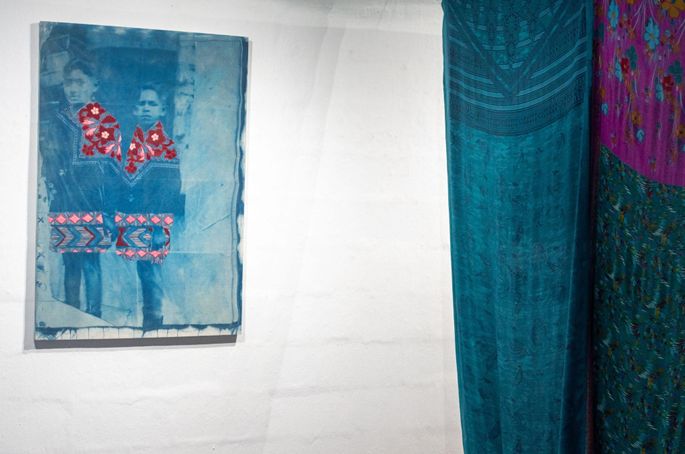
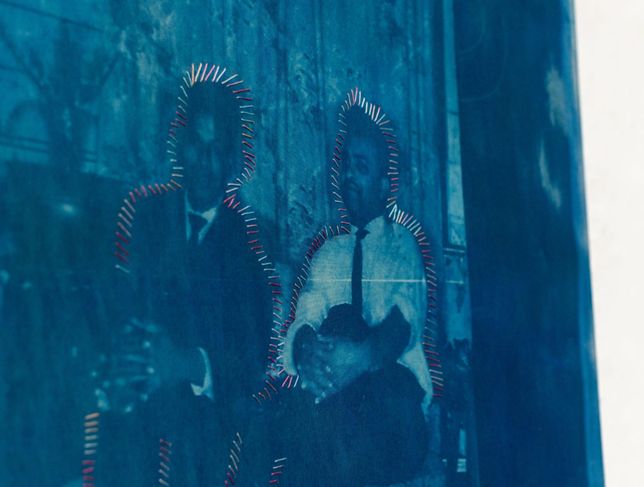
With the introduction of cyanotype, threading and embroidery, this becomes almost a second generation of her first works that involved a process with less steps, resulting in a more matured presentation of her family’s home archive.
Lusanda Ndita, another artist whose work forms part of ArtBank’s collection, obsessively creates with the same, limited archival material from his family, specifically his maternal lineage. Photographs of his mother as a young woman, his grandfather’s dompas and images of uncles or men he does or does not know are reworked in different ways into various mixed-media art pieces.
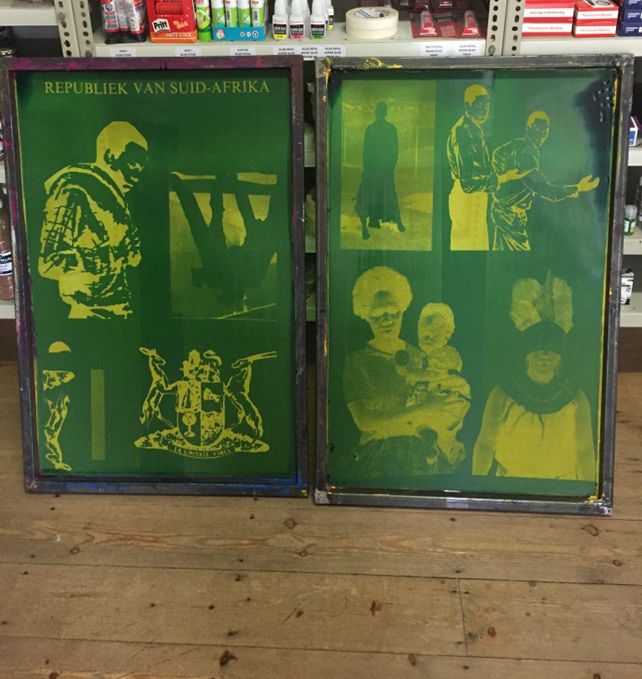
Suid-Afrika (Fig. 6) combines screen-print processes to layer and storytelling. The image of Ndita’s mother holding him as a baby is clear and the photograph is exposed positively onto the Fabriano paper he used. Screen-printing as a process begins with creating positives, an opaque artworks printed or drawn on transparent film (Fig. 7). These are placed on a light-sensitive, emulsion-coated screen and exposed to the UV light, which hardens the emulsion everywhere except where the artwork blocks the light (Fig. 8). The unexposed areas are then washed out, forming open stencils in the mesh. Ink is pushed through the screen with a squeegee onto the chosen surface, and additional layers or colours are built up by repeating the process with separate positives and screens for each layer.

This methodology becomes lyrical in the meaning-making of his work. The metaphorical layers of time and distance, history and memory (as faded figures, or overt imagery of protagonists in his life history), this process reflects the multitude of stories and experience that he, and many Black South Africans, had during and post-apartheid.
The leads and mentors of The Inbetween project reflect on Ndita’s relationship between printmaking and his employment of domestic documents like his grandfather’s dompas. Ndita uses such documents as a means of interrogation of labour both as a historical condition and as an act of resistance. Here, Lusanda reclaims the medium of print, transforming a form historically tied to systems of surveillance and control into one of subversion. His work asks: Can mass production—once a tool of oppression—become a method of rewriting history? Can repetition create disruption rather than order?

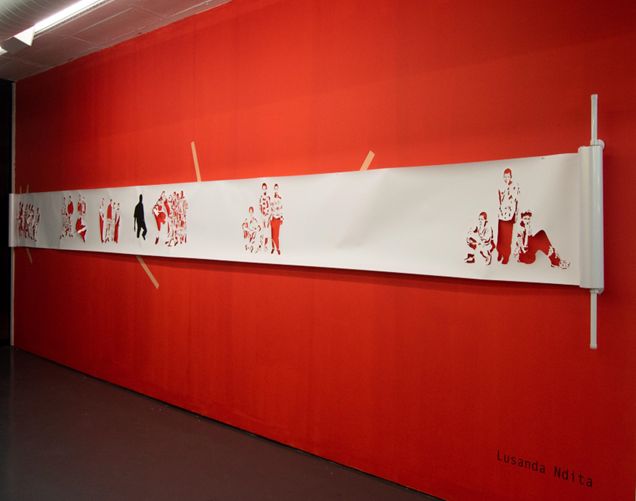
In Ndita’s previous works (Fig. 9), he used Chinese cut-out methods to remove the male figures in his domestic archives. The process could be noted as a metaphor of violence and erasure, a hangover experience of apartheid and what happened to the men in his family when they worked as migrant labourers.
Ndita’s shift to the repetitive motions of printmaking changes his relationship with the photographs’ part of his domestic archive. Similar to Dass, his work evolves, and new chapters and interpretations of his family’s lineage emerge through the reprocessing and the obsessive use of the images in the archive.
Digital collage making to complicate memory and sites of belonging
Much like Ndita, Vanessa Tembane is influenced by her mother’s memories and narratives of her mother’s home country, Mozambique. Tembane’s work wrestles with her sense of loss and belonging, as a South African-born artist with a Mozambican ancestry, a result of her mother’s migration to a neighbouring country. Tembane uses collage techniques and works with photographs made in South Africa alongside images of her Mozambican relatives producing hybrid compositions.
Using a cut-out method to create silhouettes of the family figures and incorporating fabric detail from capulanas, Tembane changes the material nature of the images in her work. Integrating textile, removing people and re-representing them as colourful, almost “other-worldly”, she dives deep into themes of alienation, Othering, and the experiences of foreign nationality and tensions of home. She uses multimedia to make a layered digital print, which surfaces these narratives true to herself and her mother.
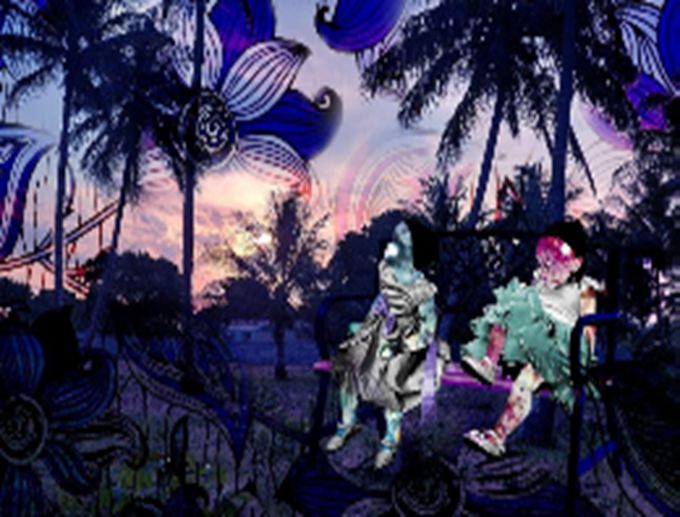
Tembane employs printmaking techniques and crochet onto the images. She utilises collages to tell stories about her origins and to untangle (and perhaps thread more complexity to a non-linear experience) notions of her “home”, which surfaces feelings of displacement while giving space for new memories through the collage development. Tembane’s style is not a conventional ‘stick-and-paste’ with glue and paper, but involves many other processes.
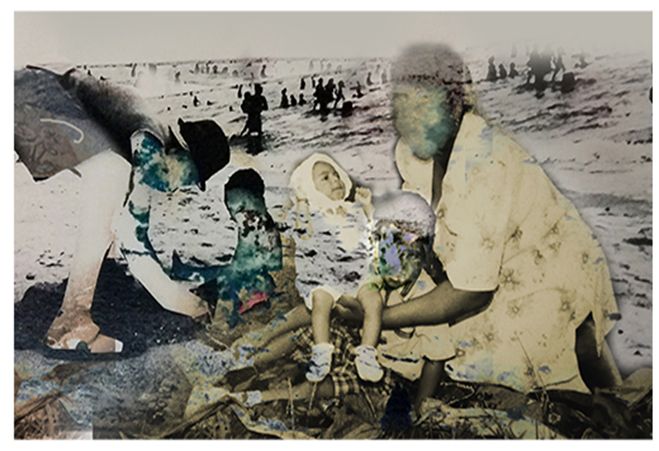
Cheriese Dilrajh, another artist whose work is housed in the collection, reminds viewers of the contemporary, digital-age-esque presentation of collage making.


Dilrajh describes her process in creating the digital collages for the PESP3 Art Creating Programme:
“I photographed in the city, and then I turned them into collages on my computer until it gave the feeling I was trying to convey. The collage emerged out of walking in the city of Johannesburg as a practice. The textures and rhythms of the city is what became most important to me and I was photographing moments that I thought were visually interesting, perhaps consciously or subconsciously.”
This intuitive making process differs from approaches of Dass, Ndita and Tembane, since Dilrajh makes the images and creates vignettes of the city as the moment arises. She starts from scratch and works with the unknown, as she needs to make her images in order to begin assembling them together to create a meaning.
Dilrajh’s practice is centred around migration and multiculturalism, which is prevalent in the content of her colleagues. While the other mentioned artists work with material where meaning is pre-existing, Dilrajh prefers to make sense and unpack her artwork after, “I don’t move with the intention of what something is supposed to be. I’m constantly trying to arrive at understanding.” The notion of “world-making” often surfaces in how she describes her work. This tactic allows her process, specifically with her digital art, to gather moments of the cities she walks through, a process in itself, to later sit and transfer photos from camera to computer. Dilrajh explains:
“I landed up with a variety of images which I then put into photoshop. I cut and edited them until it comprised a collage that made sense to me. During the January period I was able to work on another image, again using walking as a practice. I photographed in the city, and then I turned them into collages on my computer until it gave the feeling I was trying to convey.”
Another key insight is that her process requires her to step outside of a studio space and engage with the outside work, using photography as the entry point into the world, which returns onto the screen for others to view.
Among these four artists, their practices have all transformed over the years as they experiment with different techniques on how to manipulate, elevate and rethink the layers in their work. The photographs, often at the foundation of their processes and practice, become intertwined with fine-art thinking and practical elements, which allows their stories to become seeped in historical and personal nuance.
References and footnotes
Art Joburg, “Alternative articulations since nothing is linear,” FNB Art Joburg, 27 March 2025. https://artjoburg.com/alternative-articulations-since-nothing-is-linear
Jade Nair & Yussuf Essop, “As natural as daylight: Plants memory & the edge of belonging,” 15 November 2025 – 24 January 2026. https://static1.squarespace.com/static/5b98e44a5417fc11cb50ebc5/t/6924267c082b730eb29af009/1763976828632/AVA_Catalogue__As+Natural+As+Daylight_high+%281%29.pdf
Lee-Ann Olwage, “The right to play,” 2023. https://iwpa.fr/photographer/lee-ann-olwage/
Nicole Sarmiento, “The Blue House, a solo exhibition by Alka Dass,” WHATIFTHEWORLD, 23 March – 27 April 2024. https://www.whatiftheworld.com/exhibition/the-blue-house-alka-dass-solo-exhibition-2024-contemporary-art-gallery-cpt/
OATH, “Alka Dass on Flora & Photography,” 25 August 2020. https://www.oathmag.com/features/alka-daas/
Rachel Baasch, Niamh Walsh-Vorster, Anne-Marie Tully, Russel Hlongwane, and Nzuzenhle Slumko Mkhabela, “The Inbetween,” KwaZulu-Natal Society of Arts, 28 February 2025. https://kznsagallery.co.za/research_posts/the-inbetween
https://www.vanessatembane.com/artist-statement
capulanas is a vibrant, patterned fabrics central to the Mozambican culture, used as versatile clothing (skirts, dresses, headscarves, baby carriers) and household items (blankets, tablecloths).
Lusanda Ndita usually spells this as dompaas, but for the purposes of this article and uniformity I have adopted another article’s spelling.