

As the legend goes – Ex Africa semper a liquid novi – out of Africa there is always something new. In cynical times, the Latin saying can be deemed a cliché, especially when nay-sayers insist on reminding us of misfortune, corruption, barbarism, beggary, of the toxic, prejudicial, yet persistent view of Africa’s failure to mirror the West. But as Steve Bantu Biko famously reminded us, in I write what I like, Africa’s contribution to the world lies not in industrial innovation, or military might – the core ingredients of every colonizing force – but in something far more precious – humanity. Africa’s power lies in its spirit of Ubuntu, in relationality, in returning to the world its ‘human face’.
Sentiment or Truth? Whichever way one chooses to frame the ‘gap’ which Africa must bridge, there is, to my mind at least, no doubt that it does reside in what Roman Krznaric calls an ‘empathic revolution’. My aim is not to set Africa apart, this has all too often proven to be the reductive case, but to understand how and why Africa can connect the world. With the greatest labour reserve on earth, the most promising market for future innovation, great still-untapped mineral resources, the indicators, reasonably, suppose Africa to be the trigger for continued global economic innovation. Why else are the worlds super powers in the East and West knocking at our door? One would be foolish to ignore predation, or the extractive desires, and needs, of foreign powers. Neo-colonialism is omnipresent. However, my focus is not on the extractive and exploitative drives that would further hobble a benighted continent, but, on the contrary, to recognise its infinitely greater strength. It is short-sighted to suppose continued subjugation as the driving logic of foreign powers. Power-imbalances are never static, and, even when they remain unequal, inequality too must alter. The brutality of previous eras of colonisation have inevitably shifted in their logic and practice. The emergence of ‘soft power’ has, increasingly, assumed an integral role in all political and economic negotiation. That culture, or cultural exchange, has assumed centrality in the mechanics of ‘soft power’, reaffirms the realisation, and fact, that dialogue is no longer one-sided, that reciprocity, if only chimerically, remains a fundamental ingredient in every contemporary exchange.
Thus, when we speak of ‘Bridging an Africa towards an Africa we want’, it is this relative mutuality in political, economic, and cultural exchange that it critical. Without mutual respect no inter-relational economy is possible. That mutuality supposes desire – an Africa we want – further underscores the realisation that exchange cannot be merely nominal, as an exchange between two preconditioned and resolved entities, but can only occur when a critical degree of openness is permitted. Mutuality is a desirous affair. Exchange, to truly work, and be profound, requires a ‘human’ interface – a desirous mutuality, an exchange between equals, founded on the critical notion of a shared continent, Africa, which, as stated at the outset, is the globally recognised source of great novelty, of newness. This ‘newness’, however, should not be understood as an add-on, in the well-known, perhaps infamous, case of a ‘New South Africa’, which proved as vulnerable to aspiration as it was to abuse, but, rather, better understood as an integral, residual, dimension of a country, a continent, and its many cultures. To bridge the existing divides within and across Africa, to imagine the Africa we want, requires what the Cameroonian philosopher, Achille Mbembe, terms an ‘anticipatory politics’, one that supposes an integrative and inclusive vision of exchange.
That this logic necessarily also supposes a global vision is unsurprising. One cannot conceive of Africa without recognising its place in the greater world – one that is inter-regional, continental, and global. In a bid to foster ‘new integrations’, new interfaces in the art world, and its economic, cultural, and political underpinnings, we should not forget that continents too can prove to be provincial, in the recent case, say, of Europe, which, increasingly, has chosen to freeze the flow of goods and people, amplify a nation-based isolationism, not least because of the perceived threat posed by refugees from the Middle East and Africa. Thus, to understand the importance of a desirous mutuality – in the case of a unified Africa – we must, at the same time, recognise the equally aggravated and aggravating reality of a Europe under siege, caught between its respective national and global aspirations. And yet, despite this vexed and vexing contradiction, it remains of vital importance that we hold fast to our continental and global salvation, which, to my mind, requires stoicism, generosity, and fairness – some ingenious and innovative compromise. This is vital, precisely because the world finds itself caught between irreconcilable extremes, on the Left and Right, because centrism, the pillar of democracy, is under threat. Thus, it is unsurprising, given this unstable historical moment, that ArtBankSA should aspire to bridge the African divide, and explore the Africa we want. This, in my view, is only possible through a stoical compromise, a recognition of difficulty, combined with a will to pragmatically overcome it. The rest is idealism, which, while important, will not enable the changes on the ground which we require.
‘The Africa we want’ is not only an indigenous vision but also an exogenous one – it requires the entire earth. Further, it requires us to stop blaming history for our continued ills, find merit in the past that can move us forward. Colonisation cannot be redacted. If, as Fredric Jameson remarked – ‘history hurts’ – it nevertheless also possesses the power to heal and to engender alternative exchange economies. After all, Africa – in the specific case of South Africa – is, by virtue of its history, a hybrid culture. It is unsurprising that Archbishop Desmond Tutu would, as a consequence, dub ours a ‘rainbow nation’. It is this variety, this geographical, historical, and cultural complexity which we must place at the forefront. As the internationally celebrated artist, Ai Weiwei, cannily reminds us, ‘our future is just an integrated concept that combines today and yesterday’. It is through integration that we will override the toxicity of difference that sets us apart and divides the world. Integrated systems are hybrid, speculative, humane. They are built on experiment, and, as such, are fearless. If Africa has, supposedly, little to lose, it certainly has much to gain. While other economies are comparatively exhausted, ours remains bountiful. The fact of the matter, and the terrible irony, is that the world no longer has a choice. Ours is a metastasized anthropogenic time in which Africa has emerged comparatively unscathed, sanctified, and undestroyed. We are now not a last resource, but the first. The challenge, in the face of global collapse, is to learn to live anew, and differently so. This, after all, was always Africa’s lesson.
That Contemporary African Art has assumed centre-stage globally at this embattled historical moment is fortuitous but also unsurprising. In an ‘End Time’, a time morally exhausted, a time in which democracy, the foundation of Western Civilisation, is under threat, in which extremism becomes normative, and in which we find ourselves caught between two pieties – Fascism and Revisionism – it becomes all the more critical that we learn to recalibrate the world – our morality, our vision, our values. In this regard, art has a critical role to play, precisely because, at its best, it refuses to align itself to dogma. As the Irish novelist, James Joyce, might say, art at its best operates through ‘silence, exile and cunning’. Or as the French poet, Charles Baudelaire, would argue, great art outwits ‘the madness of the common people and the madness of the middle classes’, precisely because it refuses to be co-opted. My point? That for art to be generative and healing, for it to reconcile a deranging rift, it must step outside and beyond the pale, the better, from a position of an outlier, to reflect upon the ills of history, society, nationhood, or any other essentialist category that sets people apart.
Dipesh Chakrabarty’s provocative insight – the ‘Provincialising of Europe’ – posed in 2015, has proved, uncannily, to be true. The threat of a return to a balkanised Europe, in which the European Union, with its democratic centrist glue unstuck, is no longer a prophecy but a clear and present danger. We in Africa, must be wary of the destruction of our potential integration as a continent. It is not a Pan-Africanism of which I speak – this is a rhetorical ideal – but a strategic, and stoical, repurposing of our co-dependent and contrary values. If an essential Africa does not exist, it does not follow that one must abandon any attempt towards what I’ve called a desirous mutuality. One does so, not by advocating some continental universalism, but by crosshatching differences, overriding exclusivity, effecting a hybrid mutuality. In this regard, art has a particularly profound role to play.
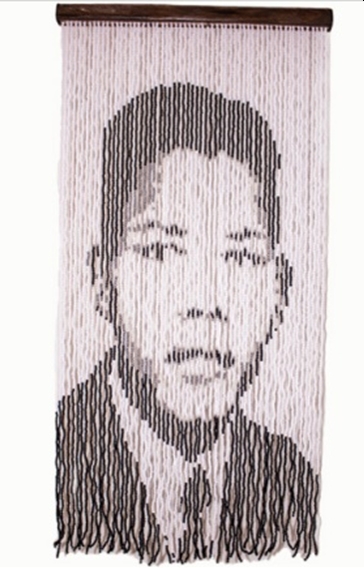
In South Africa’s case, a country impressively hybrid – a fact impossible to ignore – art and its curation at ArtBankSA is founded on ubuntu, the realisation that we are whom we are, because of others. Consider the following acquisitions, and what they embody and represent. If Collen Maswanganyi’s wooden relief carvings (1) are immediately distinctive, it is because they are conciliatory, their gestural expression founded upon the core principle of ubuntu. Perhaps the most iconic works, in this regard, they are, nevertheless, matched by a work, made of beads and framed with wood, which reveals a portrait of a young Nelson Mandela (2). Created by Morgan Mahape, it conveys all the hope and longing of an emerging nation, a dream, despite our putative democracy, which remains deferred. Still, however, against the odds, hope remains in the exemplary iconic and mythic figure of Mandela. What better votive or prayer can one nation gift to another?
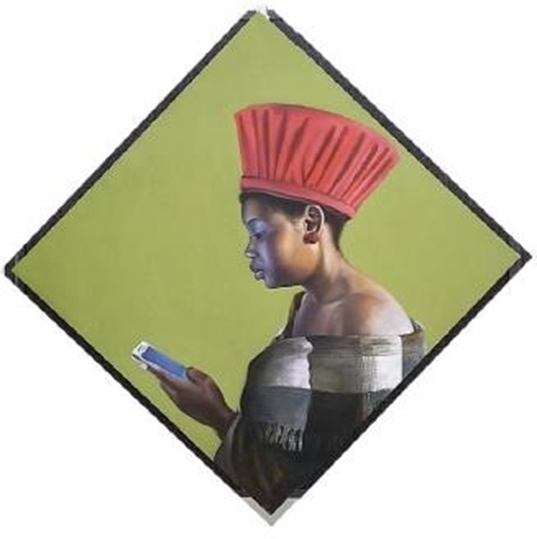
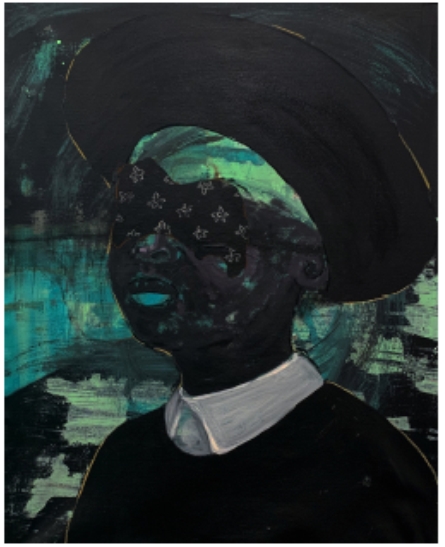
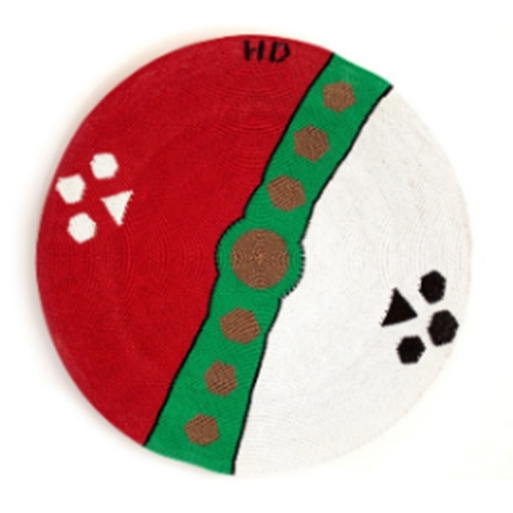
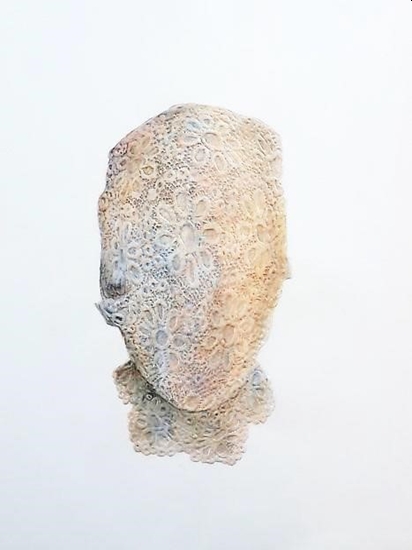
Gilbert Maepa’s oil of canvas, ‘Ts bogadi’ (3), fuses tradition and modernity, reminding us that all channels must be open in an ever-changing society. Wonder Buhle Mbambo’s (4) vision of an unseeing youth, their eyes masked by a black floral eyepatch, supposes that connection and advance is not the province of the eye alone. Hlengiwe Dube’s witty ‘Zulu Ear Plug’ (5), a nod to traditional cosmetics, reveals the innovative use of alternative material, in this case, telephone wire. Africa, of course, is famed in this regard, as a continent, more than any other, for having understood how to transform waste – often the waste of foreign nations – into a newfound beauty. As the great saying goes, out of Africa, newness arises. This is the frisson and thrill which foreigners experience on arriving in Africa. But as Pfano Bebeda reminds us, our great and ancient wood carving tradition, which predates well-nigh 600 years of colonisation, also cannot be ignored. His ‘Three Horns’ (6), made of African mahogany, returns us to a staple, wood carving, which proved enormously impactful in Europe, and, in the works of Pablo Picasso in particular, ushered forth European Modernism, the unquestionable foundation of which, despite denial, lies in Africa.
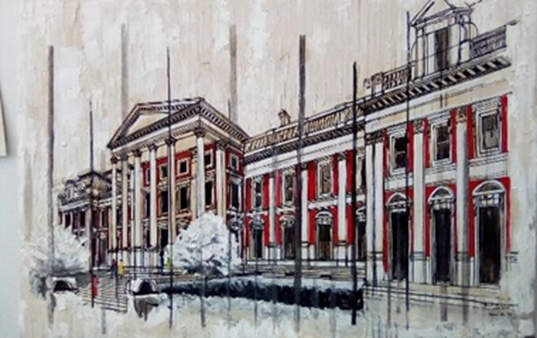
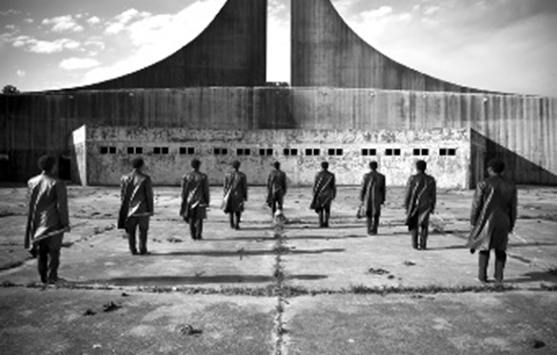
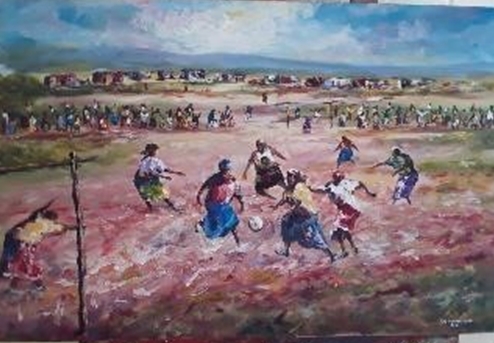
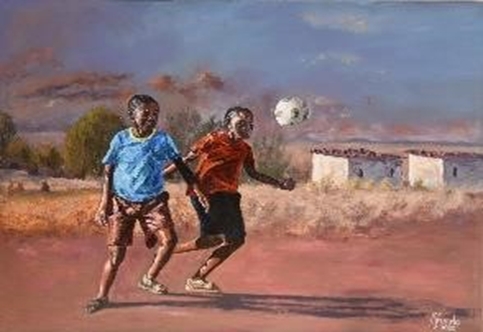
But, of course, in a culture of mutuality, Europe in turn has impacted on the work of South African artists. Taiwo Ohu’s ‘House of Parliament Cape Town’ (7) is a meticulous architectural draft. Painted in acrylic on canvas, before the catastrophic fire, it is a vision of repose in a fundamentally incendiary society, as we would later witness in the July riots of 2021. On the other hand, Thando Mama’s ‘Izingqi Zesikhumbuzo’ (8), an inkjet print on photographic paper made earlier, in 2016-17, seems to generate an almost prophetic unease regarding governance. Its seemingly multiplied coated figure evokes a surreal theatre of the absurd, some enigmatic and unfathomable state of play. What it makes apparent, is that art reflects the tensions in a society, but it cannot speak fluently on its behalf – to do so would be dogma. In the case of Ilene Bothma’s ‘Empty Threat’ (9) and ‘Conditional Threat’ (10), it can uncannily evoke unease. Or, in the case of Kabelo Pedro Serasenwe and Mfundo Mbali, it can, in ‘Grannies soccer match’ (11) and ‘Football Mateli’ (12), capture an irresistible conviviality and healthy competitiveness.
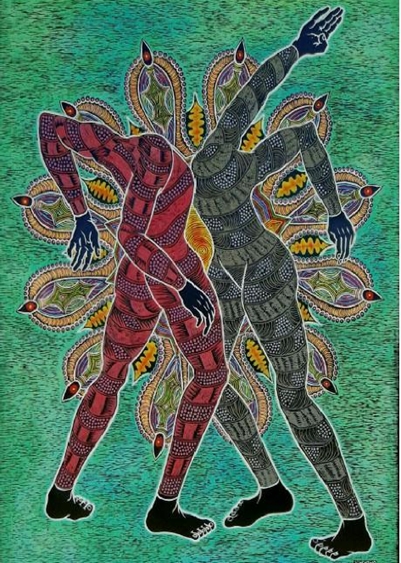
The emotional range of the works presented reveals the complexity of South African society – its grievances, unease, yet also its hopes. If Sthenjwa Luthuli’s work – a superwood cut block, acrylic and gloss – is especially arresting and unnerving, this is, in part, because of its title, ‘Chasing Fear’ (13), as it is principally about the collision course the two highly animated figures are caught within. The heads are cut off, yet echoed in the mandala-like formation that encircles the figures. Their chests are thrust out, arms akimbo, legs and feet firmly placed. A study in which wood engraving and paint are integral, the postures archetypal, the work, to my mind and eye, is not only concerned with the underworld of fear and dread, but also the overworld of a bluntly balletic encounter. If Luthuli’s work is especially emblematic, it is because it reconciles the energy of conflicting fields which comprise what is none other than a deft curation of a national treasure house.
My wager? That ArtBankSA embodies and represents a positive spirit of cultural custodianship and exchange. If anything, the ever-growing ArtBankSA collection expresses not only our benighted history but also our inspired present and illuminated future. As an art collection, a vehicle for dialogue, it signifies an open temperament, one that is as generous, as it is cautiously introspective. Integrative, novel, it is, as such, also deft. It is a national curatorial and, by extension, a diplomatic enterprise, that stands on a firm footing, with its chest thrust bravely outward, arms and hands that are not appropriative, and therefore thrust backward. This, as a symbol of a desirous mutuality, is exemplary.
Images




Comments are closed.