The dwarf burrowing skinks comprise a genus of about 22 species of small, attenuate, fossorial lizards found mainly in Southern Africa. As a group, this genus is particularly interesting because of the degree of limb reduction found amongst its members. Some species have fore- and hindlimbs, with three, four or five digits or toes on each foot, depending on the species. Then there are a few species with hindlimbs but no forelimbs, and among these some have tiny limbs with two or only one digit on each foot. Finally, a few species are completely limbless.
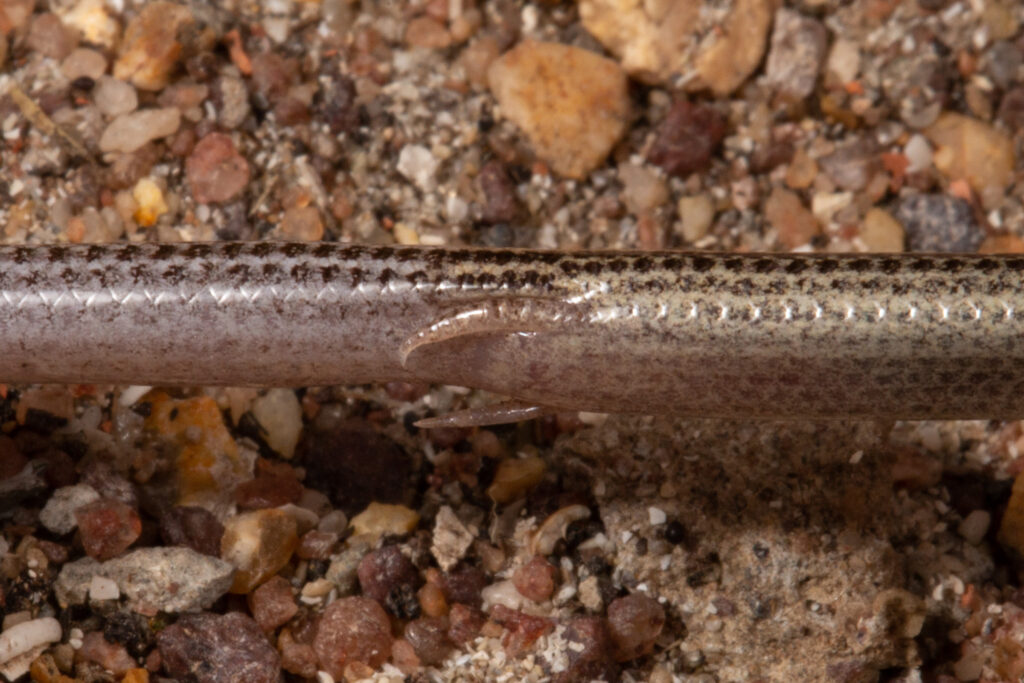
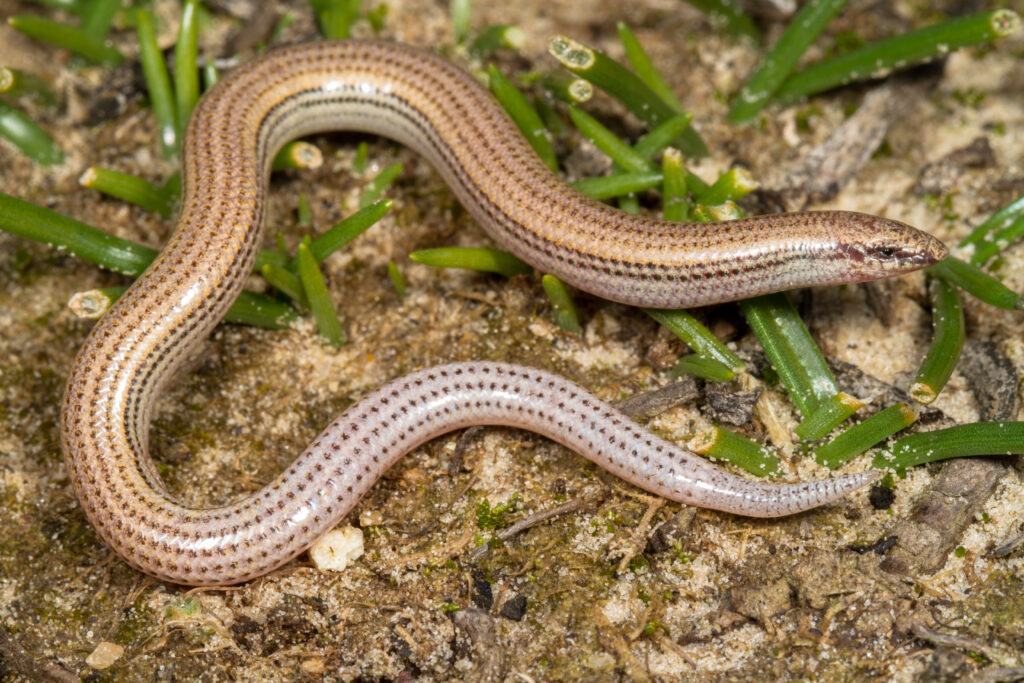
Five species with only hindlimbs are found in coastal dunes and associated habitats in the Western and Northern Cape provinces of South Africa. Two similar species—Gronovi’s Dwarf Burrowing Skink (Scelotes gronovii) and the Silvery Dwarf Burrowing Skink (S. bipes)—occur in the extreme south-western part of Africa, and are found together in an area from Lambert’s Bay to Cape Town. However, while the latter species has two digits per foot, Gronovi’s Dwarf Burrowing Skink has only one.
Gronovi’s Dwarf Burrowing Skink is one of three species of Scelotes with no forelimbs and with hindlimbs bearing only a single digit per foot. However, while the other two species have merely bud-like rudimentary digits, S. gronovii has somewhat longer, spike-like, single-jointed digits with claws. Their little legs are probably not used for locomotion, being mere evolutionary remnants. These small lizards, which may be found under fallen leaves in sand dunes, grow to about 7 cm body length, with a slightly shorter tail. The females are ovoviviparous and give birth to one or two young (40–50 mm long, including the tail) in March or April. This species is now considered Near-threatened mostly because about half its habitat has been transformed by agriculture.
In 2011, a molecular phylogeny study of the West Coast dwarf burrowing skinks was published. It used mitochondrial and nuclear gene markers to infer relationships between populations. The results indicated that Gronovi’s Dwarf Burrowing Skink, as currently understood, consisted of two distinct genetic lineages, namely a northern lineage in the Lambert’s Bay–Elands Bay area (north of the Berg River) and a southern lineage in the Velddrift‒Langebaan area north-west of Cape Town. The northern lineage was most closely related to the larger didactyle species (Scelotes sexlineatus, S. kasneri, S. montispectus), while the southern lineage was most closely related to the very similar S. bipes. Gronovi’s Dwarf Burrowing Skinks also occur on Dassen and Robben islands, which were connected to the mainland about 12 000 years ago.
The author has been studying the morphology of specimens used for the afore-mentioned molecular analysis to investigate whether morphological differences support separate species status for the two genetic lineages, as suggested by the molecular phylogeny. Specimens preserved at various South African museums, including the National Museum, have been examined. The outcome of the author’s endeavour will be submitted for publication later this year.
References
Bates, M.F., Branch, W.R., Bauer, A.M., Burger, M., Marais, J., Alexander, G.J. & de Villiers, M.S. (Eds) 2014. Atlas and Red List of the reptiles of South Africa, Lesotho and Swaziland. Suricata 1. Pretoria: South African National Biodiversity Institute. https://www.researchgate.net/publication/313878708
Branch, B.[W.R.] 1998. Field guide to snakes and other reptiles of Southern Africa. 3rd ed. Cape Town: Struik. https://archive.org/details/fieldguidetosnak0000bran
Heideman, N.J.L., Mulcahy, D.G., Sites, J.W. Jr, Hendricks, M.G.J. & Daniels, S.R. 2011) Cryptic diversity and morphological convergence in threatened species of fossorial skinks in the genus Scelotes (Squamata: Scincidae) from the Western Cape Coast of South Africa: Implications for species boundaries, digit reduction and conservation. Molecular Phylogenetics and Evolution 61: 823–833. https://doi.org/10.1016/j.ympev.2011.08.021
Tolley, K.A., Conradie, W., Pietersen, D.W., Weeber, J., Burger, M. & Alexander, G.J. (Eds) 2023. Conservation status of the reptiles of South Africa, Eswatini and Lesotho. Suricata 10. Pretoria: South African National Biodiversity Institute. https://www.sanbi.org/wp-content/uploads/2024/06/2023_Suricata10.pdf
Figure captions